
If you have ever discovered that you cited a retracted article in your research paper, you are not alone. With over 14,000 retractions recorded in 2023 alone — a new global record — and more than 9,000 additional retractions in 2024, the chances of unknowingly referencing a withdrawn study are higher than ever. Whether your manuscript is still in progress, under peer review, or already published, knowing exactly what to do next can protect your credibility, strengthen your work, and help maintain the integrity of the scientific record. This comprehensive guide walks you through every step — from detection tools and impact assessment to journal editor communication templates and proper citation formatting across major style guides.
What Does It Mean When an Article Is Retracted?
📌 In Simple Words
A retraction means the journal has officially withdrawn a published paper because the findings can no longer be trusted. Think of it like a product recall: the paper is “pulled from the shelf” so other researchers stop relying on it.
✅ Verified Fact:
Over 14,000 papers were retracted globally in 2023 — a new all-time record — with more than 9,000 additional retractions in 2024 (Xu et al., arXiv 2511.21176).
🧠 Quick Quiz:
True or False — A retracted paper is always the result of deliberate fraud. (Answer: False. Many retractions stem from honest errors, irreproducible results, or ethical oversights.)
A retraction is the most serious form of correction in scholarly publishing. Understanding the differences between various editorial actions helps you gauge the severity of the situation:
| Editorial Action | What It Means | Impact on Your Citation |
|---|---|---|
| Erratum | Publisher-side correction | Usually no action needed |
| Corrigendum | Author-initiated correction (minor errors) | Review if corrected data affects your claims |
| Expression of Concern | Journal flags potential problems under investigation | Monitor closely; avoid for critical arguments |
| Retraction | Complete withdrawal — findings deemed unreliable | Immediate action required |
A 50-year analysis of medical retractions (Okyay et al., 2025) found that data fabrication, duplicate publication, and compromised peer review account for the majority of retractions. According to COPE, the purpose of retraction is not punishment — it is a mechanism for correcting the literature. [PMID: 41327922]
The Zombie Citation Problem: Why Retracted Papers Keep Getting Cited
📌 In Simple Words
Retracted papers don’t disappear — they become “zombie papers.” Most researchers continue to cite them without knowing they’ve been withdrawn.
✅ Verified Fact:
Only 4–5% of post-retraction citations acknowledge the retracted status. The vast majority cite retracted papers as valid research (Teixeira da Silva, Learned Publishing, 2025). [DOI: 10.1002/leap.1667]
A comprehensive analysis in Accountability in Research (Khademizadeh et al., 2024) found citation rates declined only modestly after retraction. [DOI: 10.1080/08989621.2023.2223996] A 2025 systematic review in BMC Medicine found retracted stem cell papers continue accumulating citations even years after withdrawal. [PMID: 40022137]

Step-by-Step — What to Do After You Cited a Retracted Article
📌 In Simple Words
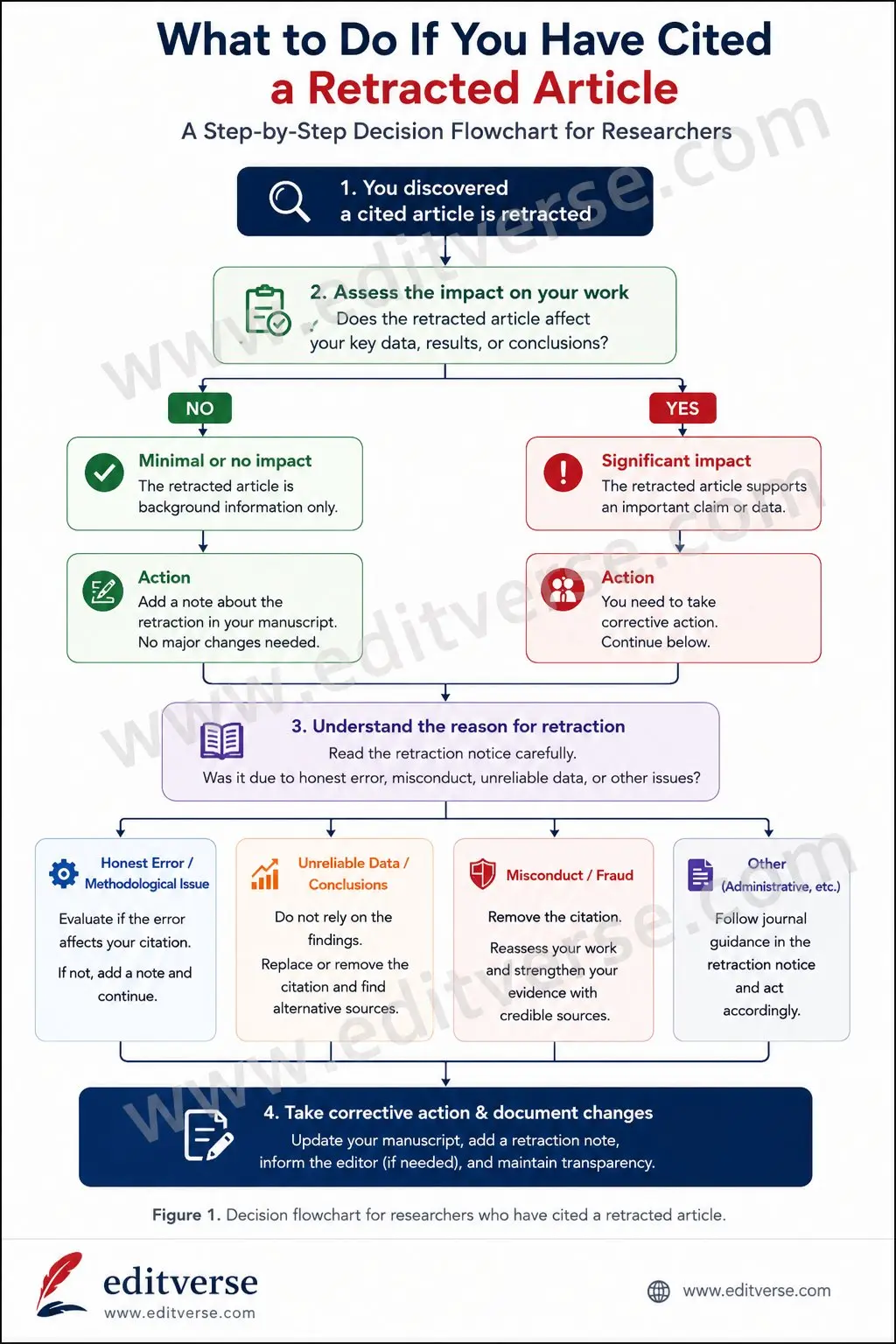
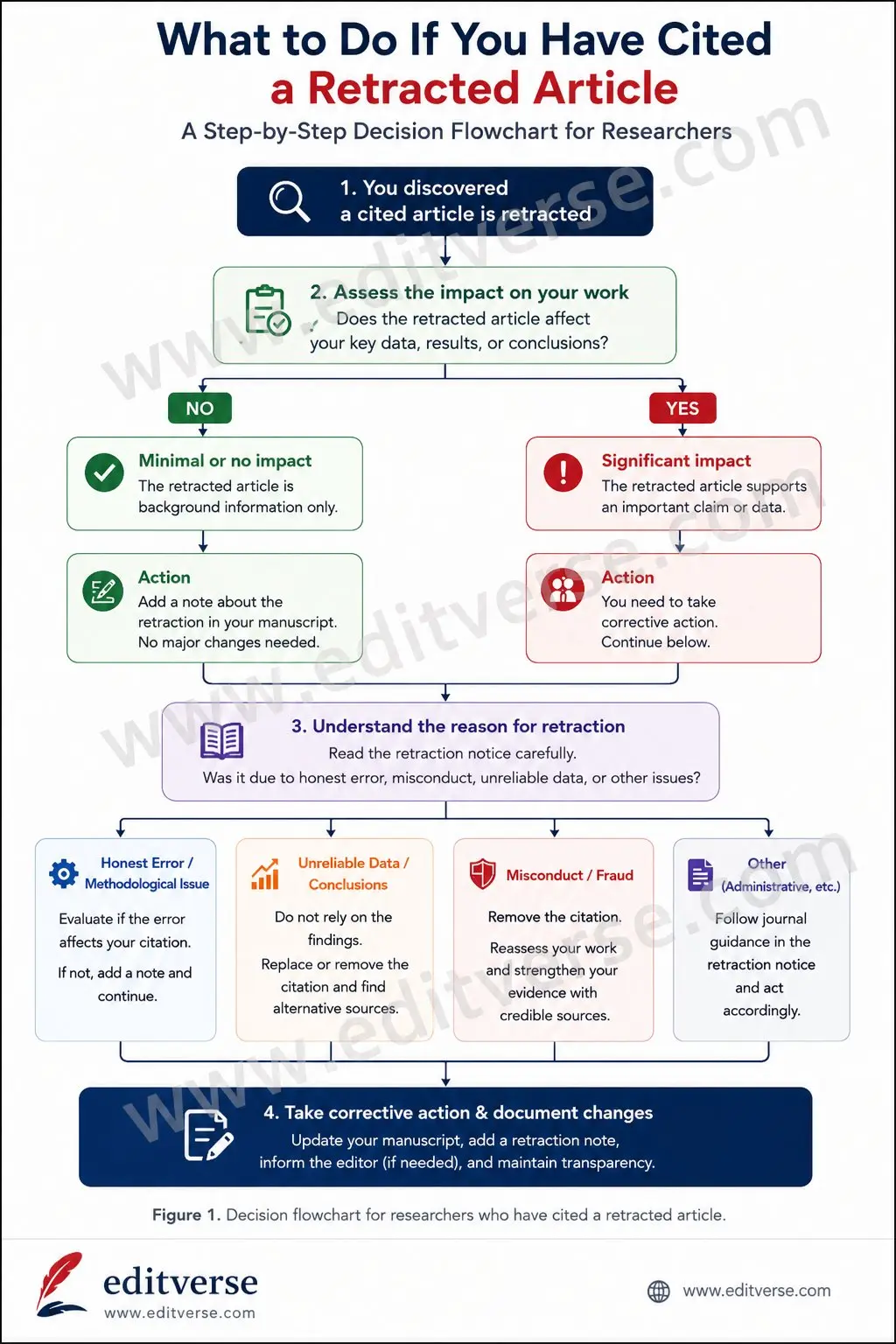
Finding out you cited a retracted article can feel alarming, but the corrective steps are straightforward. First figure out how important the retracted paper was to your conclusions. Then understand why it was retracted. Finally take the appropriate action based on where your paper is in the publication pipeline.
✅ Verified Fact:
COPE recommends that systematic reviews that included retracted studies may themselves need to be corrected or retracted if the retracted data materially changed the review’s conclusions.
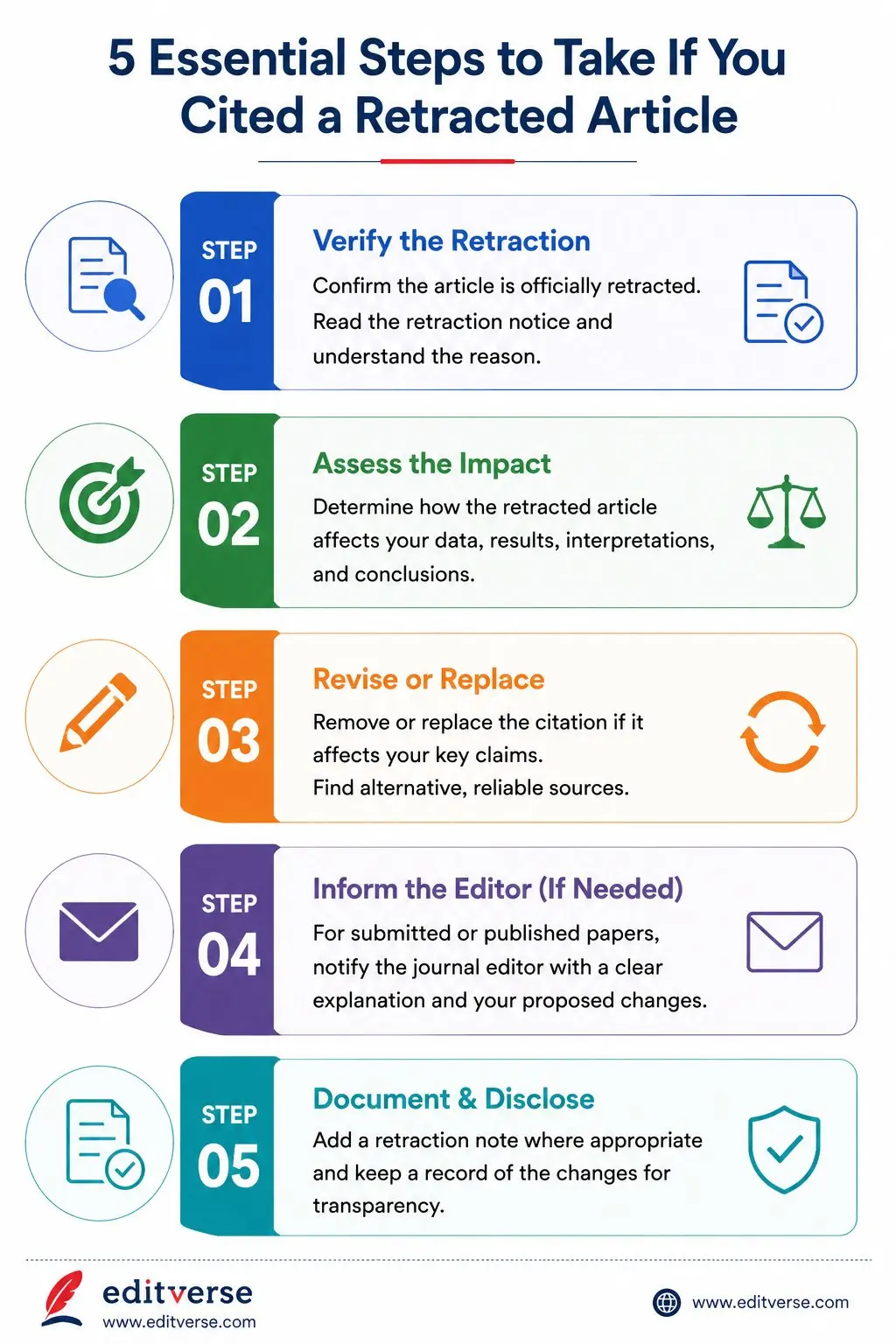
Step 1 — Verify the Retraction
Confirm the article is officially retracted via the journal’s website, PubMed, or the Retraction Watch Database. Note the retraction date and reason.
Step 2 — Assess the Impact on Your Paper’s Conclusions
| Citation Context | Risk Level | Recommended Action |
|---|---|---|
| Background/introduction only | 🟢 Low | Replace with an alternative reference |
| Supporting evidence for methodology | 🟡 Moderate | Verify independently; find alternative |
| Key argument or central evidence | 🔴 High | Reassess conclusions; significant revisions needed |
| Included study in a systematic review | 🔴 Critical | Re-run analysis excluding the retracted study |
Step 3 — Understand Why the Article Was Retracted
Data fabrication or fraud means none of the findings should be trusted. An authorship dispute or administrative issue may leave the underlying data scientifically valid. Find the retraction notice via the journal website, PubMed, or Retraction Watch.
Step 4 — Revise or Replace Based on Your Paper’s Status
Still in progress: Remove and replace with a valid alternative from PubMed or Google Scholar.
Under peer review: Notify the handling editor immediately. Most editors will allow revision before a decision is made.
Already published: Contact the journal editor and request a corrigendum, or in rare cases a retraction of your own paper.
Step 5 — Contact the Journal Editor (Template)
Subject: Request for Correction — Retracted Reference in [Your Article Title]
Dear [Editor Name],
I am writing regarding our published article “[Your Article Title]” (DOI: [your DOI]), published in [Journal Name] in [Year]. We have identified that Reference [Number] — [Author et al., Title, Journal, Year] — was retracted on [date] due to [brief reason]. After careful review, we have determined that [describe impact]. We respectfully request that a corrigendum be published to [remove/replace the citation].
Thank you for your attention to this matter.
Sincerely,
[Your Name]
How Do You Find Out a Paper You Cited Has Been Retracted?
Zotero + Retraction Watch (Free) — automatically checks your library and flags retracted items.
Scite.ai — scans your full manuscript for retracted references with Smart Citation context.
PubMed — labels retracted articles with “[Retracted Publication]” in the title.
CrossRef / CrossMark — displays retraction status when you resolve a DOI.
RetractoBot (University of Oxford) — emails you when papers you’ve cited are later retracted.
Clarivate Web of Science — following the JCR 2025 update, WoS now explicitly flags retracted content across its citation network.
The 2025 Impact Factor Change: Why This Matters for You
Starting with JCR 2025, Clarivate excludes citations to and from retracted articles from Impact Factor calculations. Source: Clarivate, October 2025.
- Citations you make to retracted papers no longer count toward journals’ JIF
- Journals that published retracted content will see their JIF reduced
- Editors now have an additional metrics-based incentive to flag uncorrected retracted citations
When Is It Acceptable to Cite a Retracted Article?
There are legitimate scholarly reasons to cite a retracted article — when discussing research integrity or the retraction itself as a case study. According to COPE’s official guidance, this is acceptable as long as the retracted status is clearly marked and the retraction notice is cited separately.
How to Cite a Retracted Article Correctly
APA 7th:
Retraction notice: Editor. (Year). Retraction notice for “Title.” Journal, Vol(Issue), Page. https://doi.org/yyyyy
Vancouver / ICMJE:
AMA:
How to Prevent Citing Retracted Articles in the Future
| Tool | Cost | Key Feature | Best For |
|---|---|---|---|
| Zotero + Retraction Watch | Free | Auto-flags retracted items in your library | Continuous library monitoring |
| Scite.ai | Free/Premium | Full manuscript scan for retracted references | Pre-submission audits |
| CrossRef / CrossMark | Free | Retraction status via DOI resolution | Individual DOI checks |
| Retraction Watch Database | Free | 63,000+ entries; searchable | Targeted lookups |
| PubMed | Free | Labels retracted articles with [Retracted Publication] | Biomedical verification |
| RetractoBot (Oxford) | Free | Emails you when cited papers are later retracted | Post-publication monitoring |
Frequently Asked Questions
Can I cite a retracted paper in my thesis or dissertation?
Yes, if discussing the retraction as a case study — with proper retraction labeling. Do not rely on its data or conclusions to support your own arguments.
Will citing a retracted article cause my paper to be rejected?
Not necessarily — but citing one without acknowledging its retracted status can raise red flags during peer review.
How long after publication can a paper be retracted?
There is no time limit. The Retraction Watch Database contains entries going back to the 1970s — which is why ongoing automated monitoring beats a one-time check.
Does citing a retracted paper affect the journal’s Impact Factor?
Yes, from 2025 onwards. Clarivate’s JCR 2025 update excludes these citations from IF calculations. Source: Clarivate JCR 2025.
Do I need to retract my own paper if I cited a retracted article?
In most cases, no. A corrigendum is sufficient unless the retracted study’s data was integral to your primary findings.
✏️ About the Authors — Editverse Research Integrity Team
This guide was developed and reviewed by the Editverse academic writing and publication support team, comprising manuscript editors and researchers with doctoral (PhD) and clinical (MD) qualifications across biomedical sciences, clinical research, and academic publishing. Our team works daily with researchers navigating publication ethics, retraction events, and manuscript correction processes across all major journal families.
Biomedical & Clinical Review
MD-qualified editors with peer review and journal submission experience across JAMA, Lancet, NEJM, and BMJ family journals.
Research Methodology & Ethics
PhD researchers specialising in systematic review methodology, COPE guidelines, and publication integrity frameworks.
Last Updated
June 2026. Reviewed against COPE Retraction Guidelines, Clarivate JCR 2025 policy, and the Retraction Watch Database.
All factual claims are verified against peer-reviewed sources with DOIs. Editverse operates an AI Fabrication Shield — human citation verification against PubMed and CrossRef — ensuring zero fabricated references in any published content. Read our full AI Use Policy.
How Editverse Can Help
Protect Your Research from Retracted Citations
Editverse provides comprehensive pre-submission reference verification, retraction screening, and manuscript health checks.
Related Editverse Resources
→ The Rise and Fall of Hindawi
→ OMICS International: The $50M Predatory Publisher Case
→ Is MDPI a Predatory Publisher?
→ Ethical Self-Citation Best Practices
→ Editverse AI Use Policy
References
- Committee on Publication Ethics (COPE). Retraction Guidelines. https://publicationethics.org/retraction-guidelines
- COPE. Guidance: Citing a retracted paper. https://publicationethics.org/guidance/case/citing-retracted-paper
- Teixeira da Silva JA. The citation of retracted papers. Learned Publishing. 2025. DOI: 10.1002/leap.1667
- Xu Y, et al. Prevalence and trends in global retractions. arXiv. 2025. arXiv: 2511.21176
- Okyay RA, et al. Fifty years of retracted medical publications. Journal of Korean Medical Science. 2025. DOI: 10.3346/jkms.2025.40.e300 [PMID: 41327922]
- Song F, et al. Temporal trends of retracted stem cell publications. BMC Medicine. 2025. DOI: 10.1186/s12916-025-03965-8 [PMID: 40022137]
- Khademizadeh S, et al. Evolution of retracted publications in medical sciences. Accountability in Research. 2024. DOI: 10.1080/08989621.2023.2223996 [PMID: 37309726]
- Clarivate. JCR 2025: Excluding retraction citations. October 2025. clarivate.com
- Higgins JPT, et al. Cochrane Handbook, Version 6.5. Section 4.4.6
- ICMJE. Recommendations for the Conduct of Scholarly Work in Medical Journals. https://www.icmje.org/recommendations/