Published | Last updated
If you are asking is MDPI predatory, the short answer is: not by the usual definition, yet risky enough in some countries that you should check before you submit. This guide gives the dated facts, each tied to a primary source, and a five-step check you can run on any MDPI journal in about ten minutes.
On this page: Verdict · Timeline · What the data shows · What MDPI says · MDPI vs predatory · 5-step check · Worked example · Common mistake · FAQ
Is MDPI a predatory publisher? The short verdict
The word “predatory” usually describes publishers that skip peer review, hide fees or lie about indexing [9,10]. MDPI does not match that pattern. Paolo Crosetto, who analysed 74 MDPI journals, described the model as “aggressive rent extracting” rather than predatory, and noted that MDPI rejects papers, with acceptance around 50% at most journals [7].
What has changed since 2021 is that institutions acted on the quality of individual journals. Finland’s Publication Forum said the article-fee model aims to increase volume with minimal editorial work and quality assessment, and moved 271 MDPI and Frontiers journals to level 0 [2]. Clarivate removed three MDPI journals from Web of Science between 2023 and 2024 [4,5]. The reasonable reading is a grey zone: judge the journal, not the publisher.
MDPI timeline: what happened and when
Every row below comes from a dated primary or near-primary source. Where a date comes from a secondary summary, the table says so.
| Date | Who | What happened | Source |
|---|---|---|---|
| Feb 2014 | Jeffrey Beall | Added MDPI to his list of predatory publishers. OASPA investigated in April 2014 and concluded MDPI met its membership criteria. MDPI was removed from the list in October 2015; the list closed in 2017. | Wikipedia summary of cited sources |
| Dec 2020, Dec 2021 | Chinese Academy of Sciences | Early Warning Journal List named 22 MDPI journals (of 65), then 7 (of 41). None remain after the 2025 revision. | [8], Wikipedia summary |
| Apr 2021 | Paolo Crosetto | Analysis by an economist of 74 MDPI journals with an impact factor: special issues rose from 388 (2013) to 39,587 (2021, counted March 2021). He called the model aggressive rent extraction, not predatory. | [7] |
| Sep 2022 | JUFO (Finland) and Norway | Sustainability moved to level 0 for articles from 2023. Norway had already done so. | [3] |
| 13 Feb 2023 | Clarivate | Stopped Web of Science coverage of IJERPH and JRFM. | [4] |
| Oct 2023 to Jan 2024 | Scopus | Paused indexing of Sustainability for re-evaluation, then confirmed it would keep indexing the journal on 4 January 2024. | [6] |
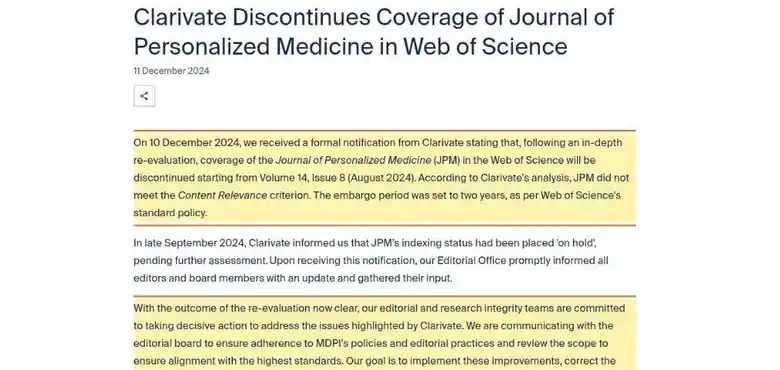
| Aug 2024 | Clarivate | Journal of Personalized Medicine stops being covered from volume 14, issue 8 (formal notice 10 December 2024). | [5] |
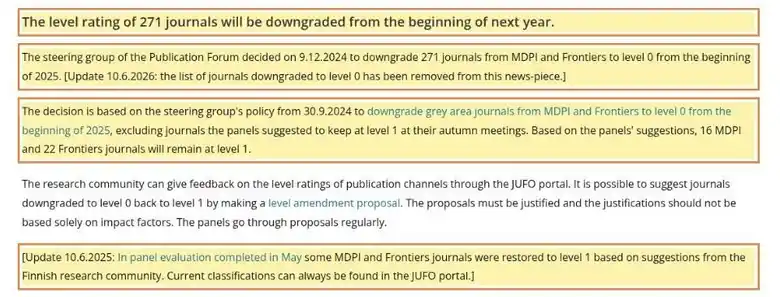
| 16 Dec 2024 | JUFO (Finland) | 271 MDPI and Frontiers journals moved to level 0, effective 2025; 16 MDPI and 22 Frontiers kept at level 1. Some journals restored to level 1 in May 2025. | [2] |
What the data shows
Special issues: the number that drives most criticism
Crosetto counted 388 special issues across MDPI’s 74 impact-factor journals in 2013 and 39,587 by March 2021, roughly 500 per journal [7]. His page’s text gives 39,687 in one place and 39,587 in its table, so treat the figure as “nearly 40,000”. The most extreme example was Sustainability: 3,303 open special issues against 24 regular issues (Figure 1).

A high special-issue share is a warning sign to investigate, not proof of poor quality. A 2025 study in Accountability in Research examines how the five largest publishers use special issues for growth and revenue, and discusses the risks for research integrity [11]. The pattern is not unique to MDPI.
Finland: the biggest single institutional action
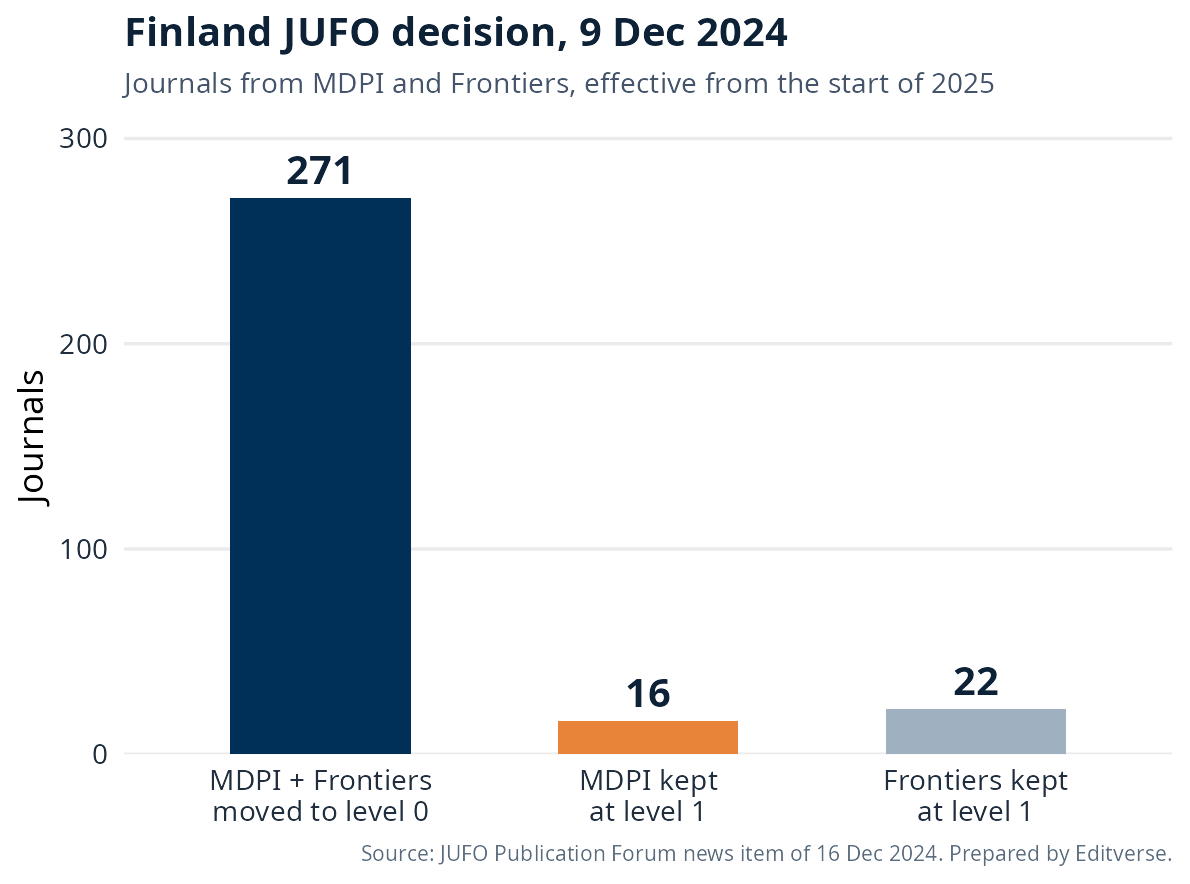
JUFO is the classification of publication channels created by the Finnish scientific community. Level 0 means the channel cannot be recommended without reservation. JUFO kept 16 MDPI and 22 Frontiers journals at level 1 on the advice of its panels, and in May 2025 restored some more after proposals from the Finnish research community, so the decision was not a blanket ban [2]. Retraction Watch counted 193 MDPI and 78 Frontiers journals in the 271 [1]; MDPI’s own statement says 187 of its journals [12].
China: from 22 journals to none
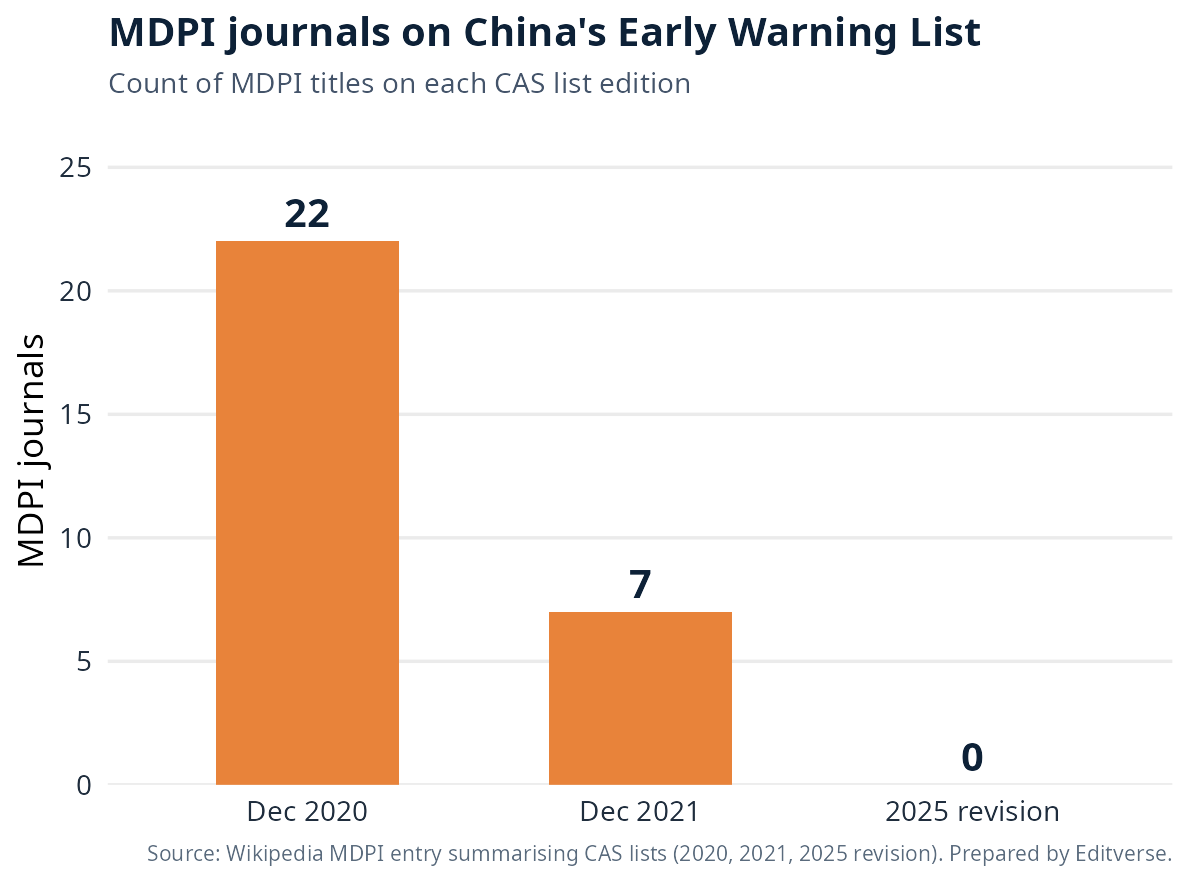
The direction is reassuring for authors in China, but the list changes every year, so check the latest edition.
Indexing: still extensive, but not guaranteed
MDPI reported 298 journals fully covered in Web of Science as of 17 December 2024 [5]. Three have lost coverage: IJERPH and JRFM (effective 13 February 2023) and the Journal of Personalized Medicine (from August 2024) [4,5]. Scopus paused Sustainability in late 2023 and then decided on 4 January 2024 to keep indexing it [6]. Coverage is decided journal by journal.
What MDPI says
MDPI has published its own responses. We list them as MDPI’s claims, with dates, so you can weigh them against the independent facts above.
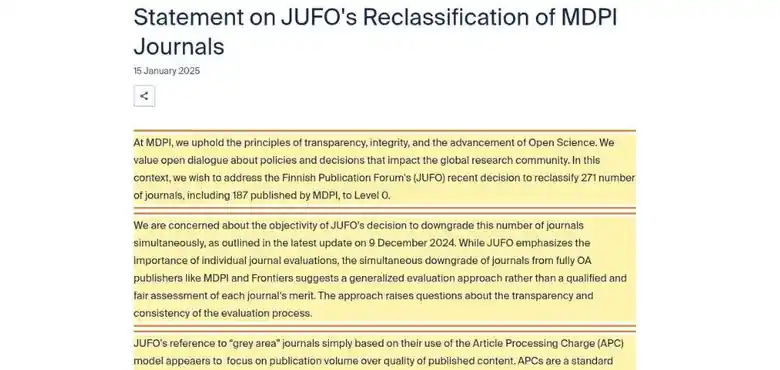
- On Finland (15 January 2025). MDPI said the simultaneous downgrade of MDPI and Frontiers journals “suggests a generalized evaluation approach” rather than a fair assessment of each journal, that article processing charges are standard across the industry, and that it reports 187 of its journals among the 271 [12].
- On Clarivate (6 April 2023). MDPI said the “Content Relevance” finding for IJERPH and JRFM concerns publications judged outside the journals’ scope, not their quality, and that it appealed the IJERPH decision on 31 March 2023 [4].
- On the Journal of Personalized Medicine (11 December 2024). MDPI said it would review the journal’s scope and editorial practices, correct the scholarly record where necessary, and reapply for indexing in December 2026 [5].
- On itself (current). MDPI says it was founded in 1996 in Basel, lists 545 open-access journals, is a COPE member, and reports a median first decision under 18 days for the first half of 2026 [13].

MDPI compared with a classic predatory publisher
| Question | Classic predatory publisher | MDPI, as documented |
|---|---|---|
| Real peer review? | Often none, or accepts nearly everything | Yes. Crosetto reports acceptance of around 50% at most journals [7]. |
| Indexed where it says? | Claims indexing it does not have | 298 journals fully covered in Web of Science (Dec 2024), but three journals lost coverage [4,5]. |
| Special-issue model | Usually not a feature | Thousands of special issues. Sustainability had 3,303 open special issues against 24 regular issues in March 2021 [7]. |
| National bodies | Not recognised anywhere | Mixed. Finland moved 271 MDPI and Frontiers journals to level 0 in total, and kept 16 MDPI journals at level 1 [2]. |
| Review speed | Days | About 35 days from submission to acceptance for most top journals in 2020 (mean, per Crosetto) [7]. |
The table shows why one label does not fit. MDPI shares some features of the predatory pattern, fast turnaround and a heavy special-issue model, but it differs on peer review and indexing [7].
The 5-step journal check (10 minutes)
Run these on the exact journal you plan to use, on the day you submit. Save screenshots; some funders ask for evidence.
| # | Check | Where | What a pass looks like |
|---|---|---|---|
| 1 | Web of Science coverage | Master Journal List (mjl.clarivate.com) | The exact journal title is listed, and its current-year status is not “discontinued”. |
| 2 | Scopus coverage | Scopus Sources list | The title is active, not “discontinued”, with a recent CiteScore. |
| 3 | DOAJ listing | doaj.org | Listed and not removed. Applies to fully open-access journals. |
| 4 | Your country or funder list | JUFO portal, Norwegian register, CAS list, your institution’s list | The journal sits at a level that earns credit, today. |
| 5 | Special-issue ratio and board | The journal’s own issues page and masthead | Regular issues exist, special issues are not the whole output, and editors are real and reachable. |
If any of checks 1 to 4 fail, stop and choose another journal. If check 5 looks odd, read recent issues and decide whether you would be comfortable having your name next to that content.
Worked example: checking IJERPH in 2026
- Web of Science. Search the Master Journal List for “International Journal of Environmental Research and Public Health”. Clarivate ended coverage effective 13 February 2023, so the journal no longer receives a Journal Impact Factor [4].
- Funder rule. If your funder or institution rewards only Web of Science-indexed outputs, ask whether a paper here still counts, because the journal is no longer covered.
- Decision. Check the journal against your institution’s own list. If the answer is unclear, pick a different MDPI journal that passes steps 1 to 4, or a non-MDPI venue.
The same ten minutes would have told you that the Journal of Personalized Medicine changed status in August 2024 [5]. Journal status moves, so a “yes” last year is not a “yes” today.
Related Editverse guides
These free guides cover the steps around a submission.
Get help choosing or recovering
If you want a second pair of eyes on where to submit, or you have already published somewhere you now doubt, these are the two services built for it.

Not sure where to submit? Send your manuscript and we return 5 to 10 ranked journal suggestions with the reasoning for each: scope fit, impact factor and acceptance rates, checked against current indexing.
Already published in a doubtful journal? Confidential support that covers a retraction strategy, communication drafting, manuscript recovery and republication in a legitimate venue.
MDPI FAQ
Is MDPI a predatory publisher?
Most definitions of predatory publishing involve fake or absent peer review, hidden fees and false claims about indexing. MDPI does not fit that classic definition: it is indexed in Web of Science and Scopus and rejects papers. But national bodies have acted against it. Finland’s JUFO moved 271 MDPI and Frontiers journals to level 0 effective 2025, and Clarivate dropped three MDPI journals from Web of Science between 2023 and 2024. The practical answer is to judge each journal, not the publisher [1,4,5].
Is MDPI indexed in Web of Science and Scopus?
Yes, for most journals. MDPI reported 298 journals fully covered in Web of Science as of 17 December 2024. Coverage is journal by journal and can change, so check the Web of Science Master Journal List and Scopus for the specific title on the day you submit [5].
Which MDPI journals were removed from Web of Science?
IJERPH and the Journal of Risk and Financial Management lost coverage effective 13 February 2023, and the Journal of Personalized Medicine stopped being covered from volume 14, issue 8 (August 2024) [4,5].
What did Finland decide about MDPI?
On 9 December 2024 the Publication Forum (JUFO) steering group moved 271 MDPI and Frontiers journals to level 0 from the start of 2025, and kept 16 MDPI and 22 Frontiers journals at level 1. JUFO’s page does not give the split by publisher: Retraction Watch reports 193 MDPI and 78 Frontiers, while MDPI says 187 of its journals. In May 2025 some journals were restored to level 1 after proposals from the Finnish research community. JUFO said the article-fee model aims to raise publication volume with minimal editorial work and quality assessment [1,2,12].
Does MDPI still appear on China’s Early Warning Journal List?
Per Wikipedia’s summary of the CAS lists, 22 MDPI journals were on the December 2020 list and 7 on the December 2021 list, and none remain after the 2025 revision. MDPI’s own page shows four MDPI journals were flagged on the 2024 list for citation-manipulation concerns. Check the current CAS list before you submit [8].
Will an MDPI paper count for funding or promotion?
It depends on your country and institution. In Finland, level 0 journals are not recommended in the national classification, and Norway moved Sustainability to level 0 for 2023. In places without such rules a paper in an indexed MDPI journal is usually treated like any other indexed paper. Ask your funder or research office, and get the answer in writing [2,3].
How do I check whether a specific journal is legitimate?
Run the five checks in this article: current indexing in Web of Science and Scopus, DOAJ listing for open-access journals, your national or funder list (JUFO, Norwegian register, CAS), the journal’s special-issue to regular-issue ratio, and its editorial board and publisher contact details.
I already published in a doubtful journal. What now?
Do not panic and do not ignore it. Confirm the journal’s status, check whether your funder or institution counts the paper, and decide between leaving it, correcting it or republishing in a sound venue. Editverse offers a confidential recovery service for this.
Conclusion
MDPI is not a classic predatory publisher, and it is not a safe default either. The evidence supports journal-level decisions: check indexing, check your funder’s list, look at the special-issue ratio, and write down what you found. If you need help choosing, the journal selection service does this for you.
References
- Retraction Watch (2024). Finland Publication Forum will downgrade hundreds of Frontiers and MDPI journals, 24 December. retractionwatch.com
- Publication Forum (JUFO). Changes to the classification, 16 December 2024 (updated 2025 and 2026). See also: Grey area journals to level 0, 23 October 2024. julkaisufoorumi.fi
- Publication Forum (JUFO). Sustainability to level 0 in 2023. julkaisufoorumi.fi
- MDPI (2023). Clarivate discontinues IJERPH and JRFM coverage in Web of Science. mdpi.com/news/5628
- MDPI (2024). Clarivate and the Journal of Personalized Medicine, 11 December. mdpi.com/news/9963
- Retraction Watch (2024). Elsevier’s Scopus to continue indexing MDPI’s Sustainability after reevaluation, 5 January. retractionwatch.com
- Crosetto P. (2021). Is MDPI a predatory publisher? Blog post, 12 April. paolocrosetto.wordpress.com
- MDPI (2024). Chinese Academy of Sciences Early Warning Journal List 2024, 20 February. mdpi.com/news/7897
- Happe LE (2020). Distinguishing predatory from reputable publishing practices. J Manag Care Spec Pharm 26(8):956-960. 10.18553/jmcp.2020.26.8.956
- Severin A, Strinzel M, Egger M, et al. (2021). Characteristics of scholars who review for predatory and legitimate journals. BMJ Open 11(7):e050270. 10.1136/bmjopen-2021-050270
- Mills D, Mertkan S, Onurkan Aliusta G (2025). ‘Special issue-ization’ as a growth and revenue strategy: reproduction by the ‘big five’ and the risks for research integrity. Account Res 32(6):1027-1045. 10.1080/08989621.2024.2374567
- MDPI (2025). Statement on JUFO’s reclassification of MDPI journals, 15 January. mdpi.com/about/announcements/10175
- MDPI. About MDPI (accessed 27 October 2026). mdpi.com/about