

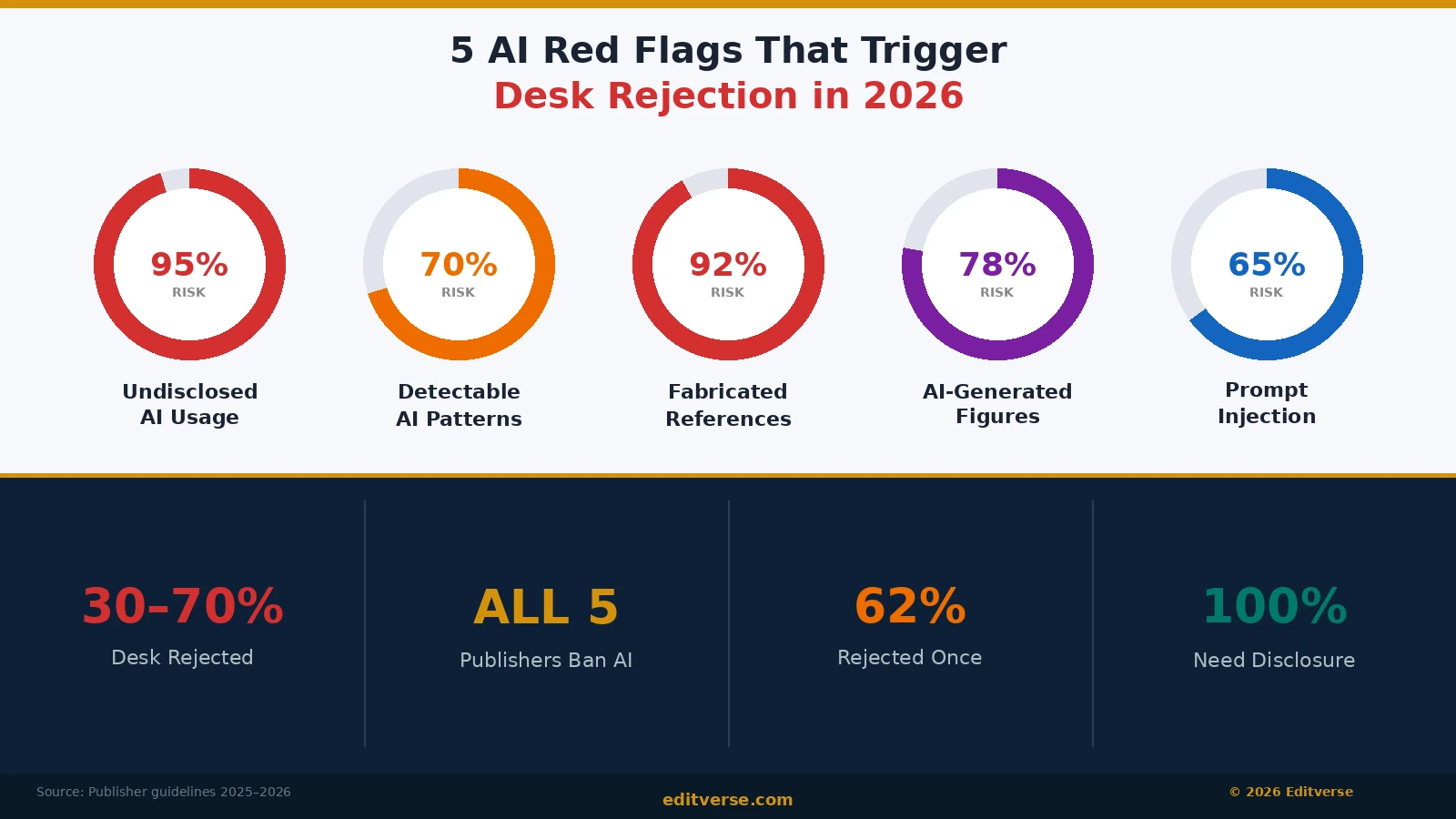
In 2026, researchers face a paradox that would have been unimaginable just five years ago. The very tools designed to accelerate scientific writing—ChatGPT, Claude, Gemini, and their successors—have simultaneously made desk rejection more likely than ever before. With AI detection algorithms now embedded in editorial workflows and publisher policies tightening monthly, the manuscript that might have sailed through in 2023 could trigger an instant rejection today. According to recent data, 30–70% of manuscripts submitted to academic journals are desk-rejected before ever reaching peer review, and AI-related red flags are rapidly climbing the list of reasons why (Teixeira da Silva & Nazarovets, 2024).
This comprehensive guide provides a practical, evidence-based framework for safeguarding your manuscript against desk rejection in the age of generative AI. Whether you are a seasoned professor or an early-career researcher navigating your first submission, these strategies will help you leverage AI responsibly while meeting the increasingly strict standards of Elsevier, Springer Nature, Wiley, Taylor & Francis, and other major publishers.
📌 In Simple Words
Desk rejection means a journal editor rejects your paper before it even reaches peer reviewers. In 2026, using ChatGPT or similar AI tools carelessly—without proper disclosure, with detectable AI patterns, or in violation of publisher policies—has become a major new trigger for desk rejection. This guide shows you how to use AI ethically and still get your manuscript past the editor’s desk.
✅ Verified Fact: 62% of published papers were rejected at least once before eventual acceptance (Editage, 2025).
✅ Verified Fact: All five major publishers—Elsevier, Springer Nature, Wiley, Taylor & Francis, and SAGE—prohibit listing AI as an author.
✅ Verified Fact: ICLR 2026 introduced mandatory AI disclosure and banned prompt injection in papers.
🧠 Quick Quiz: What percentage of manuscripts are typically desk-rejected at high-impact journals? (Answer at the end of this article)
What Is Desk Rejection—and Why Does It Matter More in 2026?
A desk rejection occurs when a journal editor rejects a manuscript before it is sent for external peer review. Unlike a post-review rejection, where reviewers evaluate the scientific merit of your work, a desk rejection happens within days—sometimes hours—of submission. It signals that the editor found a fundamental problem so significant that the manuscript did not even warrant external evaluation.
The traditional triggers for desk rejection are well documented: misalignment with journal scope, insufficient novelty, weak methodology, poor writing quality, high plagiarism scores, and failure to follow author guidelines (Teixeira da Silva & Nazarovets, 2024; Davison et al., 2024). However, the landscape has shifted dramatically since generative AI became widely accessible.
In 2026, editors are grappling with a dual challenge. On one hand, journals like The Lancet, Nature, and JAMA receive hundreds or thousands of submissions monthly. On the other hand, the proliferation of AI-assisted writing has made it harder to distinguish between genuinely well-crafted manuscripts and those that have been substantially generated by AI without proper disclosure. This has prompted publishers to invest in AI detection tools and tighten their author guidelines, creating new categories of desk-rejection triggers that every researcher must understand.
The New Desk Rejection Landscape: AI-Related Red Flags in 2026
Understanding the AI-specific reasons that editors now screen for can help you avoid common pitfalls. Here are the primary categories of AI-related desk rejection triggers that have emerged since major publishers updated their policies:
1. Undisclosed AI Usage
Every major academic publisher now requires authors to disclose the use of generative AI tools in their manuscripts. Elsevier mandates a separate “AI Declaration Statement” for any use beyond basic spell-checking. Springer Nature requires documentation in the Methods section for generative AI use while exempting routine copy editing. Wiley asks for transparent and detailed descriptions in the Methods or Acknowledgements. Taylor & Francis requires acknowledgment of any AI tool used, including its name and specific purpose. Failing to include this disclosure when AI usage is detected or suspected is now treated as a potential integrity violation—and grounds for immediate desk rejection.
2. Detectable AI-Generated Text Patterns
Journals are increasingly deploying AI detection tools alongside traditional plagiarism checkers like Crossref Similarity Check (powered by Turnitin). Manuscripts that trigger high AI-detection scores may be flagged for editorial scrutiny. Even when the detection is a false positive, the burden falls on the author to demonstrate that the work is authentically their own. Common patterns that trigger detection include overly smooth and generic phrasing, repetitive sentence structures, lack of domain-specific nuance, and conspicuously “perfect” grammar that lacks the natural variation of human writing.
3. AI-Generated Citations and References
One of the most dangerous uses of ChatGPT in academic writing is relying on it to generate references. Large language models are known to “hallucinate” citations—producing plausible-looking but entirely fictional references complete with fabricated DOIs, journal names, and page numbers. Editors and reviewers now routinely spot-check references, and a single fabricated citation can result in desk rejection and potential reporting to institutions or ethics committees.
4. AI-Generated Figures and Images
Several publishers, including Elsevier, have explicitly prohibited AI-generated images except in specific research contexts where the AI generation is itself the subject of study. Science (AAAS) has implemented one of the strictest stances, completely banning AI-generated text and treating violations as scientific misconduct. Submitting AI-generated figures without disclosure or authorization is a guaranteed path to desk rejection.
5. Prompt Injection and Manipulation Attempts
In a novel development, ICLR 2026 explicitly banned “prompt injection” in submitted papers—the practice of embedding hidden instructions in manuscripts designed to influence AI-assisted review processes. This emerging form of academic misconduct involves inserting text that, while invisible to human readers, attempts to manipulate AI review tools into providing favorable assessments. Detection of such attempts leads to immediate rejection and potential reporting.
Publisher-by-Publisher AI Policies: What You Need to Know Before Submitting
AI policies vary significantly across publishers, and the differences can be consequential for your submission. Assuming that all publishers have the same rules is a common mistake that leads to preventable desk rejections. Below is a detailed comparison of the current policies of the five largest academic publishers.
| Publisher | AI Authorship | Disclosure Requirement | AI in Peer Review | Exemptions |
|---|---|---|---|---|
| Elsevier | ❌ Prohibited | Separate AI Declaration Statement (template provided) | ❌ Banned at all stages | Basic grammar/spelling checks (no disclosure needed) |
| Springer Nature | ❌ Prohibited | Methods section documentation | ❌ Prohibited (language editing only) | AI-assisted copy editing for readability, style, or error correction |
| Wiley | ❌ Prohibited | Methods or Acknowledgements; review tool IP terms | ⚠️ Caution against confidentiality breaches | Language editing permitted with human oversight |
| Taylor & Francis | ❌ Prohibited | Acknowledgement; name + purpose of tool | ❌ Prohibited | Grammar and spelling tools exempt |
| SAGE | ❌ Prohibited | Distinguish assistive vs. generative AI | ❌ Prohibited | Assistive AI (refining your own text) treated differently from generative AI |
Source: Compiled from official publisher guidelines, updated as of February 2026. Always verify the latest version on your target journal’s website before submission.
10 Evidence-Based Strategies to Avoid Desk Rejection in the AI Era
Successfully navigating the desk rejection gauntlet in 2026 requires a combination of traditional best practices and AI-specific awareness. The following strategies are derived from editorial guidance, publisher policies, and published research on manuscript screening processes.
Strategy 1: Conduct a Pre-Submission AI Policy Audit
Before writing a single word, locate and carefully read the AI policy of your target journal. Start with the publisher’s global policy, then check the specific journal’s “Instructions for Authors” for any addendums or stricter requirements. Document the policy requirements in a checklist that you will revisit before submission. Policies change frequently—what was acceptable six months ago may no longer be compliant. Journals like Science (AAAS) maintain the strictest stance, treating AI-generated text as scientific misconduct, while others allow limited use with disclosure.
Strategy 2: Maintain a Detailed AI Usage Log
From the very start of your project, keep a running log of every instance where you use AI tools. For each use, record the full name and version of the tool (e.g., “ChatGPT-4o, February 2026”), the date, and the specific purpose (e.g., “Used to rephrase three sentences in the Discussion for improved clarity”). This log serves two purposes: it makes writing your disclosure statement straightforward, and it provides documentation should your manuscript be questioned during editorial review. The Editverse guide to ethical ChatGPT use in academic writing provides templates and frameworks for maintaining such logs.
Strategy 3: Never Use AI to Generate References or Citations
This cannot be overstated. Large language models frequently fabricate citations that look plausible but do not exist. Every reference in your manuscript must be sourced from actual database searches—PubMed, Web of Science, Scopus, Google Scholar—and personally verified by you. If you used AI to find potential references, always cross-check each one against the original source. A single fabricated reference can end your submission instantly and damage your professional reputation.
Strategy 4: Use AI as an Editor, Not as a Writer
The safest approach across all publisher policies is to use AI tools for polishing and refining text that you have already written yourself. This means drafting your manuscript in your own words first, then using AI tools for grammar correction, clarity improvement, and language polishing. This approach is explicitly permitted by most publishers (often without requiring disclosure for basic grammar tools) and produces text that reads naturally while maintaining your authentic academic voice. If you are a non-native English speaker, consider pairing AI-assisted language polishing with professional scientific language polishing services for an extra layer of quality assurance.
Strategy 5: Align Your Manuscript to Journal Scope Before Everything Else
AI tools cannot help you with what remains the single most common reason for desk rejection: submitting to the wrong journal. Research published in Learned Publishing consistently identifies scope misalignment as the primary trigger for desk rejection (Teixeira da Silva & Nazarovets, 2024). Before you begin writing, identify 3–5 target journals and study their recent publications, aims and scope statements, and editorial preferences. Your cover letter should explicitly articulate how your research contributes to the journal’s specific readership and editorial mission. For detailed guidance on journal selection, see our comprehensive guide on how to select a journal for your research paper in 2026.
Strategy 6: Craft an Exceptional Abstract and Cover Letter
Editors evaluating your manuscript for desk rejection typically spend just a few minutes assessing your abstract and cover letter. These two elements carry disproportionate weight in the initial screening. Your abstract should clearly state the research problem, methodology, key findings, and significance within the word count specified by the journal. Your cover letter should explicitly address scope fit, novelty, and the manuscript’s contribution to the field. While AI can help you refine the language of these elements, the substantive content—your research question, methods, and findings—must be authentically and accurately represented.
Strategy 7: Ensure Methodological Transparency and Rigor
Weak or unclear methodology is consistently cited as a top reason for desk rejection across all disciplines. In the AI era, this becomes even more critical because editors may scrutinize whether AI was used to generate or embellish methodology descriptions. Ensure your Methods section provides sufficient detail for reproducibility, justifies your analytical choices, and clearly states all ethical approvals. If you used AI tools for data analysis, coding, or experimental design, disclose this transparently. Our sample size calculator guide and data analysis services can help ensure your methodology meets rigorous standards.
Strategy 8: Run Your Manuscript Through Multiple Quality Checks
Before submission, subject your manuscript to a comprehensive pre-submission review that goes beyond spell-checking. This should include a plagiarism check using iThenticate or Turnitin (aim for a similarity index below 15–20%), an AI detection scan to identify passages that might trigger flags, a reference verification check to confirm all citations exist, and a formatting review to ensure compliance with author guidelines. Consider having a colleague or a pre-submission peer review service evaluate your manuscript before you submit it to the journal.
Strategy 9: Write Proper AI Disclosure Statements
When you have used AI tools beyond basic grammar checking, write a clear, specific, and honest disclosure statement. Avoid vague statements like “AI tools were used in the preparation of this manuscript.” Instead, specify the tool name and version, the sections where it was used, and the nature of its use. For example: “The authors used ChatGPT (GPT-4o, OpenAI, January 2026) to improve the readability of selected paragraphs in the Introduction and Discussion sections. All generated suggestions were critically reviewed, modified, and approved by the authors, who take full responsibility for the final content.” Place this statement according to the journal’s specific requirements—some require it in Methods, others in Acknowledgements, and Elsevier provides its own declaration template.
Strategy 10: Address Novelty and Contribution Head-On
In an era where AI can produce plausible-sounding manuscripts on nearly any topic, editors are placing greater emphasis on genuine novelty and contribution. Your manuscript must clearly articulate what is new, why it matters, and how it advances the field beyond existing knowledge. This is something AI tools cannot fabricate convincingly—original insight, unique data, novel methodological approaches, and genuine theoretical advancement are human contributions that no language model can replicate. Make your unique contribution unmistakable in the Introduction, and reinforce it in the Discussion.

The Pre-Submission Desk Rejection Prevention Checklist
Before clicking “Submit,” walk through this comprehensive checklist. Each item addresses a known trigger for desk rejection, with special attention to AI-era concerns.
| Category | Checklist Item | Status |
|---|---|---|
| Scope & Fit | Topic aligns with journal’s aims and scope | ☐ |
| Cover letter addresses scope fit explicitly | ☐ | |
| References include recent papers from target journal | ☐ | |
| AI Compliance | Read publisher’s global AI policy + journal-specific addendums | ☐ |
| AI disclosure statement included (if applicable) | ☐ | |
| No AI-generated images, figures, or data | ☐ | |
| Writing Quality | Professional English language editing completed | ☐ |
| Similarity index below 15–20% on Turnitin/iThenticate | ☐ | |
| All references manually verified against original sources | ☐ | |
| Ethics & Integrity | IRB/Ethics committee approval documented | ☐ |
| Conflict of interest and funding disclosures complete | ☐ | |
| Not simultaneously submitted to another journal | ☐ |
How to Use ChatGPT Ethically in Manuscript Preparation: Safe vs. Risky Practices
Not all uses of AI in academic writing carry the same risk. Understanding the spectrum from safe to dangerous can help you make informed decisions about when and how to incorporate AI tools into your workflow.
| Risk Level | AI Use | Disclosure Needed? | Desk Rejection Risk |
|---|---|---|---|
| ✅ Safe | Grammar and spelling checks (Grammarly, basic ChatGPT proofing) | Usually no | Very Low |
| ✅ Safe | Brainstorming research ideas or outlines (not used in final manuscript) | No | Very Low |
| ⚠️ Moderate | Rephrasing or improving clarity of your own text | Yes (most publishers) | Low (if disclosed) |
| ⚠️ Moderate | Using AI to generate experimental code or analysis scripts | Yes | Low–Medium (if disclosed and validated) |
| 🚫 High Risk | Generating entire sections (Introduction, Discussion) with AI | Yes (and may still be rejected) | High |
| 🚫 High Risk | Using AI-generated references without verification | N/A — this is misconduct | Very High + potential retraction |
| 🚫 High Risk | Submitting fully AI-written manuscript without disclosure | N/A — this is misconduct | Certain rejection + misconduct investigation |
For a deeper dive into ethical AI practices and how to reduce your AI detection score without compromising integrity, our guide on 50 ethical steps to reduce your Turnitin AI detection score provides practical, step-by-step instructions.
What to Do After a Desk Rejection: A Recovery Framework
Even with meticulous preparation, desk rejections happen. Research shows that 62% of eventually published papers were rejected at least once by other journals. The key is to treat a desk rejection as actionable feedback, not a final verdict.
When you receive a desk rejection, start by carefully reading the editor’s communication. Even brief rejection letters often contain clues—phrases like “does not fit our scope,” “insufficient novelty,” or “ethical concerns” point to specific issues. If the rejection mentions AI-related concerns, this is a critical signal to review your disclosure practices and manuscript language before resubmitting elsewhere.
Next, reassess your journal selection strategy. If scope misalignment was the issue, use journal finder tools and consult with colleagues in your field. If the rejection was related to writing quality or language concerns, invest in ethical manuscript writing services or professional language polishing before your next submission. Remember that each rejection cycle adds weeks or months to your publication timeline, so getting it right the first time—or at least the second time—is invaluable.
The Role of Professional Editing Services in Avoiding Desk Rejection
In the ChatGPT era, professional human editing services have paradoxically become more valuable, not less. While AI tools can catch surface-level errors, they cannot replicate the judgment, domain expertise, and editorial intuition that experienced academic editors bring. A professional editor can identify scope misalignment issues that AI cannot detect, ensure your methodology section meets discipline-specific standards, eliminate language patterns that might trigger AI detection flags, verify that your disclosure statements comply with publisher requirements, and provide the kind of substantive feedback that prevents desk rejection before it happens.
This is particularly important for non-native English speakers, who face disproportionately high desk rejection rates. While AI tools have helped bridge the language gap, editors still play an essential role in ensuring manuscripts meet the nuanced standards of high-impact journals. The Editverse publication support services are designed specifically for this purpose, offering comprehensive manuscript development that addresses both traditional desk rejection triggers and AI-era compliance requirements.
Looking Ahead: How Desk Rejection Screening Will Evolve Beyond 2026
The relationship between AI and academic publishing will continue to evolve rapidly. Several trends are already visible on the horizon. Publisher AI policies will become more standardized as organizations like COPE (Committee on Publication Ethics) develop unified frameworks. AI detection tools will become more sophisticated but also more prone to false positives, creating tensions between detection accuracy and fairness to authors. The line between “acceptable” and “unacceptable” AI use will continue to shift, requiring researchers to stay constantly informed about evolving norms.
Conferences are leading the way in establishing precedents. ICLR 2026’s policies on mandatory AI disclosure and prompt injection bans are likely to influence journal policies across disciplines. Meanwhile, research into AI’s actual impact on manuscript quality is still in its early stages—studies like those in Scientometrics are beginning to explore whether AI can reliably predict peer review outcomes, with mixed results so far.
For researchers, the safest long-term strategy is to develop and maintain strong writing skills that do not depend on AI, while using AI tools judiciously and transparently as supplements. The researchers who thrive in this era will be those who can demonstrate authentic expertise, methodological rigor, and intellectual contributions that no AI can replicate.
Frequently Asked Questions About Desk Rejection and AI
Q: Can I use ChatGPT to write my abstract?
A: Writing an abstract entirely with ChatGPT is risky and may violate some publisher policies. A safer approach is to write the abstract yourself and use ChatGPT only to refine language and clarity, with proper disclosure.
Q: Will journals reject my paper if AI detection flags it, even if I didn’t use AI?
A: False positives do occur with AI detection tools. If you did not use AI, you can typically appeal by providing evidence of your writing process (drafts, revision history, etc.). This is one reason why maintaining documentation of your writing process is becoming important.
Q: Do I need to disclose using Grammarly or similar grammar tools?
A: Most publishers exempt basic grammar and spelling checkers from disclosure requirements. However, if you use Grammarly’s AI-powered rewriting features extensively, disclosure may be warranted. Check your specific journal’s policy.
Q: Is it ethical to use AI for literature searching?
A: Using AI to help identify relevant literature is generally acceptable. However, you must verify every source independently through actual databases. Never trust AI-generated citations without verification.
Q: What if my target journal doesn’t have an AI policy?
A: When in doubt, disclose. Transparency is always the safest approach, and disclosure demonstrates integrity. Check the publisher’s global policy even if the specific journal hasn’t posted one.
Professional Services to Safeguard Your Manuscript Against Desk Rejection
Pre-Submission Peer Review
$150
Expert technical assessment to catch desk rejection triggers before submission
Scientific Language Polishing
$200
Professional editing that ensures natural language while maintaining your authentic voice
Publication Support – Silver
$375
Journal selection + formatting + editing to maximize acceptance chances
Manuscript Writing Services
$1,500
Full manuscript development with human writers—no AI detection risk
Conclusion
Desk rejection in the ChatGPT era demands a new level of strategic awareness from researchers. The traditional pillars of successful submission—scope alignment, methodological rigor, clear writing, and ethical compliance—remain essential. But in 2026, they must be complemented by an understanding of publisher AI policies, transparent disclosure practices, and the discipline to use AI as a tool rather than a crutch.
The researchers who succeed in this environment will be those who treat AI as what it is: a powerful assistant that can polish, refine, and accelerate certain aspects of manuscript preparation, but one that cannot replace the original thinking, genuine expertise, and intellectual contributions that journals seek to publish. By following the evidence-based strategies outlined in this guide, you can navigate the complex intersection of artificial intelligence and academic publishing with confidence—and significantly reduce your chances of receiving that dreaded desk rejection email.
🧠 Quiz Answer: High-impact journals like The Lancet and NEJM desk-reject approximately 50–70% of submitted manuscripts, with overall acceptance rates below 5%.
References
Chen, R. (2025). Why do papers get desk rejected? Stanford Digital Repository. https://doi.org/10.25740/yb785sx5019
Davison, R. M., Karanasios, S., & Chatterjee, S. (2024). Fit, scope and the shifting baseline: Is your submission likely to be desk rejected? Information Systems Journal, 35(1), 1–5. https://doi.org/10.1111/isj.12538
Kousha, K., & Thelwall, M. (2023). Artificial intelligence to support publishing and peer review: A summary and review. Learned Publishing, 37(1), 4–12. https://doi.org/10.1002/leap.1570
Lund, B. D., & Naheem, K. T. (2023). Can ChatGPT be an author? A study of artificial intelligence authorship policies in top academic journals. Learned Publishing, 37(1), 13–21. https://doi.org/10.1002/leap.1582
Teixeira da Silva, J. A., & Nazarovets, M. (2024). Rejected papers in academic publishing: Turning negatives into positives to maximize paper acceptance. Learned Publishing, 38(1). https://doi.org/10.1002/leap.1649
Wang, Y., et al. (2026). A cross-disciplinary analysis of AI policies in academic peer review. Learned Publishing. https://doi.org/10.1002/leap.2035
Related Editverse Resources
→ Ethical Use of ChatGPT in Academic Writing: 2025 Guidelines
→ 50 Steps to Reduce Your Turnitin AI Detection Score Ethically (2026)
→ How to Select a Journal for Your Research Paper in 2026
→ Journal Rejection Rate by Field: Data Analysis + How to Beat the Odds
→ Journal Metrics and Article Metrics Explained
→ How to Choose Ethical Manuscript Writing Services (2026)
→ What Are Publication Support Services?
→ Is Self-Citation OK? Best Practices for Ethical Self-Citation in 2026
→ How Systematic Reviews Accelerate H-Index Growth
→ PRISMA 2020 Guidelines: Complete Checklist for Systematic Reviews
Don’t Let Desk Rejection Delay Your Research Impact
Editverse’s team of PhD-qualified editors and publication strategists can review your manuscript for desk rejection risks—including AI compliance, scope alignment, and language quality—before you submit.
]]>