
Every analysis of the National Health and Nutrition Examination Survey rests on a choice most authors make without noticing. NHANES survey weights are either applied correctly, applied partially, or ignored, and the resulting number can differ by more than a third. We ran the same question three ways on the same 5,018 people to measure exactly how much that choice matters. The unweighted answer was…
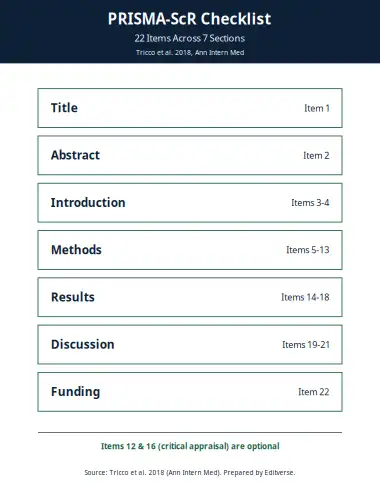
PRISMA-ScR Checklist Explained: All 22 Items
Every scoping review manuscript gets checked against the same 22 items before an editor sends it out for review, yet most authors only discover which ones they missed after a desk rejection or a major-revision letter. The PRISMA-ScR checklist is the reporting standard that governs this check, published by Tricco and colleagues in 2018 as the scoping-review-specific extension of the PRISMA family of guidelines (see…
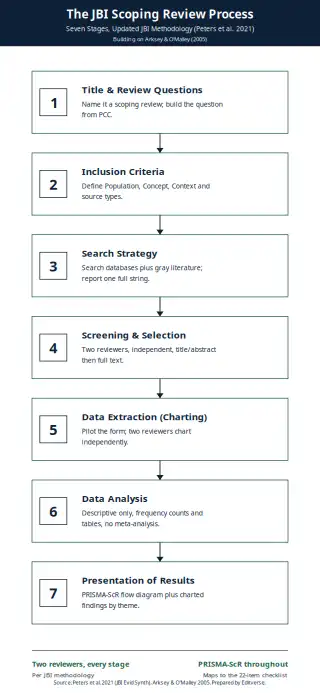
How to Write a Scoping Review: A Step-by-Step JBI and PRISMA-ScR Guide
Scoping reviews have become the default choice for research teams trying to map a broad or fast-moving body of literature, yet most authors sit down to write one without a clear procedural map. How to write a scoping review comes down to following a structured methodology from question to manuscript, not assembling a literature summary and hoping reviewers accept it. This guide assumes you have…

Mendelian Randomization Explained: What It Is, When to Use It, and How to Conduct One
Mendelian randomization (MR) uses the genetic variants a person inherits at conception as natural instruments to test whether a modifiable exposure actually causes a disease outcome, rather than simply moving alongside it in cohort data. Editverse has supported more than 1,100 manuscripts, and the single objection our statisticians see most often on an observational causal claim is some version of “the authors have not ruled…
Intention-to-Treat vs Per-Protocol Analysis: A Complete Guide for Clinical Researchers (2026)
Quick Answer: Intention-to-treat (ITT) analysis includes every randomized participant in the group they were assigned to, regardless of whether they completed treatment. Per-protocol (PP) analysis includes only participants who adhered to the protocol as planned. ITT is the primary analysis for most regulatory submissions and superiority trials because it preserves randomization and gives a conservative estimate. PP becomes equally important in non-inferiority trials, where poor…