
Self-citation — the practice of referencing your own previously published work in a new manuscript — is one of the most debated topics in academic publishing today. Every researcher building on a sustained line of inquiry will inevitably face the question: Is it acceptable to cite my own papers? The short answer is yes, but only when done transparently, judiciously, and for genuine scholarly reasons. In 2026, with citation metrics under increasing scrutiny from indexing databases, funding agencies, and tenure committees alike, understanding the ethics and best practices for self-citation has never been more important.
This comprehensive guide covers everything researchers need to know about self-citation in 2026 — from what the latest data says about acceptable rates, to how Scopus, Web of Science, and COPE evaluate self-citation patterns, to a practical framework you can apply to every manuscript you write. Whether you’re an early-career researcher worried about looking self-promotional or a senior academic concerned about inflated bibliometric indicators, this article provides evidence-based guidance to help you cite responsibly and ethically.
Understanding Self-Citation: Definition, Types, and Why It Matters
📌 In Simple Words
Self-citation means citing your own previously published work in a new paper. It’s completely acceptable when your earlier research is directly relevant — for example, when you’re building on methods or data from a prior study. It becomes problematic when you cite yourself mainly to inflate your h-index or citation count. A self-citation rate below 15% is generally considered safe; above 20% may raise red flags.
✅ Verified Fact: The median self-citation rate across all disciplines is approximately 12.7%, according to data published in PLoS Biology.
🧠 Quick Quiz
Q: At what percentage does self-citation typically raise concerns for indexing databases?
A: Beyond 20%, reviewers and indexing services such as Scopus and Web of Science may flag the pattern as potentially manipulative.
Self-citation refers to any instance in which an author references their own previously published work within a new manuscript. As defined by Chen, Ding, and Larivière (2021), self-citations can exist at multiple levels: author self-citations, journal self-citations (where a journal cites articles published in the same journal), institutional self-citations, and even national self-citations. For the purposes of this guide, we focus primarily on author-level self-citation — the most common and most scrutinized form (Chen et al., 2021).
It is important to recognize that self-citation is not inherently unethical. Research is cumulative by nature. When a researcher spends years investigating a specific topic, their earlier publications often represent the most relevant and directly applicable prior work. Omitting these references could actually be dishonest, as it would hide the reader from the full intellectual lineage of the study. As Shomoossi and Rad (2023) note, the key distinction lies between researchers who cite their own specialized body of work because it is genuinely relevant, and those who pad their reference lists to inflate metrics like the h-index (Shomoossi & Rad, 2023).
Self-Citation Rates: What the Data Says in 2026
📌 In Simple Words
Self-citation rates vary a lot by field. In the natural sciences and medicine, 10–20% is considered normal. The global median sits around 12.7%. Highly specialized fields or researchers working in niche areas naturally tend to have higher rates. What matters most is whether the citations serve a genuine scholarly purpose.
✅ Verified Fact: Among Stanford’s top 2% most-cited scientists, self-citation rates ranged from 4.47% to over 20%, depending on the discipline.
🧠 Quick Quiz
Q: What is the generally accepted “safe zone” for self-citation rates?
A: Below 15% is widely considered acceptable across most fields.
One of the most comprehensive studies on self-citation patterns comes from the Stanford University dataset analyzing the top 2% of researchers worldwide. This landmark dataset, which evaluated career-long records of over 200,000 scholars, found that acceptable self-citation rates typically range from 10% to 20% across most disciplines, particularly in the natural sciences and medicine. The study also revealed that self-citation percentages vary significantly across the 20 major academic fields, ranging from as low as 4.47% to well above 20% in certain specialized domains (Heliyon, 2025).
Gender also plays a role in self-citation patterns. A comprehensive analysis of neuroscience literature examining over eight million citations found that male first authors had average self-citation rates of approximately 5.12%, while female first authors had rates of approximately 3.34%. For last (senior) authors, male researchers self-cited at 8.18% compared to 6.80% for female researchers. Importantly, further modeling suggested these gender differences were largely explained by differences in publication volume rather than differences in citation behavior itself (Rosenblatt et al., 2025).
| Self-Citation Rate | Assessment | Risk Level |
|---|---|---|
| 0–10% | Low and generally unquestioned | ✅ No concern |
| 10–15% | Normal range for most disciplines | ✅ Acceptable |
| 15–20% | Elevated — may need justification in niche fields | ⚠️ Monitor |
| 20–30% | High — likely flagged by reviewers and indexing databases | 🔴 Caution |
| 30%+ | Excessive — strong indicator of citation manipulation | 🔴 High risk |
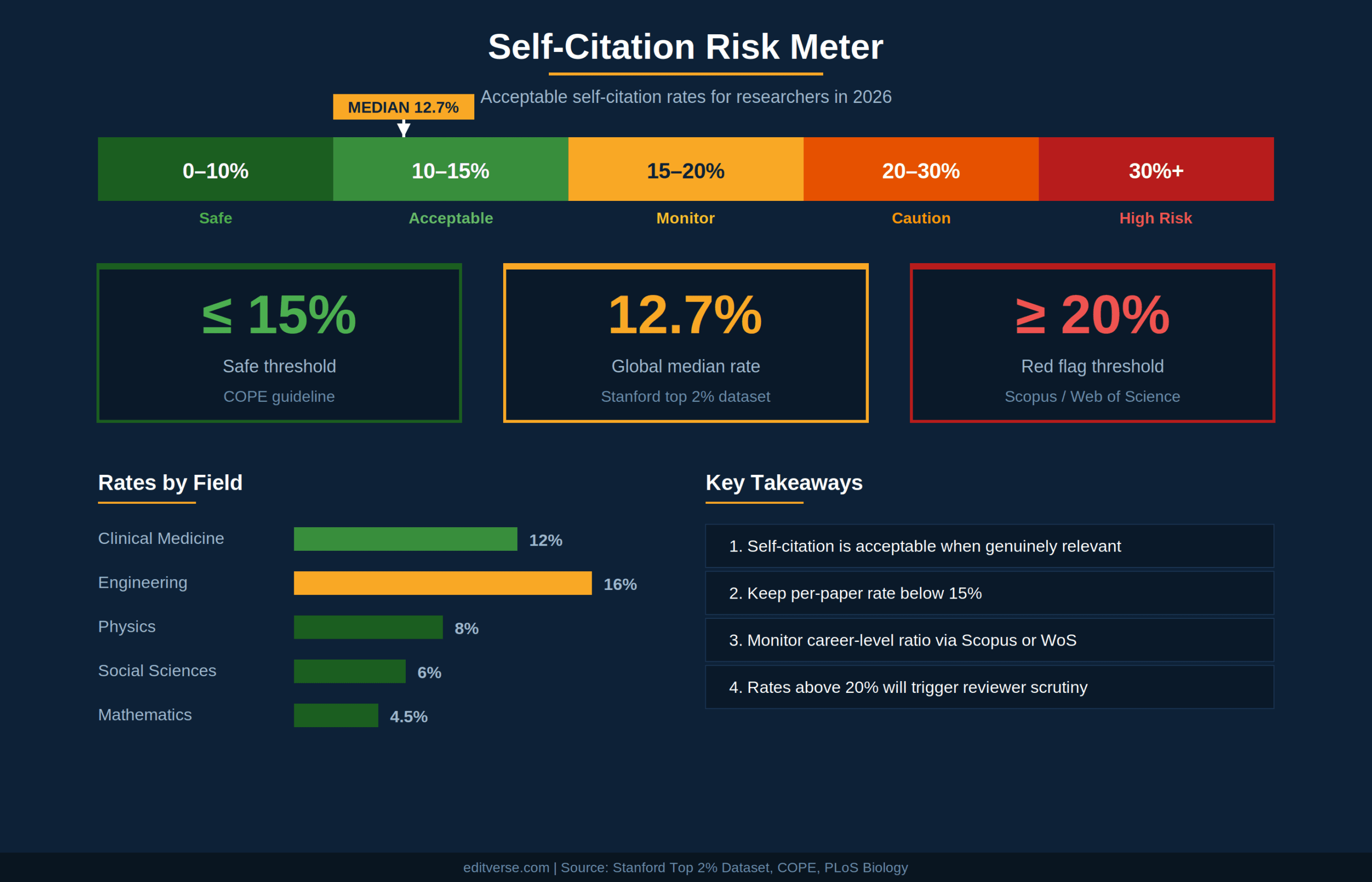
Understanding where your field-specific h-index requirements fall on this spectrum is essential. Researchers in highly specialized subfields — where few other scientists work on the same problem — will naturally have higher self-citation rates, and this is generally understood and accepted by evaluators.
When Self-Citation Is Appropriate: 5 Legitimate Reasons
📌 In Simple Words
There are several perfectly valid reasons to cite your own work: building on your previous methods, extending your earlier findings, preventing self-plagiarism by attributing prior text, providing context in a research series, or directing readers to your earlier foundational data. The test is simple: would a knowledgeable third party agree this citation is relevant?
Not all self-citations are created equal. There are clear, defensible scenarios where citing your own work is not only acceptable but necessary. Below are the five most commonly recognized legitimate reasons for self-citation.
1. Building on Prior Methods or Data
When your new study uses a methodology you developed and published previously, citing that original methods paper is essential for reproducibility. Readers and reviewers need to be able to trace the methodological lineage of your work. If you developed a novel statistical approach described in a prior paper, your new manuscript should reference it. Similarly, if your current study extends a dataset introduced in an earlier publication, that earlier work must be cited. This is standard practice in longitudinal and cohort-based research, and is especially common in fields like medical research methodology.
2. Avoiding Self-Plagiarism
Reusing your own text, figures, or concepts without attribution is considered self-plagiarism — a form of publication misconduct. Properly citing your earlier work when you draw from it is the correct way to maintain ethical standards in academic writing. This is particularly relevant when describing previously developed theoretical frameworks or repeating portions of methodology text.
3. Establishing Research Continuity
Researchers who pursue a sustained line of investigation over many years often publish a series of interconnected papers. Self-citation in these cases signals intellectual continuity and helps readers understand how the current work fits into a broader research program. Mandard (2022) notes that such citations serve an important epistemic function by connecting the dots across a body of work (Mandard, 2022).
4. Providing Relevant Prior Evidence
If your previous study produced findings directly relevant to the current manuscript — particularly pilot data, preliminary results, or foundational evidence — citing it is appropriate. However, as COPE advises, pilot studies should eventually be replaced by more comprehensive references as your research matures.
5. Directing Readers to Supplementary Information
Sometimes your earlier publications contain detailed supplementary materials, extended datasets, or technical appendices that support but are not duplicated in the current manuscript. Citing these papers provides readers with complete access to the information they need without bloating the current manuscript.
When Self-Citation Becomes Problematic: Red Flags to Avoid
📌 In Simple Words
Self-citation crosses the ethical line when the primary motivation is boosting your metrics rather than serving the reader. Warning signs include citing unrelated papers just because they’re yours, inserting self-references after peer review solely to inflate counts, or participating in citation rings where colleagues agree to mutually cite each other’s unrelated work.
While moderate, justified self-citation is a normal part of scholarly communication, it becomes ethically problematic when it crosses from scholarly necessity into metric manipulation. Indexing databases and journal editors are increasingly sophisticated at detecting these patterns. Here are the key red flags that signal problematic self-citation behavior.
Citing Unrelated Previous Work
The most common form of self-citation abuse involves inserting references to your own papers that have no substantive connection to the current manuscript. If your prior publication on Topic A is cited in a paper about Topic B simply because you wrote both, this inflates your citation count without serving any scholarly purpose. Editors and reviewers are trained to scrutinize reference lists for precisely this pattern.
Strategic Metric Inflation
When the primary purpose of a self-citation is to boost your h-index, i10-index, or total citation count, it constitutes citation manipulation — even if the cited work is tangentially related. The Committee on Publication Ethics (COPE) has identified this as a growing concern, and Scopus and Web of Science now provide filtered citation reports that separate self-citations from independent citations.
Coercive Journal Self-Citation
Some journals have been known to pressure authors to add citations to papers published in the same journal as a condition of acceptance — a practice known as coercive journal self-citation. This practice distorts journal impact factors and is explicitly condemned by COPE and major indexing services. If an editor asks you to add citations to the journal that are not relevant to your work, you have every right to respectfully decline.
Citation Rings and Mutual Inflation
Citation rings — informal agreements among collaborators to cite each other’s work regardless of relevance — represent a serious violation of publication ethics. This practice, sometimes called “citation stacking,” can lead to removal from indexing databases and severe reputational damage. Both Elsevier and Springer actively monitor for these patterns and penalize authors and journals found engaging in such behavior.
How Scopus, Web of Science, and COPE Monitor Self-Citation in 2026
📌 In Simple Words
Major databases don’t ban self-citation — they monitor it. Scopus and Web of Science both offer tools that let evaluators separate self-citations from independent citations. COPE provides guidelines but argues against completely excluding self-citations from metrics because doing so doesn’t allow for nuanced judgment about when self-citation is scientifically appropriate.
The global research community has developed increasingly sophisticated tools and policies to monitor self-citation patterns. Understanding how these systems work is essential for researchers who want to ensure their citation practices remain above reproach.
Scopus provides detailed citation reports that distinguish between total citations and citations excluding self-citations. Evaluators reviewing a researcher’s profile can easily identify the proportion of self-citations and assess whether it falls within disciplinary norms. Journals with excessively high self-citation rates may be flagged for review or removed from the database entirely.
Web of Science operates a similar system through its ResearcherID (now integrated into Publons), which provides citation analytics with a self-citation filter. Researchers can track their own ratios, and evaluators can access these metrics during hiring, promotion, and grant review processes.
COPE (Committee on Publication Ethics) takes a nuanced position. Rather than setting a hard numerical threshold, COPE emphasizes that self-citation should be transparent and justifiable. Notably, COPE has argued against simply excluding self-citations from metrics, noting that such an approach would not permit a nuanced understanding of when self-citation serves legitimate scholarly purposes. This position recognizes that blanket penalties could harm researchers working in highly specialized fields where self-citation is a natural consequence of deep expertise.
In addition to these established frameworks, newer metrics are emerging. The Self-Citation Adjusted Index (SCAI), proposed in 2025, offers a method for recalibrating traditional metrics like the h-index by accounting for self-citation patterns while preserving the useful information that citation counts provide. Early analyses suggest that SCAI could reduce gender-based disparities in perceived research impact by approximately 8.5%, making research evaluation more equitable.
Best Practices for Ethical Self-Citation: A 2026 Framework
📌 In Simple Words
Follow these steps: (1) only cite your work when it’s the best available reference, (2) keep self-citations below 15% of your total reference list per paper, (3) check your overall profile ratio periodically using Scopus or Web of Science tools, (4) explain self-citations to reviewers in your cover letter, and (5) replace pilot study citations with more comprehensive work as your research matures.
Based on the latest guidance from COPE, Elsevier, Springer, and the broader bibliometrics literature, here is a practical, evidence-based framework for ethical self-citation in 2026.

Step 1: Apply the Relevance Test
For each self-citation in your manuscript, ask: Is this reference the most relevant and informative source for the claim I’m making? If a third-party publication covers the same ground equally well — or better — use that instead. Self-citation should never displace a more appropriate independent source. This approach aligns with the recommendations in the Editverse guide on ethical strategies for increasing your h-index.
Step 2: Monitor Your Per-Paper Ratio
As a rule of thumb, aim to keep self-citations below 15% of the total references in any given manuscript. For a paper with 40 references, this means no more than 6 should be self-citations. This is not a rigid rule — niche fields may justify slightly higher rates — but it provides a useful benchmark for self-monitoring.
Step 3: Track Your Career-Level Self-Citation Rate
Periodically review your overall self-citation rate using tools available through Scopus, Web of Science, or the open-source code provided by Rosenblatt et al. (2025) for calculating self-citation rates. If your career-level rate exceeds 20%, consider whether adjustments are needed. Tools like PubMed and Google Scholar can also help you compare your citation patterns with peers in your field.
Step 4: Disclose Self-Citations in Your Cover Letter
When submitting a manuscript that includes multiple self-citations, consider adding a brief note to your cover letter explaining why these references are necessary. For example: “Several references to our prior publications are included because the current study directly extends the methodology and dataset described in [citation]. These self-citations are essential for methodological transparency and reproducibility.”
Step 5: Replace Pilot Citations as Research Matures
COPE specifically advises that pilot studies should be supplanted by more comprehensive or review-level publications as a research program matures. If you published preliminary findings in 2022 and now have a full study published in 2025, cite the more complete work. Continuing to cite the pilot is only justified if it contains unique information not available in the later publication.
Step 6: Keep Your ORCID Profile Transparent
Maintaining a complete and accurate research profile through ORCID provides context for evaluators reviewing your citation patterns. A well-organized profile demonstrates the coherence of your research program and makes it easier for others to see why self-citations are justified within a sustained line of inquiry.
Self-Citation and the H-Index: What Researchers Should Know
📌 In Simple Words
Self-citation directly influences your h-index because every citation counts toward the metric — including ones from yourself. While moderate self-citation barely moves the needle, excessive self-citation can inflate your h-index by several points, which evaluators can now detect using filtered citation reports.
The h-index — one of the most widely used measures of academic impact — does not inherently distinguish between self-citations and independent citations. This means that every self-citation that pushes a paper above the threshold contributes equally to the h-index calculation, regardless of its source. In practice, the impact of self-citation on h-index inflation varies significantly across disciplines and career stages.
Research by Flatt (2017) introduced the concept of the s-index — a complementary metric that specifically measures self-citation impact. A researcher’s s-index counts only papers that have received at least s self-citations, providing a clear picture of self-citation patterns. While the s-index has not been widely adopted, it illustrates the growing demand for more transparent bibliometric tools.
For researchers focused on building a strong publication record, the most sustainable approach is to focus on strategies that attract independent citations — such as publishing systematic reviews and meta-analyses, which consistently rank among the most-cited article types across disciplines. This is far more effective (and ethical) than relying on self-citation to boost your metrics.
Self-Citation for Early-Career Researchers vs. Senior Academics
📌 In Simple Words
Early-career researchers with few publications will naturally have higher self-citation rates as a percentage, simply because their reference pool is small. Senior academics with hundreds of papers can more easily keep rates low. The important thing for early-career researchers is to build genuine impact through high-quality work, not to artificially boost numbers through self-citation.
Self-citation rates are strongly correlated with career stage, and this is well understood by evaluators. Senior academics who have published extensively in a specialized field will inevitably have more of their own work to cite — and much of it will genuinely be the most relevant literature. For these researchers, self-citation rates of 15–20% may be entirely appropriate.
Early-career researchers face a different set of challenges. With fewer publications to their name, even a handful of self-citations can push their percentage above the typical range. This is generally understood and accepted, but it does mean that early-career researchers should be especially deliberate about ensuring every self-citation is clearly justified.
Shomoossi and Rad (2023) emphasize that overwarning early-career researchers about self-citation can have the unintended consequence of making them avoid citing their own genuinely valuable work. The goal is balance: cite your own work when it is the best available reference, but actively seek out and cite independent work when it serves the same purpose. Building this habit early in your career will serve you well as your publication record grows. For structured guidance on building your academic profile, see the Editverse guide on proven strategies for increasing your h-index.
Tools for Monitoring Your Self-Citation Rate
📌 In Simple Words
Several free and subscription tools can help you monitor your self-citation ratio. Scopus and Web of Science show self-citation counts in your author profile. VOSviewer lets you visualize citation networks. Reference managers like Zotero and Mendeley can help you tag and track which references in your papers are self-citations.
Keeping track of your self-citation rate requires the right tools. Here are the most effective options available to researchers in 2026:
Scopus Author Profile: Provides a breakdown of total citations vs. citations excluding self-citations. This is one of the most straightforward ways to monitor your ratio and is the metric most commonly used by hiring and tenure committees.
Web of Science / Publons ResearcherID: Offers similar citation analytics with a self-citation filter. You can view your metrics with and without self-citations and track trends over time. This is particularly useful for researchers applying for grants or academic positions where Scopus and Web of Science metrics are specifically requested.
VOSviewer: A free bibliometric visualization tool that maps citation networks. By analyzing your citation network, you can identify clusters and spot patterns that might indicate excessive self-citation within a particular subfield or research group.
Google Scholar Profiles: While Google Scholar does not provide self-citation filtering at the author level, you can track citation data at the article level. Cross-referencing this with your PubMed or Google Scholar records provides a more complete picture.
Zotero and Mendeley: Reference management tools that allow you to tag self-citations within your library, making it easier to audit your manuscripts before submission. Consider creating a “self-citation” tag and reviewing your ratio for each new paper.
Handling Reviewer Requests for Self-Citation
Peer reviewers sometimes request that authors add citations — and in some cases, the requested citations may be the reviewer’s own work. This creates a complex ethical situation. Here’s how to handle it:
If the suggested citation is genuinely relevant to your manuscript, there’s no issue with adding it. Good reviewers often identify relevant literature that authors have missed, and this is a valuable part of the peer review process.
However, if the suggested citation appears irrelevant or seems intended primarily to boost the reviewer’s own metrics, you have the right to politely decline. In your revision letter, explain why the suggested reference does not fit the scope of your manuscript. For example: “We appreciate the reviewer’s suggestion to include [citation]. However, after careful consideration, we believe this reference falls outside the specific scope of our methodology section. We have instead added [alternative citation] which more directly addresses the point raised.”
If you suspect a pattern of coercive citation — where a reviewer or editor systematically requires citations to their own work or to the journal — consider reporting this to COPE. Such behavior is a recognized form of publication misconduct. The Editverse guide on handling journal rejections provides additional context on navigating difficult reviewer interactions.
Self-Citation vs. Self-Plagiarism: Understanding the Difference
Self-citation and self-plagiarism are related but distinct concepts, and researchers sometimes confuse them. Self-citation is the proper way to reference your own prior work — it gives credit, provides context, and maintains transparency. Self-plagiarism, by contrast, involves reusing portions of your own published text, data, or figures without proper attribution, presenting recycled material as if it were original.
The key takeaway: self-citation is the solution to self-plagiarism, not its equivalent. When you must reference ideas, methods, or frameworks from your prior work, citing that work properly ensures transparency. When you must reuse text (such as standardized methodology descriptions), proper citation combined with quotation marks or clear paraphrasing prevents self-plagiarism. For more on maintaining ethical standards in manuscript preparation, consult dedicated guides on this topic.
Common Mistakes Researchers Make with Self-Citation
Based on the literature and expert guidance, here are the most frequent mistakes researchers make regarding self-citation — and how to avoid them:
Mistake 1: Citing Every Prior Paper in Every New Manuscript. Just because you published it doesn’t mean it belongs in every reference list. Each citation should pass the relevance test. A paper on Topic A doesn’t automatically earn a spot in a paper on Topic B, even if both fall within your general field.
Mistake 2: Ignoring Self-Citation Metrics Entirely. Some researchers never check their self-citation ratio, leaving them unaware that it has crept above acceptable thresholds. Regular monitoring using the tools described above is essential for maintaining a clean bibliometric profile.
Mistake 3: Overcorrecting and Avoiding All Self-Citation. Fear of appearing self-promotional can lead some researchers — particularly early-career academics — to deliberately avoid citing their own relevant work. This can actually harm the quality of the manuscript by omitting the most pertinent prior literature and may even constitute a form of dishonesty by hiding the paper’s intellectual lineage.
Mistake 4: Participating in Informal Citation Agreements. Agreements to mutually cite each other’s work, even among trusted collaborators, constitute citation manipulation if the citations are not independently justified. Always evaluate each citation on its own merits.
Mistake 5: Adding Self-Citations After Peer Review. Inserting additional self-citations during the revision process — when they were not present in the original submission — is a particularly visible red flag. Editors can easily compare reference lists between submission versions, and unexplained additions raise immediate concerns.
Professional Services for Citation Strategy and Publication Support
Navigating self-citation ethics while building a strong publication record can be challenging, especially for researchers working across multiple projects or preparing manuscripts for high-impact journals. Professional publication support services can help you optimize your citation strategy, ensure ethical compliance, and maximize the independent citation potential of your work.
H-Index Starter Bundle
$2,495
Complete systematic review support to boost your independent citations
Narrative Review Article
$1,000
Expert-supported review article to establish your scholarly authority
Revision & Resubmission Support
$350
Navigate reviewer comments and citation requests with expert help
H-Index Professional Bundle
$3,050
Complete SR + meta-analysis for maximum citation impact
Conclusion: Self-Citation Is OK — When Done Right
Self-citation is a legitimate, natural, and often necessary part of academic publishing. The key is intention and transparency. When you cite your own work because it genuinely represents the most relevant prior literature — whether for methodological continuity, data provenance, or theoretical grounding — you are engaging in good scholarly practice. When you cite your own work primarily to inflate bibliometric indicators, you are engaging in citation manipulation.
In 2026, the tools and frameworks for monitoring self-citation are more sophisticated than ever. Scopus, Web of Science, COPE, and emerging metrics like SCAI all provide mechanisms for ensuring transparency and fairness in citation evaluation. By applying the best practices outlined in this guide — the relevance test, per-paper monitoring, career-level tracking, cover letter disclosure, and regular self-auditing — you can cite your own work with confidence, knowing that your practices meet the highest ethical standards.
Remember: the most effective way to build a strong citation profile is not through self-citation, but through publishing high-impact, rigorous research that other scholars want to cite independently. Tools like systematic reviews, well-designed original studies following established reporting guidelines, and collaborative work across institutions all contribute to building a citation record that speaks for itself.
Ready to Build a Stronger Citation Profile — the Ethical Way?
Editverse offers expert publication support services designed to maximize your independent citation impact through systematic reviews, meta-analyses, and manuscript optimization.
Related Editverse Resources
→ What Is H-Index? Complete Guide for Researchers
→ How to Increase Your H-Index: 10 Proven Strategies
→ Field-Specific H-Index Requirements
→ Journal Metrics and Article Metrics Explained
→ How Systematic Reviews Accelerate H-Index Growth
→ Scopus vs Web of Science: An In-Depth Look
→ PubMed vs. Google Scholar: Which Tool Should You Use?
→ PRISMA 2020 Guidelines: Complete Checklist
→ Ethical Use of ChatGPT in Academic Writing
→ What Are Publication Support Services?
→ Citation Booster Services | Increase H-Index & Citations
References
1. Chen, L., Ding, J., & Larivière, V. (2021). Measuring the citation context of national self-references. Journal of the Association for Information Science and Technology, 73(5), 671–686. https://doi.org/10.1002/asi.24569
2. Mandard, M. (2022). On the shoulders of giants? Motives to cite in management research. European Management Review, 19(1), 10–21. https://doi.org/10.1111/emre.12495
3. Shomoossi, N., & Rad, M. (2023). Self-citation: to do or not to do? Journal of Medical Ethics and History of Medicine, 16, 1. PMC10338646
4. Rosenblatt, M., et al. (2025). Trends in self-citation rates in high-impact neurology, neuroscience, and psychiatry journals. eLife, 13, e88540. https://elifesciences.org/articles/88540
5. Aksnes, D. W., Langfeldt, L., & Wouters, P. (2019). Citations, citation indicators, and research quality: An overview of basic concepts and theories. SAGE Open, 9(1), 2158244019829575.
6. Flatt, J. W. (2017). The s-index: An analogous complement to the h-index for self-citations. Journal of Informetrics, 11(1), 263–269.
7. Van Noorden, R., & Chawla, D. S. (2019). Hundreds of extreme self-citing scientists revealed in new database. Nature, 572, 578–579.
8. COPE Discussion Document. (2024). Self-citation: Where’s the line? Committee on Publication Ethics. https://publicationethics.org/topic-discussions/self-citation-wheres-line