
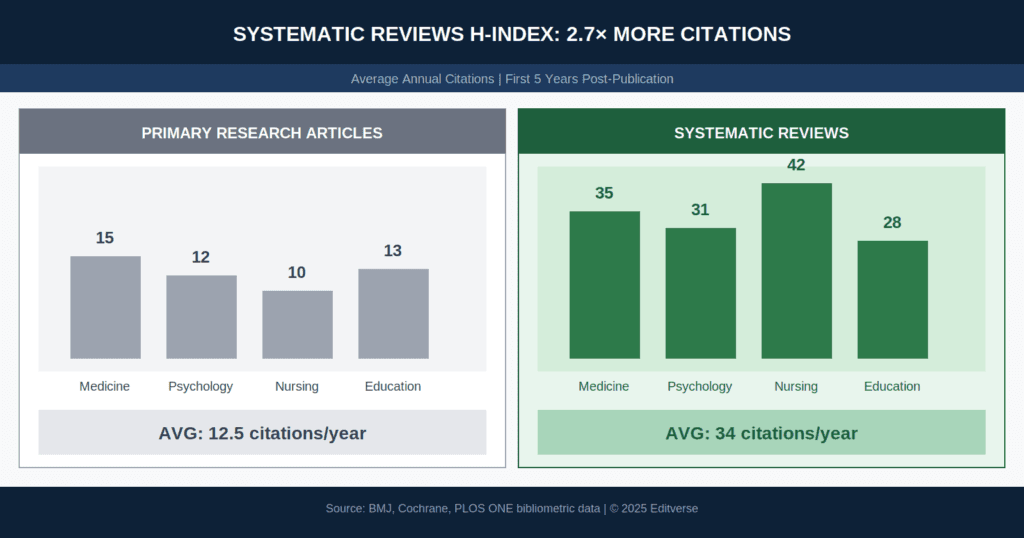
Systematic reviews and h-index improvement are directly connected through citation dynamics. If you’re an academic researcher looking to boost your citation count and h-index, you might assume the answer lies in publishing more primary research studies. However, decades of bibliometric evidence tells a different story: systematic reviews and meta-analyses consistently generate 2.7× more citations than original research articles, making them the fastest path to a higher h-index.
This comprehensive guide explains exactly why systematic reviews boost your h-index so effectively, provides step-by-step instructions for conducting high-impact reviews, and shows you how to strategically integrate them into your publication portfolio for maximum career benefit.
How Systematic Reviews Boost Your H-Index: Citation Evidence
Understanding the relationship between systematic reviews and h-index growth requires examining bibliometric data across disciplines. The evidence is compelling—and the 2.7× citation advantage compounds significantly over an academic career.
Understanding the H-Index: Why It Matters for Your Career
Before diving into systematic review strategies, let’s clarify what the h-index measures and why it’s crucial for academic advancement. The h-index, introduced by physicist Jorge Hirsch in his landmark 2005 Proceedings of the National Academy of Sciences paper, quantifies both the productivity and citation impact of a researcher’s publications.
How it works: You have an h-index of h when h of your papers have each received at least h citations. For example, an h-index of 15 means you have 15 publications that have each been cited at least 15 times.
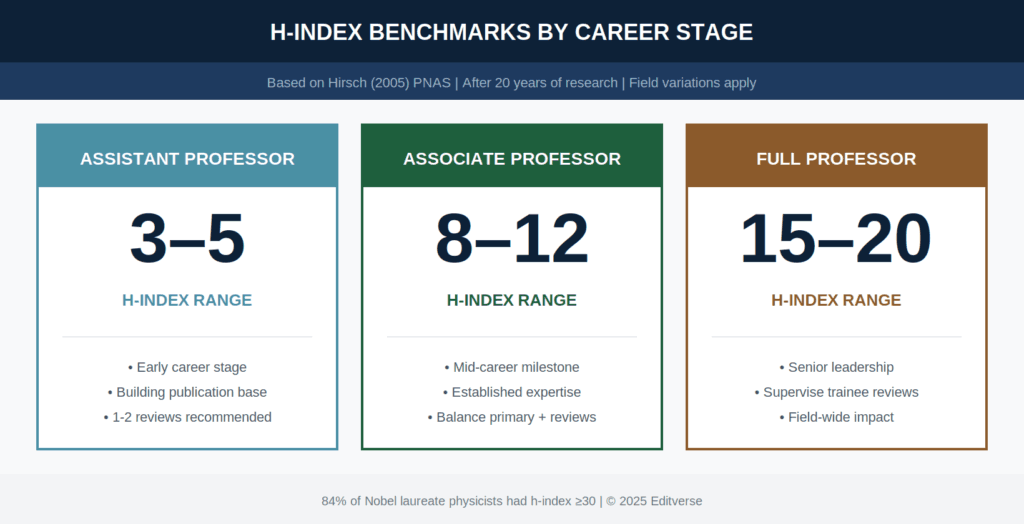
According to Hirsch’s original framework, an h-index of 20 after 20 years of research indicates a “successful scientist,” 40 represents an “outstanding scientist,” and 60 or above is “truly exceptional.” However, these benchmarks vary significantly across disciplines—a humanities scholar with an h-index of 15 may be highly accomplished, while a biomedical researcher might need 30+ for equivalent recognition.
Why Systematic Reviews Generate More Citations: 5 Key Reasons
Understanding why systematic reviews attract more citations helps you design reviews that maximize this advantage for h-index improvement. Here are the five primary mechanisms:
1. The “Foundational Reference” Effect
Every new research paper must establish what is already known about a topic. This creates a structural citation demand for comprehensive summaries of existing evidence. When researchers write their introduction sections, they face a choice: cite 15-20 individual studies, or cite one authoritative systematic review that synthesizes all that evidence.
Most researchers choose the systematic review because it demonstrates thorough scholarship while saving space and reader effort. This makes your systematic review the default citation for an entire body of literature.
How to Maximize the Foundational Reference Effect
Step 1: Write a comprehensive, citable abstract
Include your key quantitative findings (effect sizes, confidence intervals) directly in the abstract. Many researchers cite based on abstracts alone.
Step 2: Create quotable summary statements
Craft clear, specific conclusions that can be directly quoted. “The pooled effect size was 0.45 (95% CI: 0.32-0.58)” is more citable than vague language.
Step 3: Include a “summary of findings” table
GRADE-based summary tables are increasingly required by journals and make your results immediately accessible for citation.
2. Clinical Guideline Integration
Clinical practice guidelines from organizations like the World Health Organization, National Institute for Health and Care Excellence (NICE), and specialty societies rely heavily on systematic reviews as their evidence foundation. When a guideline cites your review, every subsequent paper that references that guideline indirectly extends your work’s reach.
The Cochrane Collaboration reviews, for instance, are explicitly designed to inform clinical guidelines and have accumulated millions of citations collectively. If you’re aiming for Cochrane-quality protocols, our Cochrane Protocol Writing service can help you meet their rigorous standards.
3. Grant Application Requirements
Funding agencies increasingly require evidence synthesis to justify proposed research. Your systematic review becomes the go-to citation for researchers writing grants in your area. This creates a self-reinforcing cycle: funded researchers cite your review, conduct their studies, and their publications reference your work again.
4. Educational and Training Citations
Systematic reviews are ideal teaching resources because they provide comprehensive overviews suitable for students and trainees. Educators cite them in syllabi, textbooks, and training materials, creating sustained citation flow over many years—often longer than typical research paper citation half-lives.
5. Evidence Hierarchy Position
In evidence-based practice frameworks, systematic reviews and meta-analyses occupy the highest position. Research published in Clinical Oral Implants Research confirmed that higher-level evidence studies consistently receive more citations than lower-level studies addressing similar questions (Wu et al., 2020).
Step-by-Step Guide: Conducting Systematic Reviews for H-Index Growth
Now let’s walk through exactly how to conduct a systematic review designed for maximum citation impact and h-index improvement. This process typically takes 6-18 months depending on scope and team size.
Phase 1: Topic Selection and Feasibility Assessment (2-4 weeks)
Your topic choice largely determines your review’s citation potential. A brilliantly executed review on a saturated or niche topic will underperform a competent review on a high-demand topic.
Topic Selection Process
Step 1: Identify 3-5 candidate topics in your expertise area
Start with questions you’ve encountered in clinical practice, teaching, or research. Topics where you genuinely want to know the answer will sustain your motivation through the process.
Step 2: Check for existing reviews
Search Cochrane Library, PROSPERO, and PubMed for recent systematic reviews on your topics. If a high-quality review exists from the past 3 years, consider a different angle or population.
Step 3: Assess primary study availability
Conduct preliminary searches to estimate how many eligible studies exist. Fewer than 5 studies may not justify a full systematic review; more than 200 may require narrowing your scope. Our Literature Search service can help you assess feasibility.
Step 4: Evaluate clinical or policy relevance
Topics that directly inform treatment decisions, public health policy, or clinical guidelines attract more citations than purely academic questions.
Step 5: Consider timing and trends
Reviews addressing emerging technologies, recent controversies, or rapidly accumulating evidence have higher citation potential.
Phase 2: Protocol Development and Registration (2-3 weeks)
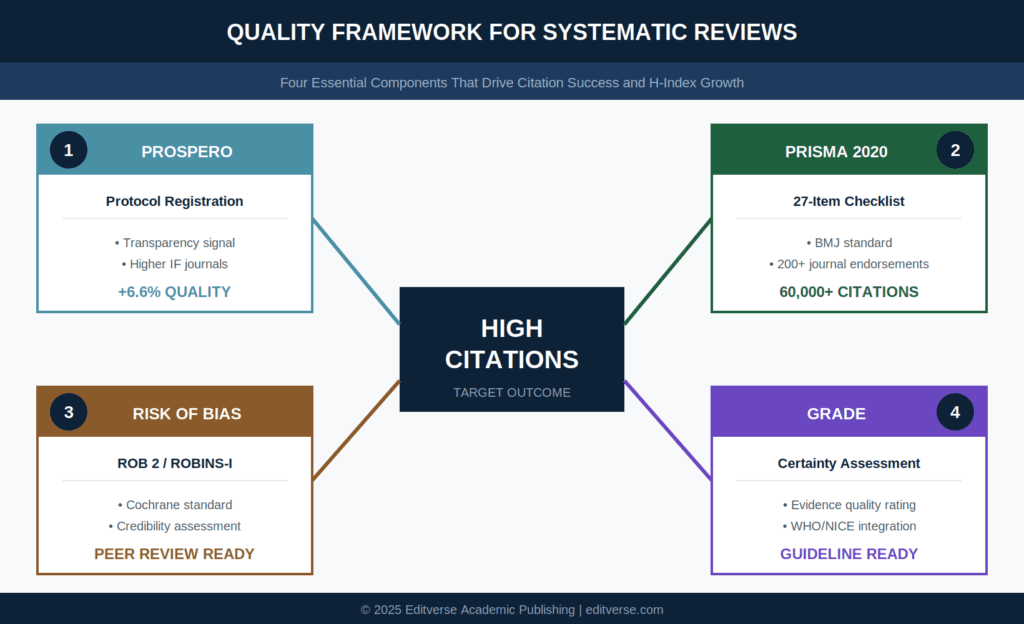
A well-designed protocol is essential for methodological rigor and distinguishes high-quality reviews from narrative summaries. Research published in the Journal of Clinical Epidemiology demonstrated that PROSPERO-registered reviews have 6.6% higher methodological quality scores and are published in journals with higher impact factors (Sideri et al., 2018).
Protocol Development Checklist
Step 1: Define your research question using PICO/PECO framework
Population, Intervention/Exposure, Comparison, Outcome.
Step 2: Specify eligibility criteria
Define inclusion/exclusion criteria for study designs, populations, interventions, comparators, outcomes, and settings.
Step 3: Develop search strategy with librarian assistance
Plan to search at minimum: MEDLINE/PubMed, Embase, and Cochrane CENTRAL.
Step 4: Plan data extraction procedures
Create a standardized extraction form.
Step 5: Select risk of bias assessment tool
Use validated tools: ROB 2 for randomized trials, ROBINS-I for non-randomized studies.
Step 6: Plan synthesis approach
Decide whether meta-analysis is anticipated and specify statistical methods.
Step 7: Register on PROSPERO
Submit your protocol to PROSPERO before beginning screening. See our PROSPERO Registration Guide.
Phase 3: Literature Search and Screening (4-8 weeks)
Search and Screening Process
Step 1-7: Develop search strategy → Execute searches → Deduplicate → Title/abstract screening → Full-text review → Search reference lists → Create PRISMA flow diagram. See our PRISMA Flow Chart Guide.
Phase 4: Data Extraction and Quality Assessment (3-6 weeks)
This phase requires meticulous attention to detail. Dual-reviewer extraction ensures accuracy and reduces bias. If you need support with this labor-intensive phase, our Systematic Review Data Extraction service provides expert dual-reviewer extraction starting at $500.
Phase 5: Data Synthesis and Analysis (2-4 weeks)
Phase 6: Manuscript Preparation and Submission (4-8 weeks)
Writing for Maximum Citation Impact
Use PRISMA 2020 checklist → craft citable abstract → write clear specific conclusions → highlight clinical implications → identify research gaps → target journals strategically. See our PRISMA 2020 Complete Checklist.
Citation Timeline: How Systematic Reviews Build Your H-Index Over Time
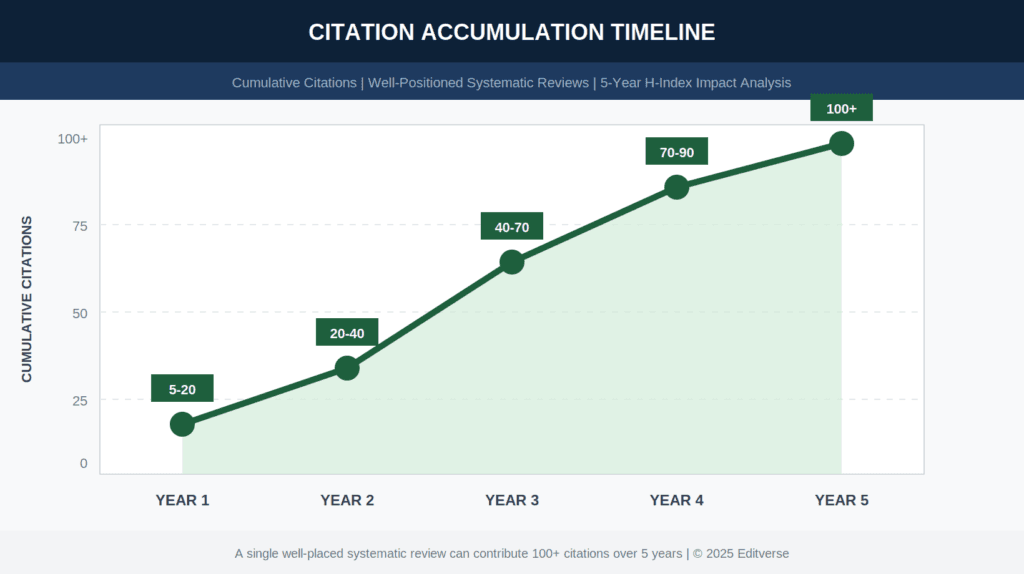
Year 1: Initial Discovery Phase (5-20 citations) — Citations begin slowly as researchers discover your review.
Year 2: Momentum Building (20-40 cumulative) — Your review starts appearing in literature searches.
Year 3: Peak Growth Begins (40-70 cumulative) — The review becomes an established reference.
Year 4: Sustained High Impact (70-90 cumulative) — Citations remain strong if the review addresses a continuing need.
Year 5+: Maintenance or Update (100+ cumulative) — Plan updates every 3-5 years for sustained impact.
Optimal Publication Strategy: Balancing Systematic Reviews and H-Index Goals
| Career Stage | Recommended Mix | Strategic Focus |
|---|---|---|
| PhD Student / Postdoc | 1-2 systematic reviews per year alongside primary research | Build expertise reputation; create citable foundation |
| Early Career (0-5 years post-PhD) | 1 major systematic review annually | Establish as field expert; target high-impact journals |
| Mid-Career (Associate level) | 1 senior-authored review per year; supervise trainee-led reviews | Mentor emerging researchers; contribute to guidelines |
| Senior Researcher (Full Professor) | Supervise and co-author trainee reviews | Shape field direction; build legacy through mentorship |
Common Mistakes That Hurt Your Systematic Reviews and H-Index
| Pitfall | Impact on Citations | Prevention Strategy |
|---|---|---|
| Methodological shortcuts | Review gets criticized; researchers avoid citing flawed work | Follow PRISMA rigorously; register on PROSPERO |
| Oversaturated topic | Your review competes with existing syntheses | Search PROSPERO and Cochrane before committing |
| Poor journal targeting | Limited visibility to your target audience | Target specialty journals; consider open access |
| Passive dissemination | Slow citation accumulation | Present at conferences; share on academic social media |
| Failure to update | Review becomes outdated; gets superseded | Plan updates every 3-5 years |
Professional Systematic Review Services
Need expert support for your systematic review? Editverse offers comprehensive services at every stage:
Conclusion: Your Action Plan for Systematic Reviews and H-Index Success
Systematic reviews and h-index growth go hand-in-hand when you follow evidence-based methodology. The data is clear: reviews generate 2.7× more citations than primary research, serve as foundational references for years, and position you as a recognized authority in your field.
Your Systematic Review Launch Checklist
☐ Identify 2-3 potential topics in your expertise area
☐ Search PROSPERO and Cochrane for existing reviews
☐ Assess feasibility: sufficient primary studies available?
☐ Develop PICO/PECO research question
☐ Draft protocol following PRISMA-P guidelines
☐ Register protocol on PROSPERO
☐ Assemble team (minimum 2 reviewers)
☐ Engage medical librarian for search strategy
☐ Execute with methodological rigor
☐ Target appropriate journals
☐ Plan active dissemination strategy
Related Editverse Resources
→ What is H-Index? Complete Guide (2025)
→ How to Increase Your H-Index: 10 Proven Strategies
→ Field-Specific H-Index Requirements
→ Systematic Review vs Meta-Analysis: Key Differences
→ PRISMA 2020 Guidelines: Complete Checklist
→ PROSPERO Registration: Essential Tips Guide
→ PubMed vs. Google Scholar: Which Tool?
→ PRISMA, MOOSE, or ENTREQ: Navigating Guidelines
→ Easy Guide to PRISMA Flow Chart Steps
→ Journal Rejection Rates by Field (2025)
→ Citation Booster Services | Increase H-Index & Citations
Ready to Accelerate Your H-Index with Expert Support?
From protocol development to publication, our systematic review specialists guide you through every step.
References
Hirsch JE. (2005). An index to quantify an individual’s scientific research output. Proceedings of the National Academy of Sciences, 102(46), 16569-16572.
Page MJ, et al. (2021). The PRISMA 2020 statement: an updated guideline for reporting systematic reviews. BMJ, 372:n71. DOI: 10.1136/bmj.n71
Sideri S, et al. (2018). Do we need PROSPERO registration for systematic reviews? Journal of Clinical Epidemiology, 93:111-113.
Weintraub WS, et al. (2018). Review articles are cited more frequently than other types of papers. International Urogynecology Journal, 29(8):1123-1129.
Wu YC, et al. (2020). Association between level of evidence and citation count. Clinical Oral Implants Research, 31(8):739-747.
Last updated: December 2025 | © 2025 editverse.com