
Selecting the right journal for your research paper is one of the most strategic decisions you will make in your entire publication journey. Yet most researchers treat journal selection as an afterthought — they finish writing their manuscript and then scramble to find a journal at the last minute. This approach almost always leads to desk rejections, wasted months waiting for editorial decisions, and lost opportunities for citations and academic visibility.
With over 30,000 peer-reviewed journals listed in the Directory of Open Access Journals alone, and thousands more behind traditional subscription models, the sheer volume of options can feel overwhelming. Add to that the constantly evolving publishing landscape of 2026 — including new open access mandates, AI-powered journal finder tools, and increasingly sophisticated predatory journals — and the need for a systematic, strategic approach to journal selection has never been greater.
This comprehensive guide provides you with 10 expert-backed, actionable tips to help you choose the best journal for your manuscript. Whether you are a first-time author preparing your very first submission or an experienced researcher exploring new publication avenues, these strategies will save you time, reduce your rejection risk, and maximize the impact of your research.
Why Strategic Journal Selection Matters More Than Ever in 2026
The academic publishing ecosystem in 2026 is dramatically different from even five years ago. Funder mandates like Plan S, the NIH public access policy, and Horizon Europe requirements now dictate where and how you can publish. Open access models have multiplied — from Gold and Green OA to the growing Diamond OA movement. Meanwhile, predatory publishers have become more sophisticated, using AI-generated editorial boards and fake peer review comments to deceive researchers.
In this environment, getting your journal selection right is not just about prestige — it is about compliance, career advancement, and ensuring your research actually reaches the audience that needs it. A well-chosen journal amplifies your work, increases your citation count, and supports your h-index growth strategy. A poorly chosen journal can bury your research or, worse, associate your name with a questionable publication.
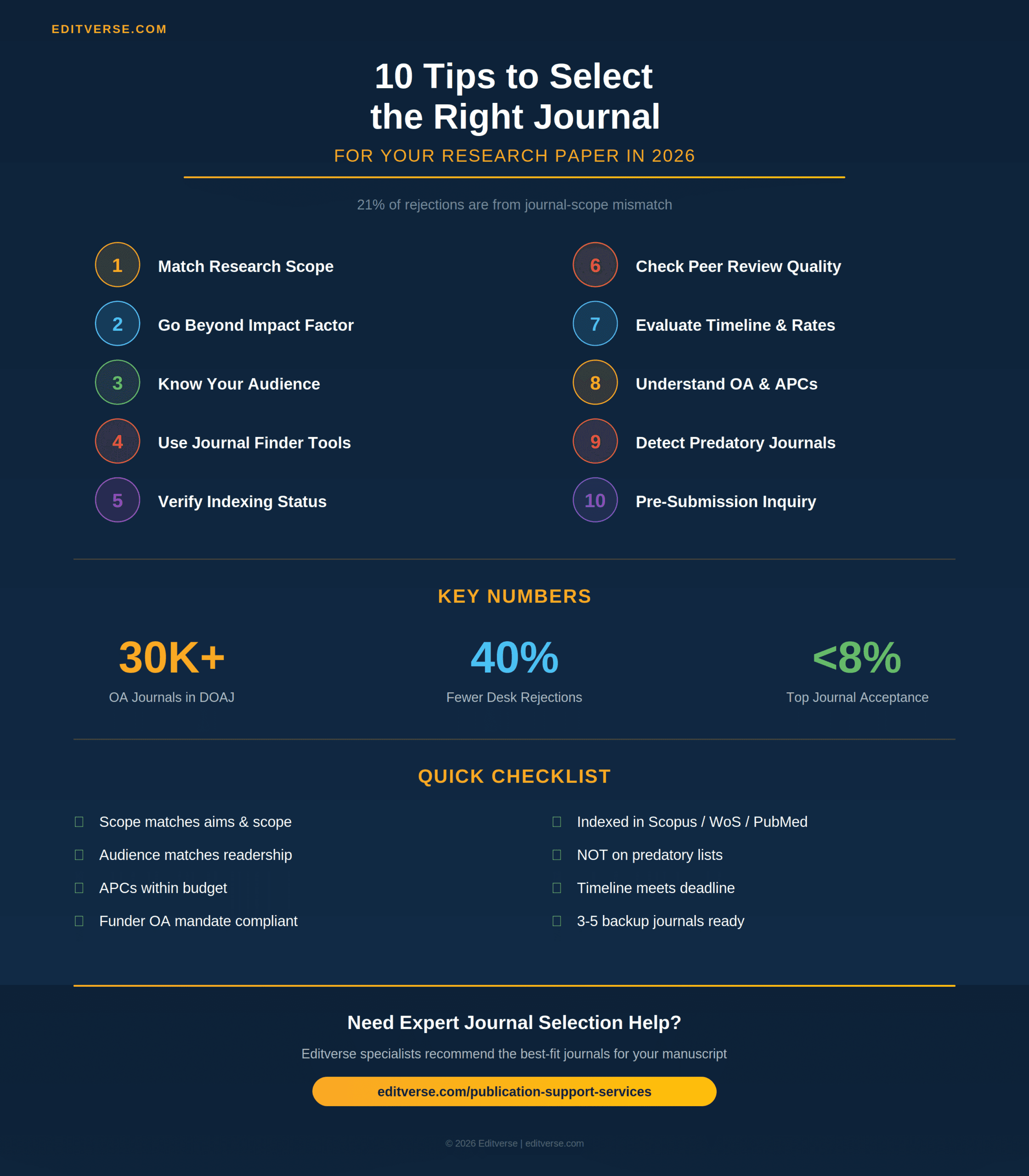
The following 10 tips are organized in a logical sequence: from understanding your own research and audience (Tips 1–3), through evaluating journal quality and fit (Tips 4–7), to navigating financial and ethical considerations (Tips 8–9), and finally using advanced strategic techniques (Tip 10).
Tip 1: Match Your Research Scope to the Journal’s Aims and Scope
The single most important step in journal selection is ensuring your manuscript topic aligns precisely with the journal’s stated aims and scope. This sounds obvious, but scope mismatch remains the leading avoidable cause of desk rejection — the editorial decision to reject your paper without even sending it for peer review.
Quiz answer: Journal-scope mismatch is indeed the most common avoidable reason for rejection!
How to Decode a Journal’s Aims and Scope Page
Every reputable journal publishes an aims and scope statement on its website. This statement describes the topics the journal covers, the types of research it prioritizes (basic science, clinical, translational, applied), and the audience it serves. However, these statements can sometimes be vague or overly broad. Here is how to extract useful information from them.
First, identify the journal’s disciplinary boundaries. A journal that states it covers “all aspects of cardiovascular research” is quite different from one focused on “interventional cardiology techniques in clinical practice.” Second, note whether the journal emphasizes methodology (e.g., randomized controlled trials, systematic reviews) or accepts a wider range of study designs. Third, check whether the journal has regional or international focus — some journals explicitly serve certain geographic communities.
The Reference List Test
One of the most reliable techniques for verifying scope match is what experienced researchers call the “reference list test.” Look through your own manuscript’s reference list and count how many of your cited papers were published in the journal you are considering. If three or more of your references come from that journal, it is a strong signal that your work fits its scope. Conversely, if none of your references were published there, it might indicate a poor fit.
Similarly, search the journal’s recent issues (last 2–3 years) for papers similar to yours in terms of topic, methodology, and sample size. If you find comparable studies, you are likely in the right place.
Specialist vs. Multidisciplinary Journal: A Decision Framework
If your research is highly technical and speaks primarily to experts in a narrow subfield, a specialist journal is usually the better choice — your work will reach the people who can build on it and cite it. If your findings have broader implications (for example, a public health intervention with policy relevance), a multidisciplinary journal like PLOS ONE, BMJ Open, or Scientific Reports may give you wider exposure.
The decision also depends on your career goals. Early-career researchers building a track record within a specific discipline often benefit from publishing in the top specialist journals of their field, whereas researchers seeking to establish interdisciplinary collaborations may prioritize broader-scope outlets.
Tip 2: Evaluate Journal Metrics — But Go Beyond the Impact Factor
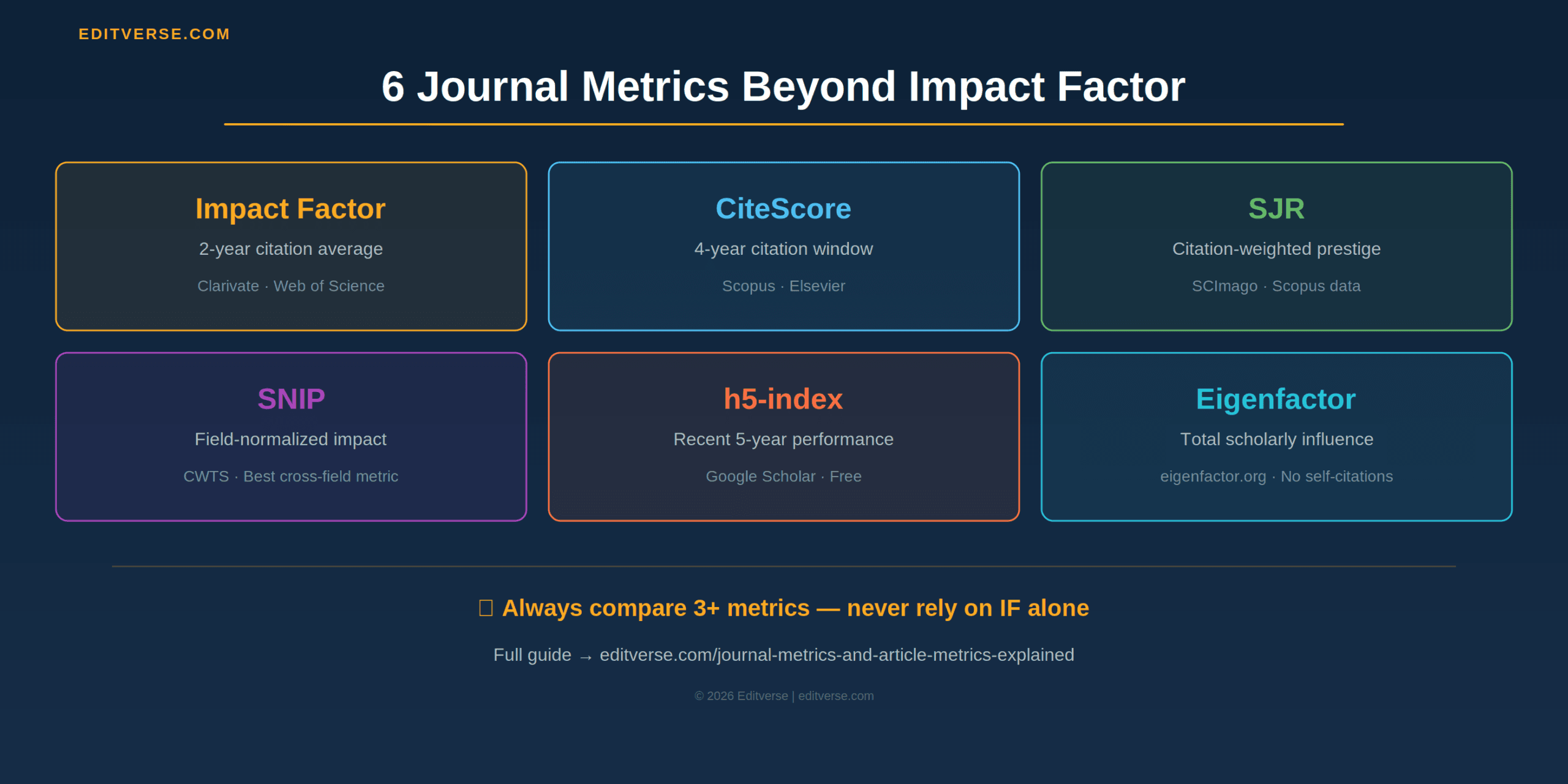
The Journal Impact Factor (JIF) has long been the default metric for assessing journal quality. However, relying solely on Impact Factor for your journal selection is not only limiting — it can actively mislead you. Impact Factor measures the average number of citations received per paper published in a journal over a two-year window, but this average is heavily skewed by a small number of highly cited papers.
Key Journal Metrics to Evaluate in 2026
| Metric | What It Measures | Best For | Limitation |
|---|---|---|---|
| Impact Factor (JIF) | Average citations per article over 2 years | Quick comparison within a discipline | Skewed by outliers; varies wildly across fields |
| CiteScore | Citations per document over 4 years (Scopus) | Broader view; includes all document types | Only covers Scopus-indexed journals |
| SJR (SCImago Journal Rank) | Citation-weighted prestige (quality of citing journals matters) | Comparing journals across disciplines | Complex algorithm; not intuitive |
| SNIP | Source Normalized Impact per Paper | Cross-discipline comparison (normalizes citation potential) | Less widely recognized by hiring committees |
| h5-index | h-index of articles published in last 5 years (Google Scholar) | Assessing recent journal performance | Favors high-volume journals |
| Eigenfactor Score | Journal’s total influence on the scholarly community | Understanding overall journal influence | Not normalized per article |
For a deeper dive into each of these metrics with worked examples and interpretation guidance, see our comprehensive guide: Journal Metrics and Article Metrics Explained.
Tip 3: Know Your Target Audience Before You Choose
Before opening any journal finder tool, ask yourself a fundamental question: who needs to read this research? Your answer determines everything about your journal selection — scope, indexing, language, and geographic reach.
Audience Mapping for Journal Selection
Consider these audience categories and the journal types that serve them best.
Clinical practitioners read journals like The BMJ, JAMA, or specialty-specific clinical journals. If your research has direct implications for patient care, clinical practice guidelines, or treatment protocols, these journals ensure your findings reach the people who will apply them at the bedside.
Basic science researchers gravitate toward discipline-specific journals with high methodological rigor. If your work advances fundamental understanding of biological mechanisms, molecular pathways, or theoretical frameworks, specialist journals in your field will connect you with peers who can build on your findings.
Policymakers and public health professionals look to journals like The Lancet, Health Affairs, or open access outlets with broad readership. If your research has societal implications — particularly in areas like public health policy, epidemiology, or health economics — prioritize journals known for influencing policy debates.
Interdisciplinary researchers benefit from mega-journals or multidisciplinary outlets. If your work bridges two or more fields (for example, combining machine learning with clinical diagnosis), look for journals that explicitly welcome interdisciplinary submissions.
Tip 4: Use AI-Powered Journal Finder Tools (2026 Updated List)
One of the most efficient ways to shortlist potential journals is to use journal finder tools — online platforms that match your manuscript’s abstract, title, or keywords to journals in their database. These tools have improved dramatically in 2026 with advances in natural language processing and machine learning.
Best Free Journal Finder Tools in 2026
| Journal Finder Tool | Publisher | Database Coverage | Input Type | Cost |
|---|---|---|---|---|
| Elsevier Journal Finder | Elsevier | 2,800+ Elsevier journals | Title + Abstract + Keywords | Free |
| Springer Nature Journal Suggester | Springer Nature | 3,000+ Springer/Nature journals | Abstract or manuscript text | Free |
| Taylor & Francis Journal Suggester | Taylor & Francis | 2,700+ T&F journals | Abstract (AI-powered) | Free |
| JANE (Journal/Author Name Estimator) | Biosemantics Group | All PubMed-indexed journals | Title, abstract, or keywords | Free |
| JournalGuide (Clarivate) | Clarivate / ResearchSquare | Multi-publisher database | Title, abstract, or keywords | Free |
| Wiley Journal Finder | Wiley | 1,700+ Wiley journals | Title + Abstract | Free |
| Scopus Journal Finder (by abstract) | Elsevier / Scopus | 27,000+ Scopus-indexed journals | Abstract text | Requires Scopus access |
How to Use Journal Finder Tools Effectively
Simply pasting your abstract into a journal finder tool and picking the first result is not enough. Here is a more strategic approach.
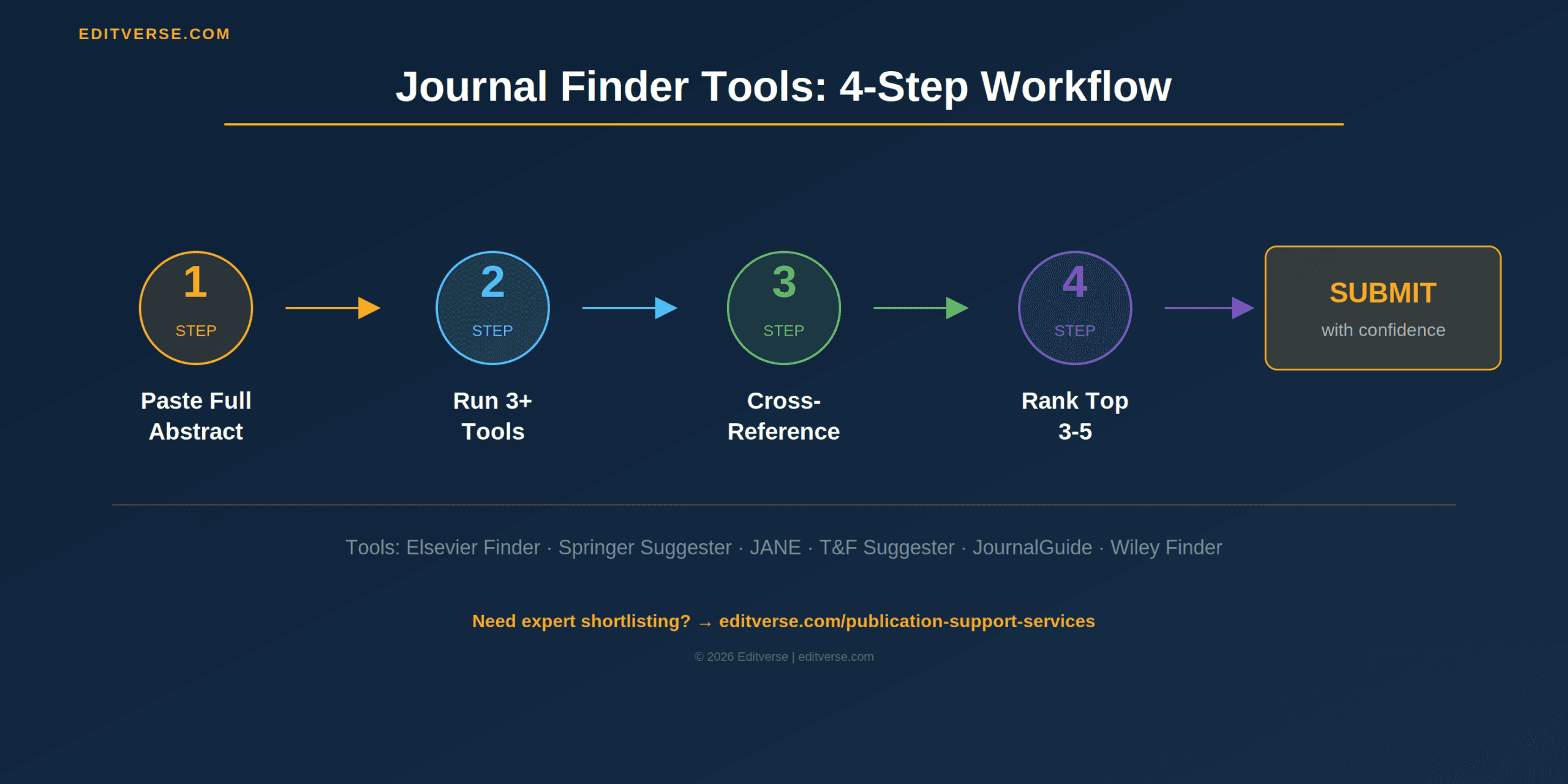
Step 1: Use multiple tools. Each tool only searches its own publisher’s database (Elsevier’s finder will never recommend a Springer journal). Use at least 3 different tools plus the publisher-neutral JANE to build a comprehensive shortlist.
Step 2: Paste your full abstract, not just keywords. AI-powered tools perform significantly better when given complete abstracts, because they can analyze contextual meaning, not just keyword frequency.
Step 3: Cross-reference suggestions with manual research. Journal finder tools are starting points, not final answers. Always verify each suggestion by reading the journal’s aims and scope, recent publications, and editorial board composition.
For researchers who need expert guidance beyond what automated tools can provide, Editverse’s Publication Support Services include personalized journal selection consultations where experienced publication specialists analyze your manuscript and recommend the 3–5 best-fit journals based on scope, acceptance rate, turnaround time, and your career goals.
Tip 5: Check Indexing, Abstracting, and Database Coverage
A journal’s indexing status is one of the strongest indicators of its legitimacy and visibility. Being indexed in major databases means the journal has been vetted for quality, editorial standards, and ethical practices — and that your published paper will be discoverable by researchers worldwide.
Key Databases to Verify
Web of Science (WoS): Maintained by Clarivate, this is one of the two most prestigious indexes. Journals indexed in WoS receive an Impact Factor. Check the Master Journal List to verify.
Scopus: Elsevier’s comprehensive index covers over 27,000 journals. Scopus-indexed journals receive CiteScore, SJR, and SNIP metrics. Verify at Scopus Sources.
PubMed / MEDLINE: Essential for biomedical and life sciences research. MEDLINE indexing is highly selective and signals exceptional quality in health-related disciplines.
DOAJ (Directory of Open Access Journals): The gold standard for verifying legitimate open access journals. DOAJ membership requires demonstrated adherence to quality and ethical publishing standards.
As we discuss in our guide on publication support services in 2026, database coverage directly affects your research visibility, citation potential, and career advancement — particularly for PhD students and early-career researchers who need every publication to count.
Tip 6: Investigate Peer Review Quality and Transparency
Not all peer review processes are created equal. The type and quality of peer review a journal employs can significantly affect both the credibility of your published work and the constructiveness of the feedback you receive during the review process.
Types of Peer Review
Single-blind review (most common): Reviewers know the authors’ identities, but authors do not know who reviewed their paper. This is the traditional model used by the majority of journals.
Double-blind review: Neither reviewers nor authors know each other’s identities. This reduces potential bias based on the author’s institution, reputation, or nationality. Journals like The BMJ and many social science outlets use this model.
Open peer review: Reviewers’ identities (and sometimes their reports) are disclosed to authors and, in some cases, published alongside the article. Journals like BMJ Open, Nature Communications, and F1000Research practice various forms of open review.
Quality Signals to Look For
Check whether the journal is a member of the Committee on Publication Ethics (COPE). COPE membership indicates the journal follows established ethical guidelines for handling misconduct, conflicts of interest, and editorial independence.
Look for transparency in the editorial board. A legitimate journal will list its editors with verifiable academic affiliations. If the editorial board members cannot be found through a simple Google Scholar search, or if the board is suspiciously large with members from unrelated fields, proceed with caution.
Also check whether the journal provides clear reviewer guidelines, reasonable review timelines (typically 2–8 weeks for first decision), and structured decision categories (accept, minor revision, major revision, reject).
For researchers preparing their first submissions, our guide on choosing ethical manuscript writing services covers how to identify quality-focused services that align with journal expectations.
Tip 7: Evaluate Publication Timeline and Acceptance Rates
Time matters in research publishing. If you are working toward a thesis deadline, grant reporting period, or job application, the time from submission to publication can make or break your plans.
Key Timeline Metrics to Research
Time to first decision: This is the period from submission to the editor’s first response (accept, reject, or revise). For top-tier journals, this can range from 2 weeks (rapid-review journals) to 6 months or more (highly selective generalist journals). Many journals now publish this statistic on their website.
Time to publication: After acceptance, how long does it take for the paper to appear online? Some journals publish accepted manuscripts within days (“Accepted Manuscript” or “Online First”), while others may take several months to complete typesetting and production.
Acceptance rate: While not always publicly available, acceptance rates give you a realistic sense of your chances. Top-tier journals like Nature and The Lancet accept fewer than 8% of submissions. Mid-tier specialty journals typically accept 20–40%. Open access mega-journals may accept 40–60% of technically sound research.
When Speed Matters vs. When Prestige Matters
If your research is time-sensitive — for example, pandemic-related findings, rapidly evolving technologies, or competitive discoveries — prioritize journals with rapid review and publication timelines. Journals like Cureus, PLOS ONE, and Frontiers series are known for relatively fast turnaround.
If you are building a long-term academic career and the research is not time-sensitive, it may be worth investing 6–12 months in the submission process to target a higher-prestige journal. The key is to be honest with yourself about the novelty and significance of your findings relative to the journals you are targeting.
Tip 8: Understand Open Access Models and APC Costs in 2026
The open access landscape in 2026 is more complex than ever. Understanding the different models — and their financial implications — is essential for informed journal selection.
Open Access Models Explained
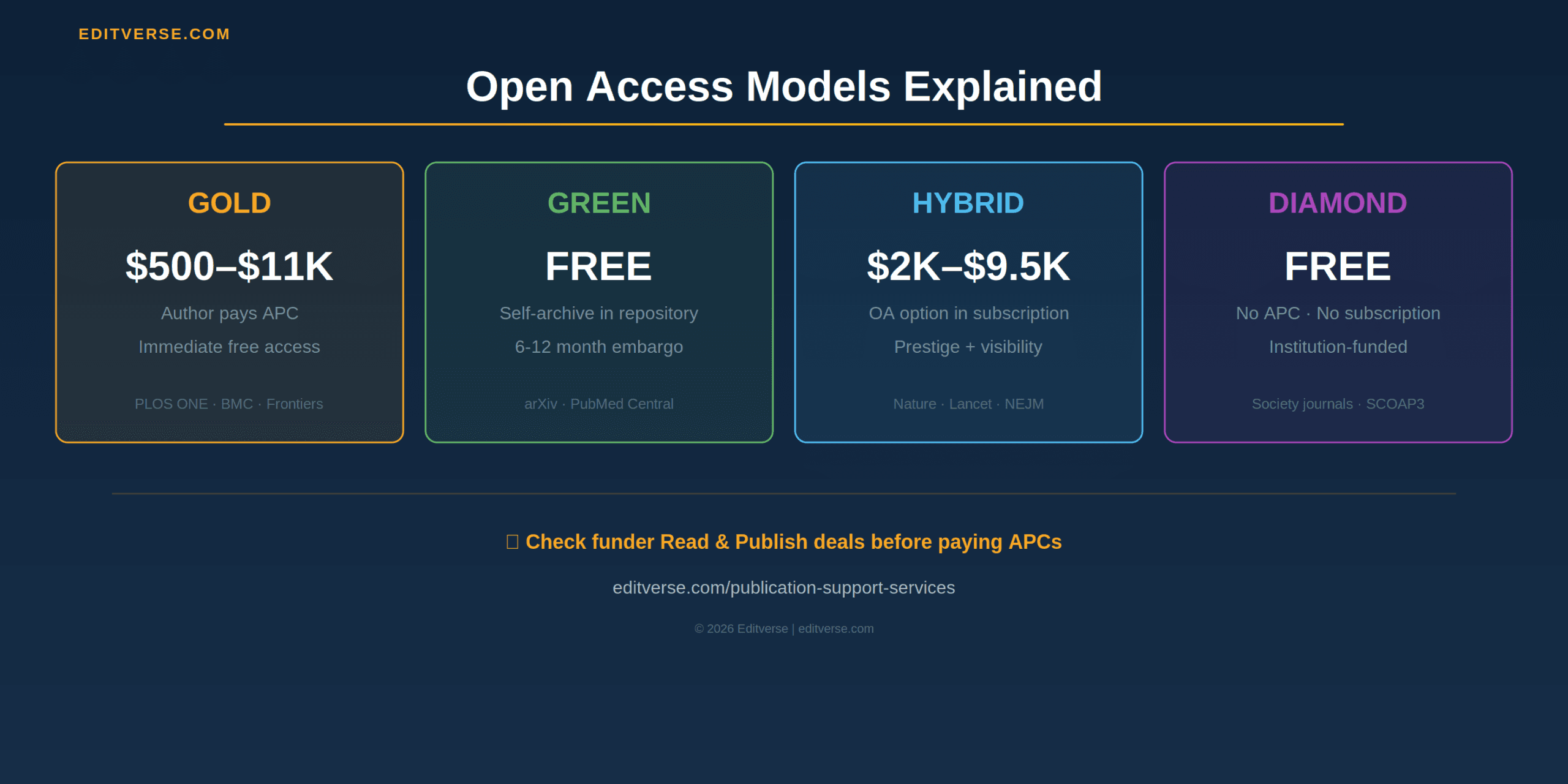
Gold Open Access: The article is freely available to all readers immediately upon publication. The author (or their institution/funder) pays an Article Processing Charge (APC). APCs in 2026 range from $500 for smaller journals to $11,000+ for journals like Nature and Cell.
Green Open Access: The article is published in a subscription journal, but the author self-archives a version (usually the accepted manuscript, not the final formatted version) in an institutional repository or preprint server after an embargo period (typically 6–12 months).
Hybrid Open Access: A subscription journal that offers authors the option to make their individual article open access by paying an APC. This gives the best of both worlds — a prestigious subscription journal with open access visibility — but is typically the most expensive option.
Diamond/Platinum Open Access: Articles are freely available with no APC charged to authors. These journals are funded by institutions, scholarly societies, or consortia. Examples include many society journals in the humanities and social sciences. This model is growing rapidly in 2026.
APC Cost Ranges by Discipline (2026)
| Discipline | Typical APC Range (Gold OA) | Top-Tier APC |
|---|---|---|
| Biomedical / Clinical Medicine | $1,500 – $3,500 | $5,000 – $11,000+ |
| Engineering / Computer Science | $1,000 – $2,500 | $3,000 – $5,000 |
| Social Sciences / Psychology | $800 – $2,000 | $2,500 – $4,000 |
| Humanities / Arts | $0 – $1,500 | $2,000 – $3,000 |
Important: Always check whether your funder or institution has transformative agreements (Read & Publish deals) with specific publishers — these can cover APCs entirely. Many universities in the US, UK, and EU now have such agreements with Elsevier, Springer Nature, Wiley, and Taylor & Francis.
For comprehensive guidance on navigating the publication process including APC management, explore Editverse’s Manuscript Writing Services which include journal selection consultation as part of end-to-end publication support.
Tip 9: Detect and Avoid Predatory Journals in 2026
Predatory journals represent one of the most serious threats to researchers’ careers and to the integrity of the scientific record. Publishing in a predatory journal can permanently damage your academic reputation, waste your APC investment, and result in work that is not recognized by hiring committees, grant agencies, or tenure boards.

Updated Red Flags for 2026
Predatory publishers have evolved significantly. The crude spam emails of the 2010s have given way to sophisticated operations that mimic legitimate publishers almost perfectly. Here are the red flags to watch for in 2026.
AI-generated editorial boards: Some predatory journals now use fictitious names with AI-generated profile photos and fabricated institutional affiliations. Always cross-check editorial board members by searching for them on Google Scholar, ORCID, or their listed institution’s website.
Fake peer review reports: A growing concern is predatory journals that send fake reviewer comments — sometimes generated by AI — to create the illusion of genuine peer review. If reviewer comments arrive suspiciously quickly (within days of submission) and lack substantive critique, this is a major red flag.
Misrepresented metrics: Some predatory journals display fake or misleading metrics on their websites, such as fabricated Impact Factors from non-existent indexing bodies (e.g., “Universal Impact Factor,” “Global Impact Factor”). Legitimate Impact Factors come only from Clarivate’s Journal Citation Reports.
Legitimate Journal vs. Predatory Journal: How to Tell the Difference
| Feature | Legitimate Journal | Predatory Journal |
|---|---|---|
| Indexing | Verifiable in Scopus, WoS, PubMed, or DOAJ | Claims indexing but not verifiable |
| Peer Review | Detailed, takes 2–12 weeks | Superficial or absent, days only |
| Editorial Board | Verifiable academics with relevant expertise | Unverifiable, broad/irrelevant expertise |
| APCs | Transparent, disclosed before submission | Hidden until acceptance; aggressive invoicing |
| COPE Membership | Yes (verifiable) | Rarely; may falsely claim membership |
| Solicitation | Does not send mass solicitation emails | Frequent, flattering emails inviting submission |
| Guarantees | Never guarantees acceptance | Promises fast or guaranteed publication |
Verification Tools
Use the Think. Check. Submit. checklist — a free tool developed by a coalition of publishers, librarians, and researchers specifically to help authors identify trusted journals. Additionally, check the DOAJ for open access journals and verify directly on the Clarivate Master Journal List and Scopus Sources for indexing claims.
Working with a professional manuscript editing service like Editverse also provides an additional layer of protection, as our team routinely verifies journal legitimacy as part of pre-submission checks.
Tip 10: Use Pre-Submission Inquiry as a Strategic Advantage
A pre-submission inquiry is a brief, professional email sent to a journal’s editor-in-chief before formally submitting your manuscript. Its purpose is to gauge whether the editor considers your work a potential fit for the journal — saving you weeks or months of waiting for a formal review decision.
When to Use a Pre-Submission Inquiry
Pre-submission inquiries are most valuable in these situations: when you are targeting a highly selective journal (acceptance rate below 15%); when your paper is at the boundary of the journal’s scope (it might fit, but you are not sure); when your study is time-sensitive and you cannot afford to wait months for a desk rejection; or when you are considering a journal you have not published in before and want to establish initial contact with the editorial team.
Pre-Submission Inquiry Email Template
Subject Line: Pre-Submission Inquiry: [Abbreviated Title of Your Study]
Dear Professor [Editor’s Name],
I am writing to inquire whether [Journal Name] would consider a manuscript entitled “[Full Title of Your Paper]” for potential publication.
Background and novelty: [2–3 sentences describing what your study addresses and what is new about it.]
Methods and key findings: [2–3 sentences summarizing your study design, sample, and main results.]
Significance: [1–2 sentences explaining why these findings matter to the journal’s readership.]
The manuscript is currently [under preparation / ready for submission] and has not been submitted to or published in any other journal. We believe it aligns with [Journal Name]’s focus on [specific aspect of the journal’s scope].
We would appreciate your feedback on whether this manuscript would be suitable for consideration at [Journal Name].
Thank you for your time and consideration.
Sincerely,
[Your Full Name]
[Your Affiliation]
[Email]
Bonus: The Complete Journal Selection Checklist for 2026
Use this checklist before submitting your manuscript to any journal. Every “Yes” answer increases your chances of acceptance and a positive publication experience.
| # | Checklist Item | Your Answer |
|---|---|---|
| 1 | Does your manuscript topic match the journal’s stated aims and scope? | ☐ Yes / ☐ No |
| 2 | Does the journal accept your manuscript type (original article, review, case report, etc.)? | ☐ Yes / ☐ No |
| 3 | Is the journal indexed in Scopus, Web of Science, PubMed, or DOAJ? | ☐ Yes / ☐ No |
| 4 | Have you verified the journal is NOT on known predatory journal lists? | ☐ Yes / ☐ No |
| 5 | Does the journal’s target audience match your intended readership? | ☐ Yes / ☐ No |
| 6 | Are the APCs (if applicable) within your budget or covered by your funder/institution? | ☐ Yes / ☐ No |
| 7 | Does the journal’s publication timeline meet your deadline requirements? | ☐ Yes / ☐ No |
| 8 | Does the journal comply with your funder’s OA mandate (Plan S, NIH, Horizon Europe)? | ☐ Yes / ☐ No |
| 9 | Have you read 3–5 recent articles from this journal to confirm style and quality fit? | ☐ Yes / ☐ No |
| 10 | Have you prepared a ranked shortlist of 3–5 backup journals in case of rejection? | ☐ Yes / ☐ No |
Common Journal Selection Mistakes to Avoid
Even experienced researchers make journal selection errors. Here are the most costly mistakes — and how to avoid them.
Mistake 1: Submitting to multiple journals simultaneously. This violates the ethical standards of virtually every academic journal. Simultaneous submission can result in retraction, blacklisting by publishers, and serious reputational damage. Always submit to one journal at a time, and wait for a final decision before submitting elsewhere.
Mistake 2: Chasing Impact Factor at the expense of fit. Submitting to a journal with a high Impact Factor but poor scope match almost always results in desk rejection. A well-placed paper in a mid-tier specialty journal with the right audience will accumulate more citations over time than a paper that gets desk-rejected from three prestigious journals before finally landing in a fourth.
Mistake 3: Ignoring author guidelines. Every journal has specific formatting requirements — word count limits, reference styles, figure specifications, and ethical disclosure formats. Submitting a manuscript that does not conform to these guidelines signals to editors that you have not done your homework, and it can trigger an immediate rejection.
Mistake 4: Not having backup journals ready. Rejection is a normal part of academic publishing. Having a ranked list of 3–5 alternative journals ready means you can quickly reformat and resubmit without losing momentum. Plan your “journal cascade” before you submit for the first time.
Mistake 5: Overlooking special issues and calls for papers. Many journals publish themed special issues with dedicated calls for papers. These often have higher acceptance rates than regular submissions because the editorial team is actively seeking content on that specific topic. Monitor relevant journals’ websites and sign up for email alerts.
For researchers who want expert support in avoiding these pitfalls, Editverse’s publication support team provides end-to-end guidance — from journal selection through submission and revision response.
Frequently Asked Questions About Journal Selection
How long does it take to select the right journal?
Budget at least one to two weeks for thorough journal selection. This includes using journal finder tools, reading recent issues, verifying indexing, checking author guidelines, and potentially sending pre-submission inquiries. Rushing this process often leads to poor choices and wasted months on inappropriate submissions.
Can I submit my manuscript to two journals at the same time?
No. Simultaneous submission is considered a serious ethical violation in academic publishing. All major publishers and ethical guidelines, including those from COPE and ICMJE, prohibit submitting the same manuscript to more than one journal at the same time. Always wait for a formal rejection (or withdraw your submission) before submitting to another journal.
What should I do if my paper gets desk-rejected?
First, read the rejection letter carefully — it often contains useful feedback. If the rejection was due to scope mismatch, move to the next journal on your ranked shortlist. If the editor cited quality concerns, consider revising your manuscript before resubmitting. Desk rejection is not a reflection of your research quality — it is often simply a signal that the journal was not the right fit.
How do I know if a journal is predatory?
Check for indexing in Scopus, Web of Science, PubMed, or DOAJ. Verify COPE membership. Search for the editorial board members on Google Scholar. Use the Think. Check. Submit. checklist. If a journal guarantees acceptance, charges hidden fees, or sends unsolicited flattering emails, these are strong indicators of a predatory operation.
Should early-career researchers aim for high-impact journals?
Not necessarily. Early-career researchers should prioritize journals where their work fits best and where publication is realistic. Building a consistent track record with 5–10 solid publications in respected specialty journals is far more valuable for career progression than a single high-profile publication surrounded by years of desk rejections. As your portfolio grows, you can gradually target higher-impact venues.
What are the best journal finder tools available for free?
The best free journal finder tools include Elsevier Journal Finder, Springer Nature Journal Suggester, Taylor & Francis Journal Suggester, JANE (Journal/Author Name Estimator), JournalGuide, and Wiley Journal Finder. Each tool searches its own publisher’s database, so use multiple tools for the most comprehensive results. For a publisher-neutral search, JANE (which searches all PubMed-indexed journals) is particularly useful.
Conclusion: Your Journal Selection Strategy Starts Now
Effective journal selection is not a single decision — it is a strategic process that begins before you write your manuscript and continues through your entire publication journey. By following the 10 tips in this guide — from matching your scope and evaluating metrics beyond Impact Factor, to using AI-powered journal finder tools, verifying indexing, and leveraging pre-submission inquiries — you can dramatically reduce your rejection rate, accelerate your time to publication, and maximize the impact of your research.
Remember: the best journal for your paper is not necessarily the one with the highest Impact Factor. It is the one where your research reaches the right audience, receives meaningful peer review, and contributes to the scholarly conversation in your field.
Need Expert Help With Journal Selection?
Editverse’s publication specialists analyze your manuscript, recommend the 3–5 best-fit journals, and guide you through the entire submission process — from formatting to revision response.
Related Editverse Resources
→ Journal Metrics and Article Metrics Explained: A Complete Guide
→ What Are Publication Support Services? How to Take Advantage in 2026
→ How to Choose Ethical Manuscript Writing Services (2026)
→ How Systematic Reviews Accelerate H-Index Growth
→ PRISMA 2020 Guidelines: Complete Checklist
→ Systematic Review vs Meta-Analysis: Key Differences
→ Propensity Score Matching Tutorial
→ Publication Support Services
→ Manuscript Writing Services
→ Manuscript Editing Services
→ Citation Booster Services
References
- Sánchez-Carbonell, J., García-Sancho, J.C., & Garrocho-Rangel, A. (2023). How to select a journal for your research. World Journal of Methodology, 13(3), 152–160. https://doi.org/10.5662/wjm.v13.i3.152
- Welch, S.J. (2019). Selecting a journal for your research: criteria to consider. The Journal of Emergency Medicine, 56(5), 570–573. https://doi.org/10.1016/j.jemermed.2019.01.035
- Grudniewicz, A., et al. (2019). Predatory journals: no definition, no defence. Nature, 576(7786), 210–212. https://doi.org/10.1038/d41586-019-03759-y
- Committee on Publication Ethics. (2024). COPE Guidelines for Ethical Editing. https://publicationethics.org/
- Think. Check. Submit. (2024). A checklist for trusted journals. https://thinkchecksubmit.org/