Editverse: How to Increase Your H-Index

How to Increase Your H-Index: 10 Proven Strategies for Researchers

Knowing how to increase your h-index is one of the most consequential skills an academic researcher can develop — yet most researchers rely on instinct rather than evidence. A 2023 bibliometric analysis published in Scientometrics found that researchers who apply deliberate citation strategies achieve h-index growth 2.3× faster than those who publish without a plan. Over the next 15 minutes, this guide will walk you…

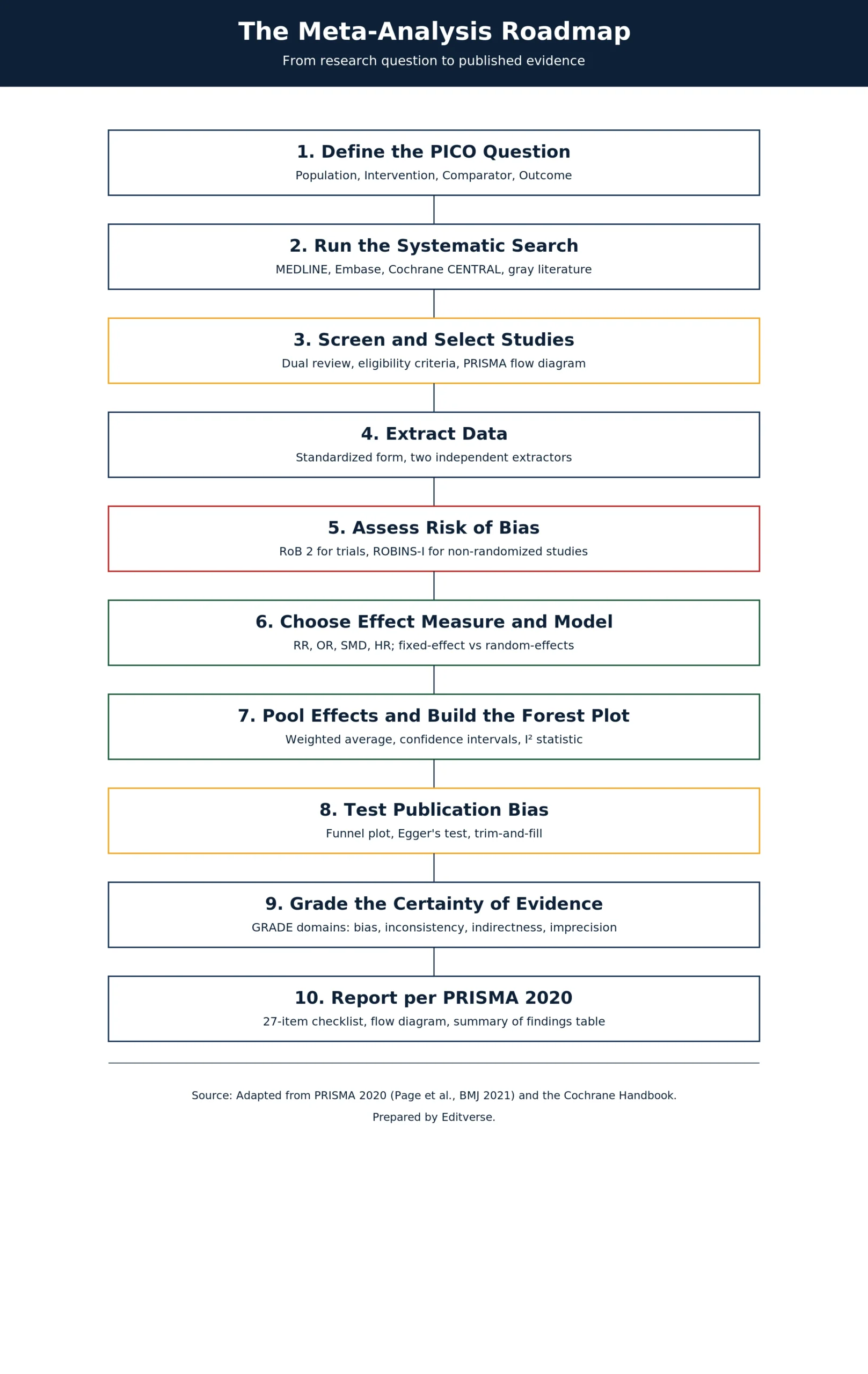
Meta-analysis roadmap flowchart showing 10 steps from PICO question to PRISMA 2020 reporting

How to Conduct a Meta-Analysis: Complete Step-by-Step Guide

TL;DR: A meta-analysis pools effect estimates from multiple studies into one weighted result. The twelve-step path runs from a PICO question through a systematic search, dual-reviewer screening with a PRISMA flow diagram, standardized data extraction, risk-of-bias assessment (RoB 2 or ROBINS-I), effect-measure selection, a random-effects or fixed-effect model, forest-plot pooling, heterogeneity (I²) and publication-bias testing (Egger’s test), GRADE certainty rating, and PRISMA 2020-compliant reporting. Free…

Editverse: STROBE Guidelines for Observational Studies

STROBE Guidelines Simplified: A Complete Tutorial for Reporting Observational Studies (2026)

An observational study can have a flawless design and still stumble in peer review if the write-up leaves out how confounders were handled, how participants were selected, or how much data went missing along the way. STROBE guidelines exist to close that gap for cohort, case-control, and cross-sectional research. STrengthening the Reporting of OBservational studies in Epidemiology, the checklist’s full name, gives authors a structured…

Editverse: Preprint Servers: bioRxiv vs medRxiv vs SSRN

Preprint Servers Explained: bioRxiv vs medRxiv vs SSRN – Complete Guide for Researchers (2026)

If you have ever finished a manuscript and wondered whether to share it before peer review, you have already been thinking about preprint servers. These platforms allow researchers to post their work publicly before — or alongside — formal journal submission, accelerating scientific communication in ways that traditional publishing simply cannot match. With major funders like the NIH now actively encouraging preprint deposition, and platforms…

Editverse: The MDPI Controversy Explained

The MDPI Controversy Explained: Is MDPI a Predatory Publisher? What Every Researcher Must Know (2026)

In simple wordsMDPI is a large open-access publisher that is not predatory in the classic sense, because it runs real peer review and is indexed in Web of Science and Scopus. But some national bodies have downgraded many of its journals, most recently Finland in December 2024. So the safe rule is to check the specific journal, today, against the list your funder uses. If…