
Published
Behind the 2026 award, the Nobel Prize in Physics papers trace a path from a 1988 preprint about polar ice to Science and Physical Review Letters articles signed by hundreds of authors.[1, 2, 3] Francis Halzen received the prize from the Royal Swedish Academy of Sciences for his contributions to the IceCube Neutrino Observatory and the discovery of high-energy neutrinos from astrophysical sources.[4]
Below are each paper’s identifiers, dates and citation counts, what it showed and at what significance, how the collaboration shares credit, the role of preprints, and lessons for your own manuscripts. For the prize story and the physics, read our guide to the Nobel Prize in Physics 2026 and IceCube.
Last verified 9 October 2026, against the official Nobel documents, PubMed, Crossref and OpenAlex.
Key Facts About the Nobel Prize in Physics Papers
- The Royal Swedish Academy of Sciences awarded the Nobel Prize in Physics 2026 to Francis Halzen, University of Wisconsin-Madison, as sole laureate on 6 October 2026, “for decisive contributions to the IceCube Neutrino Observatory and the discovery of high-energy neutrinos of astrophysical origin”.[4, 5]
- Barwick, Halzen et al., J Phys G 18(2):225-247, February 1992, doi:10.1088/0954-3899/18/2/008, not in PubMed. Citations, OpenAlex 33, Crossref 31.[6, 7]
- Andrés et al. (AMANDA), Nature 410(6827):441-443, 22 March 2001, doi:10.1038/35068509, PMID 11260705. Citations, OpenAlex 163, Crossref 140.[8]
- IceCube Collaboration, Phys Rev Lett 111(2):021103, online 8 July 2013, issue 12 July 2013, doi:10.1103/PhysRevLett.111.021103, PMID 23889381. Citations, OpenAlex 821, Crossref 659.[9]
- IceCube Collaboration, Science 342(6161):1242856, issue date 22 November 2013, doi:10.1126/science.1242856, PMID 24264993. Citations, OpenAlex 1,615, Crossref 1,237.[2]
- IceCube Collaboration, Phys Rev Lett 113(10):101101, online 2 September 2014, issue 5 September 2014, doi:10.1103/PhysRevLett.113.101101, PMID 25238345. Citations, OpenAlex 1,151, Crossref 875.[3]
- IceCube Collaboration and 15 other teams, Science 361(6398), article eaat1378, online 12 July 2018, issue 13 July 2018, doi:10.1126/science.aat1378, PMID 30002226. Citations, OpenAlex 1,115, Crossref 899.[10]
- IceCube Collaboration, Science 361(6398):147-151, issue 13 July 2018 (online 12 July per OpenAlex), doi:10.1126/science.aat2890, PMID 30002248. Citations, OpenAlex 1,081, Crossref 835.[11]
- IceCube Collaboration, Science 378(6619):538-543, online 3 November 2022, issue 4 November 2022, doi:10.1126/science.abg3395, PMID 36378962. Citations, OpenAlex 472, Crossref 422.[12]
- Citation counts were retrieved on 9 October 2026.[7]
In Simple Words
Big physics discoveries rarely sit in one paper, and the Nobel Prize in Physics papers show why. A 1992 article argued for a detector a kilometre across. In 2013, two very energetic neutrinos hinted that something was arriving from space, later that year 28 events made the case at 4 sigma, and in 2014 more data pushed it to 5.7 sigma, past the level the Nobel committee treats as a discovery. IceCube papers list the collaboration and hundreds of individual names.[6, 9, 2, 3, 13]
The Nobel Prize in Physics Papers at a Glance
Eight papers carry the IceCube story from proposal to source hunting, and the most cited of them is the 2013 Science evidence paper (OpenAlex, 9 October 2026).[7] Table 1 compares them.
| Paper | What it reported | Significance | Authors listed |
|---|---|---|---|
| Barwick et al. 1992, J Phys G[6] | Case for a detector on the square-kilometre scale | Not applicable (proposal) | 7 |
| AMANDA 2001, Nature[8] | High-energy atmospheric neutrinos seen with sensors in deep Antarctic ice | Not given in our sources | 119 |
| IceCube 2013, PRL[9] | Two events of 1.04 and 1.14 PeV | 2.8σ | 283 plus collaboration name (PubMed) |
| IceCube 2013, Science[2] | 28 events, 30 TeV to 1.14 PeV | 4σ against atmospheric-only origin | 277 plus collaboration name (PubMed) |
| IceCube 2014, PRL[3] | 37 events in three years | 5.7σ | 297 plus collaboration name (Crossref) |
| Multimessenger 2018, Science[10] | Neutrino IceCube-170922A and flaring blazar TXS 0506+056 | About 3σ against chance coincidence | 16 teams, about 1,001 entries (Crossref) |
| IceCube 2018, Science[11] | Archival neutrino flare from TXS 0506+056, 2014 to 2015 | 3.5σ | 331 entries (Crossref) |
| IceCube 2022, Science[12] | Excess of about 79 neutrinos from the direction of NGC 1068 | 4.2σ | 386 entries (Crossref) |
1992, Journal of Physics G: The Kilometre-Scale Proposal
Barwick, Halzen and five co-authors argued for neutrino astronomy on the square-kilometre scale in February 1992, a proposal the committee’s background cites in its account of IceCube.[6, 13]
Question. Could natural polar ice host a neutrino telescope large enough to see cosmic sources?
What they did. They built on Halzen and Learned’s June 1988 preprint on ice as both target and light medium, and on a 1991 Nature test, co-authored by Halzen, that recorded Cherenkov light from muons in Greenland boreholes.[1, 14, 13]
Significance. None applies, since this was a design argument rather than a measurement.
Where it was published. J Phys G Nucl Part Phys 18(2):225-247, seven authors. PubMed does not index it, and Crossref shows an online date of 1999 that reflects digitisation rather than publication.[6]
2001, Nature: AMANDA Shows That Ice Works
In its 22 March 2001 issue, Nature published AMANDA’s observation of high-energy neutrinos with detectors deep in Antarctic ice, which the committee presents as showing that detection in ice works at scale.[8, 13]
What they did. AMANDA was built in phases between 1993 and 2000. Air bubbles at 800 to 1,000 metres scattered light, so later strings went to 1,500 to 2,000 metres.[13, 15]
Result. The neutrinos it recorded were atmospheric neutrinos, not cosmic ones.[13]
Where it was published. Nature 410(6827):441-443, 119 authors, PMID 11260705.
Why it mattered. A year later, in March 2002, the NSF approved funding for IceCube.[13]
July 2013, Physical Review Letters: Two PeV Neutrinos
Titled First observation of PeV-energy neutrinos with IceCube, the paper reported two events of 1.04 and 1.14 PeV, the first hints of an astrophysical flux.[9, 13]
Question. Could IceCube find neutrinos at EeV energies, the so-called GZK neutrinos?
What they did. IceCube searched data from May 2010 to May 2012.[13]
Result. Two PeV events turned up instead, found by chance.[13]
Significance. 2.8σ. The abstract calls the pair a possible first indication of an astrophysical flux and says the data do not permit a definitive conclusion, while the committee’s background calls them the first evidence.[9, 13]
Where it was published. Phys Rev Lett 111(2):021103, published online 8 July 2013, issue date 12 July 2013, 283 individual authors plus the IceCube Collaboration in PubMed, PMID 23889381.
Why it mattered. Its title claims an observation of events, while the abstract stays cautious about their origin, a useful model for careful wording.
November 2013, Science: Evidence for Extraterrestrial Neutrinos
In the 22 November 2013 issue of Science, IceCube rejected a purely atmospheric origin for its highest-energy events at 4σ.[2]
What they did. Its analysis found 28 events between 30 TeV and 1.14 PeV, 21 cascades and 7 tracks.[13, 2]
Significance. 4σ, and the title uses the word evidence.[2]
Where it was published. Science 342(6161):1242856, PMID 24264993. PubMed lists 277 individual authors plus the collaboration, yet Crossref lists the collaboration as the sole author.[2]
Why it mattered. Physics World named IceCube’s 2013 observations its Breakthrough of the Year, and the paper now has the most OpenAlex citations in Table 1.[16, 7]
September 2014, Physical Review Letters: Observation at 5.7σ
Three years of data, 37 events and 988 days of live time raised the rejection of a purely atmospheric explanation to 5.7σ.[3]
Significance. 5.7σ, above the 5σ level the committee’s background treats as the discovery threshold, and the title moved from evidence to observation.[3, 13]
Where it was published. Phys Rev Lett 113(10):101101, published online 2 September 2014, issue date 5 September 2014, PMID 25238345.
Why it mattered. With the 2013 papers, it completes the sequence of first hints (mid-2013), evidence (November 2013) and a 5.7σ observation (2014) behind the discovery named in the prize motivation.[4, 13]
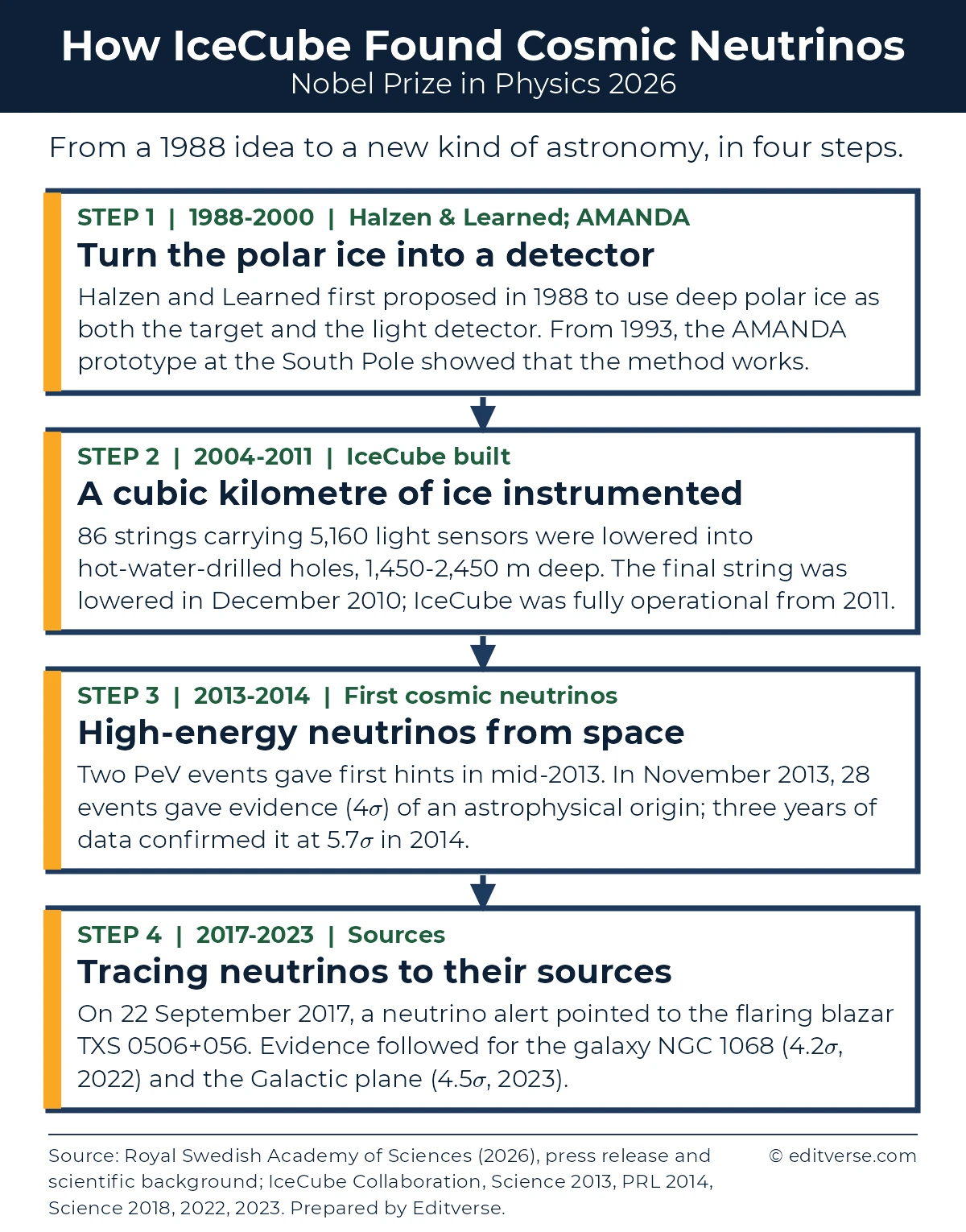
July 2018, Science: Two Papers on the Blazar TXS 0506+056
Science released two linked papers on 12 July 2018 (issue date 13 July 2018), one on the follow-up of neutrino IceCube-170922A and one on an earlier neutrino flare from the same blazar.[10, 11]
What they did. On 22 September 2017, IceCube recorded a muon neutrino of about 290 TeV and sent an alert worldwide within a minute. Its best-fit direction lay about 0.1 degrees from TXS 0506+056, a blazar flaring in gamma rays.[10, 13] Searching archival data, the second paper found a neutrino flare from that direction between September 2014 and March 2015.[11]
Significance. 3.5σ for the archival flare.[13, 11]
Where it was published. Science 361(6398), articles eaat1378 (PMID 30002226) and 147-151 (PMID 30002248). Article eaat1378 lists IceCube with 15 other teams, from Fermi-LAT to VLA/17B-403.[10]
Why it mattered. Real-time alerts turned a single neutrino into a multi-team campaign.[13]
November 2022, Science: Evidence from NGC 1068
After testing 110 gamma-ray source positions, IceCube reported an excess of about 79 neutrinos of 1 to 10 TeV from the direction of the active galaxy NGC 1068.[12, 13]
Significance. 4.2σ. Its title says evidence, and the Nobel popular background says the result is not robust enough to identify NGC 1068 definitively as a source.[12, 15]
Where it was published. Science 378(6619):538-543, published online 3 November 2022, issue date 4 November 2022, PMID 36378962.
Why it mattered. Weak gamma rays relative to the neutrino flux favour neutrino production near the galaxy’s dust-wrapped black hole.[13]
Who Gets Credit? Authorship on the Nobel Prize in Physics Papers
Across the Nobel Prize in Physics papers, IceCube results carry the collaboration’s name and hundreds of individual authors, while the Nobel Prize went to one person.[2, 4]
Author lists grew with the project, from 7 names on the 1992 proposal and 119 on the 2001 AMANDA paper to 283 individual authors on the July 2013 PRL in PubMed and 428 entries (427 people plus the collaboration) on the March 2026 PRL.[6, 8, 9, 18] The 2018 multimessenger paper credits 16 teams, and Crossref lists about 1,001 contributor entries for it.[10] Today the collaboration counts about 450 people from 58 institutions in 14 countries.[13, 19]
In PubMed and Crossref records, the 2013 lists run from Aartsen to Zoll and the 2022 list from Abbasi to Zhelnin, which reads as alphabetical order. We have not verified IceCube’s written authorship policy.[9, 2, 12] Prizes split credit in different ways too. Physics World honoured the observatory team in 2013, the 2021 Bruno Rossi Prize went to Halzen and the IceCube Collaboration, and the Nobel Prize named Halzen alone.[16, 20, 5]
Metadata can mislead. Crossref lists only the collaboration on the 2013 Science paper while PubMed lists 277 individual names, and Crossref shows a single author for the 2000 AMANDA paper, where INSPIRE lists 67.[2, 21] Agree authorship rules early, use one consortium name consistently, and check how databases display your paper.
Preprints and arXiv in the IceCube Story
Preprints bracket the Nobel Prize in Physics papers. The idea first appeared in a 1988 preprint, and one of the newest results the committee cites is a 2026 arXiv preprint.[1, 22, 13]
Halzen and Learned’s June 1988 preprint carries the report numbers MAD/PH/428 and UH-511-659-88 and has no DOI, yet the Nobel background cites it.[1, 13] At the other end, IceCube reported Galactic-plane neutrinos at 4.5σ in the peer-reviewed Science paper of 30 June 2023 (online 29 June).[17] A 12-year update posted as arXiv:2607.25966 on 28 July 2026 reports Galactic-plane emission at 5.7σ, and a further study in the same preprint finds 217 shower events above 5 TeV from the inner Galaxy against an expected background of 154.4 ± 4.1.[22] We found no journal version as of 9 October 2026, so cite it as a preprint.
arXiv lists 2,871 e-prints from 2000 to 2025 whose abstract contains IceCube, counted by year of first submission and including conference proceedings.[23] When you cite a preprint, give the arXiv identifier and date, label it as a preprint, and update the reference once a journal version appears. Our guide to preprint servers for researchers covers posting and citing.
Research Output Around the Nobel Prize in Physics Papers, 2000 to 2025
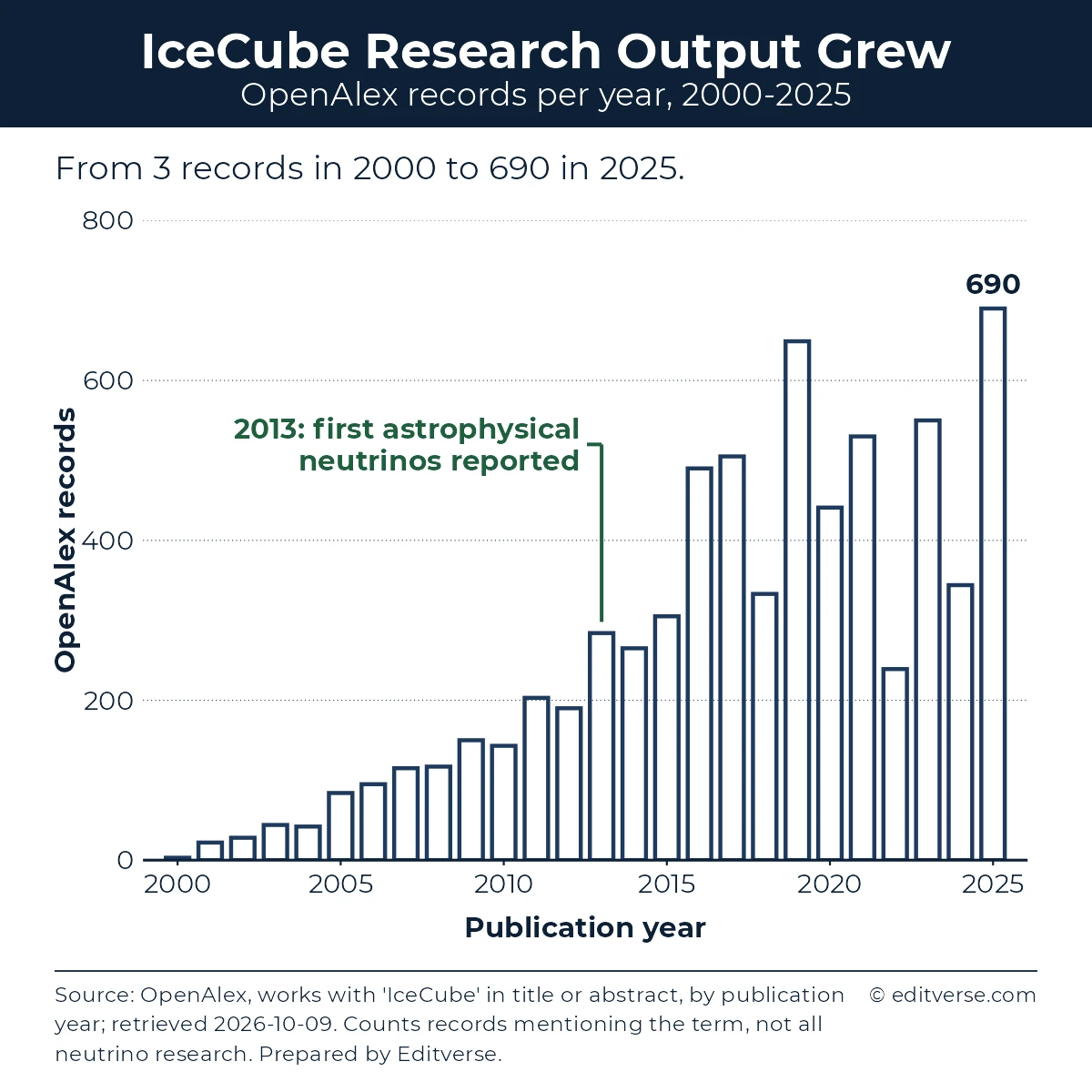
OpenAlex indexes 3 works from 2000 whose title or abstract matches IceCube, 284 from 2013 and 690 from 2025, 6,861 in total (Figure 2, Table 2).[24] Counts swing from year to year, with peaks in odd years since 2019 that match the biennial International Cosmic Ray Conference, for which OpenAlex lists 125, 148, 161 and 142 proceedings records in 2019, 2021, 2023 and 2025. The counts also include arXiv preprints and alert notices such as GCN Circulars.[25]
| Year | Works | Year | Works |
|---|---|---|---|
| 2000 | 3 | 2013 | 284 |
| 2001 | 22 | 2014 | 265 |
| 2002 | 28 | 2015 | 305 |
| 2003 | 44 | 2016 | 490 |
| 2004 | 42 | 2017 | 505 |
| 2005 | 84 | 2018 | 333 |
| 2006 | 95 | 2019 | 649 |
| 2007 | 115 | 2020 | 441 |
| 2008 | 117 | 2021 | 530 |
| 2009 | 150 | 2022 | 239 |
| 2010 | 143 | 2023 | 550 |
| 2011 | 203 | 2024 | 344 |
| 2012 | 190 | 2025 | 690 |
Lessons From the Nobel Prize in Physics Papers for Your Own Manuscripts
State the significance and choose title words to match
IceCube titled its 2.8σ letter of July 2013 a first observation of PeV-energy neutrinos.[9] Its titles used evidence at 4σ (2013) and 4.2σ (2022), and observation at 5.7σ (2014) and at 4.5σ for the Galactic plane (2023).[2, 12, 3, 17] Title words alone do not map to one threshold, so put the σ value in the abstract.
Publish the instrument as a paper
IceCube’s 2017 instrumentation paper in the Journal of Instrumentation has 816 OpenAlex and 555 Crossref citations.[26, 7] A methods or detector paper gives others a single reference to cite.
Pair a short letter with a long companion
In March 2026, IceCube published a Physical Review Letters paper and a longer Physical Review D paper on the same spectrum analysis, both online on 26 March.[18, 27]
Copy identifiers exactly
The 2026 APS papers use non-semantic DOI suffixes such as 10.1103/2gh9-d4q7, and a lookalike of the DOI for Halzen’s 2017 Nature Physics review, 10.1038/nphys4057, belongs to an unrelated article.[18, 27, 28] Online and issue dates also differ, as with the 2013 PRL (8 and 12 July).
Cite work outside PubMed with its DOI
The 1991 Nature test, the 1992 J Phys G proposal, the 2017 JINST paper and the 2026 PRD paper are not in PubMed, and each can be cited with standard details plus its DOI.[14, 6, 26, 27] Our guide to SCI, SCIE and ESCI indexing explains how coverage differs.
Name the database with every citation count
OpenAlex gives the 2013 Science paper 1,615 citations and Crossref gives 1,237 on the same day.[7] See our strategies for increasing your paper's citations and field-specific h-index norms.
More from the 2026 Nobel Prizes. Read our Nobel Prize in Medicine 2026 guide to optogenetics, the companion piece on the papers behind the optogenetics Nobel Prize, and our flagship guide to the Nobel Prize in Physics 2026.
Professional Services for Your Own High-Impact Physics Paper
Clear significance statements, exact identifiers and the right journal matter for any manuscript, as the Nobel Prize in Physics papers show. Editverse supports each step.
Journal Selection
$115
Expert journal selection with 5 to 10 ranked journal suggestions and the rationale for each, covering scope, impact factor and acceptance rate.
Premium Scientific Editing
$750
Full technical editing, figures and tables review, and re-submission support for top-tier journals. 90 days of unlimited revisions.
Data Visualization
$300
Up to 10 publication-ready figures prepared from your research data.
Cover Letter
$25
A journal-customised cover letter that states your contribution clearly. 2 to 3 business days.
For venue strategy, read our guides to publishing in Nature and other high-impact journals and selecting a journal in 2026.
- GraphPro: build publication-ready charts, 25 types, with built-in t-test, ANOVA, correlation, and chi-square p-values. Free, no signup.
- StatPro: free statistical calculators and a test-selector tool covering group comparisons, categorical outcomes, time-to-event analysis, and diagnostic accuracy.
- Flowchart Pro: generate PRISMA 2020, PRISMA-ScR, CONSORT, STROBE, STARD, MOOSE, and ARRIVE flow diagrams directly in your browser.
Related Editverse Resources
- Nobel Prize in Physics 2026: IceCube and Neutrinos from Space, Explained
- Gravitational Waves: A New Window to the Universe
- Nature Portfolio Journals Explained (2026)
- Journal Citation Reports 2026
- Journal Rejection Rate by Field: 2025 Data Analysis
- Crafting Compelling Cover Letters for Journal Submissions
Frequently Asked Questions About the Nobel Prize in Physics Papers
Which papers led to the Nobel Prize in Physics 2026?
The committee cites a chain of papers. Key ones are the 1992 kilometre-scale proposal in the Journal of Physics G, AMANDA’s 2001 Nature paper, IceCube’s 2013 Physical Review Letters and Science papers, the 2014 Physical Review Letters observation at 5.7 sigma, and the 2018 and 2022 Science papers on TXS 0506+056 and NGC 1068.[13]
What does 5.7 sigma mean in the IceCube papers?
Sigma expresses how strongly the data disfavour a background-only explanation. In 2014 IceCube rejected a purely atmospheric origin for its 37 events at 5.7 sigma, above the 5 sigma level the Nobel committee’s background calls the discovery threshold.[3, 13]
How many authors are on IceCube papers?
Hundreds. PubMed lists 277 individual authors plus the IceCube Collaboration on the 2013 Science paper and 283 plus the collaboration on the July 2013 Physical Review Letters paper, and the 2018 multimessenger paper credits IceCube and 15 other teams.[2, 9, 10]
Are the IceCube papers indexed in PubMed?
The Physical Review Letters and Science papers have PMIDs, but the 1991 Nature paper, the 1992 Journal of Physics G paper, the 2017 JINST paper and the 2026 Physical Review D paper are not in PubMed. They can still be cited with standard details plus their DOI.[14, 6, 26, 27]
Is the Milky Way neutrino result peer reviewed?
The 2023 Science paper reporting Galactic-plane neutrinos at 4.5 sigma is peer reviewed. The 12-year update at 5.7 sigma, arXiv:2607.25966 from 28 July 2026, is a preprint, and we found no journal version as of 9 October 2026.[17, 22]
Which IceCube paper is cited most?
Among the papers in this article, the 2013 Science paper reporting evidence for high-energy extraterrestrial neutrinos has the most citations, 1,615 in OpenAlex and 1,237 in Crossref as of 9 October 2026.[7]
How to Cite This Article
Editverse. (2026, October 9). The papers behind the 2026 Nobel Prize in Physics: How IceCube published its discoveries. Editverse. https://editverse.com/icecube-nobel-prize-physics-papers-behind-the-discovery/
References
- Halzen F, Learned JG. High-energy neutrino detection in deep polar ice. Preprint MAD/PH/428 (University of Wisconsin) and UH-511-659-88 (University of Hawaii). 1988 Jun. No DOI. INSPIRE record: https://inspirehep.net/literature/262563
- IceCube Collaboration, Aartsen MG, et al. Evidence for high-energy extraterrestrial neutrinos at the IceCube detector. Science. 2013 Nov 22;342(6161):1242856. doi:10.1126/science.1242856. DOI link | PMID: 24264993. PubMed
- IceCube Collaboration, Aartsen MG, Ackermann M, et al. Observation of high-energy astrophysical neutrinos in three years of IceCube data. Phys Rev Lett. 2014 Sep 5;113(10):101101. Published online 2014 Sep 2. doi:10.1103/PhysRevLett.113.101101. DOI link | PMID: 25238345. PubMed
- Royal Swedish Academy of Sciences. Press release: The Nobel Prize in Physics 2026 [Internet]. Stockholm: Royal Swedish Academy of Sciences; 2026 Oct 6 [cited 2026 Oct 9]. Available from: https://www.nobelprize.org/uploads/2026/10/press-physicsprize2026.pdf
- Nobel Prize Outreach. Francis Halzen, facts, the Nobel Prize in Physics 2026 [Internet]. NobelPrize.org; 2026 [cited 2026 Oct 9]. Available from: https://www.nobelprize.org/prizes/physics/2026/halzen/facts/
- Barwick S, Halzen F, Lowder D, Miller T, Morse R, Price PB, et al. Neutrino astronomy on the 1 km2 scale. J Phys G Nucl Part Phys. 1992 Feb;18(2):225-247. doi:10.1088/0954-3899/18/2/008. DOI link (not indexed in PubMed)
- OpenAlex and Crossref. Citation counts for the IceCube papers listed in this article, retrieved 2026 Oct 9. OpenAlex records include W1530183786 (Science 2013) and W2588745414 (JINST 2017). Available from: api.openalex.org/works/W1530183786, api.openalex.org/works/W2588745414 and api.crossref.org/works/10.1126/science.1242856
- Andrés E, Askebjer P, et al. Observation of high-energy neutrinos using Čerenkov detectors embedded deep in Antarctic ice. Nature. 2001 Mar 22;410(6827):441-443. doi:10.1038/35068509. DOI link | PMID: 11260705. PubMed
- IceCube Collaboration, Aartsen MG, et al. First observation of PeV-energy neutrinos with IceCube. Phys Rev Lett. 2013 Jul 12;111(2):021103. Published online 2013 Jul 8. doi:10.1103/PhysRevLett.111.021103. DOI link | PMID: 23889381. PubMed
- IceCube Collaboration, Fermi-LAT, MAGIC, AGILE, ASAS-SN, HAWC, H.E.S.S., INTEGRAL, Kanata, Kiso, Kapteyn, Liverpool Telescope, Subaru, Swift/NuSTAR, VERITAS, VLA/17B-403 teams. Multimessenger observations of a flaring blazar coincident with high-energy neutrino IceCube-170922A. Science. 2018 Jul 13;361(6398):eaat1378. Published online 2018 Jul 12. doi:10.1126/science.aat1378. DOI link | PMID: 30002226. PubMed
- IceCube Collaboration, Aartsen M, et al. Neutrino emission from the direction of the blazar TXS 0506+056 prior to the IceCube-170922A alert. Science. 2018 Jul 13;361(6398):147-151. doi:10.1126/science.aat2890. DOI link | PMID: 30002248. PubMed
- IceCube Collaboration, Abbasi R, et al. Evidence for neutrino emission from the nearby active galaxy NGC 1068. Science. 2022 Nov 4;378(6619):538-543. Published online 2022 Nov 3. doi:10.1126/science.abg3395. DOI link | PMID: 36378962. PubMed
- Nobel Committee for Physics. Scientific background to the Nobel Prize in Physics 2026 [Internet]. Stockholm: Royal Swedish Academy of Sciences; 2026 Oct 6 [cited 2026 Oct 9]. Available from: https://www.nobelprize.org/uploads/2026/10/advanced-physicsprize2026.pdf
- Lowder DM, Miller T, Price PB, Westphal A, Barwick SW, Halzen F, et al. Observation of muons using the polar ice cap as a Cerenkov detector. Nature. 1991 Sep;353(6342):331-333. doi:10.1038/353331a0. DOI link (not indexed in PubMed)
- Royal Swedish Academy of Sciences. Popular science background: Ice at the South Pole reveals cosmic particle accelerators [Internet]. Stockholm: Royal Swedish Academy of Sciences; 2026 Oct 6 [cited 2026 Oct 9]. Available from: https://www.nobelprize.org/uploads/2026/10/popular-physicsprize2026.pdf
- Johnston H. Cosmic neutrinos named Physics World 2013 Breakthrough of the Year [Internet]. Physics World; 2013 Dec 13 [cited 2026 Oct 9]. Available from: https://physicsworld.com/a/cosmic-neutrinos-named-physics-world-2013-breakthrough-of-the-year
- IceCube Collaboration, Abbasi R, et al. Observation of high-energy neutrinos from the Galactic plane. Science. 2023 Jun 30;380(6652):1338-1343. Published online 2023 Jun 29. doi:10.1126/science.adc9818. DOI link | PMID: 37384687. PubMed
- IceCube Collaboration, Abbasi R, Ackermann M, et al. Evidence for a spectral break or curvature in the spectrum of astrophysical neutrinos from 5 TeV to 10 PeV. Phys Rev Lett. 2026;136(12):121002. Published online 2026 Mar 26. doi:10.1103/2gh9-d4q7. DOI link | PMID: 41965033. PubMed
- IceCube Neutrino Observatory. Francis Halzen, IceCube principal investigator, wins 2026 physics Nobel Prize [Internet]. Madison (WI): University of Wisconsin-Madison; 2026 Oct 6 [cited 2026 Oct 9]. Available from: https://icecube.wisc.edu/news/awards/2026/10/francis-halzen-icecube-principal-investigator-wins-2026-physics-nobel-prize/
- IceCube Neutrino Observatory. IceCube Collaboration awarded 2021 Rossi Prize [Internet]. Madison (WI): University of Wisconsin-Madison; 2021 Jan 13 [cited 2026 Oct 9]. Available from: https://icecube.wisc.edu/news/awards/2021/01/icecube-collaboration-awarded-2021-rossi-prize/
- AMANDA Collaboration, Andres E, Askebjer P, et al. The AMANDA neutrino telescope: principle of operation and first results. Astropart Phys. 2000 Mar;13(1):1-20. doi:10.1016/S0927-6505(99)00092-4. DOI link (not indexed in PubMed)
- IceCube Collaboration. High-energy neutrino emission from the Milky Way [preprint]. arXiv:2607.25966. 2026 Jul 28 [cited 2026 Oct 9]. Not peer reviewed as far as verified. Available from: https://arxiv.org/abs/2607.25966
- arXiv. Advanced search for e-prints whose abstract contains IceCube, all categories including cross-lists, by year of first-version submission, 2000 to 2025 [Internet]. [cited 2026 Oct 9]. Available from: arxiv.org advanced search (abstract contains IceCube, year 2025)
- OpenAlex. Works per publication year matching filter title_and_abstract.search:icecube, 2000 to 2025 (meta.count) [Internet]. [cited 2026 Oct 9]. Available from: https://api.openalex.org/works?filter=title_and_abstract.search:icecube,publication_year:2025&per-page=1 (one query per year, changing the year value)
- OpenAlex. Works matching title_and_abstract.search:icecube grouped by primary source (group_by=primary_location.source.id), publication years 2019 to 2025 [Internet]. [cited 2026 Oct 9]. International Cosmic Ray Conference records 125 (2019), 148 (2021), 161 (2023) and 142 (2025). Available from: https://api.openalex.org/works?filter=title_and_abstract.search:icecube,publication_year:2019&group_by=primary_location.source.id (one query per year)
- IceCube Collaboration, Aartsen MG, et al. The IceCube Neutrino Observatory: instrumentation and online systems. J Instrum. 2017 Mar 14;12(03):P03012. doi:10.1088/1748-0221/12/03/P03012. DOI link (not indexed in PubMed)
- IceCube Collaboration, Abbasi R, Ackermann M, et al. Improved measurements of the TeV-PeV extragalactic neutrino spectrum from joint analyses of IceCube tracks and cascades. Phys Rev D. 2026;113(6):062002. Published online 2026 Mar 26. doi:10.1103/4n6v-r7n4. DOI link (not indexed in PubMed)
- Halzen F. High-energy neutrino astrophysics. Nat Phys. 2017 Mar;13(3):232-238. Published online 2016 Jul 4. doi:10.1038/nphys3816. DOI link (not indexed in PubMed)