
Three short journal articles, published between June 2002 and August 2005, form the core of the 2026 Nobel Prize in Physiology or Medicine. Georg Nagel, Peter Hegemann and Ernst Bamberg described channelrhodopsin-1 in Science in 2002 and channelrhodopsin-2 in PNAS in 2003, and in 2005 Karl Deisseroth’s group, with Nagel and Bamberg as co-authors, showed in Nature Neuroscience that the second protein could make neurons fire on command [1, 2]. Read as publications, the Nobel Prize optogenetics papers teach as much about writing as about the brain.
Below are each paper’s identifiers, citations and findings, the field’s growth, and seven publication lessons. For the prize story itself, see our guide to the 2026 Nobel Prize in Medicine for optogenetics, and for the science, our explainer on how optogenetics controls the brain with light.
Last verified: 7 October 2026, against the official Nobel documents, PubMed, Crossref and OpenAlex.
Key facts about the Nobel Prize optogenetics papers
- The Nobel Assembly at Karolinska Institutet announced on 5 October 2026 that Karl Deisseroth, Peter Hegemann and Georg Nagel share the 2026 Nobel Prize in Physiology or Medicine “for their discoveries concerning light-gated ion channels and optogenetics” (press release) [1].
- Nagel, Ollig, Fuhrmann, Kateriya, Musti, Bamberg and Hegemann reported channelrhodopsin-1 in Science 296(5577):2395-2398, published 28 June 2002 (PMID 12089443, DOI 10.1126/science.1072068), and OpenAlex counted 1,190 citations to it as of 7 October 2026 [3, 4].
- Nagel, Szellas, Huhn, Kateriya, Adeishvili, Berthold, Ollig, Hegemann and Bamberg reported channelrhodopsin-2 in PNAS 100(24):13940-13945, published online 13 November 2003, issue date 25 November 2003 (PMID 14615590, DOI 10.1073/pnas.1936192100), with 2,753 OpenAlex citations as of 7 October 2026 [5, 4].
- Boyden, Zhang, Bamberg, Nagel and Deisseroth reported light control of neurons in Nature Neuroscience 8(9):1263-1268, published online 14 August 2005 (PMID 16116447, DOI 10.1038/nn1525), with 5,034 OpenAlex citations as of 7 October 2026 [6, 4].
- On 7 October 2026, Crossref counted 1,070, 2,445 and 4,475 citations for the 2002, 2003 and 2005 papers, so counts differ by database [4, 7].
- The word “optogenetics” emerged during the development of the method and first appeared in print in a 2006 Journal of Neuroscience review, after all three founding papers had appeared (PubMed 17035522) [2, 8].
In Simple Words
In 2002 and 2003, two short papers showed that a protein from a single-celled green alga is a gate in the cell’s outer membrane that opens when light hits it and lets charged particles flow in. In 2005, a third paper put that protein into rat brain cells grown in a dish and showed that flashes of blue light made them fire with millisecond timing. Those three papers, four to six journal pages each, opened a research field that added 1,583 PubMed records in 2025 alone [2, 9, 10].
The Nobel Prize optogenetics papers at a glance
Three papers, three journals, three model systems, and the newest paper carries the most citations (OpenAlex, 7 October 2026) [4].
| Paper | Journal and date | Main claim in one plain sentence | Model system | Length | Citations (OpenAlex) |
|---|---|---|---|---|---|
| Nagel et al. 2002 [3] | Science, 28 Jun 2002 | An algal protein, channelrhodopsin-1, is itself an ion channel that opens in light and lets protons into the cell. | Xenopus (frog) oocytes | 4 pages (2395-2398) | 1,190 |
| Nagel et al. 2003 [5] | PNAS, 25 Nov 2003 | Channelrhodopsin-2 is a blue-light-gated channel for positive ions and could serve as a tool to depolarize cells with light. | Xenopus oocytes and human embryonic kidney cells | 6 pages (13940-13945) | 2,753 |
| Boyden et al. 2005 [6] | Nature Neuroscience, online 14 Aug 2005 | Channelrhodopsin-2 lets blue light trigger action potentials in neurons with millisecond precision, without adding exogenous retinal. | Cultured rat hippocampal neurons | 6 pages (1263-1268) | 5,034 |
Table 2 lists earlier and later papers from the Nobel Committee’s background [2], limited to records checked against PubMed or Crossref.
| Paper | Journal | What it added |
|---|---|---|
| Harz & Hegemann 1991 [11] | Nature | Light-evoked current in Chlamydomonas starts within a fraction of a millisecond [9]. Cite by DOI (not in PubMed). |
| Sineshchekov, Jung & Spudich 2002 [12] | PNAS, 25 Jun 2002 | RNA interference showed the two algal rhodopsins drive photocurrents and phototaxis. |
| Nagel et al. 2005 [13] | Current Biology, 20 Dec 2005 | Channelrhodopsin-2 triggered rapid behaviour in the worm C. elegans. |
| Zhang et al. 2007 [14] | Nature, 5 Apr 2007 | Halorhodopsin added yellow-light silencing for two-colour control. |
| Aravanis et al. 2007 [15] | Journal of Neural Engineering, online 31 May 2007 | Optical fibre drove motor cortex in living rodents, moving whiskers. |
| Adamantidis et al. 2007 [16] | Nature, 15 Nov 2007 | Light on hypocretin neurons woke freely moving mice more often. |
| Hegemann & Nagel 2013 [17] | EMBO Molecular Medicine | Two laureates review the path from channelrhodopsins to optogenetics. |
| Deisseroth 2015 [18] | Nature Neuroscience | Ten-year review, cited by the Nobel background for the first neuron tests. |
| Sahel et al. 2021 [19] | Nature Medicine | Partial recovery of vision in a blind patient after optogenetic therapy. |
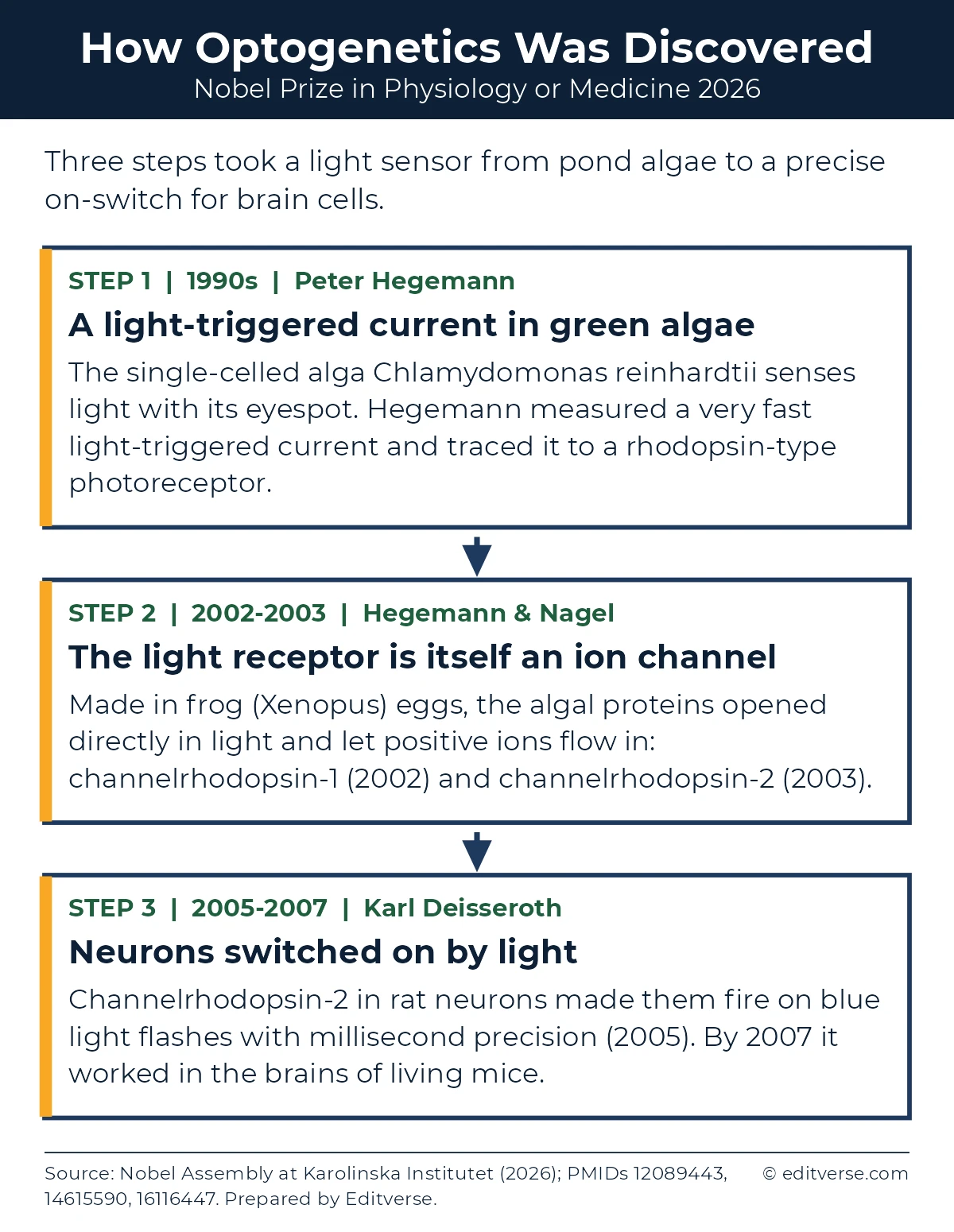
Science, 2002: the paper that found a light-gated channel
According to the Nobel Committee, the 2002 Science paper gave the first direct evidence of a light-gated ion channel [2].
Question. In the early 1990s Hegemann proposed that one protein complex in the alga Chlamydomonas both captures light and acts as an ion channel, an idea met with scepticism [9]. Around 2000 his group found two candidate genes, channelopsin-1 and channelopsin-2, in a Japanese gene database [2, 9]. Could the protein alone pass ions in light?
What they did. Hegemann contacted Nagel in Frankfurt, who had used frog egg cells to study a light-driven proton pump [9, 2]. Nagel expressed channelopsin-1 in Xenopus oocytes, added retinal, and recorded currents by two-electrode voltage clamp [2].
Key result. Green light produced inward currents carried mainly by protons, and even a shortened core of the protein, named channelrhodopsin-1, still worked [2].
Why it mattered. Hegemann’s decade-old one-protein hypothesis was confirmed [9, 2].
Where it was published. Science 296(5577), 28 June 2002, with Nagel as first author and Hegemann as last author [3]. John Spudich’s group reported RNA interference evidence on the same two rhodopsins in the 25 June 2002 issue of PNAS, and a group in Japan independently identified the same sequences [12, 2].
PNAS, 2003: channelrhodopsin-2 and the tool idea
In the 2003 PNAS paper, channelrhodopsin-2 emerged as a directly light-gated channel for positive ions, and the authors proposed it as a tool for depolarizing cells simply by illuminating them [5, 2].
Question. Did the second algal gene behave like the first, and would it work outside the frog egg?
What they did. Nagel’s team expressed channelopsin-2 in Xenopus oocytes and human embryonic kidney cells [2].
Key result. Channelrhodopsin-2 responded to blue light, opened within 0.2 milliseconds in the frog egg, and let positively charged ions flow in [9]. A fragment of only the first 315 amino acids kept the light-gated conductance [2].
Why it mattered. Mammalian cells became light-sensitive, which made a neuron experiment plausible [9].
Where it was published. PNAS 100(24), 25 November 2003, nine authors, with Nagel first, Hegemann eighth and Bamberg last [5].
Citing tip. Why a 2003 paper can show up as 2004
Some PubMed-based tools report the year of PMID 14615590 as 2004 because they read the MEDLINE indexing date (3 February 2004). The paper was published online 13 November 2003 (issue date 25 November 2003) [20, 5].
Through the same quirk, Aravanis et al. (2007) becomes 2008 and Nagel et al. in Current Biology (2005) becomes 2006 [15, 13]. Before you finalise a reference list, check each year against the DOI record rather than an indexing field.
Nature Neuroscience, 2005: the paper that made neurons answer to light
Delivered into neurons, channelrhodopsin-2 let blue light trigger action potentials with millisecond precision, a step the Nobel Committee calls a milestone for optogenetics [2].
Question. Could an algal channel drive single spikes in mammalian neurons without harming them?
What they did. Deisseroth, a psychiatrist starting his own Stanford laboratory, asked Nagel for the DNA and used a construct from Nagel with a fluorescent reporter [9, 2]. His group delivered it by lentivirus into cultured rat hippocampal neurons and obtained stable expression without apparent toxicity [2, 9].
Key result. Blue light pulses drove trains of action potentials on a millisecond timescale, with no added retinal, because Nagel had observed that trace amounts in the cells were enough [2, 6].
Why it mattered. Needing no added retinal made the method practical in living animals, and within about a year independent groups confirmed it in chick spinal cord, C. elegans, the retina and Drosophila [2, 13].
Where it was published. Nature Neuroscience 8(9), online 14 August 2005, five authors, with Edward Boyden first and Deisseroth last [6]. It arrived there after a rejection by Science [21].
The field that followed the Nobel Prize optogenetics papers: PubMed, 2005 to 2025
PubMed records matching optogenetic*[tiab] rose from 0 in 2005 to 1,583 in 2025 (by publication year, retrieved 7 October 2026) [10].
The term emerged during the development of the method and first appeared in a 2006 review by Deisseroth, Feng, Majewska, Miesenböck, Ting and Schnitzer, and it barely appears before 2009, with 13 records across 2005 to 2008 [21, 2, 8, 10]. By 2010, the year Nature Methods named optogenetics its Method of the Year, the count had reached 80 [22, 10]. Small year-on-year dips appear in 2019, 2022 and 2024, and 2006 to 2025 adds up to 14,572 records. Recent years may still rise slightly.
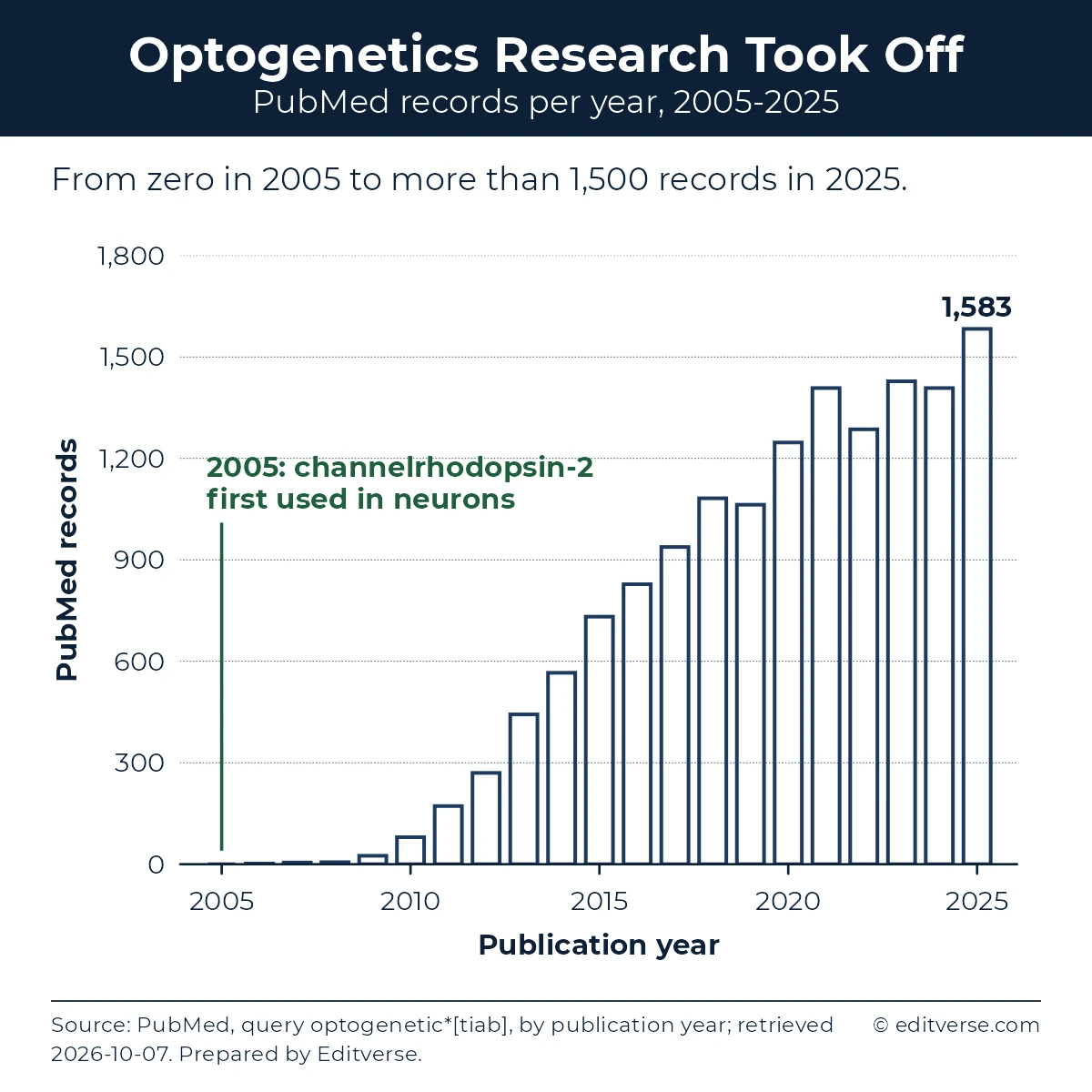
| Year | Records | Year | Records |
|---|---|---|---|
| 2005 | 0 | 2016 | 828 |
| 2006 | 2 | 2017 | 938 |
| 2007 | 5 | 2018 | 1,082 |
| 2008 | 6 | 2019 | 1,063 |
| 2009 | 25 | 2020 | 1,247 |
| 2010 | 80 | 2021 | 1,408 |
| 2011 | 172 | 2022 | 1,286 |
| 2012 | 270 | 2023 | 1,428 |
| 2013 | 443 | 2024 | 1,408 |
| 2014 | 566 | 2025 | 1,583 |
| 2015 | 732 |
Lessons from the Nobel Prize optogenetics papers for researchers writing today
Seven lessons follow from the Nobel Prize optogenetics papers, each resting on a checkable fact.
Make one claim, and let the title state it
Both channelrhodopsin titles name the protein and then state what it is, a light-gated proton channel in green algae (2002) and a directly light-gated cation-selective membrane channel (2003) [3, 5]. If your draft carries three half-finished findings, our substantive editing service can help you choose the strongest one.
Build the collaboration around complementary skills
Hegemann supplied the cloned algal genes, and Nagel brought expertise in studying channels and pumps in frog oocytes [2]. Nagel had met Hegemann while doing his PhD under Bamberg in Frankfurt, and Bamberg co-authored both channelrhodopsin papers [2, 3, 5]. The 2005 paper then joined that biophysics partnership to a psychiatrist-led neuroscience lab at Stanford, with Nagel and Bamberg as co-authors [9, 6].
Treat a method paper as a primary contribution
Although the 2005 paper reports a technique rather than a new protein, it is the most cited of the three [4]. It gave details others could repeat, such as lentiviral delivery and no added cofactor [2]. Our guide to writing clear, replicable methodology sections shows how to report such details.
Treat a rejection as a step, not a verdict
Boyden’s own history records that the neuron paper went to Science on 19 April 2005 and was rejected for reporting no discovery beyond channelrhodopsin-2 working well in neurons [21]. On 5 May the authors resubmitted to Nature, which relayed it to Nature Neuroscience, and after one round of revision it appeared online in August [21, 6]. That once-rejected manuscript now holds 5,034 OpenAlex citations, more than the two Science and PNAS discovery papers combined [4]. A prompt resubmission to a journal whose readers will use the method can matter more than the first venue. For your own manuscript, our journal selection service ranks suitable journals with a rationale, and our reviewer response and revision service supports the revision round. Our guide to top neuroscience journals explains the options.
Say plainly what the finding could be used for
In 2003 the authors proposed channelrhodopsin-2 as a tool for generating electrical signals in cells with light, and Deisseroth, on hearing of the discovery, asked Nagel for the gene [9]. Stating a concrete use in the abstract, the discussion and the cover letter to the editor shows editors why the work matters.
Record credit accurately across labs
Nagel and Bamberg appear on all three founding papers, Hegemann on the first two, and Edward Boyden and F. Zhang lead the 2005 author list [3, 5, 6]. Six people, including Bamberg and Boyden, shared the 2013 Brain Prize, the 2013 Louis-Jeantet Prize for Medicine honoured Hegemann and Nagel (alongside Michael Stratton for separate work), and the 2021 Lasker Basic Medical Research Award went to Deisseroth, Hegemann and Dieter Oesterhelt [23, 24, 25]. The published author list records the credited contributors, so agree authorship order and contributions before submission.
Get dates, identifiers and citation counts exactly right
A tool may say 2004, but the PNAS paper is 2003 [20]. Harz and Hegemann’s 1991 Nature paper is not indexed in PubMed, but it can be cited using its standard bibliographic details and DOI [11]. For the same three papers, OpenAlex and Crossref counts differ by up to 559 citations [4, 7]. Our advice is to name the database and the date whenever you quote a count. For ways to grow citations once a paper is out, see our guide on increasing your paper’s citations.
Professional Services for Your Own High-Impact Paper
A focused claim, a clear statement of use and a prompt resubmission after rejection carried the Nobel Prize optogenetics papers a long way. Editverse supports each of those steps.
Journal Selection
$115
5-10 ranked journal suggestions with a rationale covering scope, impact factor and acceptance rate.
Substantive Editing
$250
Subject-expert editing for clarity, flow and formatting, with unlimited revisions.
Response to Reviewers
$1,150
Point-by-point reviewer response plus full manuscript revision. 7 days.
When reviewer reports come back, see our advice on responding to reviewers effectively and diplomatically.
- GraphPro: build publication-ready charts, 25 types, with built-in t-test, ANOVA, correlation, and chi-square p-values. Free, no signup.
- StatPro: free statistical calculators and a test-selector tool covering group comparisons, categorical outcomes, time-to-event analysis, and diagnostic accuracy.
- Flowchart Pro: generate PRISMA 2020, PRISMA-ScR, CONSORT, STROBE, STARD, MOOSE, and ARRIVE flow diagrams directly in your browser.
Related Editverse Resources
- Nobel Prize in Medicine 2026: optogenetics, the laureates and the discovery
- Optogenetics: controlling the brain with light
- Neurophotonics: illuminating brain function
- How to publish in top neuroscience journals
- How to publish in Nature or other high-impact multidisciplinary journals
- Do journal selection services really boost acceptance rates?
- Preprint servers explained: bioRxiv vs medRxiv vs SSRN
- Nobel Prize-winning discoveries in chemistry in the last 20 years
Frequently Asked Questions about the Nobel Prize optogenetics papers
Which papers won the 2026 Nobel Prize in Medicine?
Nobel Prizes recognise discoveries, not papers, but the Nobel Committee lists five key publications [9]. At the core sit Nagel et al. in Science (2002), Nagel et al. in PNAS (2003) and Boyden et al. in Nature Neuroscience (2005). Harz, Nonnengasser and Hegemann (1992) and Aravanis et al. (2007) complete the list [26, 15].
Where was channelrhodopsin first published?
Channelrhodopsin-1 was first described in Science on 28 June 2002 [3]. Channelrhodopsin-2 followed in PNAS on 25 November 2003 [5].
How many citations do the optogenetics papers have?
As of 7 October 2026, OpenAlex counts 1,190 citations for the 2002 Science paper, 2,753 for the 2003 PNAS paper and 5,034 for the 2005 Nature Neuroscience paper [4]. Crossref gives lower figures of 1,070, 2,445 and 4,475 on the same date [7].
Why does the ChR2 paper sometimes show 2004 instead of 2003?
Some tools read the MEDLINE indexing date, 3 February 2004. It was published online 13 November 2003 (issue date 25 November 2003), so cite it as 2003 [20, 5].
Who were the co-authors of the 2005 Nature Neuroscience paper?
In order, the five authors were Edward S. Boyden, F. Zhang, Ernst Bamberg, Georg Nagel and Karl Deisseroth [6]. Bamberg and Nagel had also co-authored the 2002 and 2003 papers [3, 5].
When was the term optogenetics coined?
The term emerged during the development of the method, according to Boyden’s history, and first appeared in a 2006 Journal of Neuroscience review by Deisseroth, Feng, Majewska, Miesenböck, Ting and Schnitzer, after the three founding papers [21, 2, 8]. PubMed finds no 2005 records with optogenetic* in the title or abstract and only 13 across 2005 to 2008 [10].
How to Cite This Article
Suggested citation (APA 7)
Editverse. (2026, October 7). The papers behind the 2026 Nobel Prize: How optogenetics was published. Editverse. https://editverse.com/optogenetics-nobel-prize-papers-behind-the-discovery/
References
- Nobel Assembly at Karolinska Institutet. Press release: The 2026 Nobel Prize in Physiology or Medicine [Internet]. Stockholm: Karolinska Institutet; 2026 Oct 5 [cited 2026 Oct 7]. Available from: nobelprize.org press release (PDF)
- Nobel Committee for Physiology or Medicine. Scientific background 2026: Optogenetics, discovery of a neuronal switch [Internet]. Stockholm: Nobel Assembly at Karolinska Institutet; 2026 Oct 5 [cited 2026 Oct 7]. 15 p. Available from: nobelprize.org scientific background (PDF)
- Nagel G, Ollig D, Fuhrmann M, Kateriya S, Musti AM, Bamberg E, Hegemann P. Channelrhodopsin-1: a light-gated proton channel in green algae. Science. 2002 Jun 28;296(5577):2395-8. doi:10.1126/science.1072068. PMID 12089443. PubMed 12089443
- OpenAlex. Citation counts (cited_by_count) for works W2058488568, W2159423248 and W2167095271 [Internet]. [cited 2026 Oct 7].
- Nagel G, Szellas T, Huhn W, Kateriya S, Adeishvili N, Berthold P, Ollig D, Hegemann P, Bamberg E. Channelrhodopsin-2, a directly light-gated cation-selective membrane channel. Proc Natl Acad Sci U S A. 2003 Nov 25;100(24):13940-5. doi:10.1073/pnas.1936192100. PMID 14615590. PubMed 14615590
- Boyden ES, Zhang F, Bamberg E, Nagel G, Deisseroth K. Millisecond-timescale, genetically targeted optical control of neural activity. Nat Neurosci. 2005 Sep;8(9):1263-8. Epub 2005 Aug 14. doi:10.1038/nn1525. PMID 16116447. PubMed 16116447
- Crossref. is-referenced-by-count for DOIs 10.1126/science.1072068, 10.1073/pnas.1936192100 and 10.1038/nn1525 [Internet]. [cited 2026 Oct 7].
- Deisseroth K, Feng G, Majewska AK, Miesenböck G, Ting A, Schnitzer MJ. Next-generation optical technologies for illuminating genetically targeted brain circuits. J Neurosci. 2006 Oct 11;26(41):10380-6. doi:10.1523/JNEUROSCI.3863-06.2006. PMID 17035522. PubMed 17035522
- Nobel Assembly at Karolinska Institutet. Popular science background: A light-sensitive algal protein energised neuroscience [Internet]. Stockholm: Karolinska Institutet; 2026 Oct 5 [cited 2026 Oct 7]. Available from: nobelprize.org popular background (PDF)
- National Library of Medicine. PubMed search optogenetic*[tiab], records by publication year 2005-2025 [Internet]. Bethesda (MD): NLM [cited 2026 Oct 7]. Available from: pubmed.ncbi.nlm.nih.gov
- Harz H, Hegemann P. Rhodopsin-regulated calcium currents in Chlamydomonas. Nature. 1991 Jun;351(6326):489-91. doi:10.1038/351489a0. Not indexed in PubMed.
- Sineshchekov OA, Jung KH, Spudich JL. Two rhodopsins mediate phototaxis to low- and high-intensity light in Chlamydomonas reinhardtii. Proc Natl Acad Sci U S A. 2002 Jun 25;99(13):8689-94. doi:10.1073/pnas.122243399. PMID 12060707. PubMed 12060707
- Nagel G, Brauner M, Liewald JF, Adeishvili N, Bamberg E, Gottschalk A. Light activation of channelrhodopsin-2 in excitable cells of Caenorhabditis elegans triggers rapid behavioral responses. Curr Biol. 2005 Dec 20;15(24):2279-84. doi:10.1016/j.cub.2005.11.032. PMID 16360690. PubMed 16360690
- Zhang F, Wang LP, Brauner M, Liewald JF, Kay K, Watzke N, et al. Multimodal fast optical interrogation of neural circuitry. Nature. 2007 Apr 5;446(7136):633-9. doi:10.1038/nature05744. PMID 17410168. PubMed 17410168
- Aravanis AM, Wang LP, Zhang F, Meltzer LA, Mogri MZ, Schneider MB, Deisseroth K. An optical neural interface: in vivo control of rodent motor cortex with integrated fiberoptic and optogenetic technology. J Neural Eng. 2007 Sep;4(3):S143-56. Epub 2007 May 31. doi:10.1088/1741-2560/4/3/S02. PMID 17873414. PubMed 17873414
- Adamantidis AR, Zhang F, Aravanis AM, Deisseroth K, de Lecea L. Neural substrates of awakening probed with optogenetic control of hypocretin neurons. Nature. 2007 Nov 15;450(7168):420-4. doi:10.1038/nature06310. PMID 17943086. PubMed 17943086
- Hegemann P, Nagel G. From channelrhodopsins to optogenetics. EMBO Mol Med. 2013 Feb;5(2):173-6. doi:10.1002/emmm.201202387. PMID 23339069. PubMed 23339069
- Deisseroth K. Optogenetics: 10 years of microbial opsins in neuroscience. Nat Neurosci. 2015 Sep;18(9):1213-25. doi:10.1038/nn.4091. PMID 26308982. PubMed 26308982
- Sahel JA, Boulanger-Scemama E, Pagot C, Arleo A, Galluppi F, Martel JN, et al. Partial recovery of visual function in a blind patient after optogenetic therapy. Nat Med. 2021 Jul;27(7):1223-9. doi:10.1038/s41591-021-01351-4. PMID 34031601. PubMed 34031601
- National Center for Biotechnology Information. E-utilities eSummary record for PMID 14615590 [Internet]. [cited 2026 Oct 7]. Available from: eutils.ncbi.nlm.nih.gov
- Boyden ES. A history of optogenetics: the development of tools for controlling brain circuits with light. F1000 Biol Rep. 2011;3:11. Epub 2011 May 3. doi:10.3410/B3-11. PMID 21876722. PMCID: PMC3155186. PubMed 21876722
- Method of the Year 2010 [editorial]. Nat Methods. 2011 Jan;8(1):1. Published online 2010 Dec 20. doi:10.1038/nmeth.f.321. Not indexed in PubMed.
- Federation of European Neuroscience Societies. Six eminent scientists share the world’s largest brain research prize [Internet]. [cited 2026 Oct 7]. Available from: fens.org
- Bushati N, Rossier BC. The Louis-Jeantet Prize 2013: Michael Stratton, Peter Hegemann and Georg Nagel. EMBO Mol Med. 2013 Feb;5(2):167-8. doi:10.1002/emmm.201202394. PMID 23341150. PubMed 23341150
- Lasker Foundation. 2021 Albert Lasker Basic Medical Research Award, light-sensitive microbial proteins and optogenetics [Internet]. [cited 2026 Oct 7]. Available from: laskerfoundation.org
- Harz H, Nonnengasser C, Hegemann P. The photoreceptor current of the green alga Chlamydomonas. Philos Trans R Soc Lond B Biol Sci. 1992 Oct 29;338(1283):39-52. doi:10.1098/rstb.1992.0127. Not indexed in PubMed.