
Published | Last updated
The Journal Citation Reports 2026 (JCR 2026) release from Clarivate arrived in June 2026 — and with it, the most significant update to journal impact factor data that researchers worldwide will use when planning manuscript submissions this year. Covering 22,643 journals across 254 subject categories, the 2026 edition marks several notable shifts: a surge in Open Access journals, rapid growth in authorship from China and India, and the first Journal Impact Factors (JIFs) awarded to 521 journals from 47 countries and regions. For anyone navigating journal selection, grant applications, or institutional reporting, this release demands close attention.
At Editverse, we work with researchers across 30+ countries on manuscript preparation, journal selection, and publication strategy. Every year, the JCR release reshapes the landscape — which journals to target, how funders perceive your output, and where a citation from your paper lands in the global metrics system. This guide unpacks JCR 2026 in full: the headline numbers, what is genuinely new, the OA data from China and India, and what it all means for your submission strategy.
📖 In Simple Words — What Is JCR and Why Does It Matter?
Journal Citation Reports (JCR) is an annual database published by Clarivate that assigns performance metrics to academic journals indexed in the Web of Science. The most well-known metric is the Journal Impact Factor (JIF) — calculated as the average number of citations received per article published in that journal over the previous two years. A journal with a JIF of 10.0 received, on average, 10 citations per article published in 2023–2024.
JCR also now includes the Journal Citation Indicator (JCI) — a newer, field-normalized metric that adjusts for differences in citation behaviour across disciplines, making it easier to compare a cardiology journal with a materials science journal on equal footing.
✍ Quick check — test your JCR knowledge:
① A journal’s JIF tells you the quality of which article? [Answer: None — JIF is a journal-level metric, not an article metric]
② How often is JCR updated? [Answer: Released once a year, usually in June, with data updates through the autumn]
③ What does it mean if a journal is in JIF Q1? [Answer: It ranks in the top 25% of its subject category by JIF]
What Is the Journal Citation Reports 2026 Release?
Published annually since 1975, the Journal Citation Reports is now in its sixth decade and remains the most widely referenced source of journal performance data in academic publishing. The 2026 edition was released in June 2026 by Clarivate and covers journals across all four Web of Science Core Collection indexes: the Science Citation Index Expanded (SCIE), the Social Sciences Citation Index (SSCI), the Arts & Humanities Citation Index (AHCI) and the Emerging Sources Citation Index (ESCI). The 2026 release reports metrics based on 2025 citation data.
Unlike journal rankings produced by individual publishers or databases, JCR is independent of the journals it evaluates. Clarivate applies a multi-stage verification process before assigning metrics — and in recent years has increased its scrutiny of citation manipulation, removing journals found to engage in citation stacking or excessive self-citation. The 2026 edition continues this transparency drive, which is discussed further in the section on what is new this year.
For researchers, JCR 2026 is the primary tool for answering three questions: (1) What is this journal’s current impact standing? (2) In what quartile does it sit within its field? (3) How does it compare to alternatives across different disciplines? The addition of the JCI as a permanent metric alongside JIF now means those comparisons are richer — and more nuanced — than they were five years ago.
JCR 2026 — Key Numbers at a Glance
The scale of JCR 2026 underscores how much the indexed journal landscape has grown. Here is the headline data from the 2026 release:

| Metric | JCR 2026 Value | Context |
|---|---|---|
| Total journals with metrics | 22,643 | Across SCIE, SSCI, AHCI and ESCI |
| Subject categories covered | 254 | Across sciences and social sciences |
| First-time JIF recipients | 521 journals | From 47 countries and regions |
| Gold OA journals in JCR | 6,703 (+6%) | Up from 6,320 in JCR 2025 |
| Mainland China + US author share | 48% combined | Of all author affiliations in indexed journals |
| New JIF journals outside US/W.Europe | 58% of new recipients | Reflects geographic diversification of indexed science |
ESCI Journals and the Impact Factor: What Changed
ESCI (the Emerging Sources Citation Index) is the Web of Science Core Collection index for journals that meet Web of Science quality criteria but sit outside SCIE, SSCI and AHCI. ESCI journals used to have no Journal Impact Factor. That has changed: Clarivate has extended the JIF to every journal in the Web of Science Core Collection and unified the journal rankings, so ESCI journals now appear alongside SCIE and SSCI journals in the same subject-category tables, with a JIF and a quartile.
| Question | Answer in JCR 2026 |
|---|---|
| Does an ESCI journal have an impact factor? | Yes. The JIF now covers all Web of Science Core Collection journals, including ESCI. |
| Is it ranked with SCIE and SSCI journals? | Yes. Rankings are unified within each subject category, so the quartile is comparable. |
| How do I see which index a journal is in? | Open the journal profile in JCR and check its index (edition) label: SCIE, SSCI, AHCI or ESCI. |
| Do institutions treat ESCI the same as SCIE? | Not always. Some universities and national evaluation systems still count ESCI differently for appointments and promotion, so confirm your institution’s rule before you choose a target journal. |
Other changes to know in JCR 2026
- Retracted content is excluded. Citations to and from retracted papers are excluded from JIF metrics.
- ‘Forthcoming’ label. Journals whose Web of Science data is incomplete are now shown in JCR with a ‘Forthcoming’ label and link to their most recent available metrics, instead of being listed only in the help file.
- Data keeps updating after June. The June release is followed by updates, and final Journal Impact Factors are confirmed in the autumn (late October), so re-check your target journal’s profile before you submit.
What Is Actually New in JCR 2026? (Beyond the Headline Numbers)
Most coverage of JCR 2026 will repeat the headline statistics. What matters more — especially for researchers making submission decisions — is understanding what has structurally changed in how Clarivate presents and contextualises journal performance data.
The Journal Citation Indicator takes a bigger role
Introduced in JCR 2021, the Journal Citation Indicator (JCI) has now become a central part of every journal’s JCR profile. Unlike the JIF, which is a raw citation count averaged across article types, the JCI is field-normalised: it adjusts for differences in citation culture, publication volume, and document type across disciplines. A JCI of 1.0 means the journal performs at the field average; a JCI above 1.0 means it outperforms its peers; below 1.0 means underperformance relative to the field norm.
In JCR 2026, Clarivate continues to present the JCI as the field-normalised metric for balanced comparison across disciplines — and stresses that journal-level metrics are for evaluating journals, not individual papers or researchers. This matters most for researchers in fields where citation rates are structurally low (such as humanities, mathematics, or engineering subfields), where a modest JIF masks genuine top-quartile performance when field-normalised.
Practical implication: Before targeting any journal in JCR 2026, check both its JIF quartile and its JCI quartile. These can diverge substantially — a journal may be Q2 by JIF in its category but Q1 by JCI once field normalisation is applied.
Newly suppressed journals and citation transparency
JCR 2026 continues Clarivate’s annual suppression cycle — removing journals found to violate editorial standards through citation manipulation. Suppressed journals lose their JIF for the affected year and may be removed from the Web of Science entirely. In 2026, Clarivate has maintained its commitment to publishing the list of suppressed journals alongside the active data, so researchers can verify that a journal they are considering has a clean citation record.
This matters practically: some researchers discover mid-submission that their target journal was suppressed in a prior year, which affects indexing visibility and, ultimately, the discoverability of their paper. Always verify the suppression history of any journal before submission — the JCR platform shows this directly.
521 first-time JIF recipients across 47 countries
The addition of 521 journals receiving their first-ever JIF is the largest single-year cohort of new recipients in recent memory. These journals span 47 countries and regions, with a notable proportion from Southeast Asia, Latin America, and Eastern Europe. For researchers based in these regions, the implication is significant: journals in their national language or regional focus area may now carry a JIF for the first time, opening up domestic publication options that carry international metric recognition.
For researchers outside these regions, the expansion matters differently — it means the pool of legitimately indexed, JIF-bearing journals is broader than it was 12 months ago, and some previously unlisted alternatives in niche subfields may now be viable choices when a high-JIF generalist journal rejects the manuscript.
JIF Growth Leaders — Notable Journal Impact Factor Changes in 2026
While global averages tell one story, the most instructive data points in JCR 2026 are the journals that moved significantly. The pattern is clear: Open Access journals are outpacing subscription journals on JIF growth, particularly in chemistry, materials science, and sustainability.
Open Access journals driving the biggest gains
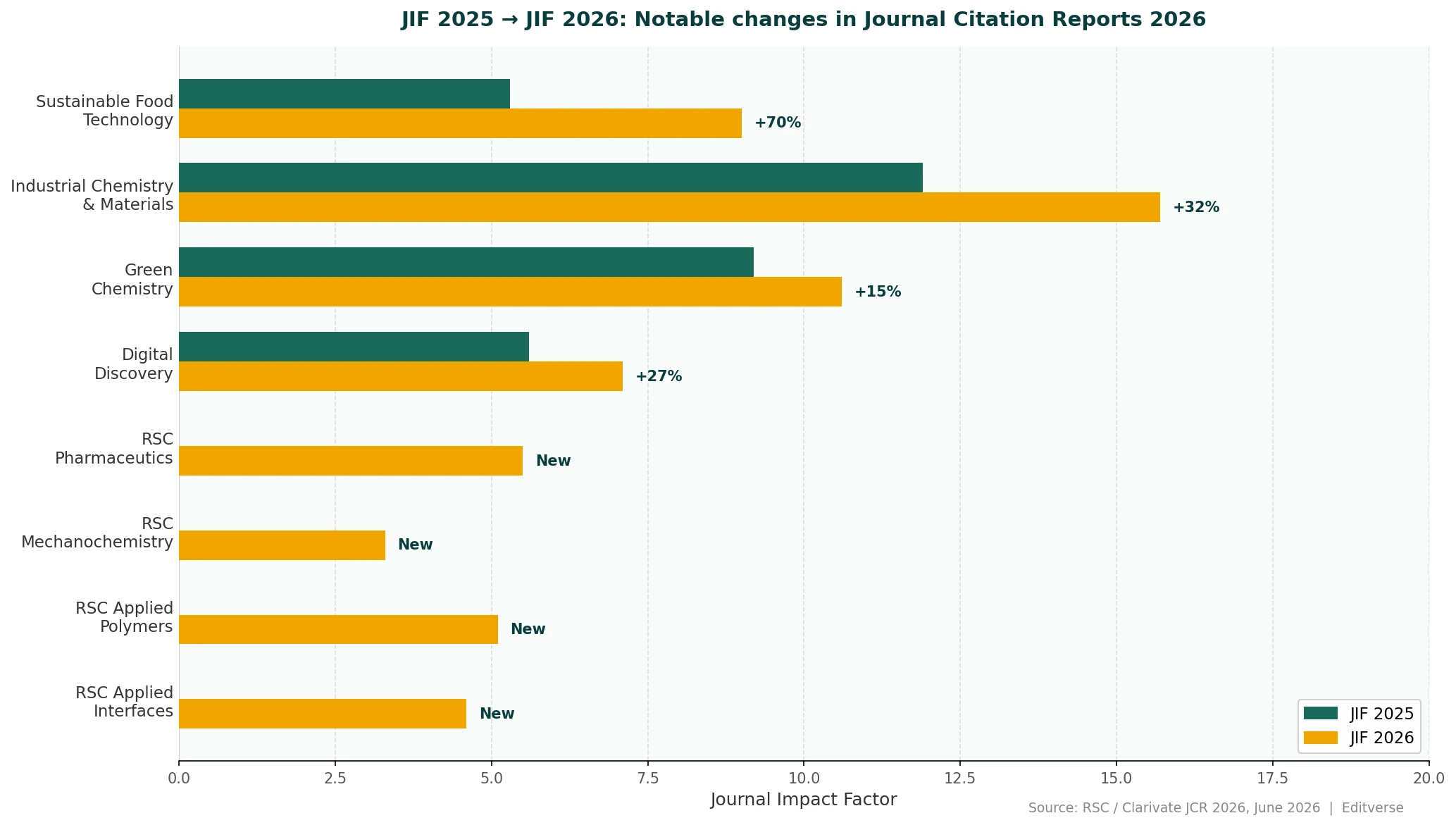
The most striking JIF movement in 2026 belongs to Sustainable Food Technology (RSC), whose JIF climbed from 5.3 to 9.0 — a 70% increase in a single year. This is not an outlier: Industrial Chemistry & Materials rose from 11.9 to 15.7 (+32%), and Digital Discovery moved from 5.6 to 7.1 (+27%). All three are fully Open Access journals. Green Chemistry, one of the most established OA journals in chemistry, added another 15% to reach 10.6.
What explains this pattern? Open Access articles attract more downloads, more early citations from researchers who would otherwise be paywalled, and greater international visibility — particularly from researchers in lower-income countries with limited library subscriptions. As the OA article pool in WoS expands, journals that have been OA longer are now seeing the compounding citation benefits of that accessibility. For researchers deciding between a subscription journal and an OA alternative in the same field, the JIF trajectory of OA journals is now a compelling argument for the latter — provided the OA journal is in a legitimate, non-predatory category.
RSC journals: first JIFs and notable increases
The Royal Society of Chemistry (RSC) made a particularly strong showing in JCR 2026. Four RSC journals received their first-ever JIFs:
- RSC Pharmaceutics — debut JIF: 5.5
- RSC Applied Polymers — debut JIF: 5.1
- RSC Applied Interfaces — debut JIF: 4.6
- RSC Mechanochemistry — debut JIF: 3.3
These are all relatively young journals launched by RSC as part of its OA expansion programme. Debut JIFs in the 3–6 range place them immediately in competitive territory within their categories — RSC Pharmaceutics at 5.5, for instance, enters the pharmaceutics category at a level comparable to well-established journals that have been accumulating citations for decades.
Which fields saw the largest JIF movements?
Chemistry and materials science account for the most dramatic single-journal movements in JCR 2026, but the pattern of OA-driven growth is visible across sustainability science, food science, and interdisciplinary engineering. Clinical medicine and the biomedical sciences showed more modest average JIF changes — historically stable categories where top journals (e.g., NEJM, JAMA, The Lancet) maintain high JIFs driven by accumulated citation momentum rather than year-on-year acceleration.
For researchers in emerging interdisciplinary fields — mechanochemistry, green chemistry, sustainable materials, food systems — 2026 represents a meaningful expansion of options with legitimate JIF credentials. Fields that were once served only by niche journals with no JIF, or by broad generalist journals, now have specialised OA options with respectable metrics.
💡 Editverse insight — from 1,100+ manuscripts edited
We consistently see researchers underestimate how quickly OA journal JIFs can move. A journal they dismissed two years ago as “too new” is now in Q2 or Q1 of its category. Checking JCR every year — not just when you are submitting — keeps your targeting strategy current.
The OA Surge in China and India — What the JCR 2026 Data Really Shows
One of the most debated questions surrounding JCR 2026 is whether the growth in Open Access authorship from China and India represents genuine scientific expansion or a metrics-driven artefact. The data, examined carefully, shows both — and the distinction matters for how researchers interpret JIF movements in journals that are attracting high volumes from these regions.

China’s Gold OA growth — what Clarivate reports
Clarivate reports a 23% increase in the number of Gold OA journals from Mainland China, and Mainland China also shows the largest rise in author representation between 2023 and 2025 (23%) — the largest single-country growth figure in the dataset. Clarivate does not explain the cause. More Chinese researchers publishing more papers is an obvious contributor, and national open access policy may also play a part, but the release does not attribute the growth to either.
Editverse interpretation (not a Clarivate finding): where a journal draws many authors from one country, that can affect its JIF in two ways. First, articles by Chinese authors that cite other articles in the same OA journal contribute to that journal’s JIF calculation — increasing it, provided those citations are organic rather than arranged. Second, journals that have actively courted Chinese authors over the past five years are now seeing citation returns from that earlier volume build-up, appearing as JIF growth in 2026.
Does this make the JIF growth unreliable? Not inherently — but it does mean that a journal’s JIF growth driven primarily by one country’s author expansion warrants a secondary look at the JCI, which normalises for article volume and citation clustering. If the JCI has not grown proportionally to the JIF, that is a signal worth noting.
India at +12% — what the growth reflects
India’s 12% rise in author representation between 2023 and 2025 is the second-largest increase in the JCR 2026 data, after Mainland China. Clarivate does not give a reason for the rise; a national push to increase international publication is one plausible factor.
Editverse interpretation (not a Clarivate finding): authors who pay article processing charges (APCs) themselves tend to favour journals with lower or waived APCs, so uptake of lower-cost OA titles may be higher among them. Check the APC and any waiver policy of a journal before you target it.
What does regional OA growth mean for citation patterns and JIF reliability?
The Global South overall showed a 10% increase in author affiliations versus 2023 (and 6% versus 2024), reflecting a genuine broadening of the indexed research community. This is welcome from a scientific equity standpoint — but it introduces a complexity for JIF interpretation.
When authorship in a journal concentrates rapidly from a single region, citation networks can form that are geographically clustered. Researchers in a given country tend to cite work from their own institutions and collaborators more heavily — not because of manipulation, but because of natural knowledge networks. If a journal’s recent article pool is 60% from one country, a disproportionate share of citations to those articles will come from the same country, accelerating the JIF in ways that may not reflect international scientific uptake. The JCI’s normalisation does not fully correct for this geographic clustering effect, which is one reason that the DORA declaration continues to recommend using primary research outputs — not journal metrics — to evaluate individual researchers.
⚠ What this means for your journal selection
If you are submitting to a journal that has shown rapid JIF growth in 2026, check whether that growth is matched by JCI growth. A journal where JIF rose by 30% but JCI rose by only 5% may have benefited from volume-driven citation accumulation rather than quality-signalled citations. Target journals where both metrics move together — that is a more reliable signal of genuine standing improvement.
JIF vs JCI vs Quartile — Three Numbers You Now Need to Understand
JCR 2026 presents every journal with three distinct metrics — and understanding the difference between them is no longer optional for researchers making submission decisions. Here is what each one measures and when it matters:
| Metric | What it measures | When to use it |
|---|---|---|
| JIF | Average citations per article over 2 years. Raw, not normalised for field. | Within-field comparisons; institutional reporting; grant forms that ask for JIF |
| JIF Quartile (Q1–Q4) | Where a journal ranks within its subject category by JIF. Q1 = top 25%. | Promotion committees; national ranking systems; tenure evaluations |
| JCI | Field-normalised citation impact. 1.0 = field average. Corrects for discipline differences. | Cross-disciplinary comparisons; evaluating niche or emerging-field journals |
| JCI Quartile | Where a journal ranks within its category by JCI. Can differ significantly from JIF quartile. | When JIF quartile seems inconsistent with your field experience; checking journals that recently entered the JCR |
A concrete example: a small-volume journal in a citation-sparse field (such as ethnobotany or computational linguistics) may have a JIF that places it in Q3 — but a JCI that places it in Q1 once field norms are applied. Publishing in that journal is not a Q3 decision; it is a Q1 decision when properly contextualised. JCR 2026 makes this information available for every journal — use it.
Should You Still Use Journal Impact Factor to Decide Where to Submit?
The short answer, based on Clarivate’s own guidance and the pattern we see at Editverse across hundreds of manuscript placements per year: yes, but not alone — and not the way most researchers currently use it.
When JIF matters
JIF remains relevant in specific, legitimate contexts. Grant applications from major funding bodies (NIH, Wellcome, ERC, NSFC) frequently still ask researchers to list JIF alongside their publications, particularly on CVs for fellowship applications. Institutional promotion and tenure committees — especially in Asia and the Middle East — often continue to use JIF quartile as a proxy for output quality, even where national science bodies have officially recommended moving away from it. For researchers operating in these contexts, knowing the JIF of every journal in your field remains practically necessary — not because the metric is scientifically ideal, but because the systems you interact with still use it.
When JIF actively misleads
JIF misleads researchers in at least three common scenarios that we observe directly at Editverse:
Scope mismatch masked by high JIF: The single most common cause of desk rejection among the manuscripts we work on is targeting a journal whose scope does not match the paper, regardless of that journal’s JIF. A clinical pharmacology study submitted to a journal with a JIF of 12 but a primary focus on molecular mechanisms will be desk-rejected — the JIF told the researcher nothing about fit. Scope alignment always precedes metric targeting.
OA cost blindness: JIF does not indicate article processing charges. Some of the journals with the highest JIF growth in 2026 carry APCs of $3,000–$5,000 per article. Targeting them based on JIF alone, without a budget for the APC or a plan for a waiver, leads to late-stage submission failure when the APC becomes visible only after acceptance.
Predatory journal confusion: The existence of a JIF does not guarantee a journal’s legitimacy — suppressed journals retain their historical JIFs in some databases even after removal from the WoS active list. Always verify current suppression status in JCR directly before submission.
The Editverse three-number framework for journal selection
Based on patterns from working with 1,100+ manuscripts, we recommend evaluating any target journal on three numbers — not one:
- JIF Quartile — confirms the journal’s standing within its field for grant and institutional purposes
- JCI Quartile — confirms that the JIF quartile is not a field-volume artefact
- Acceptance Rate — the real variable that determines whether submission is worth your time. A Q1 journal with a 5% acceptance rate and a Q2 journal with a 25% acceptance rate may both be worth targeting, but for different manuscripts at different stages of a research career
When JIF quartile, JCI quartile, and acceptance rate all point in the same direction, you have found a well-calibrated target. When they diverge, investigate before submitting. Learn more about how Editverse approaches publication support and journal targeting for researchers at every career stage.
6 Mistakes Researchers Make When Reading JCR 2026 Data
Every JCR release is followed by a wave of researcher decisions based on misread data. These are the six mistakes we see most frequently — and how to avoid them:
How Editverse Supports Your Journal Selection After JCR 2026
At Editverse, we update our journal targeting guidance every year immediately after the JCR release. Our publication support service includes a dedicated journal selection analysis: we match your manuscript’s scope, methodology, and citation profile against the current JCR data to identify the highest-probability journals for acceptance — balancing JIF quartile, JCI quartile, acceptance rate, and APC costs in a single recommendation set.
Researchers we work with consistently cite journal selection as the step that most determines whether a manuscript succeeds or spends years being rejected and re-submitted. The JCR 2026 data makes this year’s targeting decisions both richer and more complex. If you want expert guidance on navigating it for your specific manuscript, our team is here to help.
Editverse Publication Support
Struggling to choose the right journal after JCR 2026?
Our experts analyse JIF, JCI, acceptance rates, and scope fit for your manuscript — and give you a shortlist you can actually use.
Conclusion
Journal Citation Reports 2026 is more than an annual data update — it reflects a structural shift in how global science is produced and published. The rise of Gold Open Access, the growth of authorship from China, India, and the Global South, the introduction of 521 new JIF-bearing journals, and the expanded role of the JCI together make 2026 the most complex JCR release in years to interpret correctly.
For researchers, the key takeaways are practical: update your journal shortlists, check both JIF and JCI quartiles before targeting any journal, understand what drives JIF growth in the journals you are considering, and do not let headline numbers substitute for scope analysis. Impact factor still matters — but in 2026, how you use it matters more than ever.
Explore related resources on Editverse: publication support services, guidance on manuscript preparation for high-impact journals, and our overview of systematic review and meta-analysis support.
References
- Clarivate. Journal Citation Reports 2026: Supporting Transparent, Responsible Journal Evaluation. Clarivate Academia & Government Blog, June 2026. clarivate.com
- Clarivate. Clarivate Releases Journal Citation Reports 2026. PR Newswire, June 2026. prnewswire.com
- Royal Society of Chemistry. RSC Journals Receive Latest Journal Impact Factors. RSC News, June 2026. rsc.org
- San Francisco Declaration on Research Assessment (DORA). Recommendations on the Use of Journal Impact Factors. sfdora.org
- Garfield E. The history and meaning of the journal impact factor. JAMA. 2006;295(1):90–93. doi:10.1001/jama.295.1.90 [PMID: 16391221]
- Bornmann L, Marx W. The journal impact factor and alternative metrics. EMBO Reports. 2016;17(8):1094–1097. doi:10.15252/embr.201642701 [PMID: 27418315]