
Published
On 6 October 2026, the Royal Swedish Academy of Sciences awarded the Nobel Prize in Physics 2026 to Francis Halzen of the University of Wisconsin-Madison, USA.[1] Halzen saw that deep, clear South Pole ice could work as a particle detector, and his leadership shaped the IceCube Neutrino Observatory, a cubic kilometre of ice fitted with light sensors.[1, 2] With it, researchers detected high-energy neutrinos that must come from far outside our solar system.[1]
Editverse congratulates Professor Halzen and the IceCube Collaboration, about 450 people from 58 institutions in 14 countries.[2, 3] Their story runs 38 years, from a 1988 preprint about polar ice to a prize-winning observatory.[4, 1] Below are the key facts, the laureate, the science, its limits and the papers to cite.
Last verified 9 October 2026, against the official Nobel documents, PubMed, Crossref and OpenAlex.
Nobel Prize in Physics 2026: Key Facts at a Glance
Francis Halzen alone receives the Nobel Prize in Physics 2026, for his part in building IceCube and in the discovery of high-energy neutrinos from astrophysical sources.[1, 5]
Key Facts, 2026 Nobel Prize in Physics
- The Royal Swedish Academy of Sciences announced the Nobel Prize in Physics 2026 on 6 October 2026 (Nobel press release, PDF).[1]
- Francis Halzen, born on 23 March 1944 in Tienen, Belgium, is the sole laureate and is affiliated with the University of Wisconsin-Madison, USA.[5]
- The official motivation reads “for decisive contributions to the IceCube Neutrino Observatory and the discovery of high-energy neutrinos of astrophysical origin”.[1, 5]
- The prize amount is 12 million Swedish kronor, and as sole laureate Halzen receives the full amount.[1, 5]
- IceCube’s original array holds 5,160 light sensors on 86 cables, 1,450 to 2,450 metres deep.[6, 2]
- IceCube’s 28-event Science paper of 22 November 2013 rejected a purely atmospheric origin at 4σ (PMID 24264993).[7]
- A Physical Review Letters paper (online 2 September 2014, issue date 5 September 2014) raised this to 5.7σ (PMID 25238345).[8]
In Simple Words
Neutrinos are tiny, uncharged particles that pass through almost everything. Every second, about 65 billion of them from the Sun stream through your little fingernail unnoticed.[6] Once in a while, one strikes an atom in ice and sets off a faint flash of blue light. Halzen’s idea was to bury thousands of light sensors deep in Antarctic ice and wait for those flashes. Because neutrinos travel in straight lines, the pattern of light shows the direction a neutrino came from, which can point back to sources far beyond our solar system.[1, 6, 2]

Who Is Francis Halzen? Meet the Nobel Prize in Physics 2026 Laureate
Francis Halzen is a Belgian-born physicist at the University of Wisconsin-Madison and has been principal investigator of IceCube from its beginnings.[1, 2]
Born in Tienen, Belgium, in 1944, Halzen earned his PhD at KU Leuven in 1969.[1] His early research concerned massive particles built from quarks, and he moved to Wisconsin soon after his doctorate.[6] An American Physical Society profile says that in 1971, while working at CERN, he was invited by a colleague for a six-month research visit to UW-Madison, and he stayed.[9] He is now Vilas Research Professor and Gregory Breit Professor there.[3]
In autumn 1987, after a talk at the University of Kansas, glaciologist E. Zeller told Halzen about Soviet plans to detect radio signals from neutrino interactions in Antarctic ice.[2, 6] Halzen, Stanev and Zas judged the radio threshold too high for PeV neutrinos.[2] By June 1988, Halzen and J. G. Learned had reported a different plan, with ice serving as both the target and the Cherenkov medium.[4, 2] Later he became a driving force on the AMANDA prototype and principal investigator on the 1999 IceCube proposal, according to the committee.[2]
Speaking by phone from Italy to the Nobel Committee for Physics, Halzen said, “It was a great surprise and I obviously didn’t expect it,” the Associated Press reported.[10, 11]
Earlier Awards and Honours
| Year | Honour | Recipient |
|---|---|---|
| 2013 | Physics World Breakthrough of the Year[12] | IceCube observatory team (not a personal award) |
| 2015 | Balzan Prize for Astroparticle Physics including Neutrino and Gamma-ray Observation[13] | Francis Halzen |
| 2018 | Bruno Pontecorvo Prize, Joint Institute for Nuclear Research[14] | Francis Halzen |
| 2019 | Yodh Prize, IUPAP Commission on Astroparticle Physics[15] | Francis Halzen |
| 2021 | Bruno Rossi Prize, AAS High Energy Astrophysics Division[16] | Francis Halzen and the IceCube Collaboration |
| 2021 | Homi Bhabha Medal and Prize, IUPAP and TIFR[17] | Francis Halzen |
| 2024 | Election to the US National Academy of Sciences[18] | Francis Halzen |
| 2026 | APS Medal for Exceptional Achievement in Research[9] | Francis Halzen |
How the IceCube Discovery Happened, Step by Step
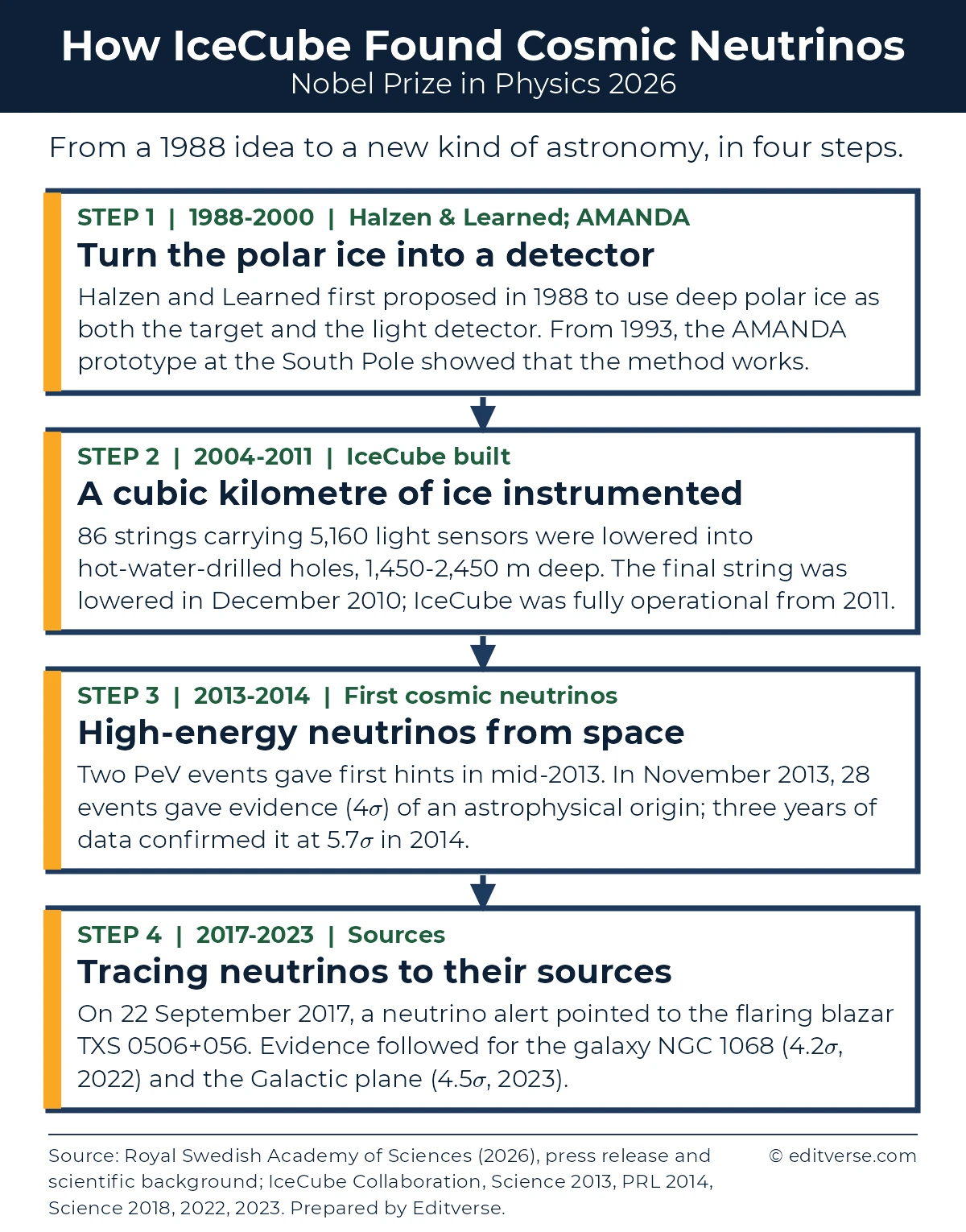
The discovery took a quarter of a century, from Halzen’s 1988 proposal through tests in Greenland and the AMANDA prototype to IceCube’s completion and the 2013 and 2014 detections.[2]
Pauli proposed the neutrino in 1930 (see our profile of Wolfgang Pauli), and around 1960 physicists suggested large volumes of water as a detecting medium.[2, 6] Off Hawaii, the ocean-based DUMAND project lost its single 1993 string soon after deployment and was cancelled in 1995.[2, 6]
Step 1 (1987 to 1988): Ice as a Detector
Deep Antarctic ice offered what the sea could not. At depth it is permanently dark, free of light from living creatures, low in radioactivity and free of earthquakes, and the South Pole research station supplied logistics.[1, 6] Halzen and Learned set out the concept in their June 1988 preprint.[4]
Step 2 (1991 to 2001): Testing the Ice
In 1991, photomultipliers lowered into boreholes on the Greenland ice sheet recorded Cherenkov light from atmospheric muons, in a Nature report Halzen co-authored, showing the ice was transparent enough.[22, 2] A year later, Barwick, Halzen and colleagues made the case for a detector on the square-kilometre scale in the Journal of Physics G.[23]
AMANDA went into the South Pole glacier in phases from 1993 to 2000.[2, 6] Shallow strings ran into trouble, because air bubbles at 800 to 1,000 metres scattered light within less than 50 centimetres, so later strings went down to 1,500 to 2,000 metres.[2, 6] In March 2001, AMANDA reported atmospheric neutrinos in Nature, showing that detection in ice worked at scale.[24, 2]
Step 3 (1999 to 2011): Building IceCube
The IceCube proposal went to the NSF in 1999 with Halzen as principal investigator, and funding followed in March 2002.[2] From 2005 to 2010, a hot-water drill melted 86 holes, each receiving a string of sensors before the water refroze.[2, 6] AMANDA was decommissioned in 2009, the final IceCube string was lowered in December 2010, and the first fully instrumented physics run began in May 2011.[2, 9]
Within four years of completion, IceCube moved from first hints of astrophysical neutrinos (mid-2013) to evidence (November 2013) and an observation at 5.7σ (September 2014).[25, 7, 8]
How Does IceCube Detect Neutrinos? Cherenkov Light in Ice
IceCube catches the rare neutrino that hits an atomic nucleus in the ice. The collision creates charged particles that move faster than light travels in ice, and they give off faint blue Cherenkov light that buried sensors record.[1, 6, 2]
One cubic kilometre of instrumented ice gives a target mass of about one gigatonne. Its 86 strings stand on a hexagonal grid 125 metres apart, and each carries 60 sensors spaced 17 metres apart between 1,450 and 2,450 metres down.[2, 6] Each sensor, a digital optical module, holds a 25.4-centimetre photomultiplier tube and digitising electronics in a glass housing.[2, 6, 9] Halzen describes the sensor as “a lightbulb in reverse”.[6]
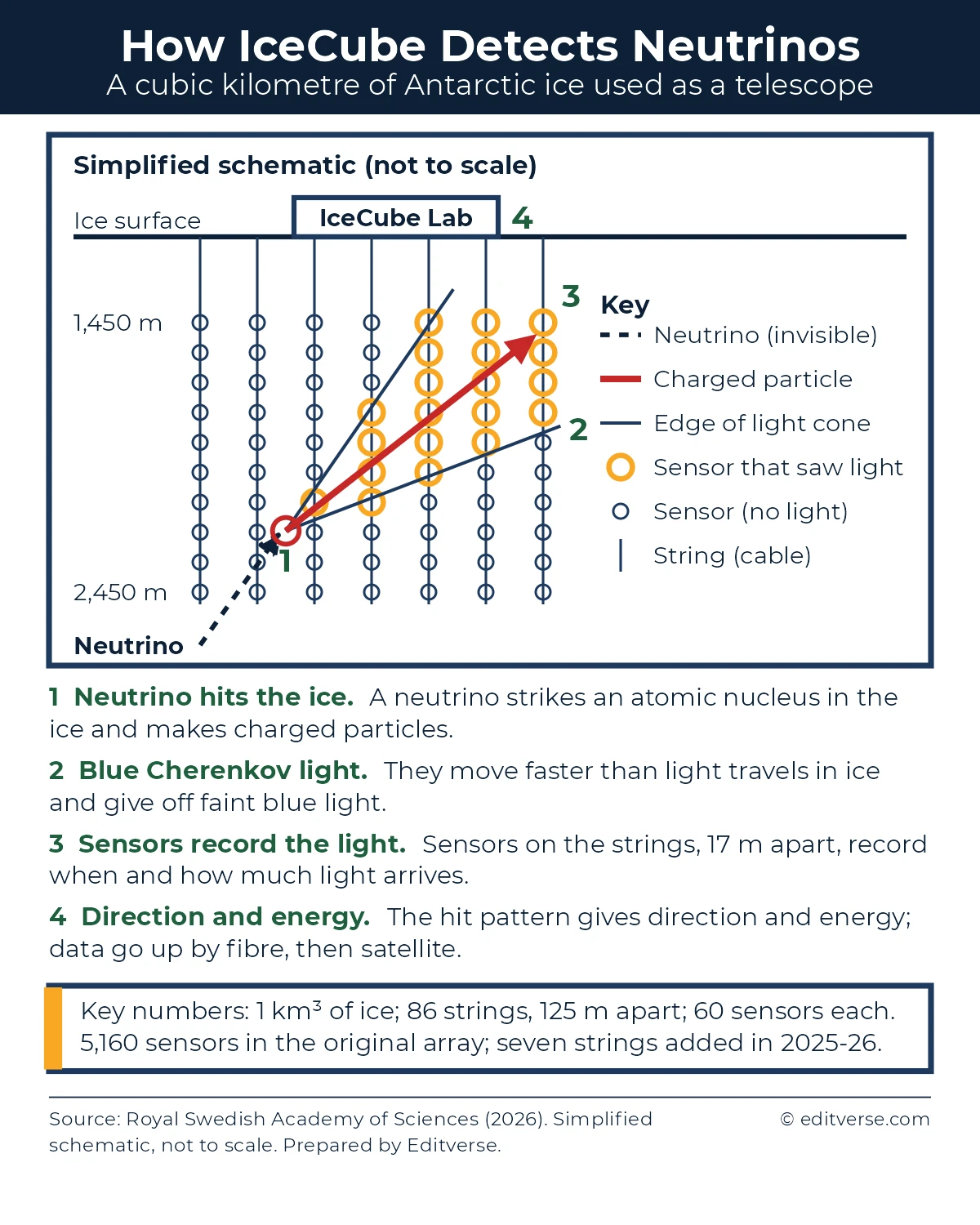
Below about 2,100 metres, light travels about 200 metres before it is absorbed and about 50 metres before it scatters.[2]
Tracks and Cascades Reveal Direction and Energy
A muon neutrino makes a muon that leaves a long light trail, a track pointing to within about 0.3 degrees at 100 TeV. Electron and tau neutrinos, and neutral-current interactions of any flavour, make a roughly spherical cascade, pointing to about 5 degrees but measuring energy to about 8% at 100 TeV.[2, 6]
Separating Cosmic Neutrinos from the Background
Atmospheric muons arrive about 3,000 times a second, so analysts keep tracks arriving from below the horizon, because the Earth blocks atmospheric muons from that direction, or events starting inside an inner volume with the outer sensors as a veto.[2, 6] Of roughly 100,000 neutrinos recorded each year above about 0.1 TeV, about 100 are expected to be astrophysical, and above a few tens of TeV the astrophysical flux rises above the atmospheric one.[2]
What Did IceCube Find? From PeV Neutrinos to NGC 1068
IceCube detected neutrinos from beyond the solar system, linked one to a flaring blazar, found evidence for neutrinos from NGC 1068 and observed neutrinos from the plane of the Milky Way.[2]
Reading the σ values
Physicists state the strength of a result in standard deviations, written σ (sigma). Larger values make a chance background fluctuation a less likely explanation, and the committee’s background treats 5σ as the discovery threshold.[2]
2013 and 2014: Neutrinos from Beyond the Solar System
In July 2013, Physical Review Letters reported two events of 1.04 and 1.14 PeV, found by chance in a search for even higher-energy neutrinos.[25, 2] Its abstract gives 2.8σ and presents the pair as a possible first indication of an astrophysical flux, too weak for a definitive conclusion.[25] In the 22 November 2013 issue of Science, the collaboration reported 28 events between 30 TeV and 1.14 PeV, 21 cascades and 7 tracks, and rejected a purely atmospheric origin at 4σ.[7, 2] Three years of data, 37 events and 988 days of live time then raised the significance to 5.7σ in the September 2014 Physical Review Letters paper.[8] Physics World had named IceCube’s 2013 observations its Breakthrough of the Year for 2013.[12]
2017: A Neutrino from the Blazar TXS 0506+056
On 22 September 2017, IceCube recorded a muon neutrino of about 290 TeV, named IceCube-170922A, and sent an alert worldwide within a minute.[2] Its best-fit direction lay about 0.1 degrees from TXS 0506+056, well inside the measurement uncertainty, and the blazar was flaring in gamma rays. Gamma-ray, X-ray, optical and radio teams followed up.[19, 2] Two Science papers released on 12 July 2018 (issue date 13 July 2018) described the campaign and an earlier neutrino flare from the same direction between September 2014 and March 2015, at 3.5σ.[19, 26]
2022: Evidence from the Active Galaxy NGC 1068
After testing 110 gamma-ray source positions, IceCube reported in November 2022 an excess of about 79 neutrinos with energies of 1 to 10 TeV from the direction of NGC 1068, also called M77, at 4.2σ.[20, 2] The paper’s title uses the word evidence, and the Nobel popular background says the result is not robust enough to identify NGC 1068 definitively as a neutrino source.[20, 6] Its central black hole, about 15 million solar masses, is blanketed in gas and dust, and weak gamma rays relative to the neutrino flux favour neutrino production in the corona around the black hole.[2]
2023 and 2026: Neutrinos from the Milky Way
In June 2023, IceCube reported neutrinos from the plane of our own Galaxy at 4.5σ, without identifying individual sources.[21] A 12-year update posted on arXiv on 28 July 2026 reports 5.7σ, which the committee’s background treats as crossing the 5σ threshold, but we found no peer-reviewed version as of 9 October 2026.[27, 2]
Later papers reported seven astrophysical tau-neutrino candidates in 2024 and, in March 2026, rejected a single power law for the spectrum from 5 TeV to 10 PeV at more than 4σ.[28, 29, 30]
Why the Nobel Prize in Physics 2026 Matters for Astronomy
Neutrinos give astronomers a messenger that arrives without being bent or absorbed, which the committee describes as “opening a new observation window on the high-energy universe”.[2]
Cosmic rays, mostly protons, are bent by magnetic fields, so their arrival directions hide their origin, and gamma rays can be absorbed en route.[6, 2] In cosmic accelerators, fast protons hit gas or light and make pions, whose decays yield both neutrinos and gamma rays.[2] Tracing high-energy neutrinos should therefore reveal where cosmic-ray protons are accelerated, in natural accelerators reaching energies up to a million times beyond laboratories on Earth.[6, 1] For a sense of laboratory energies, see our overview of CERN's Large Hadron Collider.
Multimessenger astronomy gains a partner too, since the neutrino energy flux is comparable to that of gamma rays at lower energies and of cosmic rays at higher energies, which suggests one class of sources.[2] Alerts sent within about a minute of an event let telescopes search the same patch of sky, as happened with TXS 0506+056.[2] Gravitational waves are another messenger, covered in our article on gravitational waves as a new window to the universe.
Neutrinos can also expose accelerators hidden behind dust.[6] Mark Pearce, chair of the Nobel Committee for Physics, said Halzen’s international team had “provided us with a fantastic instrument”.[1]
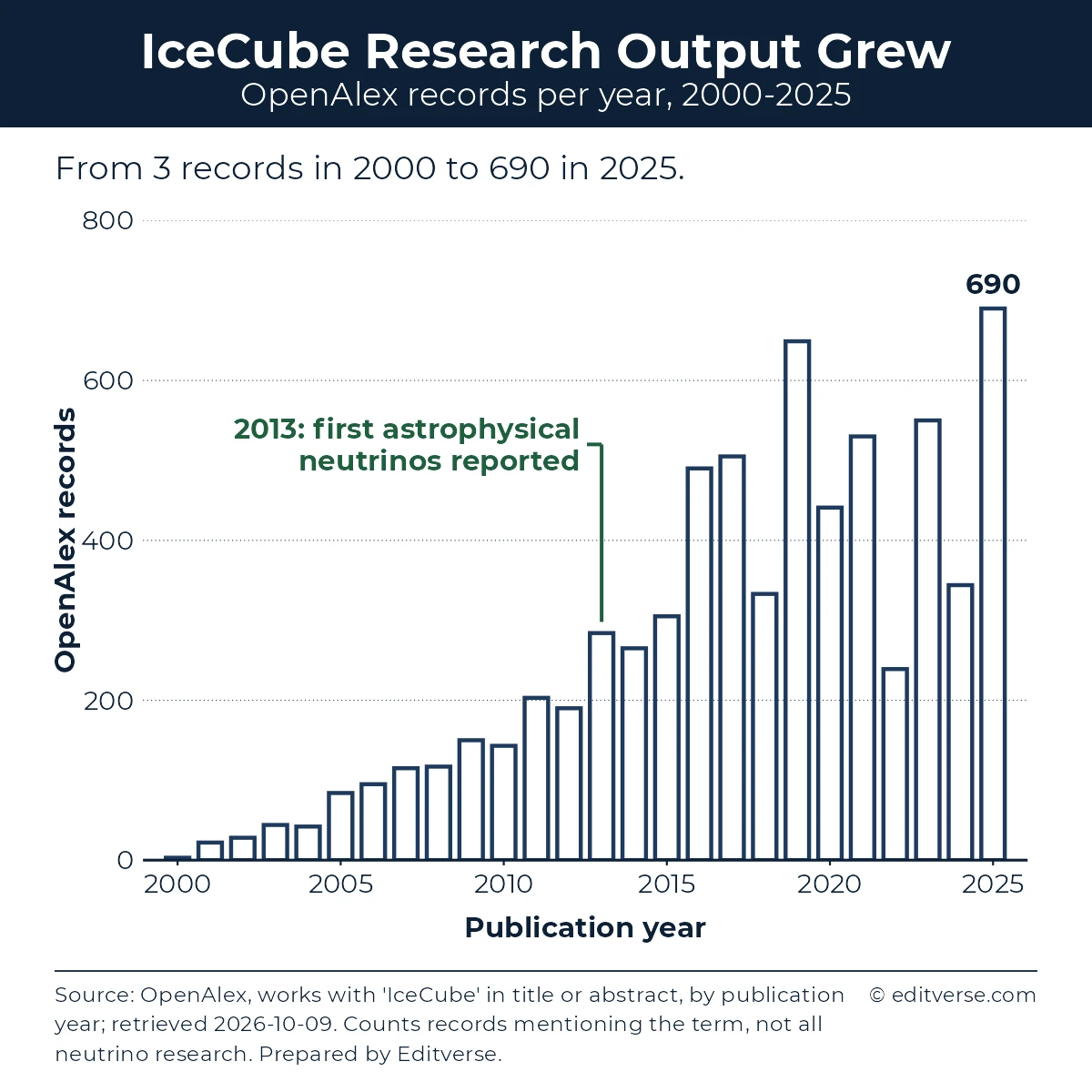
Output grew alongside the detector. OpenAlex indexes 84 works from 2005 whose title or abstract matches IceCube and 690 from 2025 (Figure 4).[31] Counts peak in odd years because the International Cosmic Ray Conference meets every two years, and OpenAlex lists 125, 148, 161 and 142 of its proceedings records in 2019, 2021, 2023 and 2025.[32]
Open Questions and Honest Limits
The Nobel Prize in Physics 2026 rewards a measured flux of cosmic neutrinos, but most of its sources remain unidentified.[2]
The sky shows no significant anisotropy, and the Galactic plane and NGC 1068 contribute little of the diffuse flux, which points to mostly extragalactic sources.[2] More than a thousand searches for neutrinos coinciding with gamma-ray bursts have found none.[2] Statistics remain thin, with about 100 astrophysical neutrinos expected per year among roughly 100,000 recorded.[2] NGC 1068 stands at 4.2σ, and the 5.7σ Milky Way result is still a preprint.[20, 27] Field work is possible only in the Antarctic summer, from November to February.[6]
Seven new strings were installed for the IceCube Upgrade in 2025 and 2026, and the planned IceCube-Gen2 would instrument about eight cubic kilometres of ice.[3, 9, 6] Elsewhere, KM3NeT in the Mediterranean, P-ONE off Vancouver Island, TRIDENT in the South China Sea and Baikal-GVD in Lake Baikal make up the next generation.[2, 6]
What the Nobel Prize in Physics 2026 Teaches Researchers About Big Science
IceCube shows that some discoveries need decades, hundreds of collaborators and a publishing system that credits whole teams.[2, 3]
Twenty-five years separate the 1988 preprint from the 2013 evidence paper.[4, 7] Along the way, bubbles forced the sensors deeper, while the ocean-based DUMAND project was cancelled.[2] A working prototype came before the funding decision, as AMANDA’s 2001 Nature paper appeared a year before the NSF approved IceCube.[24, 2]
Credit is collective. PubMed lists 277 individual authors plus the IceCube Collaboration on the 2013 Science paper, and the 2018 multimessenger paper was credited to IceCube and 15 other teams.[7, 19] Databases count citations differently, and as of 9 October 2026 OpenAlex records 1,615 citations of the 2013 Science paper and Crossref records 1,237.[33] Even IceCube’s 2017 instrumentation paper in the Journal of Instrumentation has 816 OpenAlex citations.[33, 34]
Working in a large team? Settle authorship rules, figure standards and target journals early. Our guides to publishing in Nature and other high-impact multidisciplinary journals, selecting a journal for your research paper and field-specific h-index norms cover the practical side, and our strategies for increasing your paper's citations help published work reach readers.
Next in This Series: The Papers Behind the Prize
Our companion article follows the papers behind the Nobel Prize in Physics 2026 one by one.
Part 2
The Papers Behind the 2026 Nobel Prize in Physics
Journals, dates, DOIs, significance levels and citation counts for the key IceCube papers.
More from the 2026 Nobel Prizes. Read our Nobel Prize in Medicine 2026 guide to optogenetics, the companion piece on the papers behind the optogenetics Nobel Prize, and the papers behind the IceCube Nobel Prize.
Professional Services for Physics and Astronomy Manuscripts
Papers like those behind the Nobel Prize in Physics 2026 depend on clear data figures, precise technical language and a well-chosen journal. Editverse offers four services suited to physical-science manuscripts.
Premium Scientific Editing
$750
Full technical editing, figures and tables review, and re-submission support for top-tier journals. 90 days of unlimited revisions.
Data Visualization
$300
Up to 10 publication-ready figures prepared from your research data.
Journal Selection
$115
Expert journal selection with 5 to 10 ranked journal suggestions and the rationale for each, covering scope, impact factor and acceptance rate.
Substantive Editing
$250
Subject-expert editing for clarity, flow and formatting, with unlimited revisions for 90 days.
Preparing a reply to referees? Our Response to Reviewers and Manuscript Revision Services cover point-by-point responses and the full revision of your manuscript.
- GraphPro: build publication-ready charts, 25 types, with built-in t-test, ANOVA, correlation, and chi-square p-values. Free, no signup.
- StatPro: free statistical calculators and a test-selector tool covering group comparisons, categorical outcomes, time-to-event analysis, and diagnostic accuracy.
- Flowchart Pro: generate PRISMA 2020, PRISMA-ScR, CONSORT, STROBE, STARD, MOOSE, and ARRIVE flow diagrams directly in your browser.
Related Editverse Resources
Frequently Asked Questions About the Nobel Prize in Physics 2026
Who won the Nobel Prize in Physics 2026?
Francis Halzen of the University of Wisconsin-Madison, USA, won the Nobel Prize in Physics 2026 as sole laureate, announced on 6 October 2026, for his contributions to the IceCube Neutrino Observatory and to the discovery of high-energy neutrinos from astrophysical sources.[1, 5]
What is the IceCube Neutrino Observatory?
IceCube is a neutrino detector built into one cubic kilometre of ice at the South Pole. Its original array has 5,160 light sensors on 86 cables, completed in December 2010 and fully operational from 2011.[6, 2, 9]
How does IceCube detect neutrinos?
A neutrino hitting an atomic nucleus in the ice produces charged particles that emit faint blue Cherenkov light. Buried sensors record the light, whose pattern reveals the neutrino’s direction and energy.[1, 2]
What did IceCube discover?
IceCube reported evidence for high-energy neutrinos from beyond the solar system in 2013, reaching 5.7 sigma in 2014. It later linked a 2017 neutrino to the blazar TXS 0506+056 and found evidence at 4.2 sigma for neutrinos from NGC 1068. In 2023 it reported neutrinos from the plane of the Milky Way at 4.5 sigma.[7, 8, 19, 20, 21]
Is NGC 1068 a confirmed neutrino source?
Not yet. IceCube’s 2022 Science paper reported evidence at 4.2 sigma, below the 5 sigma discovery threshold, and the Nobel popular background calls it not robust enough for a definitive identification.[20, 6, 2]
How much is the Nobel Prize in Physics 2026 worth?
The prize amount is 12 million Swedish kronor. Francis Halzen is the sole laureate, so the full amount goes to him.[1, 5]
How to Cite This Article
Editverse. (2026, October 9). Nobel Prize in Physics 2026: IceCube and neutrinos from space, explained. Editverse. https://editverse.com/nobel-prize-physics-2026-icecube-neutrinos/
References
- Royal Swedish Academy of Sciences. Press release: The Nobel Prize in Physics 2026 [Internet]. Stockholm: Royal Swedish Academy of Sciences; 2026 Oct 6 [cited 2026 Oct 9]. Available from: https://www.nobelprize.org/uploads/2026/10/press-physicsprize2026.pdf
- Nobel Committee for Physics. Scientific background to the Nobel Prize in Physics 2026 [Internet]. Stockholm: Royal Swedish Academy of Sciences; 2026 Oct 6 [cited 2026 Oct 9]. Available from: https://www.nobelprize.org/uploads/2026/10/advanced-physicsprize2026.pdf
- IceCube Neutrino Observatory. Francis Halzen, IceCube principal investigator, wins 2026 physics Nobel Prize [Internet]. Madison (WI): University of Wisconsin-Madison; 2026 Oct 6 [cited 2026 Oct 9]. Available from: https://icecube.wisc.edu/news/awards/2026/10/francis-halzen-icecube-principal-investigator-wins-2026-physics-nobel-prize/
- Halzen F, Learned JG. High-energy neutrino detection in deep polar ice. Preprint MAD/PH/428 (University of Wisconsin) and UH-511-659-88 (University of Hawaii). 1988 Jun. No DOI. INSPIRE record: https://inspirehep.net/literature/262563
- Nobel Prize Outreach. Francis Halzen, facts, the Nobel Prize in Physics 2026 [Internet]. NobelPrize.org; 2026 [cited 2026 Oct 9]. Available from: https://www.nobelprize.org/prizes/physics/2026/halzen/facts/
- Royal Swedish Academy of Sciences. Popular science background: Ice at the South Pole reveals cosmic particle accelerators [Internet]. Stockholm: Royal Swedish Academy of Sciences; 2026 Oct 6 [cited 2026 Oct 9]. Available from: https://www.nobelprize.org/uploads/2026/10/popular-physicsprize2026.pdf
- IceCube Collaboration, Aartsen MG, et al. Evidence for high-energy extraterrestrial neutrinos at the IceCube detector. Science. 2013 Nov 22;342(6161):1242856. doi:10.1126/science.1242856. DOI link | PMID: 24264993. PubMed
- IceCube Collaboration, Aartsen MG, Ackermann M, et al. Observation of high-energy astrophysical neutrinos in three years of IceCube data. Phys Rev Lett. 2014 Sep 5;113(10):101101. Published online 2014 Sep 2. doi:10.1103/PhysRevLett.113.101101. DOI link | PMID: 25238345. PubMed
- Wisconsin IceCube Particle Astrophysics Center. Prof. Francis Halzen honored with the 2026 APS Medal [Internet]. Madison (WI): WIPAC; 2026 [cited 2026 Oct 9]. Republished American Physical Society story. Available from: https://wipac.wisc.edu/prof-francis-halzen-honored-with-the-2026-aps-medal
- Associated Press. Francis Halzen wins Nobel Prize in physics for work on high-energy neutrinos from space [Internet]. Georgia Public Broadcasting; 2026 Oct 6 [cited 2026 Oct 9]. Available from: https://www.gpb.org/news/2026/10/06/francis-halzen-wins-nobel-prize-in-physics-for-work-on-high-energy-neutrinos-space
- Associated Press. Nobel Prize in physics goes to Francis Halzen [Internet]. ITV News; 2026 Oct 6 [cited 2026 Oct 9]. Available from: https://www.itv.com/news/2026-10-06/nobel-prize-in-physics-goes-to-francis-halzen
- Johnston H. Cosmic neutrinos named Physics World 2013 Breakthrough of the Year [Internet]. Physics World; 2013 Dec 13 [cited 2026 Oct 9]. Available from: https://physicsworld.com/a/cosmic-neutrinos-named-physics-world-2013-breakthrough-of-the-year
- International Balzan Prize Foundation. Francis Halzen, 2015 Balzan Prize for Astroparticle Physics including Neutrino and Gamma-ray Observation [Internet]. [cited 2026 Oct 9]. Available from: https://balzan.org/en/prizewinners/francis-halzen
- Joint Institute for Nuclear Research, Dzhelepov Laboratory of Nuclear Problems. Bruno Pontecorvo Prize [Internet]. Dubna: JINR; [cited 2026 Oct 9]. Available from: https://dlnp.jinr.ru/en/awards/award-pontecorvo/
- IceCube Neutrino Observatory. Francis Halzen awarded 2019 Yodh Prize [Internet]. Madison (WI): University of Wisconsin-Madison; 2019 Aug [cited 2026 Oct 9]. Available from: https://icecube.wisc.edu/news/awards/2019/08/francis-halzen-awarded-2019-yodh-prize
- IceCube Neutrino Observatory. IceCube Collaboration awarded 2021 Rossi Prize [Internet]. Madison (WI): University of Wisconsin-Madison; 2021 Jan 13 [cited 2026 Oct 9]. Available from: https://icecube.wisc.edu/news/awards/2021/01/icecube-collaboration-awarded-2021-rossi-prize/
- University of Wisconsin-Madison Department of Physics. 2021 Homi Bhabha award given to Francis Halzen [Internet]. Madison (WI); 2021 Jul 13 [cited 2026 Oct 9]. Available from: https://www.physics.wisc.edu/2021/07/13/2021-homi-bhabha-award-given-to-francis-halzen/
- IceCube Neutrino Observatory. Francis Halzen elected to National Academy of Sciences [Internet]. Madison (WI): University of Wisconsin-Madison; 2024 May [cited 2026 Oct 9]. Available from: https://icecube.wisc.edu/news/awards/2024/05/francis-halzen-elected-to-national-academy-of-sciences/
- IceCube Collaboration, Fermi-LAT, MAGIC, AGILE, ASAS-SN, HAWC, H.E.S.S., INTEGRAL, Kanata, Kiso, Kapteyn, Liverpool Telescope, Subaru, Swift/NuSTAR, VERITAS, VLA/17B-403 teams. Multimessenger observations of a flaring blazar coincident with high-energy neutrino IceCube-170922A. Science. 2018 Jul 13;361(6398):eaat1378. Published online 2018 Jul 12. doi:10.1126/science.aat1378. DOI link | PMID: 30002226. PubMed
- IceCube Collaboration, Abbasi R, et al. Evidence for neutrino emission from the nearby active galaxy NGC 1068. Science. 2022 Nov 4;378(6619):538-543. Published online 2022 Nov 3. doi:10.1126/science.abg3395. DOI link | PMID: 36378962. PubMed
- IceCube Collaboration, Abbasi R, et al. Observation of high-energy neutrinos from the Galactic plane. Science. 2023 Jun 30;380(6652):1338-1343. Published online 2023 Jun 29. doi:10.1126/science.adc9818. DOI link | PMID: 37384687. PubMed
- Lowder DM, Miller T, Price PB, Westphal A, Barwick SW, Halzen F, et al. Observation of muons using the polar ice cap as a Cerenkov detector. Nature. 1991 Sep;353(6342):331-333. doi:10.1038/353331a0. DOI link (not indexed in PubMed)
- Barwick S, Halzen F, Lowder D, Miller T, Morse R, Price PB, et al. Neutrino astronomy on the 1 km2 scale. J Phys G Nucl Part Phys. 1992 Feb;18(2):225-247. doi:10.1088/0954-3899/18/2/008. DOI link (not indexed in PubMed)
- Andrés E, Askebjer P, et al. Observation of high-energy neutrinos using Čerenkov detectors embedded deep in Antarctic ice. Nature. 2001 Mar 22;410(6827):441-443. doi:10.1038/35068509. DOI link | PMID: 11260705. PubMed
- IceCube Collaboration, Aartsen MG, et al. First observation of PeV-energy neutrinos with IceCube. Phys Rev Lett. 2013 Jul 12;111(2):021103. Published online 2013 Jul 8. doi:10.1103/PhysRevLett.111.021103. DOI link | PMID: 23889381. PubMed
- IceCube Collaboration, Aartsen M, et al. Neutrino emission from the direction of the blazar TXS 0506+056 prior to the IceCube-170922A alert. Science. 2018 Jul 13;361(6398):147-151. doi:10.1126/science.aat2890. DOI link | PMID: 30002248. PubMed
- IceCube Collaboration. High-energy neutrino emission from the Milky Way [preprint]. arXiv:2607.25966. 2026 Jul 28 [cited 2026 Oct 9]. Not peer reviewed as far as verified. Available from: https://arxiv.org/abs/2607.25966
- IceCube Collaboration, Abbasi R, Ackermann M, et al. Observation of seven astrophysical tau neutrino candidates with IceCube. Phys Rev Lett. 2024 Apr 12;132(15):151001. Published online 2024 Apr 11. doi:10.1103/PhysRevLett.132.151001. DOI link | PMID: 38682982. PubMed
- IceCube Collaboration, Abbasi R, Ackermann M, et al. Evidence for a spectral break or curvature in the spectrum of astrophysical neutrinos from 5 TeV to 10 PeV. Phys Rev Lett. 2026;136(12):121002. Published online 2026 Mar 26. doi:10.1103/2gh9-d4q7. DOI link | PMID: 41965033. PubMed
- IceCube Collaboration, Abbasi R, Ackermann M, et al. Improved measurements of the TeV-PeV extragalactic neutrino spectrum from joint analyses of IceCube tracks and cascades. Phys Rev D. 2026;113(6):062002. Published online 2026 Mar 26. doi:10.1103/4n6v-r7n4. DOI link (not indexed in PubMed)
- OpenAlex. Works per publication year matching filter title_and_abstract.search:icecube, 2000 to 2025 (meta.count) [Internet]. [cited 2026 Oct 9]. Available from: https://api.openalex.org/works?filter=title_and_abstract.search:icecube,publication_year:2025&per-page=1 (one query per year, changing the year value)
- OpenAlex. Works matching title_and_abstract.search:icecube grouped by primary source (group_by=primary_location.source.id), publication years 2019 to 2025 [Internet]. [cited 2026 Oct 9]. International Cosmic Ray Conference records 125 (2019), 148 (2021), 161 (2023) and 142 (2025). Available from: https://api.openalex.org/works?filter=title_and_abstract.search:icecube,publication_year:2019&group_by=primary_location.source.id (one query per year)
- OpenAlex and Crossref. Citation counts for the IceCube papers listed in this article, retrieved 2026 Oct 9. OpenAlex records include W1530183786 (Science 2013) and W2588745414 (JINST 2017). Available from: api.openalex.org/works/W1530183786, api.openalex.org/works/W2588745414 and api.crossref.org/works/10.1126/science.1242856
- IceCube Collaboration, Aartsen MG, et al. The IceCube Neutrino Observatory: instrumentation and online systems. J Instrum. 2017 Mar 14;12(03):P03012. doi:10.1088/1748-0221/12/03/P03012. DOI link (not indexed in PubMed)