
On 5 October 2026, the Nobel Assembly at Karolinska Institutet awarded the Nobel Prize in Medicine 2026 (formally, the Nobel Prize in Physiology or Medicine) jointly to Karl Deisseroth, Peter Hegemann and Georg Nagel.[1] Hegemann and Nagel showed that the light sensor of a single-celled green alga is itself an ion channel, a protein that opens a pore in the cell membrane when light strikes it. Deisseroth turned that protein into a switch that makes chosen nerve cells fire on command.[1, 2] Called optogenetics, the method lets researchers switch specific brain cells on or off with millisecond timing.[3]
Everyone at Editverse congratulates the three laureates. Their work runs from basic photobiology at two Max Planck institutes in Germany to a psychiatrist’s lab at Stanford, and it shows how curiosity about an obscure organism can change how medicine studies the brain.[1, 3] Below are the key facts, the laureates, the discovery, its uses and limits, and the papers to cite.
Last verified: 7 October 2026 against the official Nobel documents, PubMed and CrossRef.
Nobel Prize in Medicine 2026: Key Facts at a Glance
The Nobel Prize in Medicine 2026 honours the discovery of light-gated ion channels in algae and their use to control nerve cells, a method called optogenetics.[1]
Key Facts, 2026 Nobel Prize in Physiology or Medicine
- The Nobel Assembly at Karolinska Institutet announced the 2026 Nobel Prize in Physiology or Medicine on 5 October 2026 (Nobel press release, PDF).[1]
- The prize went jointly to Karl Deisseroth (born 1971, Howard Hughes Medical Institute and Stanford University, USA), Peter Hegemann (born 1954, Humboldt University of Berlin, Germany) and Georg Nagel (born 1953, University of Würzburg, Germany).[1]
- The official motivation reads “for their discoveries concerning light-gated ion channels and optogenetics”.[1]
- The prize amount is 12 million Swedish kronor, shared equally between the three laureates.[1]
- Nagel, Hegemann, Bamberg and colleagues described channelrhodopsin-1, a light-gated proton channel, in Science on 28 June 2002 (PMID 12089443).[4]
- The same group showed that channelrhodopsin-2 is a directly light-gated cation channel in PNAS on 25 November 2003 (PMID 14615590).[5]
- Boyden, Zhang, Bamberg, Nagel and Deisseroth used channelrhodopsin-2 to make mammalian neurons fire with millisecond precision in Nature Neuroscience, published online 14 August 2005 (PMID 16116447).[6]
In Simple Words
A tiny green alga steers towards light using a special protein. Hegemann and Nagel found that this protein is a door in the cell’s membrane that opens when light hits it, letting charged particles rush in. Deisseroth put the protein’s gene into rat and mouse nerve cells, so light alone could make them fire. Researchers now use this switch to test which brain cells cause a memory, a mood or a movement.
Who Won the Nobel Prize in Medicine 2026? Meet the Three Laureates
Karl Deisseroth, Peter Hegemann and Georg Nagel share the Nobel Prize in Medicine 2026 equally.[1] Hegemann and Nagel discovered the light-gated channels in Germany, and Deisseroth, a Stanford psychiatrist and bioengineer, made them work in neurons and living animals.[1, 3]
| Laureate | Born | Affiliation in 2026 | Contribution recognised |
|---|---|---|---|
| Peter Hegemann | 1954 | Humboldt University of Berlin, Germany | Light-triggered currents in algae, identification of the channelopsin genes, co-discovery of channelrhodopsins |
| Georg Nagel | 1953 | University of Würzburg, Germany | First author of the 2002 and 2003 papers proving channelrhodopsins are light-gated channels |
| Karl Deisseroth | 1971 | Howard Hughes Medical Institute and Stanford University, USA | Channelrhodopsin-2 in neurons (2005) and in living animals (2007), development of optogenetics |
Birth years and affiliations from the Nobel press release; contributions from the scientific background and original papers.[1, 3, 4, 5, 6]
Peter Hegemann
Peter Hegemann, born in 1954, earned his PhD in 1984 at the Max Planck Institute for Biochemistry in Martinsried, where his prize-winning discoveries were also made, and he is now Hertie Senior Professor of Neuroscience at Humboldt University of Berlin.[1] He trained with Dieter Oesterhelt, then joined Kenneth Foster’s laboratory, which had shown in 1984 that a rhodopsin guides Chlamydomonas towards light.[3] His group recorded the alga’s ultrafast photocurrents and identified the genes for channelopsin-1 and channelopsin-2.[3] Before the Nobel Prize, Hegemann shared the 2013 Louis-Jeantet Prize for Medicine with Nagel,[7] the 2013 Brain Prize with five colleagues including Nagel and Deisseroth,[8] and the 2021 Albert Lasker Basic Medical Research Award with Deisseroth and Dieter Oesterhelt.[9]
Georg Nagel
Georg Nagel, born in 1953, completed his PhD in 1988 at the University of Frankfurt and is Professor of Molecular Plant Physiology at the University of Würzburg. His prize-winning work was done at the Max Planck Institute for Biophysics in Frankfurt.[1] He trained there under Ernst Bamberg, first met Hegemann at that institute, and was a postdoc at Yale and Rockefeller.[3] As first author of both founding papers, Nagel reported the light-gated currents in frog (Xenopus) egg cells that proved channelrhodopsins are ion channels.[4, 5] Nobel committee members also credit him with noticing that neurons need no added retinal.[3] His earlier honours include the 2013 Louis-Jeantet Prize for Medicine, shared with Hegemann, and the 2013 Brain Prize.[7, 8]
Karl Deisseroth
Karl Deisseroth, born in 1971, earned a PhD in 1998 and an MD in 2000 at Stanford University, where he is D.H. Chen Professor and Professor of Bioengineering and of Psychiatry and Behavioral Sciences, with an affiliation at the Howard Hughes Medical Institute.[1] Meeting psychiatric patients during medical training convinced him he needed to study nerve cells in the living brain, and he was starting his own Stanford lab when he took up channelrhodopsin-2.[2, 3] His team made the protein drive cultured neurons in 2005 and brought the method into living animals in 2007.[6, 10, 11] Deisseroth told STAT he “couldn’t be happier than to share this with these two friends.”[12] His earlier honours include the 2013 Brain Prize and the 2021 Lasker Basic Medical Research Award.[8, 9]
How Was Optogenetics Discovered? Three Steps from Algae to Neurons
Optogenetics grew from Hegemann’s 1990s recordings of a light-triggered current in algae, the 2002 and 2003 proof that the algal photoreceptors are light-gated channels, and Deisseroth’s 2005 to 2007 work using one of them to control mammalian neurons.[3]
Francis Crick argued in 1979 that neuroscience needed a way to control one cell type at a time, and in 1999 suggested that light would be the ideal signal, although he called the idea far-fetched.[3, 2] Oesterhelt and Stoeckenius had shown in the early 1970s that bacteriorhodopsin is a light-driven proton pump, but a light-activated protein fast and simple enough to work inside a nerve cell was still missing.[3]
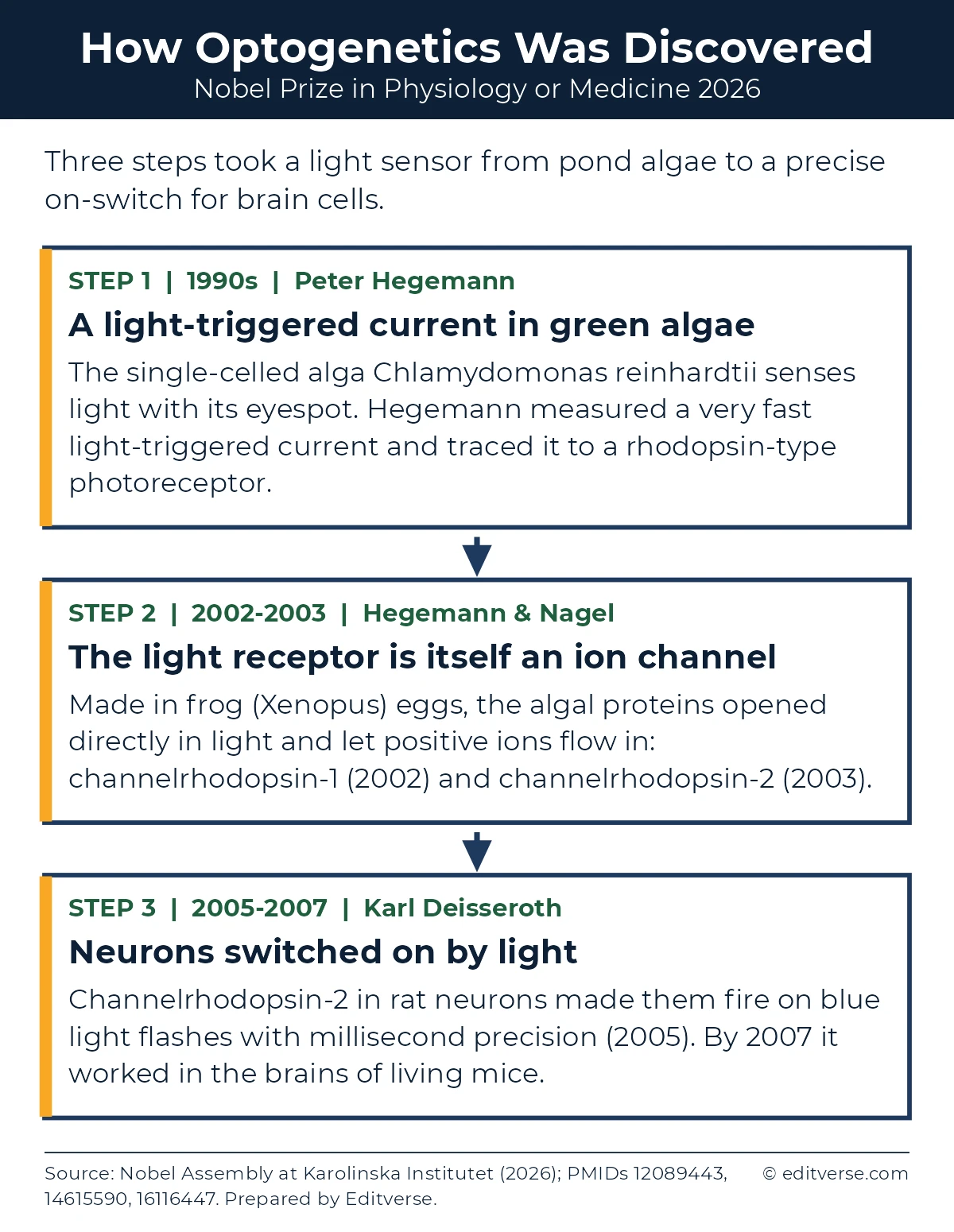
Step 1 (1990s): Hegemann Finds an Ultrafast Light Current in Algae
Chlamydomonas reinhardtii senses light with an orange eyespot containing retinal, a light-capturing molecule.[2] Light signalling in the human eye passes through many steps and takes at least 10 milliseconds, yet the alga responds more than 20 times faster.[2] Harz and Hegemann reported in Nature in 1991 that the light-evoked current in the alga begins within a fraction of a millisecond.[13, 2] Such speed hinted that a single protein might both capture light and conduct ions, an idea Hegemann proposed in the early 1990s that was initially met with scepticism.[2] Later papers from his group in 1992 and 1996 characterised this current in detail.[14, 15]
Step 2 (2002 to 2003): The Light Receptor Turns Out to Be an Ion Channel
In 2000, Japanese researchers led by Asamizu released a Chlamydomonas expressed-sequence-tag database, and Hegemann’s lab used it to identify two candidate genes, channelopsin-1 and channelopsin-2.[3, 2] In June 2002, Spudich’s group showed by RNA interference that two rhodopsins drive the alga’s photocurrents and phototaxis.[16] On 28 June 2002, Nagel, Hegemann, Bamberg and co-workers reported in Science that channelopsin-1 expressed in frog egg cells produced inward currents under green light, carried mainly by protons.[4, 3] They named the protein channelrhodopsin-1, the first direct evidence of a light-gated ion channel.[3]
In PNAS on 25 November 2003, the same team showed that channelrhodopsin-2 is a directly light-gated channel for positive ions (cations) that responds to blue light, opens within 0.2 milliseconds, and works in frog egg cells and human kidney cells.[5, 2, 3] Its authors proposed it as a tool to depolarize cells simply by illumination.[5]
Step 3 (2005 to 2007): Deisseroth Switches Neurons On and Off with Light
Deisseroth’s lab, working with Nagel and Bamberg, delivered the channelrhodopsin-2 gene by lentivirus into cultured rat hippocampal neurons and showed that pulses of blue light drove nerve impulses with millisecond precision.[6] Published online in Nature Neuroscience on 14 August 2005, the paper is called a milestone by the Nobel committee, and no retinal had to be added because mammalian neurons already contain it.[6, 3] By December 2005, Nagel, Gottschalk and colleagues had used channelrhodopsin-2 to trigger behaviour in the worm Caenorhabditis elegans.[17] The term optogenetics emerged while the method was being developed and first appeared in a 2006 Journal of Neuroscience review co-authored by Deisseroth.[24, 18]
In 2007, three studies extended the method. A Nature paper added halorhodopsin, a yellow-light pump, so neurons could be silenced as well as excited.[19] An optical fibre about 200 micrometres wide drove channelrhodopsin-2 in the motor cortex of living rodents and deflected their whiskers.[10, 3] Light stimulation of hypocretin (orexin) neurons in freely moving mice increased transitions from sleep to wakefulness.[11]
How Does Channelrhodopsin Work? The Light Switch in Plain Language
Channelrhodopsin is a single protein that is both a light sensor and an ion channel. When blue light hits channelrhodopsin-2, a pore opens and positively charged ions flow into the cell, producing an electrical signal that can make a neuron fire.[1, 2, 5]
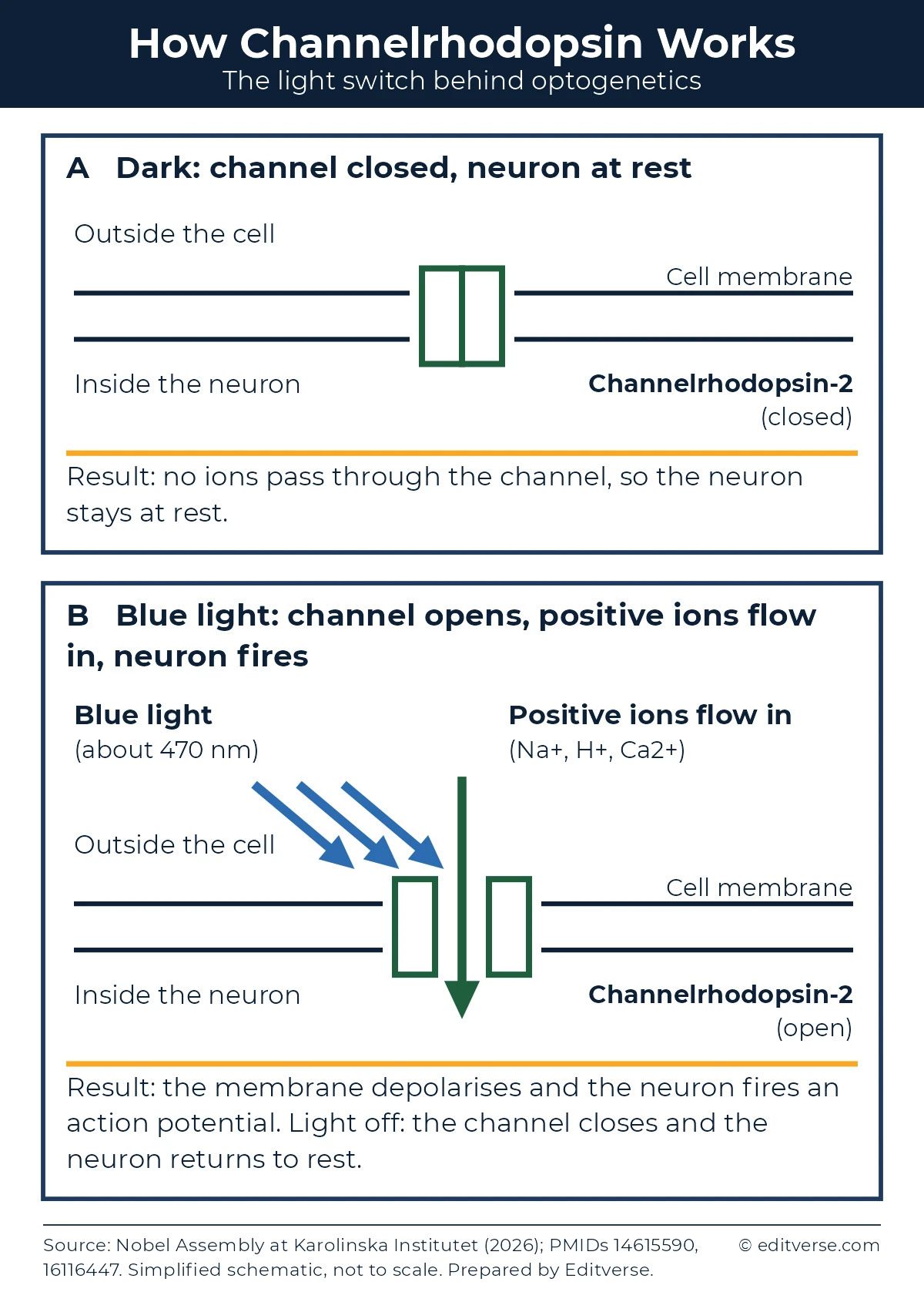
Speed made the discovery useful. Light-driven pumps such as bacteriorhodopsin and halorhodopsin move about one ion per photon against a concentration gradient, whereas channelrhodopsins open a pore and let ions flow passively down their gradient, which is fast enough to keep pace with a nerve cell’s action potentials.[3] Committee members call it “the long-sought, millisecond-precise switch for neuronal activity”.[3]
In a typical experiment, researchers insert the channelrhodopsin gene into one chosen type of nerve cell, often with a virus, then deliver light through an implanted optical fibre to switch those cells on.[3, 2] To switch cells off, they use halorhodopsin or the anion channelrhodopsins discovered in 2015.[3] For related light-based methods, see our guide to neurophotonics and optical brain imaging.
What optogenetics adds is causation. Instead of only recording which cells are active during a behaviour, researchers can test whether a defined cell type is sufficient or necessary for it.[3, 1]
Why the Nobel Prize in Medicine 2026 Matters: What Optogenetics Has Revealed
Optogenetics matters because it lets researchers test the causal contribution of specific nerve-cell populations to a behaviour, and the Nobel Assembly says it has fundamentally changed our understanding of the brain.[1] In 2021, a single blind patient also regained partial vision after optogenetic therapy.[20]
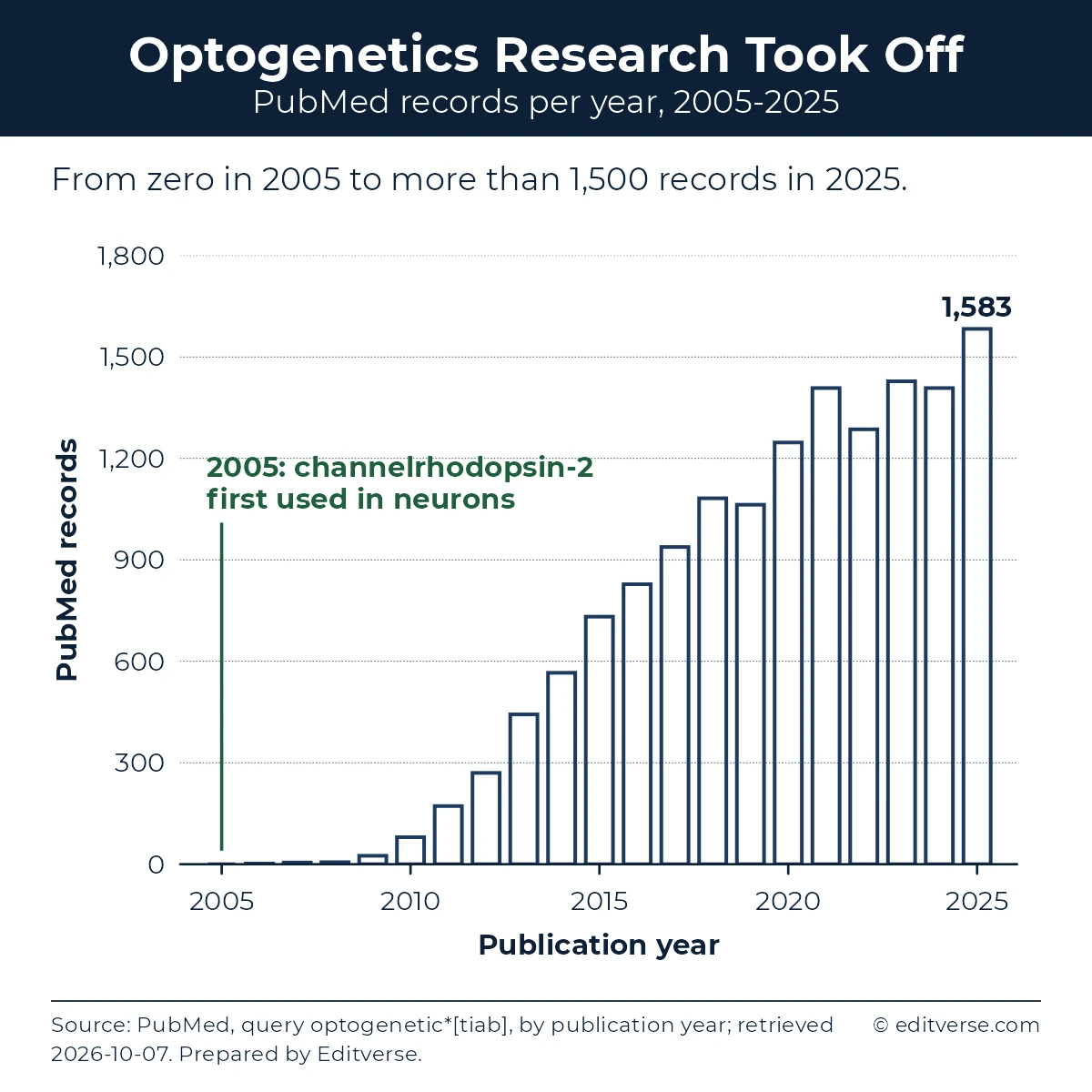
Uptake was rapid, and Nature Methods named optogenetics its Method of the Year 2010.[21] A PubMed search for optogenetic*[tiab], counted by publication year, returns 80 records for 2010 and 1,583 for 2025, retrieved on 7 October 2026 (Figure 4).[22] See also our overview of recent neuroscience and brain research advances.
What Has Optogenetics Revealed About the Brain?
Circuits mapped with light include those for pain, social behaviour, thirst, food intake, reward, attention, circadian rhythm and immune-triggered fever.[2] In 2012, Liu, Ramirez, Deisseroth, Tonegawa and colleagues reactivated a hippocampal memory engram with light and triggered recall of a fear memory, and later work described by the committee went on to create a false memory.[23, 3] Other studies separated reward from aversion in dopamine circuits and split aggression, mating and parenting into distinct neural circuits.[3, 2]
Beyond the brain, Deisseroth’s group linked heart rhythm to anxiety, and the committee credits the method with improving understanding of depression, schizophrenia, Alzheimer’s disease and Parkinson’s disease.[2]
Is Optogenetics Used in Humans? The 2021 Vision Case
Only in early clinical research so far. In 2021, Sahel, Roska and colleagues reported in Nature Medicine on a single blind patient with retinitis pigmentosa, a disease that destroys the rods and cones of the retina, who received an adeno-associated viral vector carrying the gene encoding ChrimsonR, a channelrhodopsin-like protein.[20, 2] Wearing light-projecting goggles, the patient could discern and grasp objects on a table, a partial recovery rather than restored normal sight.[20, 2] Sahel and colleagues call it the “first reported case of partial functional recovery in a neurodegenerative disease after optogenetic therapy”.[20] Clinical trials are ongoing, and researchers hope optogenetics may one day make cochlear implants more precise.[2] Compare our roundup of neurotechnology applications across research fields.
Limits of Optogenetics Today
Optogenetics remains mainly a research tool. Each use depends on two separate steps, getting a foreign gene into the right cells, usually with a viral vector, and getting light to those cells, which in the brain typically means an implanted optical fibre and in the eye meant external goggles.[3, 20] Most discoveries described above come from model organisms, and the published vision case involved one patient with partial recovery.[3, 20] The committee presents chemogenetics as a slower, complementary approach.[3]
Continue the Nobel Prize in Medicine 2026 Series
Two companion articles go deeper into the original papers and the method itself.
Part 2
The Papers Behind the Prize
A paper-by-paper guide to the 2002, 2003 and 2005 studies, the journals that published them, and how their citations grew.
Explainer
Optogenetics: Controlling the Brain with Light
Our evergreen guide to how optogenetics works, the opsins used to excite and silence neurons, and where the method is used.
What the Nobel Prize in Medicine 2026 Teaches Researchers About Discovery and Publishing
Curiosity-driven basic science, collaboration across disciplines, and persistence after a journal rejection all sit behind this prize.[1, 3, 24]
Research on how a green alga swims towards light was never aimed at psychiatry. Nobel press materials trace it to Hegemann’s curiosity, and 21 years separate the 1984 alga photoreceptor report from the 2005 neuron experiments.[1, 3, 6] Collaboration did the rest, with Nagel and Bamberg co-authoring the Stanford paper that adapted the channels for neurons.[6]
Publication was not smooth. Channel discoveries appeared in Science and PNAS, but Science rejected the neuron paper in April 2005, and it reached Nature Neuroscience only after transfer from Nature, as Boyden later recounted.[4, 5, 24] It became the most cited of the three. As of 7 October 2026, OpenAlex records 1,190 citations for the 2002 Science paper, 2,753 for the 2003 PNAS paper and 5,034 for the 2005 Nature Neuroscience paper.[25]
One habit from the 2003 paper is easy to copy, since its authors stated plainly that channelrhodopsin-2 could depolarize cells simply by illumination.[5] If your result could matter beyond your field, say so in the abstract and in a cover letter that sells the contribution to editors. Our guides on whether journal selection services improve acceptance, how to publish in top neuroscience journals and publishing in Nature and other high-impact multidisciplinary journals cover venue choice in detail. For methods papers, a clear, replicable methodology section and complete ARRIVE reporting for animal research matter as much as the result, and our strategies for increasing your paper’s citations help published work reach readers.
Professional Services for Researchers Publishing a Discovery
Matching a result to the right journal and readers is where expert help pays off most. Editverse offers four focused services for a discovery or methods paper.
Journal Selection
$115
Expert journal selection with 5 to 10 ranked journal suggestions and the rationale for each, covering scope, impact factor and acceptance rate.
Substantive Editing
$250
Comprehensive subject-expert editing for clarity, flow and formatting, with unlimited revisions.
Cover Letter
$25
A journal-customised cover letter that states your contribution and its wider use. 2 to 3 days.
Graphical Abstract
$150
A journal-sized graphical abstract that shows your mechanism or method at a glance. 2 to 3 days.
Already under review? Our Response to Reviewers and Manuscript Revision Services prepare a point-by-point reply and a full revision of the manuscript.
- GraphPro: build publication-ready charts, 25 types, with built-in t-test, ANOVA, correlation, and chi-square p-values. Free, no signup.
- StatPro: free statistical calculators and a test-selector tool covering group comparisons, categorical outcomes, time-to-event analysis, and diagnostic accuracy.
- Flowchart Pro: generate PRISMA 2020, PRISMA-ScR, CONSORT, STROBE, STARD, MOOSE, and ARRIVE flow diagrams directly in your browser.
Related Editverse Resources
- Optogenetics Nobel Prize: The Papers Behind the Discovery
- Optogenetics: Controlling the Brain with Light
- Neurophotonics: Illuminating Brain Function
- Exploring Neuroscience and Brain Research Advances
- Nobel Prize-Winning Discoveries in Chemistry in the Last 20 Years
- Journal Citation Reports 2026: What Every Researcher Needs to Know
Frequently Asked Questions About the Nobel Prize in Medicine 2026
Who won the 2026 Nobel Prize in Medicine?
Karl Deisseroth (Stanford University and Howard Hughes Medical Institute, USA), Peter Hegemann (Humboldt University of Berlin) and Georg Nagel (University of Würzburg) jointly won the 2026 Nobel Prize in Physiology or Medicine for discoveries concerning light-gated ion channels and optogenetics, announced on 5 October 2026.[1]
What is optogenetics?
Optogenetics puts the gene for a light-sensitive protein into a chosen type of nerve cell, usually with a virus, then uses light to switch those cells on or off with millisecond timing, so researchers can test whether those cells cause a behaviour.[3, 2]
What is channelrhodopsin?
Channelrhodopsin is a protein from the green alga Chlamydomonas that is both a light sensor and an ion channel. Channelrhodopsin-1 was reported in Science in 2002, and channelrhodopsin-2, which opens under blue light and lets positive ions into the cell, was reported in PNAS on 25 November 2003.[4, 5]
Why did a green alga matter for the Nobel Prize in Medicine 2026?
Chlamydomonas reinhardtii responds to light more than 20 times faster than the human eye. That speed suggested one protein both captures light and conducts ions, which Nagel, Hegemann and Bamberg confirmed in 2002 and 2003.[2, 4, 5]
Is optogenetics used in humans?
Only in early clinical research. In 2021, one blind patient with retinitis pigmentosa who received an adeno-associated viral vector carrying the gene encoding ChrimsonR and wore light-projecting goggles regained partial vision. Trials are ongoing, but optogenetics remains mainly a laboratory tool.[20, 2]
How much is the Nobel Prize in Medicine 2026 worth?
Prize money for 2026 is 12 million Swedish kronor, shared equally between Karl Deisseroth, Peter Hegemann and Georg Nagel.[1]
Which papers led to the 2026 Nobel Prize in Medicine?
Three papers form the core. Nagel and colleagues described channelrhodopsin-1 in Science (2002) and channelrhodopsin-2 in PNAS (2003), and Boyden, Zhang, Bamberg, Nagel and Deisseroth used channelrhodopsin-2 to control mammalian neurons in Nature Neuroscience (2005).[4, 5, 6]
How to Cite This Article
Editverse. (2026, October 7). Nobel Prize in Medicine 2026: Optogenetics explained. Editverse. https://editverse.com/nobel-prize-medicine-2026-optogenetics/
References
- Nobel Assembly at Karolinska Institutet. Press release: The 2026 Nobel Prize in Physiology or Medicine [Internet]. Stockholm: Karolinska Institutet; 2026 Oct 5 [cited 2026 Oct 7]. Available from: https://www.nobelprize.org/uploads/2026/10/press-medicineprize2026.pdf
- Nobel Assembly at Karolinska Institutet. Popular science background: A light-sensitive algal protein energised neuroscience [Internet]. Stockholm: Karolinska Institutet; 2026 Oct 5 [cited 2026 Oct 7]. Available from: https://www.nobelprize.org/uploads/2026/10/popular-medicineprize2026.pdf
- Nobel Committee for Physiology or Medicine. Scientific background 2026: Optogenetics, discovery of a neuronal switch [Internet]. Stockholm: Nobel Assembly at Karolinska Institutet; 2026 Oct 5 [cited 2026 Oct 7]. Available from: https://www.nobelprize.org/uploads/2026/10/advanced-medicineprize2026.pdf
- Nagel G, Ollig D, Fuhrmann M, Kateriya S, Musti AM, Bamberg E, et al. Channelrhodopsin-1: a light-gated proton channel in green algae. Science. 2002 Jun 28;296(5577):2395-2398. doi:10.1126/science.1072068. DOI link | PMID: 12089443. PubMed
- Nagel G, Szellas T, Huhn W, Kateriya S, Adeishvili N, Berthold P, et al. Channelrhodopsin-2, a directly light-gated cation-selective membrane channel. Proc Natl Acad Sci U S A. 2003 Nov 25;100(24):13940-13945. doi:10.1073/pnas.1936192100. DOI link | PMID: 14615590. PubMed
- Boyden ES, Zhang F, Bamberg E, Nagel G, Deisseroth K. Millisecond-timescale, genetically targeted optical control of neural activity. Nat Neurosci. 2005 Sep;8(9):1263-1268. doi:10.1038/nn1525. DOI link | PMID: 16116447. PubMed
- Bushati N, Rossier BC. The Louis-Jeantet Prize 2013: Michael Stratton, Peter Hegemann and Georg Nagel. EMBO Mol Med. 2013 Feb;5(2):167-168. doi:10.1002/emmm.201202394. DOI link | PMID: 23341150. PubMed
- Federation of European Neuroscience Societies (FENS). Six eminent scientists share the world’s largest brain research prize [Internet]. 2013 [cited 2026 Oct 7]. Available from: https://fens.org/news-activities/news/six-eminent-scientists-share-the-worlds-largest-brain-research-prize
- Lasker Foundation. 2021 Albert Lasker Basic Medical Research Award: light-sensitive microbial proteins and optogenetics [Internet]. 2021 [cited 2026 Oct 7]. Available from: https://laskerfoundation.org/winners/light-sensitive-microbial-proteins-optogenetics/
- Aravanis AM, Wang LP, Zhang F, Meltzer LA, Mogri MZ, Schneider MB, et al. An optical neural interface: in vivo control of rodent motor cortex with integrated fiberoptic and optogenetic technology. J Neural Eng. 2007 Sep;4(3):S143-S156. doi:10.1088/1741-2560/4/3/S02. DOI link | PMID: 17873414. PubMed
- Adamantidis AR, Zhang F, Aravanis AM, Deisseroth K, de Lecea L. Neural substrates of awakening probed with optogenetic control of hypocretin neurons. Nature. 2007 Nov 15;450(7168):420-424. doi:10.1038/nature06310. DOI link | PMID: 17943086. PubMed
- Merelli A. 2026 Nobel Prize in Medicine awarded for brain research tool called optogenetics [Internet]. STAT. 2026 Oct 5 [cited 2026 Oct 7]. Available from: https://www.statnews.com/2026/10/05/nobel-prize-medicine-2026-winner-deisseroth-hegemann-nagel/
- Harz H, Hegemann P. Rhodopsin-regulated calcium currents in Chlamydomonas. Nature. 1991 Jun;351(6326):489-491. doi:10.1038/351489a0. DOI link (not indexed in PubMed)
- Harz H, Nonnengasser C, Hegemann P. The photoreceptor current of the green alga Chlamydomonas. Philos Trans R Soc Lond B Biol Sci. 1992 Oct 29;338(1283):39-52. doi:10.1098/rstb.1992.0127. DOI link (not indexed in PubMed)
- Holland EM, Braun FJ, Nonnengasser C, Harz H, Hegemann P. The nature of rhodopsin-triggered photocurrents in Chlamydomonas. I. Kinetics and influence of divalent ions. Biophys J. 1996 Feb;70(2):924-931. doi:10.1016/S0006-3495(96)79635-2. DOI link | PMID: 8789109. PubMed
- Sineshchekov OA, Jung KH, Spudich JL. Two rhodopsins mediate phototaxis to low- and high-intensity light in Chlamydomonas reinhardtii. Proc Natl Acad Sci U S A. 2002 Jun 25;99(13):8689-8694. doi:10.1073/pnas.122243399. DOI link | PMID: 12060707. PubMed
- Nagel G, Brauner M, Liewald JF, Adeishvili N, Bamberg E, Gottschalk A. Light activation of channelrhodopsin-2 in excitable cells of Caenorhabditis elegans triggers rapid behavioral responses. Curr Biol. 2005 Dec 20;15(24):2279-2284. doi:10.1016/j.cub.2005.11.032. DOI link | PMID: 16360690. PubMed
- Deisseroth K, Feng G, Majewska AK, Miesenböck G, Ting A, Schnitzer MJ. Next-generation optical technologies for illuminating genetically targeted brain circuits. J Neurosci. 2006 Oct 11;26(41):10380-10386. doi:10.1523/JNEUROSCI.3863-06.2006. DOI link | PMID: 17035522. PubMed
- Zhang F, Wang LP, Brauner M, Liewald JF, Kay K, Watzke N, et al. Multimodal fast optical interrogation of neural circuitry. Nature. 2007 Apr 5;446(7136):633-639. doi:10.1038/nature05744. DOI link | PMID: 17410168. PubMed
- Sahel JA, Boulanger-Scemama E, Pagot C, Arleo A, Galluppi F, Martel JN, et al. Partial recovery of visual function in a blind patient after optogenetic therapy. Nat Med. 2021 Jul;27(7):1223-1229. doi:10.1038/s41591-021-01351-4. DOI link | PMID: 34031601. PubMed
- Method of the Year 2010 [editorial]. Nat Methods. 2011 Jan;8(1):1. Published online 2010 Dec 20. doi:10.1038/nmeth.f.321. DOI link (not indexed in PubMed)
- National Library of Medicine. PubMed search optogenetic*[tiab], records by publication year 2005 to 2025 [Internet]. Bethesda (MD): National Library of Medicine; [cited 2026 Oct 7]. Available from: https://pubmed.ncbi.nlm.nih.gov/?term=optogenetic*[tiab]
- Liu X, Ramirez S, Pang PT, Puryear CB, Govindarajan A, Deisseroth K, et al. Optogenetic stimulation of a hippocampal engram activates fear memory recall. Nature. 2012 Mar 22;484(7394):381-385. doi:10.1038/nature11028. DOI link | PMID: 22441246. PubMed
- Boyden ES. A history of optogenetics: the development of tools for controlling brain circuits with light. F1000 Biol Rep. 2011 May 3;3:11. doi:10.3410/B3-11. DOI link | PMID: 21876722. PubMed | PMCID: PMC3155186.
- OpenAlex. Citation records for works W2058488568 (Nagel 2002), W2159423248 (Nagel 2003) and W2167095271 (Boyden 2005) [Internet]. [cited 2026 Oct 7]. Available from: api.openalex.org/works/W2058488568, api.openalex.org/works/W2159423248, api.openalex.org/works/W2167095271