
A literature review is not a pile of paper summaries. It is a reasoned account of what is already known on a topic, where the evidence agrees, where it clashes, and what is still missing. Most weak reviews go wrong before the first search, because the author never decided which kind of review to write. A well-known analysis of review methods found 14 distinct review types, and noted that few have a prescribed method and many overlap[1]. This guide helps you choose the right type with two questions, then walks you through six steps and a synthesis matrix, the simple table that turns a stack of papers into an argument.
In Simple Words
A literature review answers three questions: what do we know, where do studies disagree, and what is still missing? Decide the review type first. Search at least two databases and write down how. Record every paper in a matrix. Then write about ideas, not about papers one by one.
Which type of literature review should you write?
A widely used guide to writing reviews lists “choose the type of review you wish to write” as its own step. The right choice depends on the material, the preferences of your target journal, the time you have and the number of co-authors[2]. Figure 1 turns that choice into two questions.
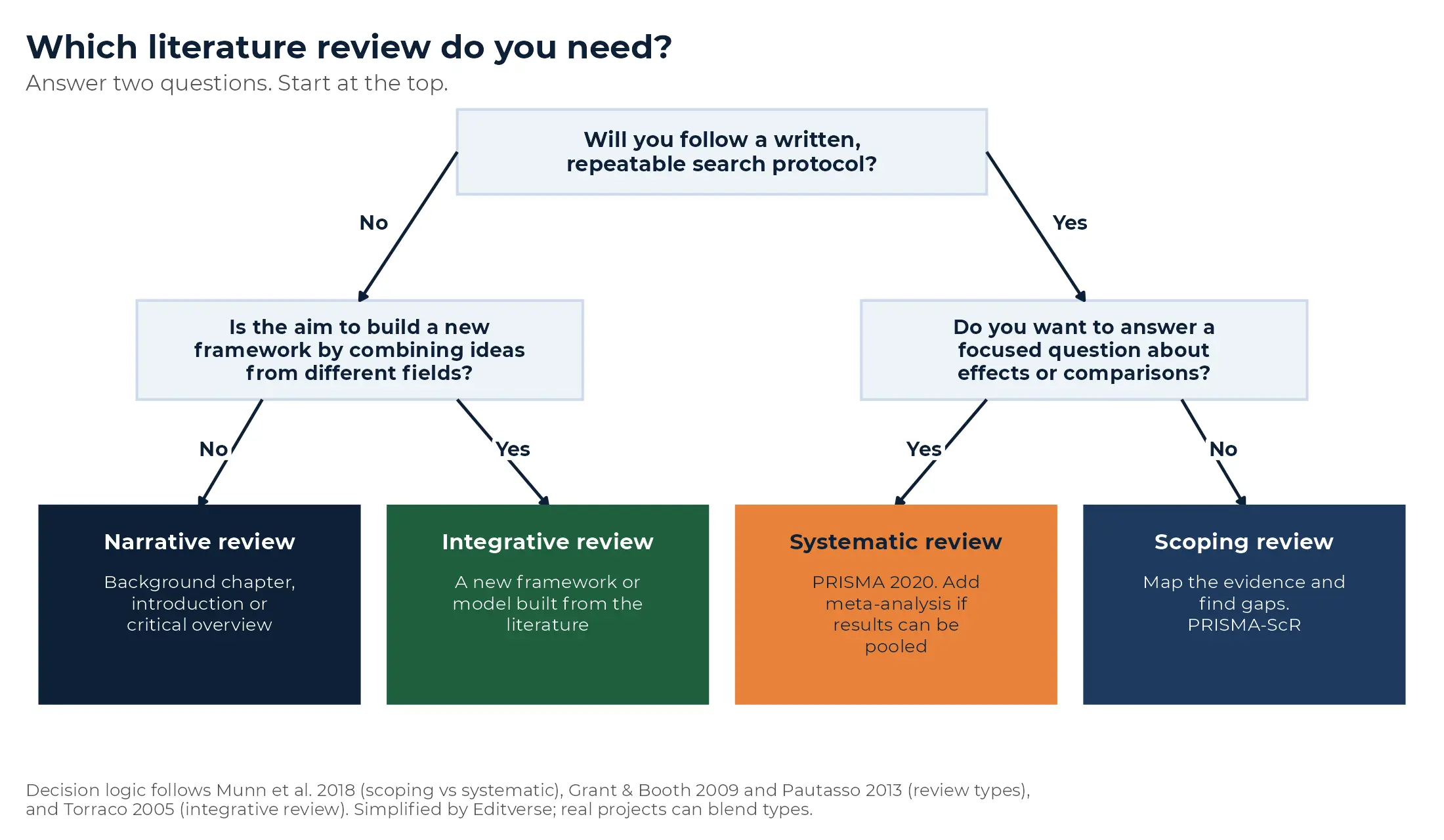
The first question is about method. A systematic review tests a question using a predefined search protocol, and becomes a meta-analysis when the numerical results can be pooled. A narrative review is a qualitative overview[2]. A scoping review is the better choice when your aim is to identify knowledge gaps, scope a body of literature, clarify concepts or look at how research is conducted, and it can be a first step before a systematic review[3]. An integrative review aims to generate new knowledge about the topic by combining ideas across studies[4]. Real projects blend these types, so say in your first paragraph which one you are writing.
Table 1. The four main types at a glance.
| Type | Use it when | How it works | Reporting guide |
|---|---|---|---|
| Narrative | You need background, a critical overview or an introduction chapter | Qualitative overview with no fixed protocol; still write down how you searched[2] | No single standard. Follow your journal or university guide |
| Integrative | You want a new framework or model built from ideas across studies | Looks for common ideas across studies and aims to produce new knowledge[2][4] | No single standard. Follow your journal or university guide |
| Systematic | You have a focused question and need a repeatable, defensible answer | Predefined search protocol; meta-analysis if results can be pooled[2] | PRISMA 2020, a 27-item checklist[5] |
| Scoping | You need to map the evidence, find gaps or clarify concepts | Rigorous, transparent method, but a different purpose from a systematic review[3] | PRISMA-ScR, 20 essential and 2 optional items[6] |
Go deeper on each type: how to write a scoping review, the PRISMA-ScR checklist item by item, our comparison of scoping, systematic and narrative reviews, and how many studies a meta-analysis needs. If you are writing a thesis, check what your university expects, because our guide to dissertation editing explains what help is allowed.
Six steps from topic to finished review
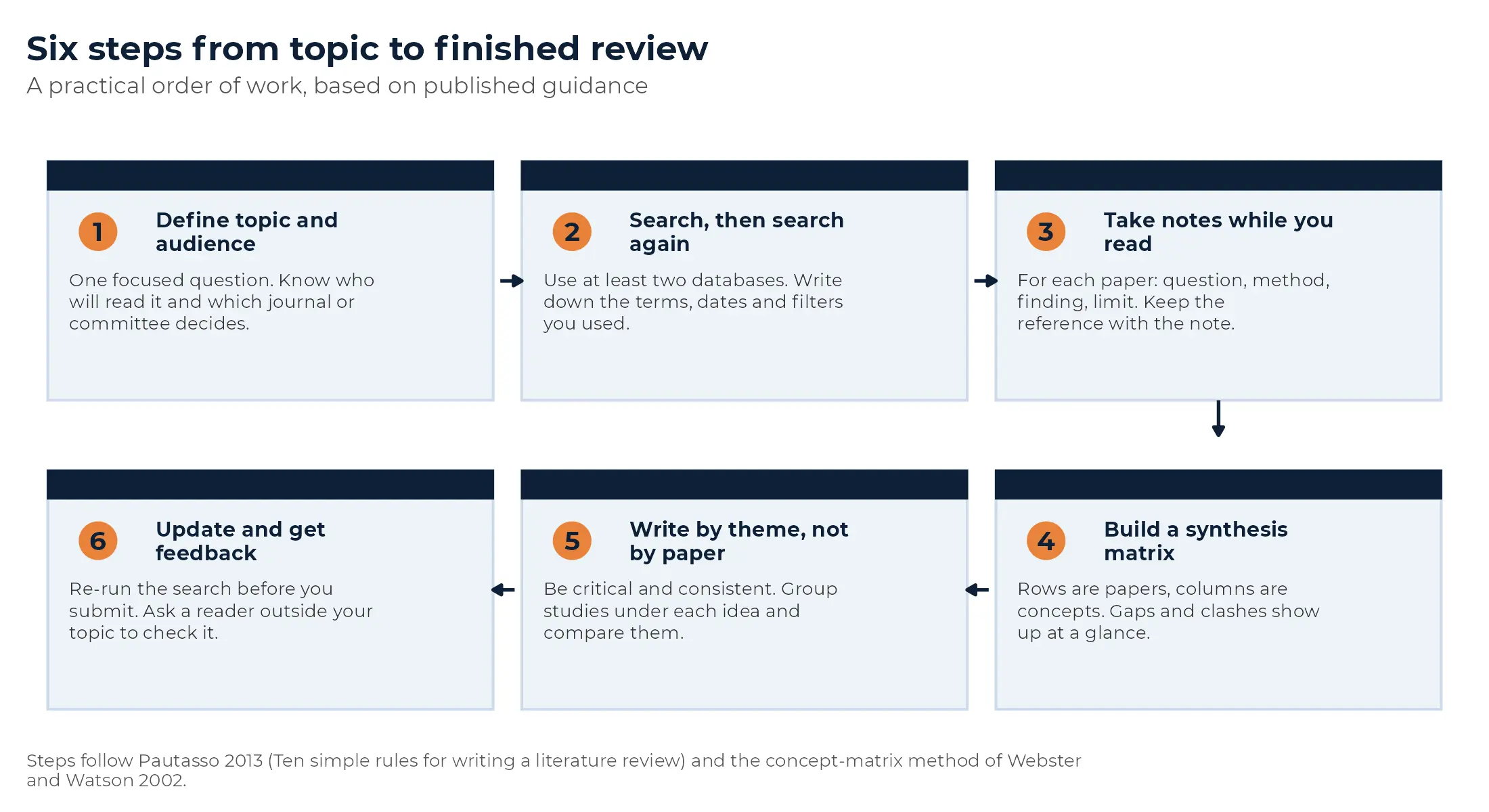
Figure 2 shows the order of work. The steps follow the published rules for writing a review[2] and the concept-matrix method[7].
Step 1. Define the topic and the audience
Write your review question in one sentence. If it needs the word “and” twice, you probably have two reviews. Decide who will read it, because a thesis committee and a journal readership want different things. The published advice is to keep the review focused but make it of broad interest[2].
Step 2. Search, then search again
Search at least two databases. As a working rule, choose indexed sources that your field and your target journal accept, such as Scopus, Web of Science or PubMed for health topics, and add Google Scholar to catch what they miss. Your first search teaches you the words authors really use. Use those words in the next search, which is what “search and re-search” means[2]. For every search, record the database, the date, the exact search string, the filters and the number of results. You will need this for your Methods section, and it is required for systematic reviews[5].
Step 3. Take notes while you read
For each paper write down the question, the method, the sample, the main finding and one limit, and keep the full reference with the note[2]. Do this at the time of reading. Going back to papers later costs far more time.
Step 4. Build a synthesis matrix
A review should be built around ideas, not around authors[7]. The tool for this is a synthesis matrix: one row per paper, one column per idea. Table 2 shows a template with invented placeholders, not real studies.
Table 2. Synthesis matrix template. The entries are placeholders to show the layout.
| Paper | Method and sample | Idea A: effect of the factor | Idea B: setting | Limit noted |
|---|---|---|---|---|
| Study 1 | Survey, 200 adults | Positive | Hospital | Self-reported data |
| Study 2 | Trial, 60 patients | No effect | Clinic | Small sample |
| Study 3 | Cohort, 5,000 adults | Positive | Community | Possible confounding |
| Read down a column | Two of three agree. Study 2 differs | All three settings differ | Sample size and data source explain part of the gap |
Reading down a column shows you where studies agree, where they clash and why. Reading across a row reminds you what each paper can and cannot support. Gaps appear as empty cells, and those become the “what is missing” part of your review.
Step 5. Write by theme, not by paper
Each column of the matrix becomes a section or a paragraph. Be critical and consistent, and use a logical structure[2]. Table 3 shows the difference.
Table 3. The same material written two ways. The wording is an illustration.
| Study by study (weak) | Theme by theme (strong) |
|---|---|
| Smith found that the factor helped patients. Jones found no effect. Lee reported a positive effect in a large group. | Two of three studies report a positive effect. The one study with no effect had the smallest sample, so the disagreement may reflect power rather than biology. No study has tested the factor in primary care, which is the setting of this thesis. |
A paragraph that works follows four moves: make a claim, give evidence from several studies, explain where and why they differ, and say what is still missing for your question.
Step 6. Update and get feedback
Re-run your searches shortly before you submit, because the guidance is to be up to date without forgetting older studies[2]. Ask a reader outside your topic to read the draft, since feedback is its own step in the published rules[2]. If you include your own earlier research, treat it with the same critical eye as everyone else’s[2].
Six mistakes that weaken a literature review
Table 4. Common mistakes and the fix.
| Mistake | Fix |
|---|---|
| Summarising one paper after another | Build the matrix and write by idea |
| No record of how you searched | Log database, date, string, filters and counts at every search |
| Only recent papers, or only old ones | Be up to date, but include the older work that shaped the field |
| No position on the evidence | State which studies are stronger and why |
| A topic too broad to finish | Narrow the question until one matrix can hold it |
| Never updating the search | Re-run it just before you submit |
Check before you submit
- The first paragraph names the review type and the question.
- At least two databases were searched and the searches are recorded.
- Every paper sits in the matrix, and each section is built on an idea.
- Studies that disagree are compared, not just listed.
- You say clearly what is missing and how your work fills it.
- The search was re-run recently and every reference is complete.
Frequently asked questions
What is the difference between a literature review and a systematic review?
A systematic review is one kind of literature review. It follows a predefined search protocol, and is reported with PRISMA 2020[2][5]. Other kinds, such as narrative and integrative reviews, do not need that protocol.
Do I need PRISMA for my thesis literature review?
PRISMA 2020 is a reporting guideline for systematic reviews, and PRISMA-ScR is the one for scoping reviews[5][6]. A narrative chapter has no single standard, so follow your university guide and ask your supervisor.
How many sources do I need?
There is no fixed number. It depends on the topic, the review type and the rules of your journal or committee, so ask them. Aim for completeness on your question rather than a target count.
What is a synthesis matrix?
It is a table with one row for each paper and one column for each idea, used to compare studies and see agreement, conflict and gaps at a glance[7].
How many databases should I search?
At least two. Use sources your field and your target journal accept, and record every search.
Building a Literature Review? Consult Editverse
A strong review needs a sound search, a clear matrix and a position you can defend. Editverse subject-matter experts work to COPE, ICMJE and GPP 2022 guidance, with institutional and country-specific ethics followed. Choose the service that matches what you are writing.
WRITING A THESIS CHAPTER?
Editverse Literature Review Support Package
The research foundation for your literature review.
- ✓Search strategy document with all databases and terms
- ✓Literature matrix in Excel, organised by key findings
- ✓Gap analysis report that positions your contribution
- ✓Annotated bibliography with relevance notes
$500
Flat fee · 7 to 10 business days
WRITING A REVIEW ARTICLE?
Editverse Narrative Review Article
From topic to a journal-ready review.
- ✓Topic and scope refined with you
- ✓Critical analysis and thematic organisation
- ✓Complete manuscript with references formatted for your target journal
- ✓Journal recommendation with rationale
$1,000
Flat fee · 4 to 6 weeks
NEED TO MAP A FIELD?
Editverse Scoping Review
JBI method, PRISMA-ScR reporting.
- ✓Protocol ready for PROSPERO or OSF registration
- ✓Search across multiple databases, with grey literature where relevant
- ✓Data charting tables, evidence map and gap analysis
- ✓Complete manuscript and PRISMA-ScR flow diagram
$1,200
Fixed price · 6 to 10 weeks from protocol sign-off
Free Research Tools from Editverse
- PRISMA 2020 flow diagram generator: draw the flow diagram for a systematic review in your browser.
- PRISMA-ScR flow diagram generator: the same for scoping reviews.
- GRADE evidence table calculator: rate how certain the evidence is.
Conclusion
A good literature review starts with a decision, not a search. Choose the type that fits your purpose, record how you searched, put every paper into a matrix, and write about ideas. The published guidance agrees on the core of it: keep the review focused, be critical, find a logical structure and keep it up to date[2]. All sources were checked on 27 October 2026.
Once your review is drafted, our guide to APA vs MLA vs Harvard shows how to format in-text citations and the reference list.
References
- Grant MJ, Booth A. A typology of reviews: an analysis of 14 review types and associated methodologies. Health Info Libr J. 2009;26(2):91-108. doi:10.1111/j.1471-1842.2009.00848.x [PMID: 19490148]
- Pautasso M. Ten simple rules for writing a literature review. PLoS Comput Biol. 2013;9(7):e1003149. doi:10.1371/journal.pcbi.1003149 [PMID: 23874189]
- Munn Z, Peters MDJ, Stern C, Tufanaru C, McArthur A, Aromataris E. Systematic review or scoping review? Guidance for authors when choosing between a systematic or scoping review approach. BMC Med Res Methodol. 2018;18(1):143. doi:10.1186/s12874-018-0611-x [PMID: 30453902]
- Torraco RJ. Writing integrative literature reviews: guidelines and examples. Hum Resour Dev Rev. 2005;4(3):356-367. doi:10.1177/1534484305278283
- Page MJ, McKenzie JE, Bossuyt PM, et al. The PRISMA 2020 statement: an updated guideline for reporting systematic reviews. BMJ. 2021;372:n71. doi:10.1136/bmj.n71 [PMID: 33782057]
- Tricco AC, Lillie E, Zarin W, et al. PRISMA extension for scoping reviews (PRISMA-ScR): checklist and explanation. Ann Intern Med. 2018;169(7):467-473. doi:10.7326/M18-0850 [PMID: 30178033]
- Webster J, Watson RT. Analyzing the past to prepare for the future: writing a literature review. MIS Q. 2002;26(2):xiii-xxiii. doi:10.2307/4132319