
Every scoping review manuscript gets checked against the same 22 items before an editor sends it out for review, yet most authors only discover which ones they missed after a desk rejection or a major-revision letter. The PRISMA-ScR checklist is the reporting standard that governs this check, published by Tricco and colleagues in 2018 as the scoping-review-specific extension of the PRISMA family of guidelines (see our comparison of scoping, systematic, and narrative reviews if you are still deciding whether PRISMA-ScR is the right standard for your project). This guide walks through all 22 items in the order a reviewer reads them, what each one actually requires, which two items are optional, and how a real published scoping review satisfied every one of them.
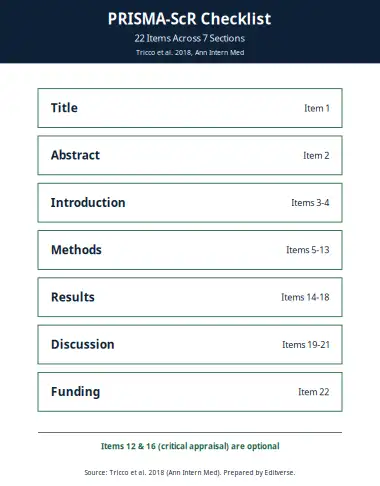
PRISMA-ScR is a 22-item checklist covering everything a scoping review manuscript needs to report, from the title through funding disclosures. Twenty items are required for every scoping review; two (critical appraisal, items 12 and 16) only apply if your team chose to do critical appraisal. Reporting against the checklist while writing, not after, is the fastest way through peer review.
What Is PRISMA-ScR and Why It Matters
PRISMA-ScR extends the original PRISMA reporting guideline for systematic reviews to the specific needs of scoping reviews, since a scoping review’s broader, more exploratory purpose does not map cleanly onto a checklist built for effectiveness trials.1 The Joanna Briggs Institute’s methodology group and the PRISMA-ScR development team coordinated the two efforts so the checklist aligns directly with the seven-stage JBI process (see our step-by-step guide to conducting a scoping review for the methodology side of that process).2 Journals that publish scoping reviews increasingly require a completed PRISMA-ScR checklist as a submission file, and editors use it as a fast first-pass filter before a manuscript reaches peer reviewers, which makes gaps in reporting an easy way to lose weeks to a desk rejection rather than substantive feedback. Tricco and colleagues built the 22 items specifically to avoid importing systematic-review assumptions, such as mandatory critical appraisal or a strict PICO structure, into a checklist meant for a fundamentally more exploratory study design.1 That design choice explains why two items stay optional while the rest do not, and why the checklist reads as noticeably shorter than PRISMA 2020’s 27 items despite covering similar manuscript territory.
The Full PRISMA-ScR Checklist: All 22 Items
The table below reproduces all 22 items in the order Tricco and colleagues published them, grouped by manuscript section.1 Items 12 and 16 (critical appraisal) are marked optional, required only if your team conducted a critical appraisal of included sources.
| # | Section | Item | What to Report |
|---|---|---|---|
| 1 | Title | Title | Identify the report as a scoping review. |
| 2 | Abstract | Structured summary | Background, objectives, eligibility criteria, sources of evidence, charting methods, results, conclusions. |
| 3 | Introduction | Rationale | Describe the rationale relative to what is already known, and explain why a scoping approach fits. |
| 4 | Introduction | Objectives | State the questions and objectives, referencing Population, Concept, Context. |
| 5 | Methods | Protocol and registration | State whether a protocol exists and where it can be accessed. |
| 6 | Methods | Eligibility criteria | Specify source characteristics used as eligibility criteria, with rationale. |
| 7 | Methods | Information sources | Describe all information sources, with dates of coverage. |
| 8 | Methods | Search | Present the full electronic search strategy for at least one database. |
| 9 | Methods | Selection of sources of evidence | State the process for selecting sources (screening and eligibility). |
| 10 | Methods | Data charting process | Describe charting methods, including any piloted or calibrated forms. |
| 11 | Methods | Data items | List and define all variables sought, with assumptions and simplifications. |
| 12 * | Methods | Critical appraisal of individual sources | If done, give rationale and describe the methods used. |
| 13 | Methods | Synthesis of results | Describe the methods of handling and summarizing charted data. |
| 14 | Results | Selection of sources of evidence | Give numbers screened, assessed, and included, with reasons for exclusion, ideally as a flow diagram. |
| 15 | Results | Characteristics of sources of evidence | For each source, present the characteristics charted, with citations. |
| 16 * | Results | Critical appraisal within sources | If done, present the critical appraisal data. |
| 17 | Results | Results of individual sources of evidence | For each source, present the relevant charted data relating to the review questions. |
| 18 | Results | Synthesis of results | Summarize and present the charted results relating to the questions and objectives. |
| 19 | Discussion | Summary of evidence | Summarize the main results and link them to the review questions and objectives. |
| 20 | Discussion | Limitations | Discuss the limitations of the scoping review process. |
| 21 | Discussion | Conclusions | Give a general interpretation of results relative to the questions and objectives, with implications. |
| 22 | Funding | Funding | Describe funding sources for the included evidence and for the review itself. |
* Optional, required only if critical appraisal was conducted.
Item-by-Item Guidance, Section by Section
The table above states what each item requires. The notes below cover where authors most often lose points on each section, grouped the way a reviewer actually reads a manuscript.
Title and Abstract (Items 1-2)
Item 1 fails more often than its simplicity suggests, usually because a title calls the paper a “review” or “systematic review” without the word “scoping” anywhere in it, which confuses indexing and reader expectations from the first line. Item 2’s structured abstract needs every element PRISMA-ScR lists (background, objectives, eligibility criteria, sources, charting methods, results, conclusions) present as identifiable content, not necessarily as labeled subheadings, since many journals still require a single unstructured abstract paragraph.
Introduction (Items 3-4)
Item 3’s rationale needs to justify a scoping approach specifically, not just justify reviewing the topic at all, since a reviewer checking this item is looking for an explicit statement of why a systematic review of effectiveness would not answer the question better. Item 4’s objectives should be traceable directly to the PCC elements named in the methods section. A common gap is an introduction that states a broad motivating question in prose but never restates it in the PCC-structured form the methods section then uses, which reads as if the objectives shifted midway through the study.
Methods (Items 5-13)
This section carries the most items and the most common point deductions. Item 5 (protocol and registration) trips up authors who registered nowhere, since PROSPERO does not accept scoping reviews, leaving Figshare, the Open Science Framework, or a peer-reviewed protocol in JBI Evidence Synthesis as the accepted alternatives. Item 8 (search) is graded on whether the full string for at least one database appears as a reproducible appendix, not a paraphrased description of what was searched. Items 9 through 11 (selection process, charting process, data items) are satisfied together by a clearly described, piloted charting form and a documented dual-reviewer screening process. Items 12 and 13 (critical appraisal, synthesis) are the pair most often left ambiguous, since a manuscript that never explicitly states “critical appraisal was not conducted, as is standard for scoping reviews” leaves a reviewer to guess whether appraisal was forgotten or deliberately skipped.
Results (Items 14-18)
Item 14 is the PRISMA-ScR flow diagram requirement, and it is the single most commonly flagged item in peer review, usually because the diagram’s numbers do not reconcile with the numbers stated in the text, or because the diagram was built before a late-stage exclusion and never regenerated. Items 15 and 17 (characteristics and results of individual sources) are best satisfied with a single well-designed summary table rather than prose describing each source in turn, which keeps the manuscript readable and gives reviewers a fast way to verify completeness against the included-sources count from item 14. Item 18’s synthesis should read as an answer to the objectives stated back in item 4, not a restatement of the table already shown in items 15 and 17.
Discussion and Funding (Items 19-22)
Item 20’s limitations section needs to name limitations specific to this review’s evidence base and search, not a generic paragraph about publication bias that could be pasted into any manuscript. Item 22 (funding) is an easy item to satisfy and an easy one to forget entirely, particularly the requirement to disclose funding for the included sources of evidence, not only funding for the review itself, which is the half of item 22 authors miss most often.
The Two Items That Are Optional
Items 12 and 16, both concerning critical appraisal, are the only two of the 22 that do not apply to every scoping review. JBI guidance treats critical appraisal as uncommon in scoping reviews, since the purpose is mapping the extent and nature of evidence rather than judging whether individual studies are reliable enough to inform a practice recommendation.2 A manuscript that skips critical appraisal entirely still needs to satisfy items 12 and 16 by explicitly stating that appraisal was not conducted and briefly noting why, rather than leaving the items unaddressed. A manuscript that does conduct critical appraisal needs to report the tool used, the process (ideally dual-reviewer, like screening and charting), and the results, typically as a supplementary table.
Getting a Fillable Copy for Your Own Submission
Most target journals ask for the checklist itself as a supplementary file, with a page number or section noted against each of the 22 items showing a reviewer exactly where to check compliance. The EQUATOR Network’s PRISMA-ScR page hosts the official fillable checklist alongside the full explanation and elaboration paper, and is the version most journals link to directly in their author guidelines. Filling it in alongside the manuscript, item by item, as each section gets written rather than as a final pre-submission task, catches gaps like an unaddressed item 12 while there is still time to add a sentence rather than after a reviewer has already flagged the omission.
How the Checklist Maps to the JBI Stages
Every checklist item traces back to a decision made during one of the JBI’s seven methodology stages, which is why documenting each stage as you go makes the checklist far faster to complete than reconstructing it from memory at write-up time. Items 5 and 6 come directly from Stage 2 (inclusion criteria) and the protocol decision made before Stage 3. Items 7 through 11 come from Stages 3 through 5 (search, screening, charting). Items 14 through 18 come from Stages 6 and 7 (analysis and presentation). Keeping a running log of each stage’s decisions as the review progresses turns checklist completion into a transcription exercise rather than a research project of its own.
A Real Example, Checklist-Complete
Kassa and colleagues’ 2025 scoping review of obstetric triage shows several of the harder items satisfied cleanly.3 Item 7 (information sources) names four databases explicitly (PubMed/Medline, Embase via Ovid, Maternity and Infant Care, and CINAHL). Item 14 (selection of sources) reports the full chain from 622 records identified, through 112 duplicates removed, 465 excluded at title and abstract, and 30 excluded at full text, down to 15 included studies, exactly the granularity a PRISMA-ScR flow diagram needs. Item 9 (selection process) names the two independent screeners by initials and describes the third reviewer’s role in resolving disagreements, which is precisely the level of detail item 9 asks for and a generic “two reviewers screened independently” sentence does not provide.
Common Reporting Gaps That Trigger Revisions
Editverse’s editorial team sees the same reporting gaps recur across scoping review manuscripts regardless of field. A flow diagram with numbers that do not match the text is the single most frequent finding, typically caught only when a careful reviewer adds up the exclusion reasons and finds they do not sum to the stated total. Ambiguous critical appraisal reporting is the second most common, where items 12 and 16 are simply absent rather than explicitly addressed either way. A funding statement that discloses the review’s own funding but says nothing about funding for the included sources, missing half of item 22, is a small gap but an easy one for a reviewer to flag. Search strategies pasted as a narrative paragraph rather than the full reproducible string required by item 8 close out the list of usual suspects, usually fixed in minutes once flagged but avoidable entirely by exporting the search history directly from the database interface during Stage 3 rather than retyping it from memory later.
- GraphPro: build publication-ready charts, 25 types, with built-in t-test, ANOVA, correlation, and chi-square p-values. Free, no signup.
- StatPro: free statistical calculators and a test-selector tool covering group comparisons, categorical outcomes, time-to-event analysis, and diagnostic accuracy.
- Flowchart Pro: generate PRISMA 2020, PRISMA-ScR, CONSORT, STROBE, STARD, MOOSE, and ARRIVE flow diagrams directly in your browser.
Get Expert Help With Your Scoping Review
Checking a finished manuscript against all 22 items is faster with a second set of eyes trained on exactly this checklist. Editverse’s scoping review service includes a PRISMA-ScR compliance check as a standard part of every engagement, alongside protocol development, dual-reviewer screening, and JBI-aligned data charting, at a transparent fixed price.
Want a PRISMA-ScR Compliance Check on Your Manuscript?
PhD methodologists check every one of the 22 items before you submit.
Frequently Asked Questions
How many items are in the PRISMA-ScR checklist?
22 items across 7 sections (title, abstract, introduction, methods, results, discussion, funding). Twenty are required for every scoping review; two (items 12 and 16, both about critical appraisal) apply only if your team conducted one.
Is PRISMA-ScR the same as PRISMA 2020?
No. PRISMA 2020 is the 27-item checklist for systematic reviews. PRISMA-ScR is a separate, shorter, purpose-built extension for scoping reviews, published by Tricco and colleagues in 2018.
Do I need to submit the checklist itself to the journal?
Most journals that publish scoping reviews require a completed PRISMA-ScR checklist as a supplementary file, mapping each item to the page or section where it is addressed. Check the target journal’s author guidelines for the exact format.
What is the most commonly missed item?
Item 14, the PRISMA-ScR flow diagram, most often for numbers that do not reconcile between the diagram and the text. Building the diagram last, from final numbers, avoids this.
Can I use the PRISMA 2020 flow diagram template for a scoping review?
No, use the PRISMA-ScR-specific flow diagram template, which has minor wording differences from the systematic review version. Editverse’s free generator builds the correct PRISMA-ScR version directly from your screening numbers.
Conclusion
All 22 PRISMA-ScR items map back to a decision your review team already made somewhere in the seven JBI stages, which means the checklist is a reporting exercise, not a research one, if the underlying work was documented as it happened. The items that most often cost authors a fast desk acceptance, an unreconciled flow diagram, an unaddressed critical appraisal item, an incomplete funding statement, are also the fastest to fix once a manuscript is checked systematically against the table above before submission rather than after a reviewer flags it.
References
- Tricco AC, Lillie E, Zarin W, O’Brien KK, Colquhoun H, Levac D, et al. PRISMA Extension for Scoping Reviews (PRISMA-ScR): Checklist and Explanation. Ann Intern Med. 2018;169(7):467-473. doi: 10.7326/M18-0850
- Peters MDJ, Marnie C, Tricco AC, Pollock D, Munn Z, Alexander L, McInerney P, Godfrey CM, Khalil H. Updated methodological guidance for the conduct of scoping reviews. JBI Evid Synth. 2021;18(10):2119-2126. doi: 10.11124/JBIES-20-00167
- Kassa ZY, Dadi AF, Bizuayehu HM, Thapa S, Kibret GD, Hassen TA, Seid A, Ketema DB, Bore MG, Tegegne TK. Implementation, effectiveness, and barriers of obstetric triage in reducing waiting time: a scoping review. Reprod Health. 2025;22(1):43. doi: 10.1186/s12978-025-01982-7