
Published
A major revision decision means the editor has not said no. The editor wants your paper, but only after real changes. In the best-documented dataset, 116 of 137 papers that got a major revision at first decision, or 84.7%, were later accepted[1]. This guide gives you the numbers from published studies, a clear timeline, and a step-by-step way to answer the reviewers.
In Simple Words
Major revision means “fix these things and send it back.” It is not a rejection. Answer every comment, show exactly where you changed the paper, and send it on time. If you cannot do something the reviewers ask, say so and explain why.
What a major revision means
The editors of the American Journal of Roentgenology (AJR) explain it this way. A major revision usually means you must redo part of the work, for example collect more data or repeat an analysis. A minor revision usually means you change how existing results are explained, for example clarify the methods or add missing limitations[1]. Other journals draw the line differently, so read the decision letter. The letter, not the label, tells you how much work is expected.
Authors often misread this decision. A 2026 editorial in The American Surgeon notes that some authors treat a major revision as nearly accepted and rush their changes, while others treat it as a polite rejection and give up[6]. Both reactions are mistakes. The decision is a request, and the editor, who is responsible for what the journal publishes, decides what happens next[7].
Will my paper be accepted after a major revision?
Most likely yes, if you do the work, but the exact odds depend on the journal. Table 1 shows what real journals reported.
Table 1. What published studies found about revisions and acceptance.
| Study | What they looked at | Main result |
|---|---|---|
| Rosenkrantz and Harisinghani, 2015[1] | 696 new papers sent to AJR (a radiology journal) in 2012 | Major revision at first decision: 116 of 137 finally accepted (84.7%). Minor revision: 58 of 59 (98.3%). All papers together: 25.3% accepted. |
| Joubert et al., 2020[3] | 95 papers from a South African medical school, sent to 72 journals (163 submissions), 2014 to 2017 | Only 48.4% were accepted by the first journal tried. Accepted papers needed a median of one round of revision. |
| Baethge et al., 2013[4] | 343 papers at a German medical journal, 554 reviewer reports | 157 papers were published (45.8%). None was accepted without revision. |
| Twentyman and Selby, 1990[5] | 100 papers at the British Journal of Cancer | 42 got a major revision, 21 a minor revision, 36 were rejected, 1 was accepted unchanged. |
Read the 84.7% as a reference point, not a promise. It comes from one selective journal in 2012. What it does show is that a journal that invites a major revision usually wants to publish the paper. The same AJR study found that authors returned 97.3% of major revision invitations (145 of 149)[1]. After a first resubmission, 40.0 to 55.2% of major-revision papers were accepted and about 10% were rejected. The 6 papers that reached a third round were all accepted[1].
How long does a major revision take?
Plan for months, not weeks. A 2020 study that tracked journal response times found a median of 81 days for a journal to ask for changes, about 1 month allowed to make them, 13.5 days for the journal to answer a revised paper, and 119.5 days from submission to final acceptance[3].
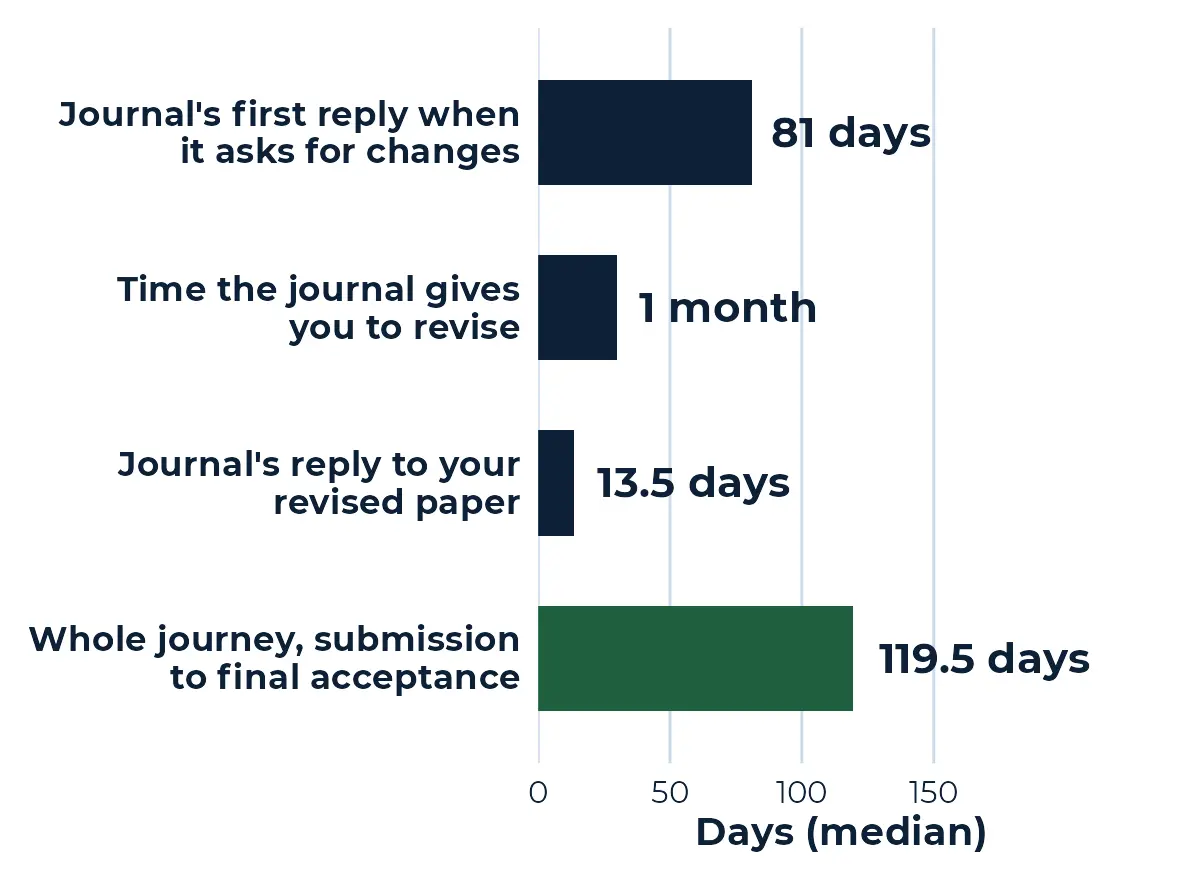
Your deadline may be longer. AJR allowed 6 months for a major revision, and authors there took a mean of 73.7 days to resubmit[1]. Journals change these limits, so check your letter. If new experiments or analyses need more time, write to the editor early and ask.
What if the reviewers disagree?
This is the situation that worries authors most, and it is normal. A 2026 study of 16,006 papers at one journal (Healthcare, 2021 to 2025) found that reviewers gave different advice on the first round for 74.8% of papers that were later published and 85.8% of papers that were later rejected[2].
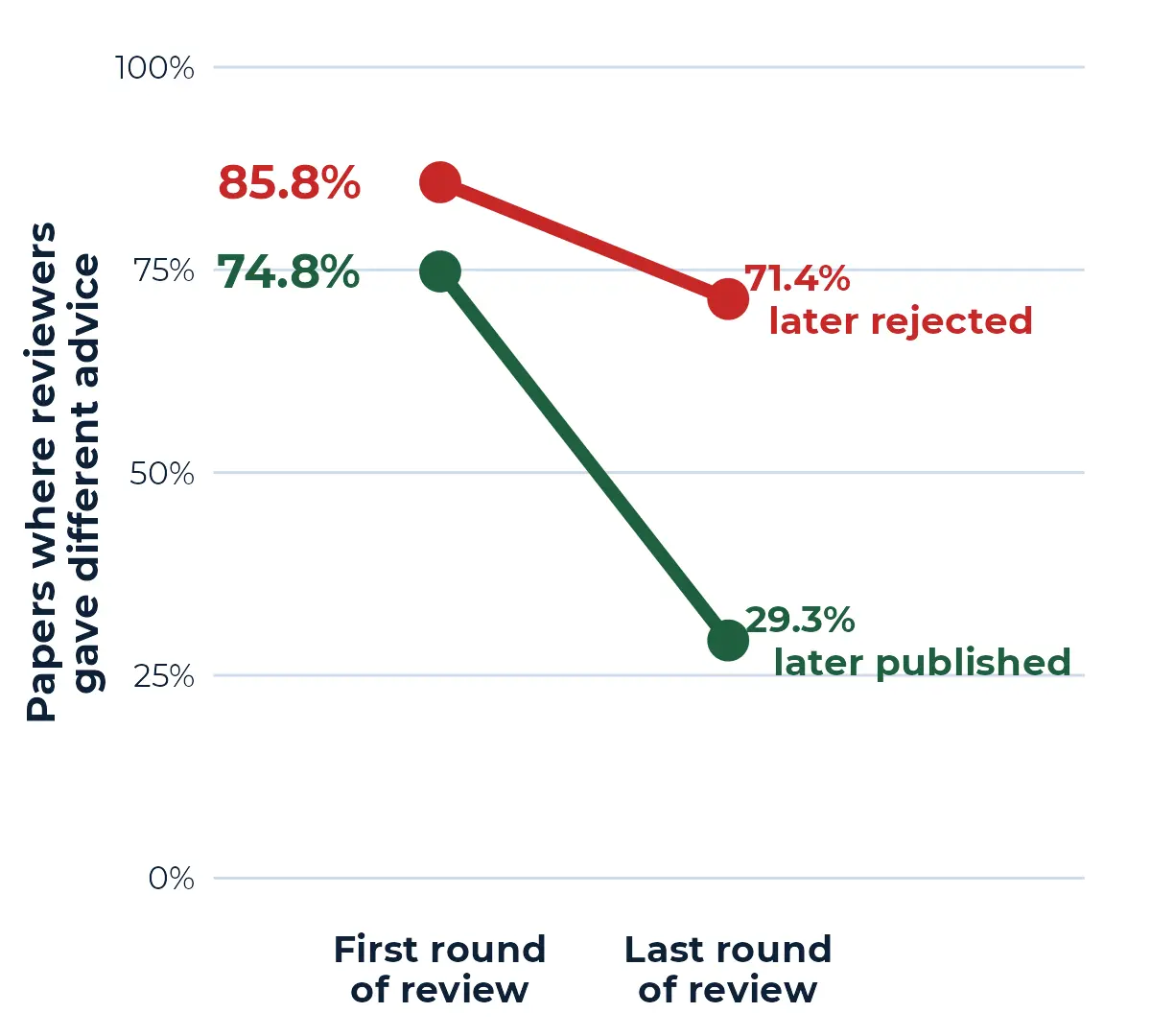
The difference shows up later. By the last round, disagreement had fallen to 29.3% for published papers but stayed at 71.4% for rejected ones. Among published papers, 53.1% moved from disagreement to agreement. Among rejected papers, 61.4% were still in disagreement at the end[2].

What this means for you: when reviewers disagree, the editor weighs their advice and makes the final call, and the study describes peer review as less like a vote and more like a judgment by the editor[2]. So aim your revision at bringing the reviewers together. Give the most critical reviewer your most careful, best-evidenced answer. An earlier study also found that reviewers agree more often about acceptance than about rejection[4]. These data describe papers that were published or rejected after review, not only papers that got a major revision, so use them as a guide and not a forecast.
Before you send: two simple checks
These checks are our own practical rule of thumb, not a result from the studies above. Figure 4 turns them into two logic gates. The AND gate says you send only when every item is true. The OR gate says you write to the editor first if any one item is true.

How to answer each reviewer comment
Treat every comment as a request to improve the paper, even when it is blunt. Reviewers are expected to be constructive and polite[7][8], and you should be too. Answer each comment in the reviewer’s order, and show the editor where the paper changed[1]. Use Figure 5 to decide what each comment needs.
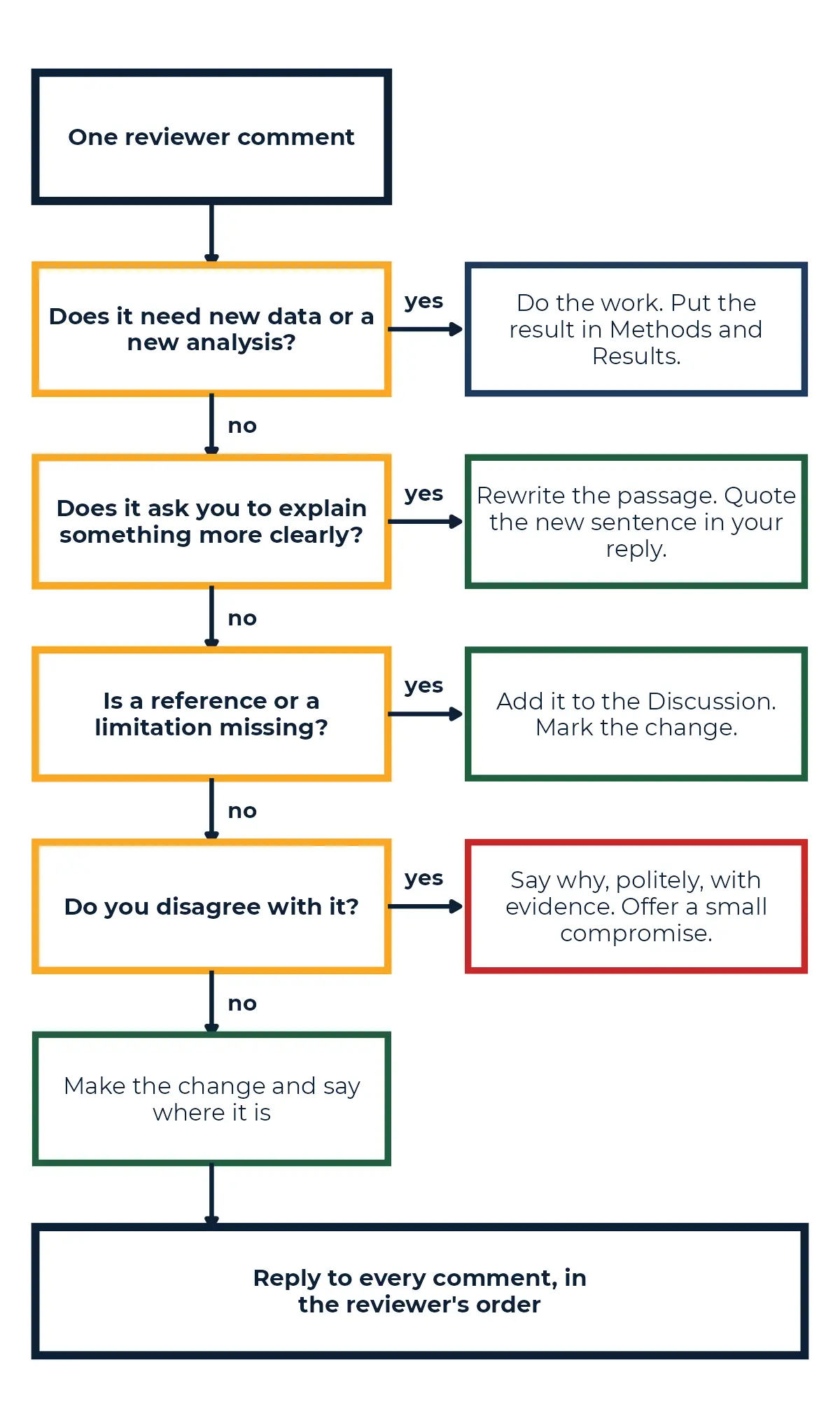
Table 2. What to write in your reply, by type of comment.
| If the comment asks for | Do this | Show this in your reply |
|---|---|---|
| New data or a new analysis | Do the work and add it to Methods and Results | The new result and where it is in the paper |
| A clearer explanation | Rewrite the passage | The new sentence, quoted beside your reply |
| A missing reference or limitation | Add it to the Discussion | The new sentence and reference number |
| Something you disagree with | Say why, politely, with evidence. Offer a small compromise if one is fair | The source you rely on and the wording you propose |
If AI tools helped with the revision, follow the journal’s disclosure rules, which our guide to the AI watermark policy and your submission journey explains. Also confirm the journal is genuine before you spend weeks on a revision, because some fake journals claim to run peer review but do not[7]. Our guide to open access and predatory publishing traps shows how. If the paper is rejected in the end, choose the next journal by scope first and metrics second, as our JCR 2026 guide explains.
Received a Major Revision? Consult Editverse to Satisfy the Editor and Reviewers
A major revision is won or lost in the response. Editverse subject-matter experts answer every reviewer comment, rework the manuscript and return a revision the editor can check line by line. We work to COPE, ICMJE and GPP 2022 guidance, with institutional and country-specific ethics followed. Choose the service that matches where your paper is now.
RECEIVED A MAJOR REVISION?
Editverse Revision & Resubmission Support
Consult Editverse to satisfy the editor and reviewers.
- ✓Every comment analysed and answered
- ✓Point-by-point response letter
- ✓Clean and tracked manuscript versions
- ✓Updated figures, tables and resubmission cover letter
$350
Flat fee · 1 to 2 weeks
REJECTED AFTER A REVISION?
Editverse Premium Scientific Editing
Rework it with Editverse before the next journal.
- ✓Technical editing of methods, results and discussion logic
- ✓Figures and tables edited to journal specification
- ✓Re-submission editing after rejection
- ✓Revision rounds for 90 days plus direct editor Q&A
$750
Flat fee, no per-word charges · 10 to 14 business days
NEED A STRONGER ARGUMENT?
Editverse Advanced Scientific Editing
Editverse sharpens the science, not only the language.
- ✓Substantive editing of argument and logic flow
- ✓Scientific language polishing
- ✓APA, AMA or Vancouver style editing
- ✓Reference verification and one free revision round
$550
Flat fee, no per-word charges · 7 to 10 business days
Free Research Tools from Editverse
- GraphPro: build publication-ready charts, 25 types, with built-in t-test, ANOVA, correlation, and chi-square p-values. Free, no signup.
- StatPro: free statistical calculators and a test-selector tool covering group comparisons, categorical outcomes, time-to-event analysis, and diagnostic accuracy.
- Flowchart Pro: generate PRISMA 2020, PRISMA-ScR, CONSORT, STROBE, STARD, MOOSE, and ARRIVE flow diagrams directly in your browser.
Conclusion
A major revision is a conditional yes. Published data show that most papers invited to revise were eventually accepted at the journal studied[1], that the process takes months[3], and that reviewer disagreement is common and is more often resolved in papers that end up published[2]. Read the letter for scope, sort every comment, answer all of them in the reviewers’ order, show where each change sits, and send on time. All figures were checked against the source pages on 27 October 2026.
References
- Rosenkrantz AB, Harisinghani M. Metrics for original research articles in the AJR: from first submission to final publication. AJR Am J Roentgenol. 2015;204(6):1152-1156. doi:10.2214/AJR.14.13944 [PMID: 26001223]
- De las Cuevas C. Reviewer recommendations and editorial outcomes in peer review: a longitudinal analysis of agreement and disagreement across review rounds. Res Integr Peer Rev. 2026;11:15. doi:10.1186/s41073-026-00200-7 [PMID: 42260682]
- Joubert G, Mulder T, Steinberg WJ, Botes J. Journal response types and times: the outcomes of manuscripts finalised for submission by the University of the Free State School of Medicine medical editor, South Africa. Pan Afr Med J. 2020;36:212. doi:10.11604/pamj.2020.36.212.24175 [PMID: 32963678]
- Baethge C, Franklin J, Mertens S. Substantial agreement of referee recommendations at a general medical journal, a peer review evaluation at Deutsches Arzteblatt International. PLoS One. 2013;8(5):e61401. doi:10.1371/journal.pone.0061401 [PMID: 23658692]
- Twentyman P, Selby P. From receipt to publication. Br J Cancer. 1990;62(6):875-877. doi:10.1038/bjc.1990.399 [PMID: 2257213]
- Nakayama DK. Turning a major revision request into an accepted manuscript: how to respond to reviewers’ comments. Am Surg. 2026;92(4):1068-1070. doi:10.1177/00031348261416462 [PMID: 41549524]
- International Committee of Medical Journal Editors. Recommendations, section II.C, Responsibilities in the Submission and Peer-Review Process. Accessed 27 October 2026. icmje.org
- Committee on Publication Ethics. Ethical guidelines for peer reviewers, version 2, September 2017. doi:10.24318/cope.2019.1.9