
Dissertation editing is one of the few purchases in a doctorate where three questions arrive at once: is it allowed, what will it cost, and what exactly comes back? Most candidates start looking when the draft is nearly done and the submission date is fixed, which leaves little time to compare services that describe the same work in different words.
This guide answers all three questions with published research and real numbers. It explains what universities typically permit, sets out the four levels of dissertation editing and what each one changes, shows the full price arithmetic for 30,000, 60,000 and 90,000 word dissertations, lists the files you should receive, and ends with a checklist for choosing a service. If you already know the level you need, the two-click service finder points you to it directly.
In Simple Words
Most universities allow a professional editor to fix your language, consistency and formatting, and to leave comments on structure and argument. The line is simple: the editor improves how your work reads, and you stay the author of what it says. At Editverse you pay per 300-word page at one of three levels ($9, $16 or $26), so a 60,000-word dissertation is 200 pages and costs $1,800, $3,200 or $5,200. You get a tracked-changes file, a clean copy, an editor’s report and a standards checklist, and a second editor checks the work before it reaches you.
On this page
Is Dissertation Editing Allowed? What Universities Typically Permit
Yes. Professional dissertation editing is a normal, widely permitted part of doctoral and master’s research, and the published research on university practice says so plainly. In her study of Australian postgraduate editing, Lines notes that almost all Australian universities allow postgraduate students to have their thesis professionally edited, with the permitted scope drawn around language and presentation rather than content [5]. Studies from the UK and South Africa describe the same pattern [2, 3]: universities welcome help that makes a thesis easier to read, and they keep the intellectual work with the candidate.
In practice, university editing policies sort third-party help into a few bands:
- Proofreading and copyediting. Correcting spelling, grammar, punctuation, syntax, terminology, consistency, referencing style and formatting. This is the core of what policies permit.
- Developmental feedback. Comments and queries that point out where an argument is unclear, a section is out of order, or a claim needs support. Supervisors give this feedback all the time; a professional editor giving it in the margin, for you to act on, follows the same model.
- Statistical review. Checking that the reported tests match the design, that numbers agree between tables and text, and that results follow the required reporting style. The analysis and its interpretation remain yours.
- Writing new content for the candidate. Drafting sections, generating arguments or producing analysis that the candidate then submits as their own. This is ghostwriting, and it sits outside editing altogether.
The working rule that follows is easy to apply: the editor improves how your dissertation reads; you decide what it says. Every change arrives as a tracked suggestion or a comment, and you accept, reject or rework it. That is also how Editverse structures every edit, aligned with COPE, ICMJE and GPP3, with institutional and country-specific ethics followed.
A sensible first step is to read your graduate school’s editing or third-party assistance policy and share the planned scope with your supervisor. Some universities ask candidates to name the editor and the type of help in the acknowledgements. A clear scope written down at the start makes that statement a single sentence.
What Published Research on Thesis Editing Shows
Proofreading and editing of student work has been studied in detail for more than 15 years. The findings give a useful map of what academics, editors and students agree on, and they explain why a defined scope produces better results than an open-ended request to “fix the English”.
Editors and supervisors agree on copyediting and style
Kruger and Bevan-Dye surveyed South African editors on 63 generic editing tasks and nine modes of editing and querying for dissertations and theses [3]. Editors judged the majority of copyediting and stylistic editing tasks appropriate for theses, while structural and content editing tasks were seen as belonging with the author. Their list of agreed tasks is effectively a scope document for dissertation editing: language, style, consistency and presentation, with queries used where content questions arise.
Lecturers, tutors and students accept language-level correction
Harwood surveyed and interviewed content lecturers, English language tutors and students about the ethics of proofreading [2]. All three groups generally accepted minor corrections such as punctuation, grammar and sentence structure. That shared ground is exactly where the Essential level of dissertation editing works.
A defined scope produces consistent results
In an earlier study, 14 UK university proofreaders each worked on the same master’s essay. The number of interventions ranged from 113 to 472, and some proofreaders concentrated on language while others proposed changes to structure and argument [1]. An interview study of 16 proofreaders found similar variety in labels, fees and practices [7]. The practical lesson for a buyer is positive: when a service defines each level in writing, states what it changes, and checks the result with a second editor, you get the same, predictable quality of dissertation editing every time.
Tools that make the scope explicit
Richards and Harwood turned this research into a stakeholder tool that lays out possible interventions from the lightest touch, such as correcting typos, to the heaviest, and lets an academic mark which ones they permit for a given student [6]. If your supervisor wants to agree a scope with you, a list like this, or the level descriptions below, makes that conversation quick.
Writing well is part of the achievement
Turner argues that calling all of this “proofreading” understates how much skill academic writing takes, especially for international and non-traditional students, and that writing well in a discipline is an academic achievement in its own right [4]. Good dissertation editing supports that achievement: it shows you where your prose loses the reader, so the final draft reflects the quality of your research.
The Four Levels of Dissertation Editing and What Each Changes
“Editing” covers very different amounts of work. The table below separates the four levels that most dissertation editing services offer, what each one changes, and what stays untouched. Each level includes everything below it.
| Level | What it changes | What stays yours | Best moment | Editverse level |
|---|---|---|---|---|
| Proofreading | Typos, spelling, punctuation, spacing, page and heading numbering, figure and table labels | Everything else | Last pass, after all revisions are approved | Included in every level |
| Copyediting | Grammar, syntax, word choice, academic register, terminology, consistency, citation style (APA, MLA, Harvard, Vancouver, AMA, Chicago or your university’s guide) | Argument, structure, content, data | Complete draft that your supervisor is broadly happy with | Essential, $9 per page |
| Substantive / developmental | Sentence and paragraph flow and transitions, plus margin comments on chapter structure, argument, logic and evidence | Every decision on content; you revise in response to queries | Draft with committee comments, or chapters that feel disconnected | Professional, $16 per page |
| Statistical review | Checks test choice against design, assumptions, effect sizes and confidence intervals, table and text agreement, reporting-guideline compliance | Your data, analysis and interpretation | Quantitative or mixed-methods thesis before defence | Premium, $26 per page |
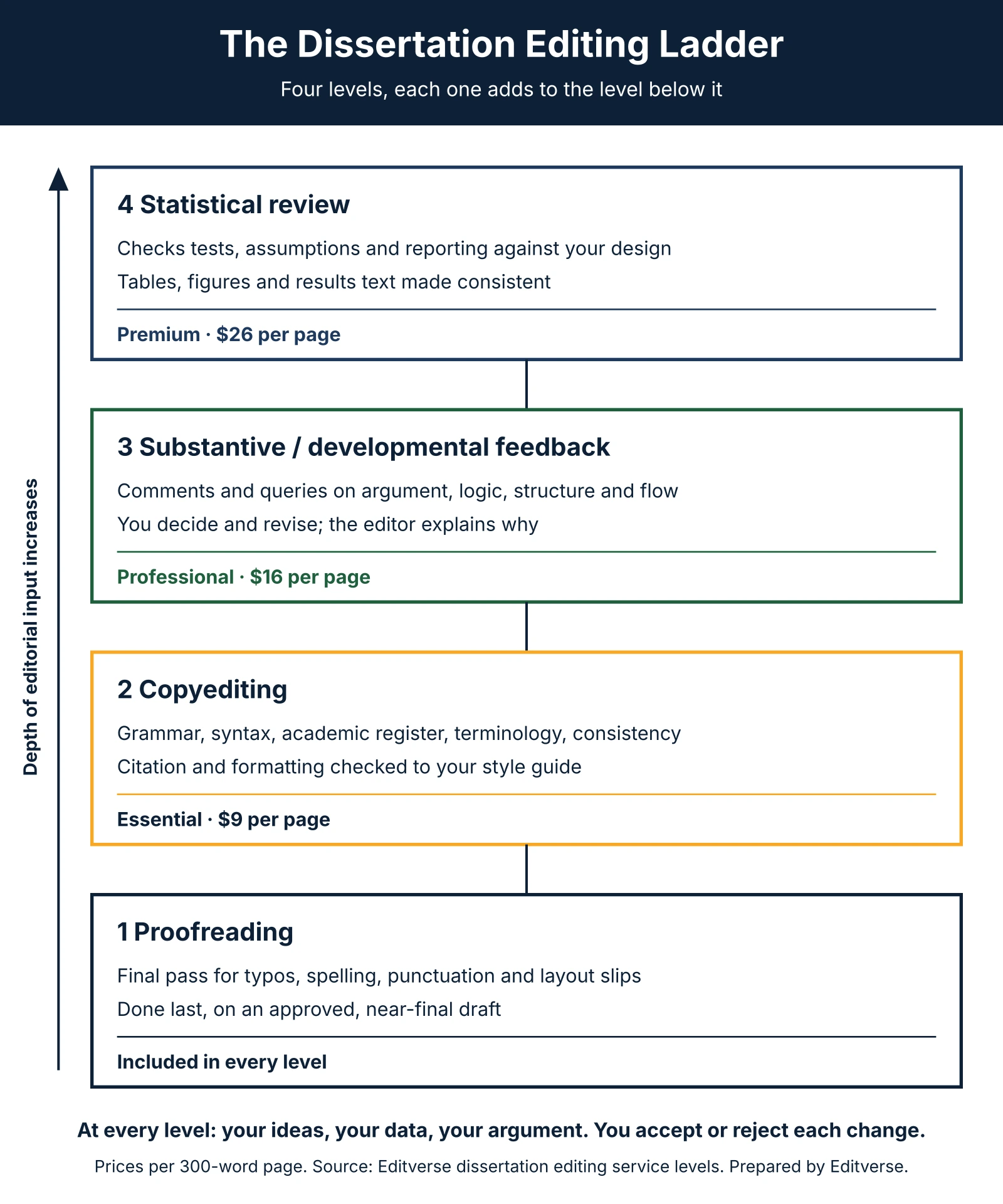
Which level fits your draft?
Choose by the state of the draft, not by the deadline. If your supervisor has signed off the structure and you mainly want clean, consistent prose in the right style, Essential is enough. If you have committee comments about flow, argument or chapter order, Professional gives you an editor’s commentary on each chapter, revision support, and a report you can use in your response to the committee. If your thesis reports statistics, Premium adds a review of the methods and results chapters so the numbers, tables and text agree before an examiner checks them. Clinical and health-science candidates can also see how reporting guidelines map onto each chapter in our guide to medical dissertation reporting guidelines.
Proofreading vs Editing a Dissertation: The Practical Difference
The question “proofreading vs editing dissertation” usually hides a different question: how much does my draft need? Proofreading assumes the writing is already sound and catches surface slips. Editing works on the sentences themselves, so a reader moves through each paragraph without stopping. The difference shows up in a single sentence:
Original: The results of the analysis that was carried out shows that there is a significant effect of the intervention on the outcome which was measured.
Proofread: The results of the analysis that was carried out show that there is a significant effect of the intervention on the outcome which was measured.
Copyedited: The analysis showed a significant effect of the intervention on the measured outcome. [Query: please add the test statistic, p value and effect size here, as required by APA 7.]
Proofreading fixed one agreement error. Copyediting cut the sentence nearly in half and, through a query, flagged missing statistical detail that an examiner would ask about. The author still decides what to report; the editor makes sure the reader can see it. For most doctoral drafts, copyediting is the minimum useful level, and proofreading is the final pass that comes with it.
A clear thesis statement makes every level of editing more effective, because the editor can test each chapter against it. If your central claim still feels loose, our guide on how to write a thesis statement is a good use of an hour before you send the draft.
Dissertation Editing Cost: How Transparent Pricing Works
Dissertation editing cost varies widely across the market because services price by word, by hour, by chapter or by “custom quote”. Editverse uses one rate per level, per 300-word page, whatever the length of the document:
- Essential (language and consistency): $9 per page.
- Professional (language, argument and structure): $16 per page.
- Premium (full editing plus statistics review): $26 per page.
A full dissertation of up to 60,000 words (200 pages) is covered by a fixed package: $1,800, $3,200 or $5,200. Longer or shorter documents are priced at the same per-page rate for every page, so there are no length bands to guess at. Single chapters start at $350. You can check any length in seconds with the dissertation editing price calculator, and your final quote is confirmed in the free assessment before any payment.
Turnaround
- Essential: 48-72 hours per chapter; 5-7 business days per full dissertation.
- Professional and Premium: 5-7 business days per chapter.
- Rush delivery (24-48 hours): $175 add-on. Weekend and holiday priority: $88.
How to count your pages
Take the word count of the text you want edited and divide by 300. Most candidates include the main chapters and abstract and leave out the reference list and appendices of raw instruments, unless they want those checked too. If your committee has asked for an appendix such as a reporting checklist or a coding framework to be edited, include it in the count.
Worked Dissertation Editing Cost Examples: 30k, 60k and 90k Words
The arithmetic is the same at every length: words divided by 300 gives pages, pages multiplied by the level’s rate gives the price. A 60,000-word dissertation lands exactly on the fixed packages.
| Dissertation length | Pages (÷300) | Essential ($9) | Professional ($16) | Premium ($26) |
|---|---|---|---|---|
| 30,000 words (master’s or shorter professional doctorate) | 100 | $900 | $1,600 | $2,600 |
| 60,000 words (typical doctoral dissertation) | 200 | $1,800 (package) | $3,200 (package) | $5,200 (package) |
| 90,000 words (long PhD thesis) | 300 | $2,700 | $4,800 | $7,800 |
Three practical notes on these numbers:
- Mixed levels are allowed. Many candidates choose Premium for the methods and results chapters and Essential for the rest. For a 60,000-word thesis with 18,000 words of methods and results (60 pages) and 42,000 words elsewhere (140 pages), that is 60 × $26 + 140 × $9 = $1,560 + $1,260 = $2,820.
- Chapter by chapter works too. If your committee releases chapters one at a time, chapter editing starts at $350 and the per-page rate keeps the total predictable.
- Add-ons are flat. Rush delivery adds $175 and weekend or holiday priority adds $88, whatever the length.
Not sure which column you belong in? The Editverse dissertation help service starts every order with a free assessment that names the level and confirms the quote, so the first payment is always for the right amount of work.
What You Receive From Professional Dissertation Editing
The files you receive matter as much as the edit itself, because they are what you take to your supervisor and committee. Every Editverse dissertation editing order returns five things:
- Tracked-changes file. Every edit is visible in Word, so you accept or reject each one. Nothing changes without your approval.
- Clean copy. The same document with all suggested changes applied, so you can read the result as an examiner will see it.
- Editor’s report. A short report on strengths, recurring issues and recommendations, chapter by chapter at Professional and Premium. Candidates often reuse it when writing a response to committee feedback.
- Standards checklist. A checklist against your required style (APA, MLA, Harvard, Vancouver, AMA, Chicago or your university’s own guide) covering headings, citations, tables, figures and front matter.
- Second-editor QA. An independent subject-matter expert checks the edited file before release, so consistency does not depend on a single reader.
Behind those files sits a fixed sequence: a structural read of the whole draft, the substantive or language edit at your chosen level, a standards check, and then the second editor. Each dissertation is matched to a subject-matter expert with a doctorate in a related field, so the editor reads your methods and terminology as a specialist in your area would.
How to Choose Dissertation Editing Services: A Checklist
Use this checklist on any service you are considering, including ours. A strong service should answer every item before you pay.
- Defined levels in writing. Each level states what it changes and what it leaves to you.
- A published rate. A per-page or per-word price you can calculate yourself, not only “contact us for a quote”.
- Turnaround per chapter and per full dissertation, with rush and weekend options priced up front.
- Subject-matter expertise. An editor who knows your discipline’s methods and vocabulary.
- Tracked changes, clean copy and a report. You should never receive a silently rewritten file.
- Style standards named. APA, MLA, Harvard, Vancouver, AMA, Chicago or your university’s guide, checked with a list.
- A second check before delivery. Independent QA catches what a single pass misses.
- Author control. A clear statement that content, data and conclusions stay yours, aligned with COPE, ICMJE and GPP3.
- A free assessment. A sample or review of your draft that names the right level before you commit.
- Statistics handled by statisticians. If your thesis is quantitative, the person reviewing results should understand research design.
Programme type also shapes the choice. Clinical, nursing and public-health theses benefit from an editor who knows reporting guidelines, which is what medical dissertation help is built around. Professional doctorates have their own structure and committee expectations: candidates writing a DBA or EdD, including those framing a problem of practice for an EdD dissertation, can see the dedicated packages on the DBA and EdD dissertation help page.
Timing is the last factor. Editing pays off most once your literature review and argument are settled, because an editor then works on a stable text. If your review chapter is still growing, these literature review tips from experienced researchers will help you close it out first.
Free Research Tools from Editverse
- GraphPro: build publication-ready charts, 25 types, with built-in t-test, ANOVA, correlation, and chi-square p-values. Free, no signup.
- StatPro: free statistical calculators and a test-selector tool covering group comparisons, categorical outcomes, time-to-event analysis, and diagnostic accuracy.
- Flowchart Pro: generate PRISMA 2020, PRISMA-ScR, CONSORT, STROBE, STARD, MOOSE, and ARRIVE flow diagrams directly in your browser.
Professional Dissertation Editing Services at Editverse
Each package below maps directly onto the levels and prices in this guide. Full-dissertation packages cover up to 60,000 words; chapter editing suits candidates working chapter by chapter with their committee.
Chapter
From $350
Editing for an individual chapter: argument structure, academic voice and presentation, with your ideas preserved.
Essential
$1,800
Full dissertation: language, tone, citation format and consistency, with tracked changes. 5-7 business days.
Professional
$3,200
Developmental editing of every chapter: stronger argument, clearer evidence, revision support and a detailed editor’s report.
Premium
$5,200
Everything in Professional plus statistical analysis review, methodology chapter support and committee feedback support.
For anything the grid does not cover, such as coaching, committee responses or defence preparation, the full menu sits on the dissertation help page, with a free assessment and a confirmed quote within 24 hours.
Frequently Asked Questions
Is dissertation editing allowed at my university?
At most universities, yes, for language, style, consistency and formatting, with comments on structure and argument for you to act on. Check your graduate school’s editing policy, agree the scope with your supervisor, and acknowledge the help if your university asks for it.
How much does dissertation editing cost?
At Editverse, $9, $16 or $26 per 300-word page depending on the level. A 60,000-word dissertation costs $1,800, $3,200 or $5,200 as a fixed package; a 30,000-word thesis costs $900 to $2,600; a 90,000-word thesis costs $2,700 to $7,800. Chapters start at $350.
What is the difference between proofreading and editing a dissertation?
Proofreading corrects surface errors on a finished text. Editing improves the sentences, consistency and style, and at higher levels adds comments on structure, argument and statistics. Proofreading is included as the final pass at every Editverse level.
Will the editor change my argument or results?
No. Your argument, data and conclusions stay yours. The editor suggests changes in tracked form and raises queries where something is unclear; you decide what to accept.
How long does dissertation editing take?
Essential takes 48-72 hours per chapter or 5-7 business days for a full dissertation. Professional and Premium take 5-7 business days per chapter. Rush delivery in 24-48 hours is a $175 add-on.
Do I need statistical review?
If your dissertation reports quantitative results, a statistical review is worth it before defence: it checks that tests fit the design and that numbers agree across tables and text. Qualitative theses usually need Essential or Professional.
Should I mention the editor in my acknowledgements?
Follow your university’s guidance. Some ask candidates to state that professional editing was limited to language and presentation; the scope description from your order makes that a single sentence.
Dissertation Editing: The Decision in Three Steps
Dissertation editing is allowed, affordable when priced transparently, and most useful when its scope is written down. Decide in three steps: confirm the scope your university permits, choose the level that matches the state of your draft, and calculate the price from your word count. Then insist on tracked changes, a clean copy, an editor’s report, a standards checklist and a second-editor check. If you would like a specialist to read your draft and name the right level, start with a free assessment on the Editverse dissertation editing page.
References
- Harwood N. What do proofreaders of student writing do to a master’s essay? Differing interventions, worrying findings. Writ Commun. 2018;35(4):474-530. doi:10.1177/0741088318786236
- Harwood N. Lecturer, language tutor, and student perspectives on the ethics of the proofreading of student writing. Writ Commun. 2023;40(2):651-719. doi:10.1177/07410883221146776
- Kruger H, Bevan-Dye A. Guidelines for the editing of dissertations and theses: a survey of editors’ perceptions. South Afr Linguist Appl Lang Stud. 2010;28(2):153-169. doi:10.2989/16073614.2010.519110
- Turner J. Rewriting writing in higher education: the contested spaces of proofreading. Stud High Educ. 2011;36(4):427-440. doi:10.1080/03075071003671786
- Lines L. Substantive editing as a form of plagiarism among postgraduate students in Australia. Assess Eval High Educ. 2016;41(3):368-383. doi:10.1080/02602938.2015.1013919
- Richards F, Harwood N. Proofreading student writing: a research-based stakeholder tool focused on ethical practice. Int J Educ Integr. 2024;20:20. doi:10.1007/s40979-024-00165-4
- Harwood N, Austin L, Macaulay R. Proofreading in a UK university: proofreaders’ beliefs, practices, and experiences. J Second Lang Writ. 2009;18(3):166-190. doi:10.1016/j.jslw.2009.05.002