
Scoping reviews have become the default choice for research teams trying to map a broad or fast-moving body of literature, yet most authors sit down to write one without a clear procedural map. How to write a scoping review comes down to following a structured methodology from question to manuscript, not assembling a literature summary and hoping reviewers accept it. This guide assumes you have already decided a scoping approach fits your question (see our comparison of scoping, systematic, and narrative reviews if you have not) and walks through the Joanna Briggs Institute’s seven-stage framework, the PCC approach to scoping a question, and the PRISMA-ScR reporting standard that will govern how the finished manuscript gets judged. A real published scoping review shows each stage in practice, alongside the errors that most often delay publication.
A scoping review follows seven structured stages set by the Joanna Briggs Institute (JBI), starting with a tightly scoped question under the PCC framework (Population, Concept, Context) and ending with a PRISMA-ScR-compliant write-up. Two independent reviewers screen and chart the evidence at every stage, which keeps the process transparent and repeatable for anyone who reads the final paper.
What You Need Before You Start
A scoping review is not a solo literature summary written over a weekend. JBI methodology assumes a small team and a documented process from the outset, and skipping either usually shows up later as a reviewer’s request for major revisions. Four things should be in place before the first database search runs.
A team of at least two reviewers is the baseline requirement, since JBI guidance calls for independent screening and independent data charting, with a third reviewer available to resolve disagreements. A single author working alone cannot produce a review that meets the methodology, regardless of how thorough the search looks. A clearly scoped question, built with the PCC framework covered below, has to exist before the search strategy is drafted, because an unscoped question produces an unmanageable number of results. A decision on protocol registration needs to be made early, even though the options differ from a systematic review’s PROSPERO pathway (see the dedicated section below). Finally, a draft data charting form, piloted on a handful of included sources before full extraction begins, saves a full re-extraction pass later when reviewers realize halfway through that a key variable was never captured.
The JBI Framework: Seven Stages of a Scoping Review
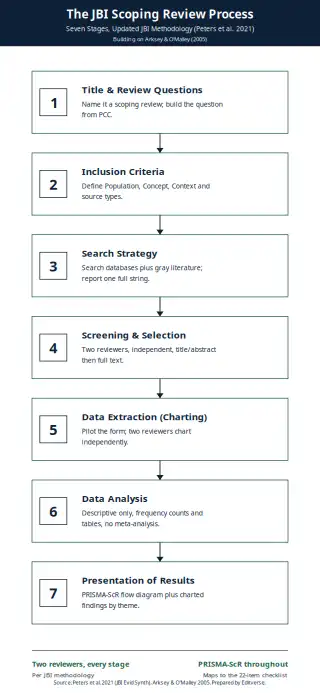
Arksey and O’Malley published the original scoping review framework in 2005, describing six stages for identifying and charting evidence on a broad question.1 The Joanna Briggs Institute’s methodology group built on that framework over the following decade, and Peters and colleagues published updated guidance in 2021 that expanded the process into seven stages, tightened the language around each one, and aligned the whole approach with the PRISMA-ScR reporting standard.2 The seven stages below reflect that current JBI guidance.
Stage 1: Title and Review Questions
The title has to identify the paper as a scoping review, not a systematic review or a narrative review, since the label itself signals to readers and indexers which methodology to expect. The review question follows directly from the PCC elements (Population, Concept, Context), and JBI guidance recommends keeping the question broad enough to justify a scoping approach rather than a narrower systematic review of effectiveness. A question written for a systematic review, such as “does intervention X improve outcome Y,” rarely survives contact with scoping review methodology intact, because scoping reviews map the extent and nature of evidence rather than test a single effect.
Stage 2: Inclusion Criteria
Inclusion criteria specify which sources of evidence the review will consider, built directly from the PCC elements defined at Stage 1. Population describes participant characteristics such as age, condition, or role, though JBI guidance notes this element may not apply where the review focuses on study designs or interventions rather than people. Concept explains the core phenomenon, intervention, or outcome under investigation. Context covers geographic setting, care setting, or cultural factors, and can be left deliberately open if the review question does not depend on where the evidence comes from. Publication date range, language, and source type (peer-reviewed articles, theses, conference proceedings, policy documents) complete the criteria and belong in the protocol before screening starts, not decided ad hoc partway through.
Stage 3: Search Strategy
JBI guidance calls for a search “as comprehensive as possible within the constraints of time and resources,” which in practice means searching multiple databases plus gray literature sources such as theses, conference abstracts, and policy repositories, since scoping reviews draw on a wider evidence base than systematic reviews of effectiveness. At minimum, the full electronic search strategy for one database has to be reported as an appendix in the final manuscript, string by string, so another researcher could rerun it. Building the search string against a librarian-reviewed set of keywords and subject headings before running it across every database avoids the common problem of discovering a missed synonym after 400 records have already been screened.
Stage 4: Evidence Screening and Selection
Screening runs in two passes, title/abstract first and then full text, with a minimum of two reviewers working independently at each pass and a documented process for resolving disagreement, whether that is discussion, a third reviewer, or a predefined tie-breaking rule. Every exclusion at the full-text stage needs a reason recorded against it, since the PRISMA-ScR flow diagram (covered in detail in our companion guide to the 22-item PRISMA-ScR checklist) requires reporting how many sources were excluded and why at each step. Piloting the screening criteria on a sample of 25 to 50 records before screening the full set catches ambiguous criteria early, while reviewer disagreement is still cheap to resolve.
Stage 5: Data Extraction (Charting)
JBI methodology uses the term “charting” rather than “extraction” deliberately, since it reflects the iterative, evolving nature of capturing data across a broad and often heterogeneous evidence base rather than pulling fixed fields from homogeneous trial reports. A charting form lists every variable the review needs, piloted on two or three included sources before the full charting pass begins, with at least two reviewers charting independently to catch transcription errors and interpretation differences. Because a scoping review’s charting form tends to evolve as unexpected data patterns surface partway through, JBI guidance explicitly permits revising the form during charting, provided the revision and its rationale are documented rather than applied silently.
Stage 6: Data Analysis
Analysis in a scoping review stays descriptive. Frequency counts of study designs, populations, geographic regions, or concepts, presented in tables, bar charts, or a bubble plot mapping the evidence, are the standard output, and JBI guidance is explicit that meta-analysis or effect-size pooling does not belong in a scoping review, since the included sources are rarely homogeneous enough to combine statistically. Where a review team wants to say more about the quality of the underlying evidence, critical appraisal is optional under PRISMA-ScR (items 12 and 16), rarely undertaken in scoping reviews, and should be flagged explicitly as either done or not done rather than left ambiguous.
Stage 7: Presentation of Results
Results fall into two parts under PRISMA-ScR, namely the search and selection results, shown as a PRISMA-ScR flow diagram plus narrative text describing how many records moved through each screening stage, and the charted findings themselves, presented in whatever tabular, diagrammatic, or descriptive format best matches the review question. A table cross-tabulating study characteristics against key concepts is the most common format, though a map, timeline, or conceptual diagram can work better depending on what the evidence looks like once charted.
Using the PCC Framework to Scope Your Question
PCC replaces the PICO framework familiar from systematic reviews of intervention effectiveness, and gets its structure from the broader, more exploratory nature of a scoping review question. Population defines who or what the review is about, though JBI guidance notes this element can be dropped entirely where a review examines research designs, methodologies, or reporting practices rather than a population of people. Concept is the heart of the question, covering the intervention, phenomenon, exposure, or outcome the review maps, and needs enough specificity to bound the search without narrowing it into a systematic review question. Context adds geographic, cultural, or setting-based boundaries, such as primary care versus hospital settings, or a specific country or region, and can be left open if the review question genuinely applies across every setting.
A poorly scoped PCC produces one of two failure modes downstream. A Population, Concept, and Context defined too broadly returns an unmanageable number of records at the search stage, sometimes tens of thousands, and forces the team into ad hoc exclusion decisions that were never written into the protocol. Defined too narrowly, the PCC produces a handful of included sources and a question better suited to a systematic review or a single-topic narrative summary. Testing a draft PCC against a scoping search of one database, checking whether the record count falls into a workable few hundred to low thousands before committing to the full multi-database search, catches this problem while it is still cheap to fix.
Should You Register a Protocol?
Scoping reviews cannot currently be registered with PROSPERO, the international registry built for systematic review protocols, since PROSPERO’s own eligibility criteria exclude scoping reviews from registration. That leaves authors with alternative options rather than no option at all. JBI guidance points to open platforms such as Figshare, the Open Science Framework, ResearchGate, and ResearchSquare for posting a protocol ahead of the review itself, which still establishes a public, time-stamped record of the planned methodology. A second route, and the one JBI itself recommends, is submitting the protocol for formal peer review and publication in JBI Evidence Synthesis, the same journal that publishes the completed reviews, which adds an extra layer of methodological scrutiny before data charting begins. Either route accomplishes what PROSPERO registration accomplishes for a systematic review, a public commitment to the planned PCC, search strategy, and analysis approach before the results are known.
A Real Scoping Review, Stage by Stage
Kassa and colleagues published a scoping review of obstetric triage in 2025, explicitly combining the Arksey and O’Malley framework with the JBI Reviewers’ Manual and PRISMA-ScR reporting, which makes it a useful worked example of the seven stages in practice.3 Their PCC was built around Population defined as pregnant and postnatal women, Concept defined as triage systems, obstetric emergency services, and health facility processes, and Context left broad, spanning delivery, childbirth, prenatal, perinatal, and postnatal maternal health services in any setting.
The search covered four databases (PubMed/Medline, Embase via Ovid, Maternity and Infant Care, and CINAHL) and returned 622 records. After removing 112 duplicates, 510 records went to title and abstract screening, where 465 were excluded, leaving 45 for full-text assessment. A further 30 were excluded at full text, most commonly for not meeting the Concept criteria, which left 15 studies in the final review. Two reviewers (identified in the paper by initials ZYK and MG) conducted the screening independently, with a third reviewer available to resolve disagreements during synthesis. That flow, 622 down to 15 through four documented decision points, is exactly the structure a PRISMA-ScR flow diagram is built to report, and it shows why piloting the PCC and search strategy before committing to the full run matters, since a scoping review that starts at 622 records and ends at 15 is normal, not a sign that the search was too broad.
Common Mistakes That Delay Publication
Editverse’s editorial team has worked on scoping review manuscripts across public health, nursing, and clinical medicine, and the same handful of errors recur across otherwise well-researched submissions. Treating the review like a systematic review of effectiveness is the most common, where authors attempt to pool results statistically or draw a single conclusion about “what works” from a body of evidence that was never meant to answer that question. Single-reviewer screening is a close second, usually discovered when a peer reviewer asks who the second screener was and the honest answer is nobody.
Skipping protocol registration, or worse, writing the protocol retroactively after charting has already started, tends to surface when reviewer comments ask for a protocol link that does not exist. An unpiloted charting form causes a different kind of delay, where the team realizes partway through extraction that a variable central to the discussion section was never captured, forcing a return trip through sources already charted. A PRISMA-ScR flow diagram that does not match the numbers stated in the text, often because the diagram was built early and never updated after a late round of exclusions, is an easy catch for any careful reviewer and an easy one to avoid by generating the diagram last, from the final numbers, using Editverse’s free PRISMA-ScR flow diagram generator.
PRISMA-ScR Reporting: What Comes Next
Completing all seven JBI stages is only half the task. The manuscript itself has to satisfy PRISMA-ScR, a 22-item reporting checklist covering everything from how the title identifies the review to how funding sources get disclosed.4 Every item maps back to a decision made during one of the seven stages above, which is why documenting each stage as it happens, rather than reconstructing the process from memory at write-up time, makes the reporting checklist far faster to complete. Our item-by-item breakdown of the full PRISMA-ScR checklist covers exactly what each of the 22 items requires and how to satisfy it, and pairs naturally with the flow diagram generator linked below for building the required Stage 4 diagram directly from your own screening numbers.
- GraphPro: build publication-ready charts, 25 types, with built-in t-test, ANOVA, correlation, and chi-square p-values. Free, no signup.
- StatPro: free statistical calculators and a test-selector tool covering group comparisons, categorical outcomes, time-to-event analysis, and diagnostic accuracy.
- Flowchart Pro: generate PRISMA 2020, PRISMA-ScR, CONSORT, STROBE, STARD, MOOSE, and ARRIVE flow diagrams directly in your browser.
Get Expert Help With Your Scoping Review
Running all seven stages correctly while holding down a clinical or teaching job is where most scoping review timelines slip. Editverse’s scoping review service pairs a team with PhD-qualified methodologists for protocol development, dual-reviewer screening, JBI-aligned data charting, and a PRISMA-ScR-compliant manuscript at the end, at a transparent fixed price rather than a custom quote.
Need Hands-On Support With Your Scoping Review?
Protocol to publication, with PhD methodologists and JBI/PRISMA-ScR compliance built in.
Frequently Asked Questions
Do I need to register a protocol for a scoping review?
PROSPERO does not accept scoping review protocols. Registering on an open platform such as the Open Science Framework or Figshare, or submitting the protocol to JBI Evidence Synthesis for peer review, is the accepted alternative.
How many reviewers does a scoping review need?
JBI methodology calls for a minimum of two reviewers working independently at both the screening and charting stages, with a third available to resolve disagreements. A single-author scoping review does not meet the methodology.
What is the difference between charting and data extraction?
Charting is the term JBI uses deliberately, reflecting an iterative process where the data-capture form can evolve as patterns emerge across a broad and often mixed-methods evidence base. Extraction, the systematic review term, assumes a fixed set of fields pulled from more homogeneous trial reports.
Do I need to critically appraise the quality of included studies?
Critical appraisal is optional in a scoping review under PRISMA-ScR items 12 and 16, and most scoping reviews skip it, since the goal is mapping the extent of evidence rather than judging intervention effectiveness. If your team does appraise quality, the methods and results both need reporting explicitly.
Can a scoping review include meta-analysis?
No. JBI guidance is explicit that scoping reviews report findings descriptively, through frequency counts, tables, and narrative summary, rather than statistically pooling effect sizes across studies.
What if my project synthesizes existing reviews rather than primary studies?
That is an umbrella review, a related but distinct methodology. See our guide to conducting umbrella reviews for the equivalent step-by-step process.
Conclusion
A scoping review that follows the JBI’s seven stages in order, from a PCC-scoped question through to a PRISMA-ScR-compliant write-up, moves through peer review with far fewer major-revision requests than one assembled without a documented process. The stages are not bureaucratic overhead. Each one produces a specific piece of the eventual manuscript, from the protocol that answers reviewer questions about registration to the flow diagram that reports exactly how 622 records became 15 included studies. Building the habit of documenting each stage as it happens, rather than reconstructing it at write-up time, is what separates a scoping review that clears peer review smoothly from one that stalls on methodology questions the authors cannot fully answer.
References
- Arksey H, O’Malley L. Scoping studies: towards a methodological framework. Int J Soc Res Methodol. 2005;8(1):19-32. doi: 10.1080/1364557032000119616
- Peters MDJ, Marnie C, Tricco AC, Pollock D, Munn Z, Alexander L, McInerney P, Godfrey CM, Khalil H. Updated methodological guidance for the conduct of scoping reviews. JBI Evid Synth. 2021;18(10):2119-2126. doi: 10.11124/JBIES-20-00167
- Kassa ZY, Dadi AF, Bizuayehu HM, Thapa S, Kibret GD, Hassen TA, Seid A, Ketema DB, Bore MG, Tegegne TK. Implementation, effectiveness, and barriers of obstetric triage in reducing waiting time: a scoping review. Reprod Health. 2025;22(1):43. doi: 10.1186/s12978-025-01982-7
- Tricco AC, Lillie E, Zarin W, O’Brien KK, Colquhoun H, Levac D, et al. PRISMA Extension for Scoping Reviews (PRISMA-ScR): Checklist and Explanation. Ann Intern Med. 2018;169(7):467-473. doi: 10.7326/M18-0850
- PROSPERO eligibility criteria. National Institute for Health and Care Research. https://www.crd.york.ac.uk/prospero/