
Published
Five papers published between 1986 and 2003 carry the discoveries behind the 2026 Nobel Prize in Chemistry, awarded to Henri B. Kagan and Kenso Soai “for the discovery of non-linear effects and autocatalysis in asymmetric organic synthesis”.[1] Kagan’s 1986 paper reported non-linear effects, and Soai’s papers of 1990, 1995 and 2003 built asymmetric autocatalysis step by step.[2] Read as publications, the Nobel Prize in Chemistry papers also teach lessons about short papers, exact reporting and credit for parallel work. For the science in plain words, see our guide to the Nobel Prize in Chemistry 2026.
Last verified: 9 October 2026 against the official Nobel documents, Crossref, PubMed and OpenAlex.
Key Facts About the Nobel Prize in Chemistry Papers
- Puchot, Samuel, Dunach, Zhao, Agami and Kagan, J Am Chem Soc 108(9):2353-2357, issue date 1 April 1986 (DOI 10.1021/ja00269a036, PMID 22175583). OpenAlex counts 482 citations and Crossref 459.[3, 4, 5]
- Soai, Niwa and Hori, J Chem Soc Chem Commun 1990, issue 14, page 982 (DOI 10.1039/C39900000982), not indexed in PubMed. OpenAlex counts 146 citations and Crossref 136.[4, 5, 6]
- Soai, Shibata, Morioka and Choji, Nature 378(6559):767-768, issue date 28 December 1995 (DOI 10.1038/378767a0), not indexed in PubMed. OpenAlex counts 1,081 citations and Crossref 1,036.[4, 5, 7]
- Sato, Urabe, Ishiguro, Shibata and Soai, Angew Chem Int Ed 42(3):315-317, published online and in the issue of 20 January 2003 (DOI 10.1002/anie.200390105, PMID 12548688). OpenAlex counts 233 citations and Crossref 217.[4, 5, 8]
- Soai and 11 co-authors, Tetrahedron: Asymmetry 14(2):185-188, January 2003 issue (DOI 10.1016/S0957-4166(02)00791-7), not indexed in PubMed. OpenAlex counts 266 citations and Crossref 248.[4, 5, 9]
- Singleton and Vo, independent work the committee cites beside Soai’s, J Am Chem Soc 124(34):10010-10011, published online 6 August 2002, issue date 28 August 2002 (DOI 10.1021/ja027129o, PMID 12188664). OpenAlex counts 118 citations and Crossref 111.[4, 5, 10]
In Simple Words
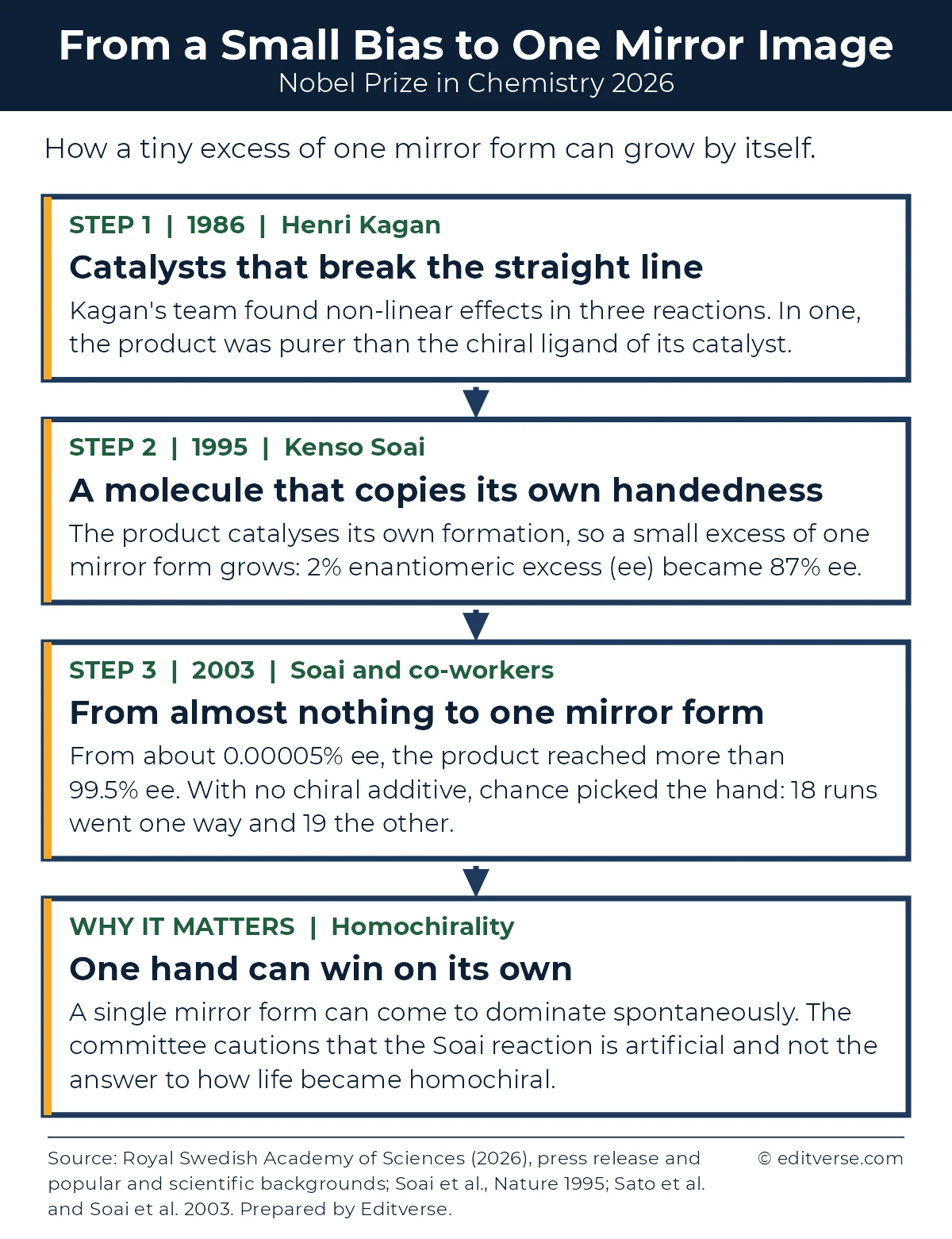
Kagan’s 1986 paper showed that a partly pure chiral catalyst can still give a purer product, because mixed left-right catalyst pairs work poorly. Soai then found a molecule that speeds up its own production, so a small excess of one mirror form grows each round. By 2003 his group had turned about 0.00005% ee into more than 99.5% ee.[2, 3, 8]
The Nobel Prize in Chemistry Papers at a Glance
Five prize papers in five journals span 1986 to 2003, and the 1995 Nature paper is the most cited in both OpenAlex and Crossref.[4, 5]
| Paper | Journal, date | Pages | Main result in plain words | Citations, OpenAlex / Crossref |
|---|---|---|---|---|
| Puchot … Kagan 1986[3] | J Am Chem Soc, 1 Apr 1986 | 2353-2357 | Product ee leaves the straight line, above it in one reaction and below it in two | 482 / 459 |
| Soai, Niwa, Hori 1990[6] | J Chem Soc Chem Commun, 1990 | 982 | A pyridyl alcohol catalyses its own formation, but ee falls from 86% to 35% | 146 / 136 |
| Soai, Shibata, Morioka, Choji 1995[7] | Nature, 28 Dec 1995 | 767-768 | A pyrimidyl alcohol copies itself while its ee rises | 1,081 / 1,036 |
| Singleton, Vo 2002[10] | J Am Chem Soc, online 6 Aug 2002 | 10010-10011 | Optical activity in 48 additive-free runs, traced mostly to chiral impurities, with a 2003 follow-up supporting absolute asymmetric synthesis | 118 / 111 |
| Sato … Soai 2003[8] | Angew Chem Int Ed, 20 Jan 2003 | 315-317 | About 0.00005% ee amplified to more than 99.5% ee in three runs | 233 / 217 |
| Soai et al. 2003[9] | Tetrahedron: Asymmetry, Jan 2003 | 185-188 | No chiral additive, 18 (R) and 19 (S) outcomes in 37 runs | 266 / 248 |
Citation counts retrieved 9 October 2026. The two databases differ.[4, 5]
JACS, 1986: Kagan’s Non-Linear Effects Paper
Kagan’s 1986 paper showed that product ee need not follow ligand ee in a straight line, and the committee says it redefined how chemists saw chirality and catalysis.[2]
Question. Chemists took product ee to be ligand ee times the best achievable ee, a rule expected for one chiral ligand per metal. Would it hold with two?[2]
What they did. At Université Paris-Sud, the team ran three reactions with ligands of varying ee, a titanium and diethyl tartrate sulfide oxidation, Sharpless epoxidation of geraniol and the L-proline-catalysed Hajos-Parrish reaction.[2, 11]
Result. Sharpless epoxidation gave a positive non-linear effect, and the other two gave negative effects.[2]
Why it mattered. Kagan’s result met the mutual-inhibition condition in Frank’s model and offered a two-ligand model that made the curve a probe of mechanism.[2, 11, 12]
Where published. Six authors with Kagan last. Crossref also shows an online date of 1 May 2002, a date shared by many older ACS articles posted to the web archive, so cite the 1986 issue date.[3]
How it was received. Noyori’s group reported a ligand of 15% ee giving a product of 98% ee in 1989, and Kagan co-authored reviews of the field in 1998 and 2009.[2, 13, 14, 15]
Chemical Communications, 1990: Autocatalysis Without Amplification
Soai’s 1990 paper reported a chiral alcohol that catalyses its own formation, although purity fell.[2, 6]
Question. Soai noticed that the catalyst and product of his dialkylzinc additions looked alike. Could the product be its own catalyst?[2, 11]
What they did. Soai, Niwa and Hori added diisopropylzinc to pyridine-3-carbaldehyde with a catalyst prepared from the product alcohol at 86% ee.[2]
Result. More of the same alcohol formed, with the same configuration, at 35% ee.[2]
Why it mattered. Two of Frank’s three conditions were met, and the committee calls it the discovery of an asymmetric autocatalytic process.[2]
Where published. Crossref records page 982 and no volume, while the committee’s list gives pages 982-983.[2, 6]
How it was received. It is the least cited of the five prize papers (146 in OpenAlex), yet the committee presents it as the step that started the search for amplification.[2, 4]
Nature, 1995: The Soai Reaction
The 1995 Nature paper reported asymmetric autocatalysis in which the product’s ee rises, meeting all three of Frank’s conditions in one reaction.[2, 7]
Question. Could another alcohol amplify the excess? Soai tested many molecules before a 5-pyrimidyl alcohol worked.[11]
What they did. Soai, Shibata, Morioka and Choji treated the low-ee alcohol with diisopropylzinc and pyrimidine-5-carbaldehyde, reusing products as catalysts in further runs.[2, 7]
Result. According to the Academy’s popular background, ee rose from 2% to 87%, and the Nature abstract gives the 2% start. Citing the same paper, the scientific background describes five runs from 5% that levelled off at 90%.[2, 7, 11]
Why it mattered. Soai’s name is now attached to the reaction, and the committee calls it the most powerful case so far of non-linear effects in asymmetric catalysis.[2]
Where published. Four authors with Soai first. The Crossref record lists December 1995 only, so the day comes from the Nature issue page.[7]
How it was received. The most cited paper in Table 1, it started a mechanism debate running from Blackmond and Brown’s 2001 reaction-calorimetry study to rival 2020 models from Denmark’s and Trapp’s groups.[2, 4, 16]
Angewandte Chemie, 2003: From 0.00005% to More Than 99.5% ee
This paper showed that an excess of about 0.00005% ee can grow to more than 99.5% ee in three consecutive runs of the Soai reaction.[2, 8]
Question. How small an imbalance can the reaction detect and amplify?
What they did. Sato, Urabe, Ishiguro, Shibata and Soai used an alkynyl pyrimidyl alcohol, adding fresh substrate and reagent each round.[2, 11]
Result. Product ee exceeded 99.5% after the third run, an amplification of the ratio of the two forms by a factor of 630,000, according to the committee.[2, 8]
Why it mattered. Its title states the figure exactly, greater than 99.5% ee, which means more than 99.75% of one enantiomer.[8]
How it was received. OpenAlex counts 233 citations and Crossref 217, and the Academy’s Soai reaction figure uses this series.[4, 5, 11]
Tetrahedron: Asymmetry, 2003: Chance Picks the Hand
Soai’s group ran the reaction with no chiral additive, and chance decided which mirror form came out in excess.[2, 9]
Question. Can the reaction break mirror symmetry by itself, a process called absolute asymmetric synthesis?[2]
What they did. Soai and co-workers added diisopropylzinc to a pyrimidine-5-carbaldehyde without any chiral substance, 37 times.[2, 9]
Result. Eighteen runs favoured the (R) alcohol and 19 the (S), with ee from 15% to 91%. According to the committee, tiny random fluctuations at the start decide the outcome, and the reaction amplifies them.[2]
Why it mattered. In the committee’s account, the Soai reaction is the first successful laboratory test of Frank’s model without external chiral influence, though not relevant to biological homochirality in water-based systems.[2]
Where published. Crossref lists 12 authors, the committee 10 plus et al.[2, 9]
How it was received. OpenAlex counts 266 citations and Crossref 248.[4, 5]
Independent Parallel Work Beside the Nobel Prize in Chemistry Papers: Singleton and Vo, 2002 and 2003
Daniel Singleton’s group tested absolute asymmetric synthesis in the Soai reaction independently, and the scientific background credits both groups side by side, citing two Singleton papers.[2]
Singleton and Vo’s two-page paper, “Enantioselective synthesis without discrete optically active additives”, appeared online on 6 August 2002 and in the issue of 28 August 2002. All 48 runs without added chiral substances gave optically active products, but the authors concluded that most, and likely all, were not true absolute asymmetric synthesis and traced the activity to optically active impurities. Their follow-up in Organic Letters, online 21 October 2003, gave 27 (R) and 27 (S) outcomes in 54 runs, which they read as evidence that chance decides the hand.[10, 17] The popular background credits Soai alone, while the scientific background names both groups, the fuller wording to follow.[2, 11]
When you cite parallel work, read what each paper concluded as well as its online and issue dates, and cite independent confirmation.
After the Nobel Prize in Chemistry Papers: Asymmetric Catalysis in OpenAlex, 1980 to 2024
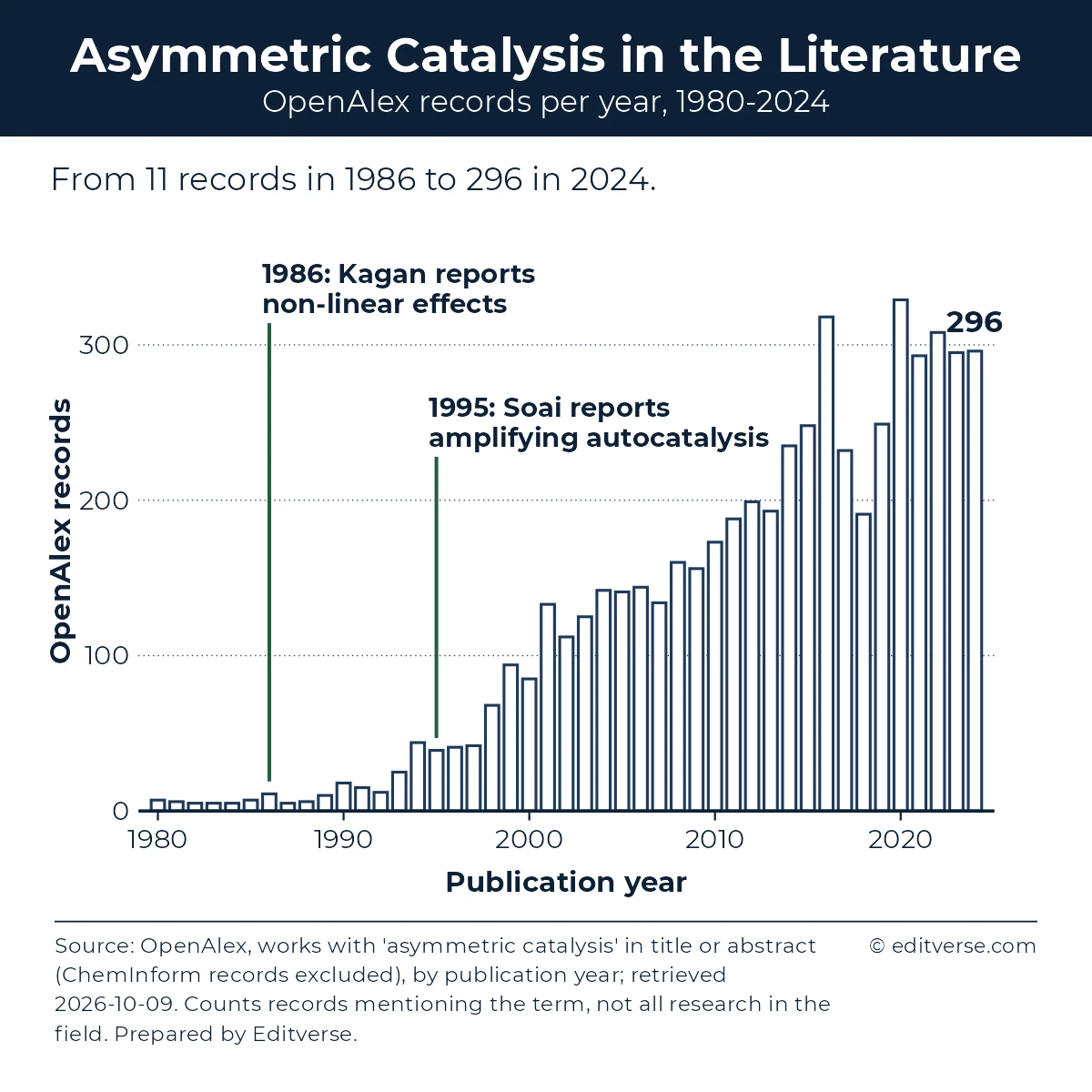
OpenAlex works with the phrase asymmetric catalysis in the title or abstract rose from 7 in 1980 and 11 in 1986 to 296 in 2024.[18]
Per million OpenAlex works, the share grew from 6.7 in 1986 and 15.2 in 1995 to 26.6 in 2024. Figure 2 and Table 2 stop at 2024 because OpenAlex indexed 33% more works overall for 2025, which would inflate that year’s count of 429.[18]
| Year | Works | Year | Works | Year | Works |
|---|---|---|---|---|---|
| 1980 | 7 | 1995 | 39 | 2010 | 173 |
| 1981 | 6 | 1996 | 41 | 2011 | 188 |
| 1982 | 5 | 1997 | 42 | 2012 | 199 |
| 1983 | 5 | 1998 | 68 | 2013 | 193 |
| 1984 | 5 | 1999 | 94 | 2014 | 235 |
| 1985 | 7 | 2000 | 85 | 2015 | 248 |
| 1986 | 11 | 2001 | 133 | 2016 | 318 |
| 1987 | 5 | 2002 | 112 | 2017 | 232 |
| 1988 | 6 | 2003 | 125 | 2018 | 191 |
| 1989 | 10 | 2004 | 142 | 2019 | 249 |
| 1990 | 18 | 2005 | 141 | 2020 | 329 |
| 1991 | 15 | 2006 | 144 | 2021 | 293 |
| 1992 | 12 | 2007 | 134 | 2022 | 308 |
| 1993 | 25 | 2008 | 160 | 2023 | 295 |
| 1994 | 44 | 2009 | 156 | 2024 | 296 |
Lessons From the Nobel Prize in Chemistry Papers for Researchers
Four lessons from the Nobel Prize in Chemistry papers rest on facts you can check.
Short papers can carry a prize-winning result
The 1995 Nature paper fills two pages, Singleton and Vo’s paper two and the 2003 Angewandte paper three.[7, 8, 10] Each puts its key number up front, as the Nature abstract does with its 2% starting ee.[7] Our guide to publishing in Nature and other high-impact journals covers framing.
Report enantiomeric excess and conditions exactly
The Academy’s two background documents describe the same 1995 work as 2% to 87% and as a five-run series from 5% to 90%.[2, 11] State the ee, substrate, reagent and run number for every value, and keep ee separate from the share of one enantiomer, since more than 99.5% ee means more than 99.75% of one form.[8]
Report every run, not just the best one
As summarised by the committee, the 2003 Tetrahedron: Asymmetry paper gives the full distribution, 18 (R) and 19 (S) outcomes in 37 runs with ee from 15% to 91%, so readers can judge reproducibility.[2, 9]
Get dates, identifiers and counts right
Several key papers, including the 1995 Nature paper, are not in PubMed, but they can be cited with standard bibliographic details and a DOI.[7] PMID 22175583 for the 1986 paper is a record added years later and does not date it.[3] Counts differ by database too, with the 1998 Girard and Kagan review at 840 in OpenAlex and 584 in Crossref, so name the source and date.[4, 5, 14] Our guides to SCI, SCIE and ESCI indexing, field-specific h-index norms and increasing your paper’s citations go further.
Professional Services for Your Own Chemistry Paper
A focused claim, exact numbers and the right journal carried the Nobel Prize in Chemistry papers. Editverse supports each of those steps.
Journal Selection
$115
5 to 10 ranked journal suggestions with a rationale covering scope, impact factor and acceptance rate.
Premium Scientific Editing
$750
Full technical editing, figures and tables review, and re-submission support. 90 days of unlimited revisions.
Graphical Abstract
$150
A journal-sized graphical abstract that shows your reaction or mechanism at a glance. 2 to 3 days.
Cover Letter
$25
A cover letter customised to your target journal. 2 to 3 days.
- GraphPro: build publication-ready charts, 25 types, with built-in t-test, ANOVA, correlation, and chi-square p-values. Free, no signup.
- StatPro: free statistical calculators and a test-selector tool covering group comparisons, categorical outcomes, time-to-event analysis, and diagnostic accuracy.
- Flowchart Pro: generate PRISMA 2020, PRISMA-ScR, CONSORT, STROBE, STARD, MOOSE, and ARRIVE flow diagrams directly in your browser.
Related Editverse Resources
More from the 2026 Nobel Prizes. Read our guide to the Nobel Prize in Chemistry 2026, our guide to the Nobel Prize in Medicine 2026 for optogenetics, and the papers behind the optogenetics Nobel Prize.
Frequently Asked Questions About the Nobel Prize in Chemistry Papers
Which papers are behind the 2026 Nobel Prize in Chemistry?
The committee’s scientific background rests on Kagan’s 1986 JACS paper on non-linear effects and Soai’s papers in Chemical Communications (1990), Nature (1995), Angewandte Chemie (2003) and Tetrahedron: Asymmetry (2003).[2]
In which journal was the Soai reaction reported?
Soai, Shibata, Morioka and Choji reported asymmetric autocatalysis with amplification of enantiomeric excess in Nature, volume 378, pages 767-768, issue date 28 December 1995.[7]
Did Soai and Singleton achieve absolute asymmetric synthesis independently?
Yes. According to the Nobel Committee’s scientific background, Soai and Daniel Singleton showed it in the Soai reaction independently of each other. Singleton and Vo’s 2002 paper traced its optical activity mainly to chiral impurities, and their 2003 Organic Letters paper, with 27 (R) and 27 (S) outcomes in 54 runs, supported absolute asymmetric synthesis.[2, 10, 17]
Why do sources give different starting values for Soai’s 1995 result?
According to the Academy’s popular background, ee rose from 2% to 87%, matching the 2% start in the Nature abstract. Citing the same paper, the scientific background describes five runs from 5% that levelled off at 90%. Quote the source you cite.[2, 7, 11]
How do I cite a chemistry paper that is not in PubMed?
Give the authors, title, journal, year, volume, issue, pages and DOI. Soai’s 1995 paper has no PMID but is fully citable as Nature, volume 378, issue 6559, pages 767-768, DOI 10.1038/378767a0.[7]
How to Cite This Article
Editverse. (2026, October 9). The papers behind the 2026 Nobel Prize in Chemistry. Editverse. https://editverse.com/nobel-prize-chemistry-2026-papers-asymmetric-synthesis/
References
- The Royal Swedish Academy of Sciences. Press release: The Nobel Prize in Chemistry 2026 [Internet]. Stockholm: The Royal Swedish Academy of Sciences; 2026 Oct 7 [cited 2026 Oct 9]. Available from: nobelprize.org press release (PDF)
- Nobel Committee for Chemistry. Scientific background to the Nobel Prize in Chemistry 2026: Non-linear effects and autocatalysis in asymmetric organic synthesis [Internet]. Stockholm: The Royal Swedish Academy of Sciences; 2026 Oct 7 [cited 2026 Oct 9]. 22 p. Available from: nobelprize.org scientific background (PDF)
- Puchot C, Samuel O, Dunach E, Zhao S, Agami C, Kagan HB. Nonlinear effects in asymmetric synthesis. Examples in asymmetric oxidations and aldolization reactions. J Am Chem Soc. 1986 Apr 1;108(9):2353-7. doi:10.1021/ja00269a036. PMID 22175583. PubMed 22175583
- OpenAlex. cited_by_count for works W2026655238, W1971390350, W2139673467, W2085268679, W2092356369, W2063192409, W1966449631, W2162537337, W2049177977 [Internet]. [cited 2026 Oct 9].
- Crossref. is-referenced-by-count for DOIs 10.1016/0006-3002(53)90082-1, 10.1021/ja00269a036, 10.1039/C39900000982, 10.1038/378767a0, 10.1021/ja027129o, 10.1021/ol035605p, 10.1002/anie.200390105, 10.1016/S0957-4166(02)00791-7 and the Girard and Kagan 1998 review DOI [Internet]. [cited 2026 Oct 9].
- Soai K, Niwa S, Hori H. Asymmetric self-catalytic reaction. Self-production of chiral 1-(3-pyridyl)alkanols as chiral self-catalysts in the enantioselective addition of dialkylzinc reagents to pyridine-3-carbaldehyde. J Chem Soc Chem Commun. 1990;(14):982-3. doi:10.1039/C39900000982. Not indexed in PubMed.
- Soai K, Shibata T, Morioka H, Choji K. Asymmetric autocatalysis and amplification of enantiomeric excess of a chiral molecule. Nature. 1995 Dec 28;378(6559):767-8. doi:10.1038/378767a0. Not indexed in PubMed.
- Sato I, Urabe H, Ishiguro S, Shibata T, Soai K. Amplification of chirality from extremely low to greater than 99.5% ee by asymmetric autocatalysis. Angew Chem Int Ed. 2003 Jan 20;42(3):315-7. doi:10.1002/anie.200390105. PMID 12548688. PubMed 12548688
- Soai K, Sato I, Shibata T, Komiya S, Hayashi M, Matsueda Y, et al. Asymmetric synthesis of pyrimidyl alkanol without adding chiral substances by the addition of diisopropylzinc to pyrimidine-5-carbaldehyde in conjunction with asymmetric autocatalysis. Tetrahedron Asymmetry. 2003 Jan;14(2):185-8. doi:10.1016/S0957-4166(02)00791-7. Not indexed in PubMed.
- Singleton DA, Vo LK. Enantioselective synthesis without discrete optically active additives. J Am Chem Soc. 2002 Aug 28;124(34):10010-1. Epub 2002 Aug 6. doi:10.1021/ja027129o. PMID 12188664. PubMed 12188664
- The Royal Swedish Academy of Sciences. Popular science background: They solved chemistry’s asymmetric mystery [Internet]. Stockholm: The Royal Swedish Academy of Sciences; 2026 Oct 7 [cited 2026 Oct 9]. 7 p. Available from: nobelprize.org popular background (PDF)
- Frank FC. On spontaneous asymmetric synthesis. Biochim Biophys Acta. 1953;11:459-63. doi:10.1016/0006-3002(53)90082-1. PMID 13105666. PubMed 13105666
- Kitamura M, Okada S, Suga S, Noyori R. Enantioselective addition of dialkylzincs to aldehydes promoted by chiral amino alcohols. Mechanism and nonlinear effect. J Am Chem Soc. 1989 May;111(11):4028-36. doi:10.1021/ja00193a040. Not indexed in PubMed.
- Girard C, Kagan HB. Nonlinear effects in asymmetric synthesis and stereoselective reactions: ten years of investigation. Angew Chem Int Ed. 1998 Nov 16;37(21):2922-59. doi:10.1002/(SICI)1521-3773(19981116)37:21<2922::AID-ANIE2922>3.0.CO;2-1. PMID 29711141. PubMed 29711141
- Satyanarayana T, Abraham S, Kagan HB. Nonlinear effects in asymmetric catalysis. Angew Chem Int Ed. 2009;48(3):456-94. Epub 2008 Dec 29. doi:10.1002/anie.200705241. PMID 19115268. PubMed 19115268
- Athavale SV, Simon A, Houk KN, Denmark SE. Demystifying the asymmetry-amplifying, autocatalytic behaviour of the Soai reaction through structural, mechanistic and computational studies. Nat Chem. 2020 Apr;12(4):412-23. Epub 2020 Mar 23. doi:10.1038/s41557-020-0421-8. PMID 32203445. PubMed 32203445. PMCID PMC7117993.
- Singleton DA, Vo LK. A few molecules can control the enantiomeric outcome. Evidence supporting absolute asymmetric synthesis using the Soai asymmetric autocatalysis. Org Lett. 2003 Nov 13;5(23):4337-9. Epub 2003 Oct 21. doi:10.1021/ol035605p. PMID 14601994. PubMed 14601994
- OpenAlex. Works per publication year matching title_and_abstract.search “asymmetric catalysis” NOT ChemInform, 1980-2024, grouped by publication_year [Internet]. [cited 2026 Oct 9]. Available from: api.openalex.org query