
Published | Last updated

Open access is no longer a niche publishing choice. Gold open access journals alone now number 6,703 in Clarivate’s Journal Citation Reports 2026, a 6% increase in a single year, and every major funder from the NIH to China’s National Natural Science Foundation now expects researchers to have an open access plan before a manuscript ever reaches a journal. Choosing well means understanding what open access actually offers beyond the label. Choosing badly can mean paying a stranger with a fabricated editorial board to publish work that no serious reader, funder, or hiring committee will ever find. This guide walks through the five recognized types of open access, the opportunities each one creates, and the predatory publishing traps that catch even experienced researchers off guard.
📖 In Simple Words — What Does Open Access Actually Mean?
Open access means a research article is free for anyone to read online, with no journal subscription, institutional login, or paywall standing between the reader and the paper. A nurse in Manila, a policy adviser in Nairobi, and a graduate student in Ohio can all open the same PDF on the day it publishes.
The complexity begins with who pays for that free access. Someone always covers the cost of editing, hosting, and indexing an article. Under most open access models, the author, their funder, or their institution pays an article processing charge instead of the reader paying a subscription. Under a smaller but growing model called Diamond open access, neither side pays because a university, society, or government funds the journal directly.
✍ Quick check:
① A journal charges no subscription and no author fee. What type of open access is this? [Answer: Diamond, sometimes called Platinum, open access]
② Does open access mean the same thing as free to publish? [Answer: No. Most open access models still charge the author or funder an APC]
What Is Open Access, Exactly?
The formal definition traces back to the Budapest Open Access Initiative of February 2002, when researchers and librarians meeting in Hungary committed to free online availability of the peer-reviewed literature, permitting any user to read, download, copy, distribute, print, search, or link to the full text of articles without financial, legal, or technical barriers. The Berlin Declaration followed in October 2003, extending the same principle beyond journal articles to research data and cultural heritage material. Neither document specifies a business model. Open access describes what a reader can do with an article, not who funded its production.
Two separate barriers have to fall before an article counts as genuinely open. The price barrier disappears once a reader can access the paper without paying a subscription or a per-article fee. The permission barrier disappears only once a license, typically Creative Commons Attribution (CC BY), grants the reader rights to copy, redistribute, and reuse the material beyond simply viewing it. An article can clear the price barrier while leaving the permission barrier standing, which is exactly what happens with Bronze open access, covered below.
The Five Types of Open Access Explained
Librarians and publishers sort open access into five widely used categories, often nicknamed by color. Each one answers the same three questions differently: who pays, where the article lives, and whether access is permanent.
| Type | Who Pays | Where It Lives | Permanence |
|---|---|---|---|
| Gold | Author or funder pays an APC | Fully OA journal (PLOS ONE, BMC series) | Permanent, licensed (usually CC BY) |
| Green | No direct fee | Repository (PubMed Central, institutional archive, arXiv) | Permanent once deposited, sometimes after an embargo |
| Hybrid | Author pays an APC on top of the journal’s subscription revenue | Subscription journal with a per-article OA option | Permanent for the paying article only |
| Diamond | Nobody; a society, university, or government funds the journal | Community-run or society journal | Permanent, licensed |
| Bronze | Nobody pays a fee; the publisher chooses to unlock it | Publisher’s own website | Reversible; the publisher can repaywall it later |
Gold Open Access
Gold open access places the finished, peer-reviewed article on the publisher’s own site under an open license, most commonly CC BY, on the day it publishes. PLOS ONE, Scientific Reports, and BMC Medicine all operate this way. Kim and Shrime’s 2024 cross-sectional analysis of otolaryngology journals found article processing charges varying enormously by publisher and prestige tier, from journals charging nothing at all to APCs running into several thousand dollars. Gold access guarantees permanence. Once an article carries a CC BY license, no publisher can quietly restrict it again.
Green Open Access
Green open access works through self-archiving rather than journal choice. An author deposits a version of the manuscript, usually the peer-reviewed author-accepted manuscript, into a repository such as PubMed Central, an institutional archive, or a discipline-specific server like arXiv. Some publishers historically imposed an embargo of six to twelve months before that deposited copy became visible. That has changed quickly. The revised NIH Public Access Policy, effective July 1, 2025, eliminated the embargo entirely for NIH-funded work, requiring the author-accepted manuscript to appear in PubMed Central with no delay once the paper is officially published. Authors bear no direct cost under Green open access, which makes it the most financially accessible route for anyone without grant funding earmarked for an APC.
Hybrid Open Access
A hybrid journal sells subscriptions to libraries while also letting individual authors pay to unlock their own article. Elsevier, Springer, and Wiley journals across most disciplines offer this option. Librarians and funders criticize the arrangement consistently, because a publisher can collect subscription revenue from libraries and an APC from the author for the same issue, a practice known as double dipping. cOAlition S built its Rights Retention Strategy specifically to route around this problem, letting Plan S-funded authors submit to any journal, hybrid ones included, while retaining the right to make their accepted manuscript public under a CC BY license regardless of that journal’s own OA policy. The strategy has already pushed roughly 150 subscription and mixed-model publishers to renegotiate their author agreements.
Diamond (Platinum) Open Access
Diamond open access, sometimes called Platinum, charges neither the reader nor the author. A university press, scholarly society, national library consortium, or government science agency absorbs the cost of running the journal instead. Because no APC exists, Diamond journals sidestep the equity problem that article processing charges create for under-funded researchers, and Saloojee and Pettifor’s 2024 analysis in Calcified Tissue International argues this model best serves researchers in low- and middle-income countries who face APCs as a genuine barrier to publishing their own findings. The trade-off is scale. Diamond journals tend to run smaller and more specialized than major commercial OA titles, and fewer of them carry an established Journal Impact Factor.
Bronze Open Access
Bronze open access describes articles that are free to read on a publisher’s website without carrying any explicit open license. A publisher might unlock older content, run a promotional access window, or free up an issue without formally reclassifying it as Gold. Nothing stops that same publisher from repaywalling the article later, and without a CC license, readers cannot legally redistribute, translate, or reuse the text even while it happens to sit in front of no paywall. Bronze is the type of open access most likely to create false confidence. An article bookmarked as freely available today can return behind a paywall next year with no notice to anyone who linked to it.
The Real Opportunities Open Access Creates
Whether open access articles earn more citations than paywalled ones remains one of the most contested questions in scholarly communication. Langham-Putrow, Bakker, and Riegelman’s 2021 systematic review in PLOS ONE searched seventeen databases, screened 5,744 candidate studies, and ultimately compared 134 that directly measured citation counts between open access and subscription articles. Sixty-four of those studies (47.8%) confirmed a citation advantage for open access, thirty-seven (27.6%) found no advantage at all, and the rest produced mixed or inconclusive results. Open access probably helps a paper get read and cited in many fields, but the effect is neither universal nor guaranteed, so a citation-advantage promise alone is a weak reason to pick one publishing route over another.
Funder mandates now make open access a compliance requirement for a large share of researchers rather than a preference. The revised NIH Public Access Policy removed its twelve-month embargo altogether for papers accepted on or after July 1, 2025, requiring immediate deposit of the accepted manuscript in PubMed Central at no cost to the author. cOAlition S applies a parallel logic across Europe and beyond through Plan S, and China’s National Natural Science Foundation has layered on its own OA mandates since 2022. A researcher funded by any of these bodies now needs an open access plan before submission, not as an afterthought once a journal accepts the paper. Our recent breakdown of Journal Citation Reports 2026 found Gold OA journals gaining Journal Impact Factor faster than subscription titles in several fields, a trend tied directly to this mandate-driven growth.
Open access also shifts who gets to read new research, though not without introducing a new trade-off. Saloojee and Pettifor describe how the subscription model historically locked clinicians and researchers in low- and middle-income countries out of literature their own patients and communities needed, while the open access shift solved that reader-side barrier only to create a different one on the author side. Article processing charges, which Feres and colleagues’ 2026 analysis of general surgery journals found can meaningfully limit publishing access for authors from lower-resourced settings, remain the unresolved half of the equity question. Diamond journals, APC waiver programs, and funder-subsidized publishing funds are the current partial answers.
💡 Editverse insight — from 1,100+ manuscripts edited
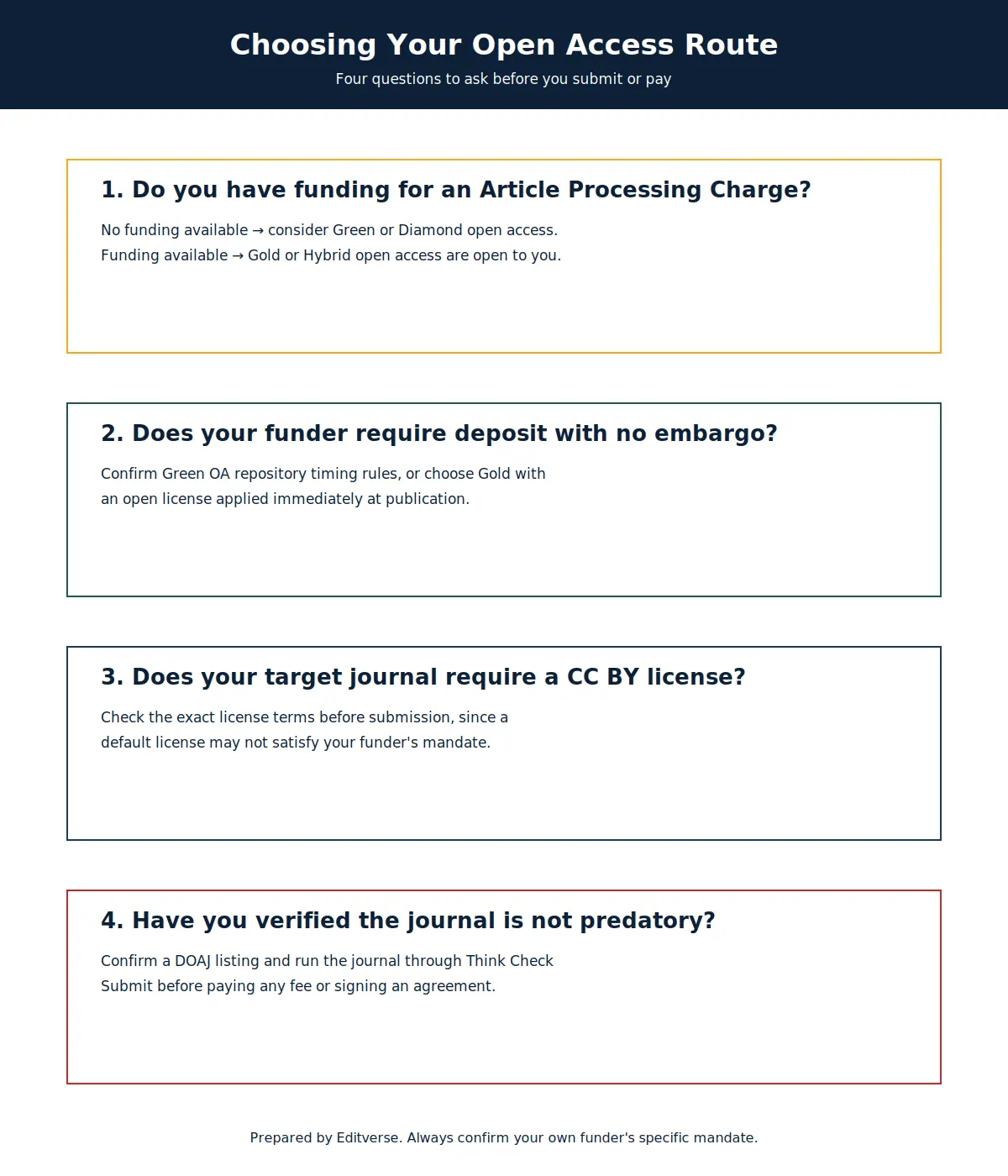
Researchers frequently discover a target journal’s APC only after acceptance, once redirecting the paper elsewhere would mean restarting peer review from scratch. Confirming the APC, or the availability of a waiver, belongs on the same pre-submission checklist as confirming journal scope.
The Traps: Predatory Publishing and Other Open Access Pitfalls
Predatory journals and publishers exploit the open access business model itself. They collect an article processing charge while skipping the peer review, editing, and indexing work that fee is supposed to fund. Cook, Govender, and Brennan’s 2023 overview in the British Journal of Oral and Maxillofacial Surgery describes predatory publishers as operations charging substantial APCs without the scientific rigor or ethical process legitimate journals provide, and the scale of the problem keeps growing. Roughly 10,000 predatory journals were estimated to exist in 2015; by late 2024, tracking services placed the figure above 18,000.
Fung and colleagues’ 2026 audit in the ANZ Journal of Surgery tracked twelve months of unsolicited journal emails received by a single academic urologist and logged 422 solicitations from 196 unique journals across 89 publishers, cross-checked against Beall’s list, the KSCIEN list, and independent verification through PubMed, Journal Citation Reports, and SCImago. Fabricated or unverifiable impact-factor claims, vague indexing statements, and aggressive submission deadlines formed the recurring pattern across those solicitations. A genuine journal rarely needs to cold-email a stranger asking for a submission within days.
Cobey and colleagues’ 2020 survey in BMJ Open reached corresponding authors who had already published in journals presumed predatory under Beall’s criteria, drawing 82 full responses across two sampled groups with response rates of 11.4% and 19.3%. Many respondents described minimal or superficial peer review, occasionally acceptance within days of submission with no substantive feedback at all. That speed can feel like good news to a researcher facing a tenure deadline, right up until the paper lands in a venue no search committee, funder, or fellow scientist trusts.
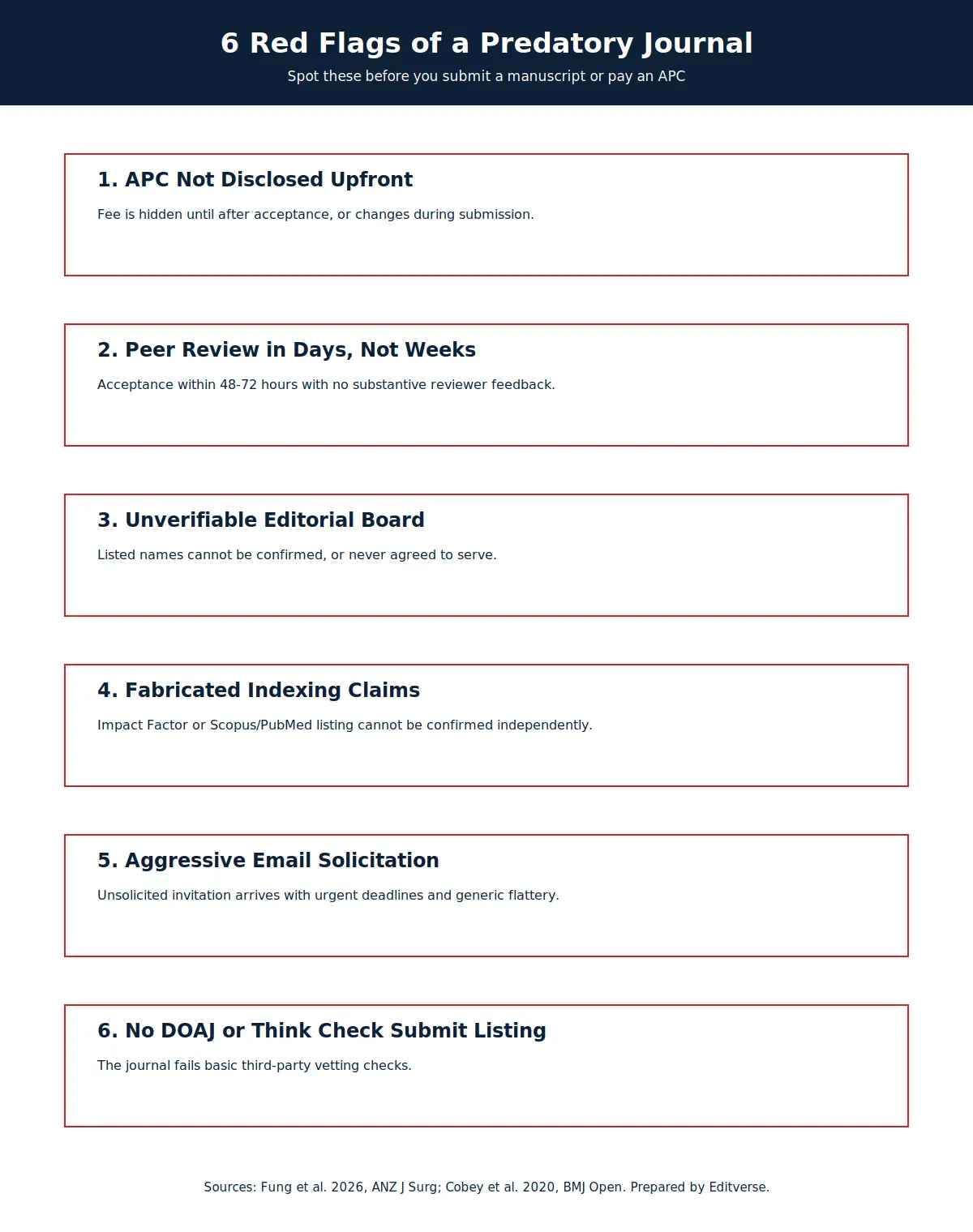
⚠ Six Red Flags of a Predatory Journal
- The article processing charge is undisclosed until after acceptance, or it changes during submission
- Peer review takes days rather than weeks, with generic or superficial reviewer comments
- Editorial board members cannot be verified, or never agreed to be listed
- Impact Factor, Scopus, or PubMed indexing claims cannot be confirmed on the original database
- An unsolicited email invitation arrives with an urgent deadline and generic flattery
- The journal has no listing in DOAJ and fails the Think Check Submit checklist
Rights and Licensing Confusion
A CC BY license lets anyone reuse an article, including for commercial purposes, provided they credit the author. A CC BY-NC-ND license blocks commercial reuse and any modification entirely. Authors who accept a journal’s default license without reading it sometimes discover later that their funder required CC BY while the journal issued something more restrictive, a compliance gap that tends to surface during a grant audit rather than at submission. Checking license terms belongs on the same pre-submission checklist as checking the APC and the journal’s scope.
How to Vet a Journal Before You Submit or Pay
A short verification routine catches most predatory offers before any money changes hands. Search the journal in the Directory of Open Access Journals, which manually vets every title it lists against transparency and quality criteria. Run the journal through the free Think Check Submit checklist, built by a coalition of publishers, libraries, and researcher organizations to help authors evaluate an unfamiliar journal in a few minutes. Confirm Committee on Publication Ethics membership, search independently for two or three editorial board members to see whether they list the journal on their own institutional page, and read the journal’s most recent issue for scope fit and basic editorial quality rather than trusting its own description of itself. Our guide to using DOAJ effectively walks through the search filters that catch most red flags in under ten minutes.
Common Mistakes Researchers Make with Open Access
Get Expert Help With Your Journal and Publishing Strategy
Deciding between Gold, Green, Hybrid, and Diamond routes, then confirming a journal clears every legitimacy check, takes real time away from writing. Editverse’s publication support service pairs each manuscript with a journal-selection review that weighs scope fit, APC cost, funder compliance, and predatory-risk screening in a single recommendation, alongside manuscript editing that gets the paper submission-ready for whichever route fits.
Premium Scientific Editing
$750
Full technical editing, figures, and re-submission support
Editverse Publication Support
Not sure which open access route fits your manuscript?
Our team checks funder mandates, APC costs, and journal legitimacy before you submit or pay anything.
Frequently Asked Questions About Open Access
What is open access in simple terms?
Open access means a published research article is free for anyone to read online immediately, without a journal subscription or institutional login.
What is the difference between Gold and Green open access?
Gold open access publishes the final peer-reviewed article openly on the publisher’s site, usually funded by an author-paid APC. Green open access means the author self-archives a version of the same paper in a repository, usually at no direct cost.
Is Diamond open access the same as free open access?
Yes, for both sides. Diamond, also called Platinum, open access charges neither the reader nor the author, with a society, university, or government covering the cost of running the journal.
Are all open access journals predatory?
No. Legitimate Gold and Diamond open access journals apply genuine peer review and editorial standards. Predatory publishers copy the fee-based Gold OA business model while skipping the actual editorial work, which is why vetting the journal matters more than the open access label itself.
How can I check if an open access journal is legitimate?
Search it in the Directory of Open Access Journals, run it through the Think Check Submit checklist, verify a few editorial board members independently, and confirm any impact-factor or indexing claim on the original database rather than the journal’s own site.
Do I always have to pay to publish open access?
No. Green and Diamond open access carry no direct author fee. Many funders and institutions also offer APC waivers or discounts for Gold open access, particularly for researchers in lower-income countries.
Article processing charge budgets and predatory-journal risk look different depending on where the funding sits. Authors at Chinese institutions can get venue screening, APC planning and submission handled through our publication support service for Chinese authors.
Conclusion
Open access has moved from an idealistic proposal in a 2002 Budapest meeting room to a mandatory requirement attached to a large share of the world’s research funding. Gold, Green, Hybrid, and Diamond routes each solve a different combination of cost, speed, and compliance, while Bronze access solves none of them permanently. The opportunities are real, spanning broader readership, faster funder compliance, and a meaningful, if incomplete, step toward equity for researchers in lower-income settings. The traps are equally real, and they prey specifically on researchers under deadline pressure who skip a verification step that takes ten minutes. Run every unfamiliar journal through DOAJ and Think Check Submit before money or manuscript rights change hands, and the open access decision becomes a strategic choice again instead of a gamble.
Explore related resources on Editverse: our guide to using DOAJ to vet journals, the latest Journal Citation Reports 2026 data on OA growth, and our systematic review and meta-analysis support for researchers preparing a submission.
Related Editverse Resources
→ DOAJ Use Guidelines: Tips for Researchers
→ Journal Citation Reports 2026: What Every Researcher Needs to Know
→ Publication Support Services
→ Manuscript Editing Services
→ Systematic Review & Meta-Analysis Support
→ The Benefits of Open Access Publishing for Research Impact
References
- Budapest Open Access Initiative. Budapest Open Access Initiative Declaration. February 14, 2002. budapestopenaccessinitiative.org
- Max Planck Society. Berlin Declaration on Open Access to Knowledge in the Sciences and Humanities. October 2003. openaccess.mpg.de
- Langham-Putrow A, Bakker C, Riegelman A. Is the open access citation advantage real? A systematic review of the citation of open access and subscription-based articles. PLoS One. 2021;16(6):e0253129. doi:10.1371/journal.pone.0253129 [PMID: 34161369]
- Cook F, Govender R, Brennan PA. Greetings from your predatory journal! What they are, why they are a problem, how to spot and avoid them. Br J Oral Maxillofac Surg. 2023;61(4):277-281. doi:10.1016/j.bjoms.2023.02.005 [PMID: 36959056]
- Fung C, Razi B, Basto M, et al. Trust, but Verify: An Exploratory Audit of Predatory Journal and Publisher Solicitations. ANZ J Surg. 2026;96(4):786-791. doi:10.1111/ans.70568 [PMID: 41792872]
- Cobey KD, Grudniewicz A, Lalu MM, Rice DB, Raffoul H, Moher D. Knowledge and motivations of researchers publishing in presumed predatory journals: a survey. BMJ Open. 2020;9(3):e026516. doi:10.1136/bmjopen-2018-026516 [PMID: 30904874]
- Saloojee H, Pettifor JM. Maximizing Access and Minimizing Barriers to Research in Low- and Middle-Income Countries: Open Access and Health Equity. Calcif Tissue Int. 2024;114(2):83-85. doi:10.1007/s00223-023-01151-7 [PMID: 37962622]
- Feres B, Palte N, Wagemaker Viana S, et al. Article Processing Charges in General Surgery Journals: Implications for Equitable Publishing Access in Low-Income and Middle-Income Countries. J Surg Res. 2026. doi:10.1016/j.jss.2026.06.016 [PMID: 42398260]
- Kim EK, Shrime MG. Cost of open access publishing in otolaryngology-head and neck surgery. World J Otorhinolaryngol Head Neck Surg. 2024. doi:10.1002/wjo2.78 [PMID: 38059140]
- cOAlition S. Plan S Rights Retention Strategy. coalition-s.org
- University of California Office of Scholarly Communication. Guidance on the Revised NIH Public Access Policy, Effective July 2025. osc.universityofcalifornia.edu
- Directory of Open Access Journals. doaj.org
- Think Check Submit. thinkchecksubmit.org