
Published | Last updated
If you have ever stared at a Methods section and wondered what to call your own study design, you are not alone. Reviewers ask for it, journals expect it in your discussion of limitations, and grant panels use it to weigh your proposal against competing ones. Levels of evidence is the term researchers use for this ranking, and it answers a narrow but important question: given the design you used, how much confidence should a reader place in your result before anything else about the study is considered?
This guide walks through what the term actually means, the two frameworks that dominate current practice (OCEBM and GRADE), and a five-step method you can apply to any clinical study in a few minutes. By the end, you will be able to place your own manuscript, or a paper you are appraising for a literature review, on the ladder with confidence.
Free tool · takes about a minute
Level of Evidence Finder
Skip the reading. Answer 4 quick questions and get your study’s level right now.
What "Level of Evidence" Really Means
A level of evidence is a rank assigned to a study based on its design, not its topic, its sample size, or how interesting its findings are. The ranking exists because different designs carry different amounts of built-in protection against bias. A randomized controlled trial protects against confounding by balancing known and unknown patient characteristics across groups through random allocation. A case series offers no such protection, because there is no comparison group at all. The level tells a reader how much of that protection was designed into the study before a single result was analyzed.
It helps to separate three terms that get used interchangeably in casual conversation but mean different things in a manuscript.
- Level of evidence describes the study design itself (a systematic review, an RCT, a cohort study, and so on).
- Quality of evidence (the GRADE term is "certainty") describes how well that design was executed and reported, including sample size, follow-up completeness, and risk of bias.
- Strength of recommendation describes how confidently a guideline panel can tell a clinician to act on the evidence, which folds in quality, consistency across studies, and the balance of benefits and harms.
A well-conducted cohort study can carry a higher certainty rating than a poorly reported randomized trial, even though the RCT design outranks the cohort design on the hierarchy. The level is a starting point, not a final verdict.
In Simple Words
Think of the level of evidence as a study's starting credit score, based only on its design. Everything else about how well the study was run and reported can raise or lower that score, but it does not change which design category the study belongs to.
The Two Systems Researchers Actually Use: OCEBM and GRADE
More than 80 different evidence-ranking schemes have been proposed since the 1970s, but two now cover the overwhelming majority of journals and guideline bodies a researcher will encounter.
The Oxford Centre for Evidence-Based Medicine (OCEBM) 2011 Levels of Evidence sorts studies into five numbered levels by design alone, with separate tables for questions about treatment benefit, harm, prognosis, diagnosis, and economic analysis. It is fast to apply and works well for a single study or a quick literature scan.
The GRADE (Grading of Recommendations, Assessment, Development and Evaluation) approach, described in detail by Guyatt and colleagues in the Journal of Clinical Epidemiology, starts from the same design hierarchy but treats it as a starting point rather than a fixed score. Randomized trials begin as high-certainty evidence and observational studies begin as low-certainty evidence, then both can move up or down based on five factors: risk of bias, inconsistency across studies, indirectness to the actual question, imprecision, and publication bias. Well-designed observational studies with a large effect size can move up; RCTs with serious flaws can move down.
Editverse's own systematic review and meta-analysis clients almost always need both. OCEBM sorts the initial evidence table by design during the literature search, and GRADE produces the certainty ratings that appear in the summary-of-findings table a journal or guideline panel expects to see.
| Feature | OCEBM 2011 Levels | GRADE |
|---|---|---|
| What it ranks | The study design | Certainty in a specific outcome estimate |
| Output | Level 1 through Level 5 | High, moderate, low, or very low |
| Can the rating change after the design is set? | No, the level follows the design | Yes, up or down across five domains |
| Typical use | Quick appraisal, single-study grading, literature review tables | Systematic reviews, clinical practice guidelines |
| Adopted by | Journals, university library guides, individual appraisal | Over 100 organizations, including Cochrane and WHO |
The Study Design Hierarchy, Ranked From Strongest to Weakest
The ladder below reflects the therapy/prevention table most researchers mean when they say "levels of evidence." Diagnosis, prognosis, and harm questions use adjusted versions of the same idea, but the logic is the same throughout, designs that control more sources of bias sit higher.
Level 1: Systematic Review and Meta-Analysis of Randomized Controlled Trials
A systematic review follows a pre-specified protocol to find, appraise, and combine every relevant trial on a question. When the included trials are similar enough to pool statistically, the review becomes a meta-analysis, and the combined estimate typically carries narrower confidence intervals than any single trial. This is why the top of the ladder belongs to a synthesis of trials rather than any individual trial, however large.
Level 2: Randomized Controlled Trial
Random allocation is the design feature that does the real work here. By assigning participants to groups by chance, an RCT balances both the confounders a researcher thought to measure and the ones nobody thought to measure. A single well-powered trial with adequate blinding and complete follow-up is strong evidence on its own, though it still reflects one population, one setting, and one point in time.
Level 3: Cohort Study
A cohort study follows a group defined by exposure (or lack of it) forward in time and compares outcomes between the exposed and unexposed groups. Cohorts are indispensable when randomization is impossible or unethical, for instance when studying a harmful exposure. Without random allocation, though, confounding by indication remains a real threat, which is why cohort designs rank below RCTs even when they are large and well run.
Level 4: Case-Control Study
A case-control study works backward, starting with people who already have the outcome (the cases), matching them to people who do not (the controls), and then looking back at prior exposures. This design is efficient for rare outcomes, since a researcher does not need to wait years for enough events to accumulate, but it is more vulnerable to recall bias and to the way cases and controls were selected.
Level 5: Case Series and Case Reports
A case series describes what happened to a group of patients with no comparison group at all. It cannot establish cause and effect, but it remains genuinely valuable for flagging a new adverse event, an unusual presentation, or a signal worth testing in a controlled design later.
Where Cross-Sectional Studies Fit
A cross-sectional study measures exposure and outcome at a single point in time, which makes it fast and inexpensive but leaves it unable to establish which came first. On the therapy table it sits alongside case-control designs, but the OCEBM diagnostic-accuracy table treats a well-conducted cross-sectional study with a consistently applied reference standard as a much stronger design, because a diagnostic question only needs to know whether a test result and a true disease status agree at one moment, not which one caused the other. The type of data your study collects often signals which table you should be using before you even look at the level itself.
Level 6: Expert Opinion and Mechanism-Based Reasoning
At the base sits reasoning built on physiological plausibility, bench research, or clinical experience without new patient data. It is not worthless; it is often where a hypothesis is first proposed. It simply has not yet been tested against a comparison group.
A Simple 5-Step Method to Find Your Study's Level of Evidence
Most of the confusion researchers run into comes from trying to jump straight to a level number without working through the design features that actually determine it. The figure below breaks the decision into five checks you can run in order.

Step 1. Name your question type. Therapy and prevention questions, diagnostic accuracy questions, prognosis questions, and harm questions each have a slightly different OCEBM table. Confirm which one applies before you start ranking, since a diagnostic accuracy study is graded on a completely different scale from a treatment trial.
Step 2. Check whether the paper is a synthesis or a primary study. If it pools or systematically summarizes other people's data, you are looking at Level 1 territory. If it reports new data collected from a new sample, move to Step 3.
Step 3. Check for random allocation. Were participants assigned to a treatment or control arm by a random process such as a computer-generated sequence? If yes, you are looking at an RCT (Level 2). If no, move to Step 4.
Step 4. Check the comparison structure. Is there a comparison group at all? If groups were formed by exposure and followed forward in time, that is a cohort study (Level 3). If groups were formed by outcome and traced backward, that is a case-control study (Level 4). If there is no comparison group, you are looking at a case series or case report (Level 5).
Step 5. Apply GRADE on top of the level. Once the design-based level is set, walk through the five GRADE domains (risk of bias, inconsistency, indirectness, imprecision, and publication bias) to decide whether the certainty should move up or down from where the raw design would place it. This step is the one researchers skip most often, and it is the one journal reviewers and guideline panels actually care about.
Common Mistakes Researchers Make When Grading Their Evidence Level
Working across the systematic reviews and meta-analyses we support at Editverse, a handful of grading errors show up on repeat, well before a manuscript ever reaches a journal's reviewers.
Mistakes to Avoid
- Calling a quasi-experimental design (no randomization, but a comparison group) a full RCT because it "felt controlled."
- Treating any paper with "review" in the title as a systematic review, when it is a narrative review with no pre-registered protocol or comprehensive search strategy.
- Assigning a level and stopping there, without running the GRADE domains that can move an observational finding up for a large effect size or move a flawed trial down for high risk of bias.
- Using the therapy table to grade a diagnostic accuracy study, which inflates or deflates the apparent level because the two tables weigh design features differently.
- Citing the level of evidence in the abstract but never stating it in the Methods, which leaves a reviewer to work it out independently, often landing on a different answer than the author intended.
The fifth item is the one worth dwelling on. A reviewer who has to infer your design's level from scattered details in the Methods section is a reviewer primed to ask for a major revision. Stating it plainly, with the framework you used to determine it, removes that friction before it starts.
Why Your Level of Evidence Matters to Journal Reviewers
Journal reviewers use the level of evidence as an early filter for how strong a causal claim your discussion is allowed to make. A cohort study that talks about an intervention "reducing" an outcome, rather than being "associated with" a lower rate of that outcome, is a common desk-rejection trigger, because the language claims a causal certainty the design cannot support. Matching your claims to your design's actual level, and stating that level explicitly, is one of the fastest ways to keep a Methods and Discussion section internally consistent.
This matters even more once you move from a single study to a synthesis of several. Editverse has supported more than 2,500 manuscripts since 2019, and evidence grading is a recurring theme in the systematic reviews and meta-analyses we work on, where every included study needs a level before the pooled certainty rating can be calculated with GRADE. If you are building a PRISMA-compliant systematic review or preparing a manuscript that leans on someone else's primary data, getting this step right at the start saves a full round of reviewer comments later.
Grant panels lean on the same ladder for a different reason. A funder reviewing a proposal built entirely on Level 5 case series evidence will ask why a Level 3 or Level 2 study was not attempted first, or will expect the proposal to justify explicitly why a lower-level design is the only feasible option for the population or exposure in question. Naming the level of evidence behind your preliminary data, and behind the gap you intend to fill, does some of that justification for you before a reviewer has to ask.
Need Help Grading Evidence Across an Entire Review?
Editverse's Meta-Analysis and Systematic Review service handles OCEBM-level grading and full GRADE certainty ratings for every included study, alongside PRISMA-compliant search strategies and publication-ready flow diagrams.
How Journals Actually Grade Evidence: Examples From Orthopaedic Publishing
The clearest picture of level-of-evidence grading in practice comes from orthopaedic surgery journals, which have required it the longest and have published data on how well the process actually works.
Worked example
The 3-question method (Hohmann et al., Arthroscopy, 2018)
Applied to a sample study comparing two surgical repair techniques.
1. What is the research question?
A therapy question, does technique A outperform technique B, so the therapy table applies rather than the diagnosis or prognosis table.
2. What is the study type?
Check the Methods for randomization and follow-up direction. Patients randomly assigned to A or B and followed forward means an RCT.
3. Where does that type sit on the hierarchy?
A single RCT is Level 2 (Level 1 is reserved for a synthesis of RCTs).
The same paper notes basic-science and lab studies skip the ladder entirely and get a "clinical relevance statement" instead.
A worked example of grading up or down
JBJS's 2015 update (Marx et al.) added a footnote letting editors move a study off its design-based starting level.
Graded up
A retrospective cohort study normally starts at Level 3. A very large effect size can move it up to Level 2, treating a dramatic effect as a partial substitute for randomization.
Graded down
A randomized trial normally starts at Level 2. Serious imprecision, a small sample, or an indirect outcome can drop it a level, the same bias, imprecision, and indirectness flags GRADE uses.
What happens when journals check the numbers
32%
of articles across 9 orthopaedic journals carried Level I or II evidence (Obremskey et al., 2005). Higher-impact-factor journals published more Level I/II work than lower-impact titles.
188/353
JBJS-accepted articles (53%) even had an author-submitted level of evidence in the first place (Hussain et al., 2015).
κ 0.62
agreement between author and editor on the level itself (0.79 for study design). Above 0.80 is usually called strong agreement.
Hussain and colleagues concluded that JBJS needed to enforce the level-of-evidence requirement more strictly at the point of submission.
Plastic and Reconstructive Surgery runs the same requirement and periodically republishes its own author-facing explainer of the pyramid, most recently updated by Sullivan and colleagues in 2021. Their guidance reinforces the same rule covered above: a meta-analysis occupies the apex only when it pools randomized controlled trials, and a well-designed cohort or case-control study can still outrank a poorly controlled trial once GRADE's five domains are applied on top of the design-based starting level.
Levels of Evidence FAQ
Is a meta-analysis always Level 1?
Only if it pools randomized controlled trials. A meta-analysis of cohort studies is still a synthesis, but it inherits the lower starting level of the observational designs it combines.
Can an observational study ever outrank an RCT?
Under GRADE, yes. A cohort study with a very large or highly consistent effect size can be graded up, while an RCT with serious risk of bias, indirectness, or imprecision can be graded down. The design hierarchy sets the starting point, not the final certainty rating.
Do diagnostic accuracy studies use the same ladder as treatment studies?
No. The OCEBM tables for diagnosis prioritize cross-sectional studies with a consistently applied reference standard and blinded assessment, which is a different set of design features from the therapy table's emphasis on randomization.
Where do animal studies and in vitro research fit?
Below clinical case series in most clinical hierarchies. They generate the mechanistic hypotheses that justify running a clinical study in the first place, but they do not involve human outcome data.
Should I state the level of evidence in my abstract or in the Methods?
Both, when space allows. A brief mention in the abstract orients readers immediately, and a fuller statement in the Methods, naming the framework (OCEBM, GRADE, or both), removes any ambiguity for reviewers appraising your manuscript for publication.
My study does not fit neatly into one level. What should I do?
This is common with mixed-methods designs, pragmatic trials with partial randomization, or registry-based studies that blend cohort and cross-sectional elements. State the closest matching design level, then describe in a sentence or two which specific features of your study depart from that category. Reviewers are far more forgiving of an honestly described hybrid design than one forced into a category it does not fully match.
Related Reading From Editverse
- Common Mistakes in Meta-Analysis and How to Avoid Them
- Intention-to-Treat vs. Per-Protocol Analysis: A Complete Guide
- Mendelian Randomization Explained
- Statistical Tests Guide: Making the Right Choice
- How to Publish a Single-Case Experimental Design Study
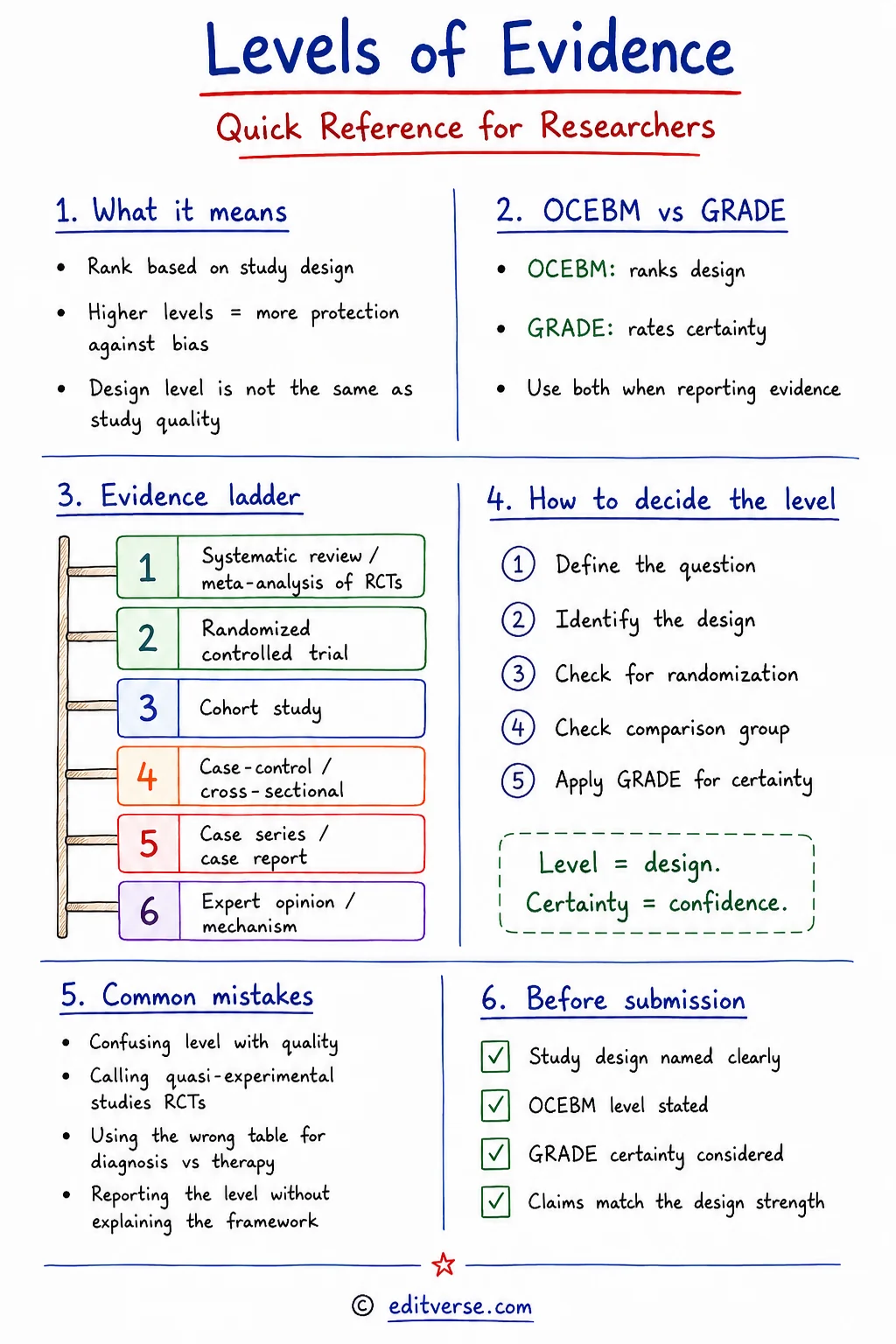
For a one-page summary you can save or share, here is the quick reference version of everything above.
Key Takeaways
- A level of evidence ranks study design, not study quality; GRADE certainty ranks the specific outcome estimate and can move up or down from the design's starting level.
- The design ladder runs, from strongest to weakest: systematic review/meta-analysis of RCTs, RCT, cohort study, case-control study, case series or case report, expert opinion.
- Five checks (question type, synthesis vs. primary study, randomization, comparison structure, and a GRADE pass) are enough to place almost any clinical study correctly.
- State your level of evidence explicitly in the Methods, and match your causal language in the Discussion to what that level actually supports.
References
- OCEBM Levels of Evidence Working Group. The Oxford 2011 Levels of Evidence. Centre for Evidence-Based Medicine, University of Oxford. cebm.ox.ac.uk
- GRADE Working Group. GRADE Handbook for Grading Quality of Evidence and Strength of Recommendations. gradepro.org/handbook
- Guyatt GH, Oxman AD, Vist G, et al. GRADE guidelines: 4. Rating the quality of evidence, study limitations (risk of bias). J Clin Epidemiol. 2011;64(4):407-415. doi.org/10.1016/j.jclinepi.2010.07.017
- Page MJ, McKenzie JE, Bossuyt PM, et al. The PRISMA 2020 statement: an updated guideline for reporting systematic reviews. BMJ. 2021;372:n71. doi.org/10.1136/bmj.n71
- Hopewell S, Chan AW, Collins GS, et al. CONSORT 2025 statement: updated guideline for reporting randomised trials. BMJ. 2025. doi.org/10.1136/bmj-2024-081123
- von Elm E, Altman DG, Egger M, et al. The Strengthening the Reporting of Observational Studies in Epidemiology (STROBE) Statement. strobe-statement.org
- Hierarchy of Evidence Within the Medical Literature. Hospital Pediatrics. American Academy of Pediatrics. publications.aap.org
- Marx RG, Wilson SM, Swiontkowski MF. Updating the Assignment of Levels of Evidence. J Bone Joint Surg Am. 2015;97(1):1-2. doi.org/10.2106/JBJS.N.01112
- Obremskey WT, Pappas N, Attallah-Wasif E, Tornetta P 3rd, Bhandari M. Level of Evidence in Orthopaedic Journals. J Bone Joint Surg Am. 2005;87(12):2632-2638. doi.org/10.2106/JBJS.E.00370
- Hohmann E, Feldman M, Hunt TJ, Cote MP, Brand JC. Research Pearls: How Do We Establish the Level of Evidence? Arthroscopy. 2018;34(12):3271-3277. doi.org/10.1016/j.arthro.2018.10.002
- Hussain N, Yankanah R, Wright JG. The Validity of Level of Evidence Ratings of Articles Submitted to JBJS. J Bone Joint Surg Am. 2015;97(2):e8. doi.org/10.2106/JBJS.M.01491
- Sullivan D, Chung KC, Eaves FF, Rohrich RJ. The Level of Evidence Pyramid: Indicating Levels of Evidence in Plastic and Reconstructive Surgery Articles. Plast Reconstr Surg. 2021;148(5S):68S-71S. doi.org/10.1097/01.prs.0000794868.07051.b4