
A prior art search for researchers answers one question before you publish, present or post a preprint: has anyone already made this public? Prior art is everything available to the public before your filing date, in any form and in any language, and it is not limited to patents. A journal article, a thesis, a poster, a product datasheet and your own earlier talk can all count.
This guide walks through seven steps, the databases to use (with their scale as checked on 14 October 2026), how classification codes find documents that never use your words, and how to log every query so your patent attorney, agent or technology transfer office (TTO) can repeat the search. If you would rather hand the work over, our prior art search and invention disclosure services deliver a ranked report your counsel can work from.
In Simple Words
Prior art is anything the public could already see before you apply for a patent. A prior art search is a documented hunt for it. You run the hunt before you publish, because the closest thing you find shows your counsel what is genuinely new in your work.
Key takeaways
- Prior art is anything made public before the filing date, in any language, anywhere, in any form.
- Search patents and the scientific literature. For academic inventions the closest reference is often a paper.
- Combine keyword queries with CPC classification symbols to reach documents that describe the same idea in different words.
- Keep a search log with the query, database, date and hit count so the work can be repeated and refreshed.
- Map each feature of your invention to the references that disclose it. The gaps are what your counsel builds on.
What counts as prior art?
Under the European Patent Convention, the state of the art covers everything made available to the public by written or oral description, by use, or in any other way before the date of filing (Article 54(2) EPC). United States law is similarly wide. Under 35 U.S.C. 102(a)(1), a claimed invention is not patentable if it was patented, described in a printed publication, in public use, on sale or otherwise available to the public before its effective filing date. Section 102(a)(2) adds earlier-filed US applications that were later published or granted.
Three consequences follow for researchers.
- Non-patent literature counts equally. A journal article from 2014, a conference abstract or a PhD thesis from another country can be the reference that matters most.
- Language and geography do not limit it. A Japanese patent publication or a Chinese-language thesis is prior art in Europe and the United States.
- Your own disclosures count. A poster, a public talk or an open preprint can become prior art against your own application. Relief for your own disclosure differs by country, which is covered in our guide on how to write an invention disclosure. Disclosures made under a confidentiality agreement are generally not public, which is why an NDA comes before you share unpublished work. For preprints see our guide to preprint servers.
The World Intellectual Property Organization describes the aim of a prior-art report in the same terms. Such a report can cover patent and non-patent literature, looks for references published before the filing date, and helps the attorney who drafts the claims see how broad they can reasonably be (WIPO Guidelines for Preparing Patent Landscape Reports, section 4.6.5).
Why a prior art search for researchers is not a literature review
You already know how to search the literature. A prior art search uses the same skills for a different purpose, so the habits that serve a literature review can mislead you here.
| Literature review | Prior art search | |
|---|---|---|
| Question it answers | What is known about this topic? | Has this specific combination of features been made public? |
| Unit of analysis | A topic or research question | Each feature of the invention, and the combinations of features |
| Sources | Journals and indexed databases | Patent collections in several languages, plus journals, preprints, theses and product literature |
| When to stop | When the topic is covered | When new queries stop returning new close references, and the log shows it |
| Output | A narrative or a table of studies | A ranked reference list mapped to features, with the queries that produced it |
The second difference matters most. A literature review reads papers to learn what they found. A prior art search reads each document for what it discloses and what it leaves out, feature by feature.
Where to run a prior art search for researchers
No single database covers everything, and each one returns a different set for the same query. The table lists the main free sources with what each says about itself when checked in a browser on 14 October 2026.
| Source | What it says about itself (checked 14 Oct 2026) | Best used for |
|---|---|---|
| Google Patents | Search and read the full text of patents from around the world, with an option to include non-patent literature through Google Scholar. | A fast first pass in plain language, then citations and family members from each record. |
| Espacenet (EPO) | Free access to inventions and technical developments from 1782 to today, with data on more than 150 million patent documents. | Classification searching and reading the symbols on relevant hits. |
| WIPO Patentscope | 129.9 million patent documents, including 5.5 million published international (PCT) applications. | International filings and multilingual searching. |
| USPTO Patent Public Search | Replaced PubEAST, PubWEST, PatFT and AppFT on 30 September 2022. From 7 November 2026 users must sign in with a USPTO account. | Full-text and field searching of US patents and published applications. |
| J-PlatPat | Japan’s patent information platform. Its simple search is limited in scope, and the site points users who need a detailed search to its jurisdiction-specific services. | Fields with heavy Japanese filing activity. |
| PubMed, Scopus, Web of Science, Google Scholar | Scientific and clinical literature. | Papers that disclose your method, material or device before any patent does. |
| Preprint servers, thesis repositories, proceedings | Public, but not always indexed in the big databases. | Recent and early-stage work in your field. |
Two of those details change how you plan. The USPTO tool you may remember from earlier searches is gone, and its replacement is described in the USPTO announcement of 20 September 2022. The sign-in requirement is posted on the tool page, so create the account before you need the search.
Prior art search for researchers: the 7-step method

Step 1. Split the invention into features
Write the invention in three to five sentences, then list its elements. Include the structure or composition, the process steps, the key parameters and the intended use. Every later decision refers back to this list.
Illustrative example. Take an electron-beam-crosslinked hydrogel wound dressing loaded with an antimicrobial peptide. The features are (A) a polymer network crosslinked by irradiation with no chemical crosslinker, (B) the peptide loaded at a stated concentration, (C) sterilisation in the same irradiation step, and (D) a defined swelling-ratio range. Four features give you four concepts to search and a matrix with four columns later.
Step 2. Build a vocabulary
Patent drafters often write in generic terms. A paper says hydrogel, while a patent may say polymer network, water-swellable matrix or gel composition. List synonyms, abbreviations, chemical and trade names and spelling variants for each feature, and search each concept as a group of alternatives joined with OR.
Step 3. Find classification codes
The Cooperative Patent Classification (CPC) is the result of a partnership between the EPO and the USPTO to build a common, internationally compatible classification system for patent publications. Each patent document carries one or more CPC symbols that describe its technical subject, and classifications are part of the bibliographic data on a patent record, as the WIPO guidelines explain in section 4.3.1.5.
Run a quick keyword search, open the two or three most relevant documents and note their CPC symbols. Then search by those symbols combined with your keywords. Classification finds documents that never use your words, and that is the main reason to use it.
Step 4. Search at least three patent databases
Run your keyword-plus-CPC queries in Google Patents, Espacenet and Patentscope, and add the USPTO or J-PlatPat when your field is concentrated in those offices. Start wide. WIPO notes that recall and precision normally pull against each other, so a search built to find everything will also return off-topic documents, and a first pass that favours recall is the safer way to begin (section 7.4 of the guidelines). Narrow later, using the log to record what each narrowing removed.
Step 5. Chain citations and families
For each strong reference, look at what it cites (backward citations), who cites it (forward citations) and its patent family, meaning the same invention filed in several countries. The EPO defines a simple patent family as all documents with exactly the same priority or combination of priorities, and reading one family member in English often saves you from reading five in other languages. Citation chains frequently surface the best reference faster than another round of keywords.
Step 6. Search the scientific literature
For academic inventions, search PubMed, Scopus, Web of Science and Google Scholar with the same vocabulary, then check preprint servers and thesis repositories. Papers describe methods in more detail than patents do, so a single article can cover several of your features at once.
Step 7. Screen, rank and map features to references
Read the abstract, claims and description of each candidate. Keep the ones that disclose at least one feature and record which ones. A feature-by-reference matrix shows the picture at a glance.
| Reference (illustrative) | A: crosslinking | B: peptide | C: one-step sterilisation | D: swelling range |
|---|---|---|---|---|
| Ref 1 (patent) | Yes | Yes | No | No |
| Ref 2 (journal article) | Yes | No | Yes | No |
| Ref 3 (preprint) | No | Yes | No | Partly |
Read the matrix by column. Feature D has no full disclosure in any reference, and feature C appears in only one. Those two columns are where your data and your counsel’s claims have the most room.
How to read the results of a prior art search for researchers
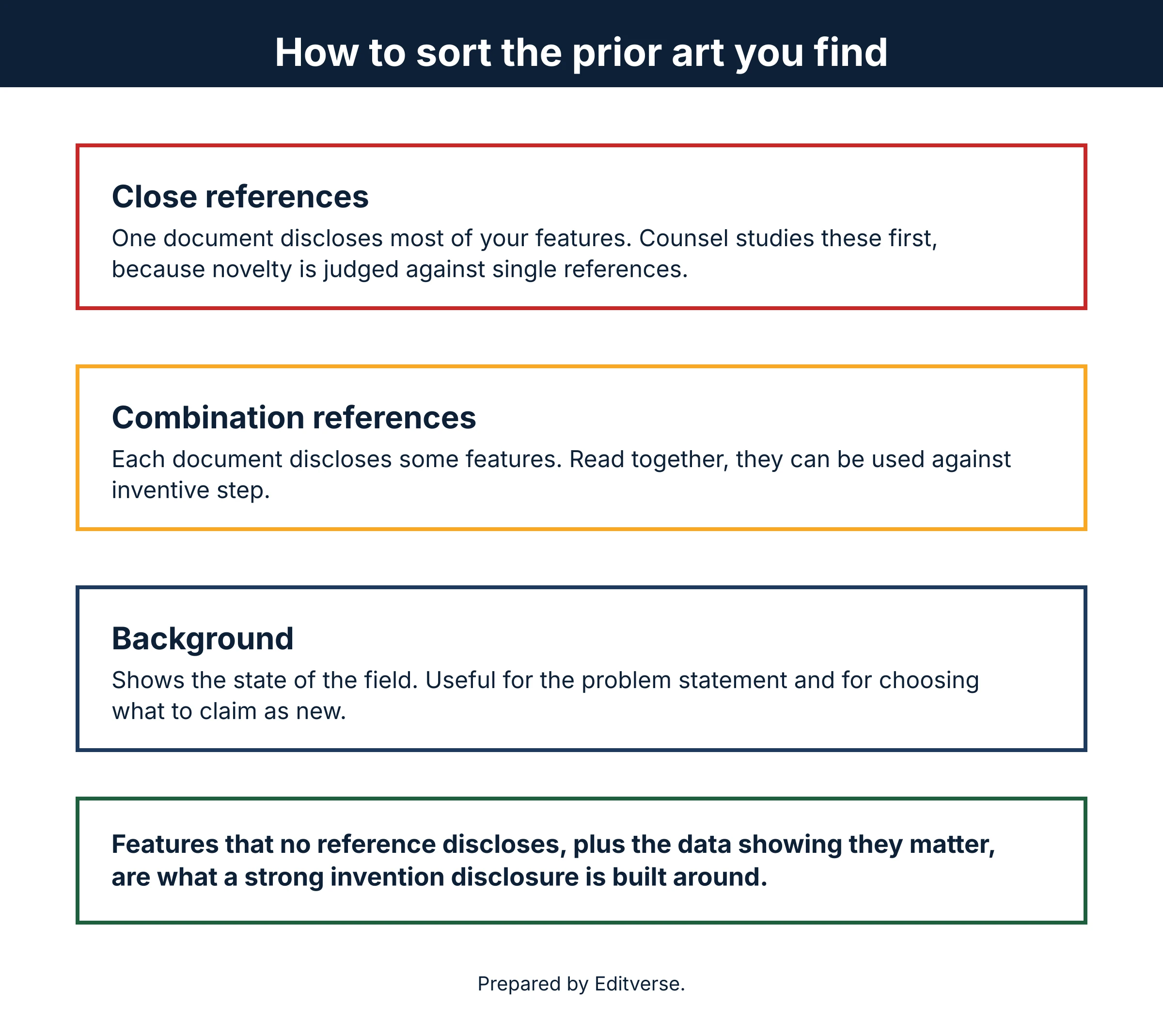
Sort the references into three groups. Close references disclose most of your features in a single document. Combination references each disclose some features and could be read together. Background shows the state of the field. Counsel studies the close and combination groups first, because those are the documents an examiner can use against novelty and inventive step.
The features that no reference discloses, together with the data showing they matter, are what a strong disclosure is built around. Recording them early is the most useful output of the search, and the next step is to write them up in an invention disclosure.
A worked example of search timing
Timing is the part of a prior art search that researchers most often get wrong, and it can be calculated.
- Publication lag. A US application is generally published promptly after 18 months from its earliest filing date (35 U.S.C. 122(b)). As of 14 October 2026, an application filed after about 14 April 2025 may exist and still be invisible to you.
- The one-year window. WIPO notes that US inventors have up to a year from their first public disclosure to file, so some searchers look further back than the filing date to be sure they found the best references. A poster shown on 3 March 2026 leaves a US filing window to 3 March 2027, and the rules are different elsewhere, as the grace period comparison in our disclosure guide shows.
- The refresh. Because of the lag, run the search once at the start and again shortly before filing. The second pass takes a fraction of the time because the log already holds your queries.
Pro tip. Put the refresh date in your calendar when you finish the first search. A search that is eight months old is a different search.
Keep a search log for your prior art search
A log turns a one-off search into a record that can be repeated, refreshed and reviewed. One row per query is enough. The first row below shows how a real entry reads.
| Date | Database | Query string and filters | Hits | Reviewed and kept |
|---|---|---|---|---|
| 14 Oct 2026 (example) | Patentscope | (hydrogel OR “polymer network”) AND (peptide OR antimicrobial) AND irradiat*, CPC A61L, published 2015 to 2026 | 212 | 40 read, 6 kept (Ref 1 to Ref 6) |
| Search date | Database name and version | Exact text entered, CPC symbols, date range, document types | Number returned | How many you read and which you kept |
The log has a second use. If a reviewer, an examiner or a collaborator asks why a reference was missed, the log shows what was searched and when.
Six mistakes in a prior art search for researchers
| Mistake | What goes wrong | Fix |
|---|---|---|
| Keywords only | Differently worded documents never surface | Add CPC symbols |
| One database | Each has different coverage and syntax | Use at least three for patents |
| Patents only | Papers and preprints are prior art too | Search the literature as well |
| English only | Non-English patent collections hold relevant hits | Check them and machine-translate the hits |
| No log | The search cannot be repeated or refreshed | One row per query |
| Searching after publishing | Findings can no longer shape what you protect | Search before the paper, poster or preprint goes public |
Where the search fits in your IP file
A prior art search is one of three documents that sit together. The search tells you what is already public. The invention disclosure records what you made and what is different about it. A patent landscape analysis steps back to show who is patenting what across the whole technology area. They answer different questions, so they use different methods, and the landscape guide explains how to tell them apart.
Industry partners and funders often ask for these documents in that order. If your project involves one, our guide to collaborations between academic researchers and industry partners covers how that conversation usually starts. More patent support guides are collected in the patent drafting and IP strategy category.
Tools and resources
Searching produces numbers and diagrams as well as references. These free Editverse tools help with the charts, the statistics and the flow diagrams that end up in your reports and papers.
Free Research Tools from Editverse
- GraphPro: build publication-ready charts, 25 types, with built-in t-test, ANOVA, correlation, and chi-square p-values. Free, no signup.
- StatPro: free statistical calculators and a test-selector tool covering group comparisons, categorical outcomes, time-to-event analysis, and diagnostic accuracy.
- Flowchart Pro: generate PRISMA 2020, PRISMA-ScR, CONSORT, STROBE, STARD, MOOSE, and ARRIVE flow diagrams directly in your browser.
Professional Services: Prior Art Search Support
If you would rather not spend the weeks, Editverse prepares the search for you. Every package starts with a signed NDA before any technical detail is shared, and every output is written for your own patent attorney, agent or TTO to use. Editverse provides technical documentation, prior-art search reports and writing support, and patent drafting, filing and prosecution stay with your own registered counsel.
Search
$350
Prior-art search across Google Patents, Patentscope, Espacenet, USPTO and J-PlatPat, plus PubMed and Scopus, as a ranked reference table mapped to your features. 3 to 5 business days.
Disclosure
$1,490
A structured invention disclosure with a prior-art summary across 3 patent databases and figure briefs, ready for your attorney or TTO. 5 to 7 business days.
Full file
$3,990
Full disclosure, a 6-database search with PubMed and Scopus, a complete figure set and a landscape summary. 3 to 4 weeks. $2,500 if you start from the Disclosure Package.
For TTOs
$490
A 60-minute session for technology transfer offices, hospitals and R&D teams. Up to 3 inventions reviewed, with a written roadmap within 48 hours.
Not sure which package fits?
The patent services page lists every package with what is included and how to start.
Conclusion
A good prior art search for researchers is short on mystery and long on records. Split the invention into features, search the patent collections and the literature with the same vocabulary, use classification symbols to find documents that use different words, and map what you find to your features. Then keep the log, refresh before filing and give the result to your counsel before the work goes public.
- Features listed and numbered
- Vocabulary built for each feature
- CPC symbols noted from the best hits
- At least three patent databases searched
- Citations and families chained
- Scientific literature and preprints searched
- References mapped to features and logged
- Refresh date set before filing
Frequently asked questions
Is Google Patents enough for a prior art search?
It is a strong free starting point, and it can include non-patent literature through Google Scholar. A thorough search also uses Espacenet for classification searching, Patentscope for international applications and the scientific literature, because different databases return different results for the same idea.
Does my own preprint or poster count as prior art?
If it is public, it can. How much relief you get for your own disclosure depends on the country and the route you file through. The safest sequence is to give your counsel the invention before the work goes public.
How is a prior art search different from a patent landscape analysis?
A prior art search asks whether your specific invention is new and returns a ranked set of references. A patent landscape analysis asks who is patenting what, where and how fast across a technology area, and returns counts, trends and white space.
Should I search before or after writing the invention disclosure?
Before. The closest references belong in the disclosure, together with what your invention does differently, and counsel reads the two documents together.
How long does a prior art search take?
A focused first pass on one invention is typically a matter of days when you work through all seven steps, mostly spent on reading and mapping. The refresh before filing is much shorter because the log already holds the queries.
Related Editverse resources
References
- United States Code. 35 U.S.C. 102, Conditions for patentability; novelty. law.cornell.edu/uscode/text/35/102
- United States Code. 35 U.S.C. 122, Confidential status of applications; publication of patent applications. law.cornell.edu/uscode/text/35/122
- European Patent Office. European Patent Convention, Article 54, Novelty. epo.org/en/legal/epc/2020/a54.html
- World Intellectual Property Organization (2015). Guidelines for Preparing Patent Landscape Reports. doi.org/10.34667/tind.28858
- USPTO (20 September 2022). Convenient Patent Public Search tool replacing four legacy systems this fall. uspto.gov
- USPTO. Patent Public Search. uspto.gov/patents/search/patent-public-search
- Cooperative Patent Classification. Home. cooperativepatentclassification.org
- European Patent Office. Espacenet, patent search. epo.org
- WIPO. PATENTSCOPE simple search (figures as displayed on 14 October 2026). patentscope.wipo.int