
Knowing how to write an invention disclosure is the difference between a filing your counsel can start on this week and a pile of follow-up questions that costs you a month. An invention disclosure is the first formal record of your invention. Your technology transfer office (TTO) reads it to decide whether to pursue protection, your patent attorney or agent works from it to draft the claims, and when federal funding is involved it starts reporting duties to the funding agency.
This guide shows how to write an invention disclosure section by section, which dates and funding details to record, how grace periods differ by region, and what to finish before you publish. If you want the document prepared from your lab notes and data, our invention disclosure and prior art search services produce a structured file your counsel can use directly.
In Simple Words
An invention disclosure is a written report of what you made, how it works and what is new about it, with dates, data and funding. You write it before you publish so that your counsel still has every option open. A complete one lets them file quickly, and a thin one costs weeks.
Key takeaways
- Write for a skilled reader who was not in your lab, with enough detail to repeat the work.
- Describe alternatives, ranges and variants, not only the one version you tested.
- Record the dates of conception, first written description and first working demonstration, with notebook references.
- List every public disclosure, past and planned, and every source of funding and materials.
- Submit before you publish, present or post a preprint.
What an invention disclosure is, and is not
It is not a research paper and it is not a patent application. A paper argues for a result. A disclosure records a technical solution completely enough that counsel can decide what to claim. Institutional policies generally ask researchers to disclose to the TTO before any public disclosure such as a talk, a poster, an abstract or a thesis defence, because that is when counsel still has every option.
University forms ask for the same core items. The UCLA Invention Disclosure Form asks for the inventors, funding support and third-party materials, public disclosures, invention details and an invention timeline. The UC Santa Barbara Disclosure and Record of Invention Form asks for disclosures outside the university, planned publications, sponsors and a development timeline. The template below covers all of those and adds the technical detail that counsel needs.
How to write an invention disclosure: the 10 sections
| Section | What to write | Common gap |
|---|---|---|
| 1. Title and summary | A plain descriptive title and a 3 to 5 sentence summary of what the invention is and what problem it solves | Promotional wording instead of technical description |
| 2. Inventors | Each person who contributed to the conception, with a line on what each contributed and their affiliation | Listing everyone in the group, or leaving out an external collaborator |
| 3. Problem and background | The limitation of current approaches that the invention addresses | Assuming the reader already knows the field |
| 4. Closest known solutions | References from your prior art search, with what each one lacks | No search done, so counsel starts from zero |
| 5. Description of the invention | Components or steps, materials with grades and suppliers, parameter values and ranges, how to make it and how to use it | Describing only the single configuration that was tested |
| 6. Alternatives and variants | Other materials, ranges, configurations and applications you expect to work, and which you have tested | Leaving them out, which narrows what counsel can claim |
| 7. Data and examples | Working examples with controls, comparison to the closest known solution, and any surprising results | Data left in a manuscript draft that is not attached |
| 8. Figures | A schematic, a process flow, structures, key plots and photographs, each with a legend that names its parts | Paper figures with no labels for the parts |
| 9. Dates and records | Date of conception, first written description and first successful demonstration, with notebook or file references | “Around 2026” instead of dates with records |
| 10. Disclosures, funding and obligations | Every talk, poster, abstract, thesis and manuscript (past and planned, with dates), all grants with numbers, industry sponsors, material transfer agreements, collaborating institutions | Forgetting a conference abstract or a co-funding source |
Treat sections 5 to 7 as the core. UCLA’s form asks you to describe how to make and use the invention in enough detail for someone in your field to understand it, and it points out that for federally funded inventions this section must be complete in technical detail to the extent known at the time. Plan your writing time accordingly.
How to write an invention disclosure with the right level of detail
Counsel can only claim what the disclosure supports, so specifics matter. Here is an illustrative comparison.
Illustrative example. Thin: “The coating is applied to the substrate and cured.” Strong: “The coating composition (polymer A and crosslinker B at stated weight percentages, with supplier and grade) is applied by dip coating at 25 °C at a withdrawal speed of 1 to 5 mm/s and cured at 80 to 120 °C for 10 to 30 minutes. Curing below 80 °C gave tacky films (Example 3, Figure 4). Polymer C can replace polymer A at up to 40% of the polymer content.” The strong version gives ranges, a lower limit with evidence, a substitute material and a pointer to data. Each of those is something counsel can build on.
Record the dates
Both university forms ask for a development timeline. UCLA asks for the initial conception, the first description of the complete invention (oral or written) and the first successful demonstration. UC Santa Barbara asks for conception, the first written record with the document, page and location, the first successful test and the stage of development. Write them down while they are easy to reconstruct.
| Event | Date (illustrative) | Record that supports it |
|---|---|---|
| Initial conception | 12 January 2026 | Notebook 4, page 31, signed and dated |
| First description of the complete invention | 20 January 2026 | Email to co-inventor, subject line “gel idea”, saved as a PDF |
| First successful demonstration | 9 March 2026 | Experiment 14, file 2026-03-09_swelling.xlsx, photo 2026-03-09_01.jpg |
Pro tip. Use dates with a record behind them. A line reading “around early 2026” gives your counsel nothing to verify, while a notebook page does.
Public disclosures, grace periods and how to write an invention disclosure around them
Disclosure forms ask for any talk, poster, abstract, thesis, preprint or manuscript, with dates, because a public, non-confidential description of the invention can affect your rights. A manuscript in confidential peer review is a different situation from a preprint, a conference abstract or a poster. The date a document becomes public is the date that matters, so list planned dates as well as past ones. For preprints, see our guide to preprint servers.
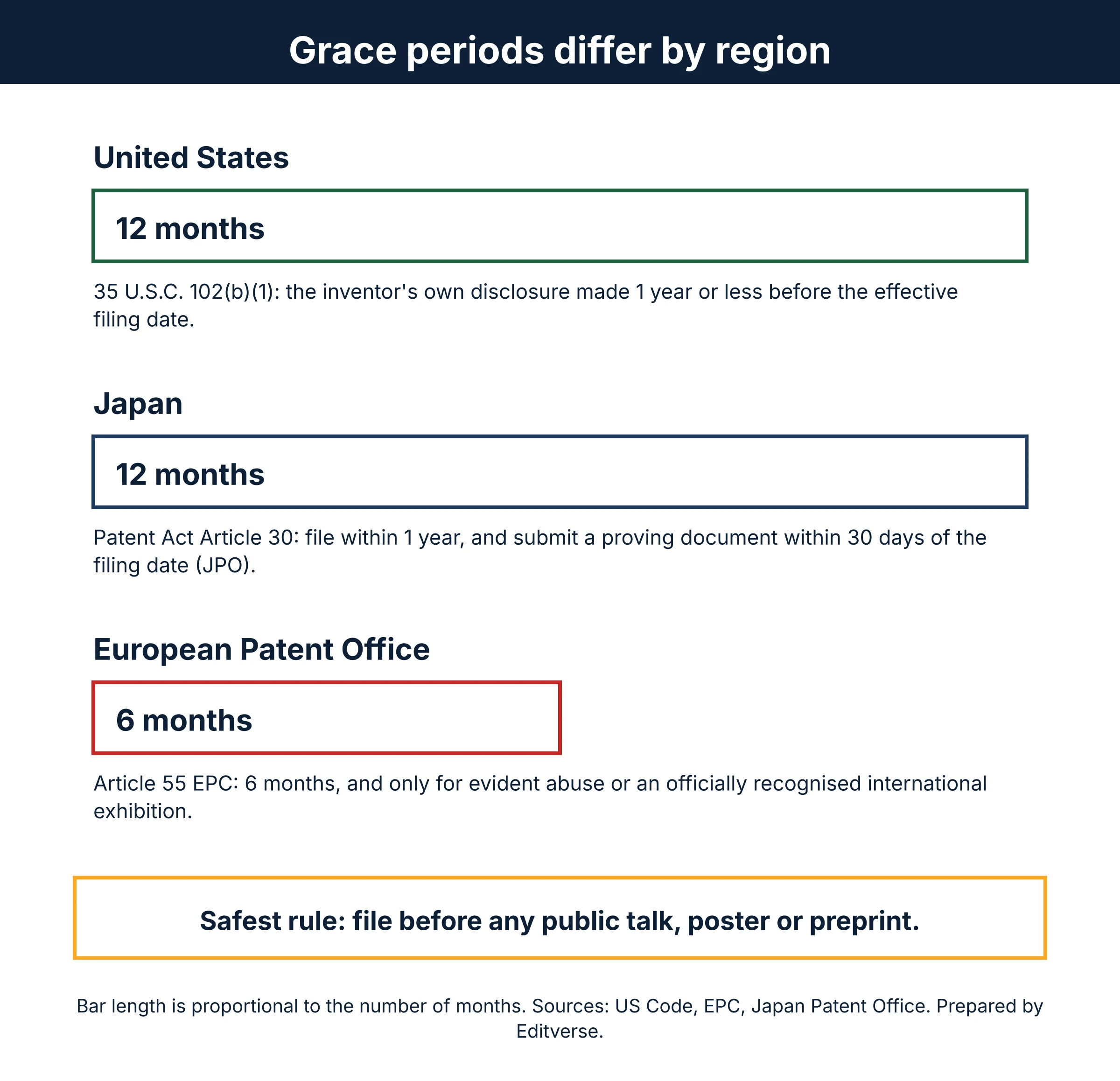
How much relief you get for your own earlier disclosure depends on the region. The figure and table compare three that researchers meet most often.
| Region | Relief for the inventor’s own earlier disclosure | Source |
|---|---|---|
| United States | A disclosure made 1 year or less before the effective filing date, by the inventor or from the inventor, is not prior art under 35 U.S.C. 102(b)(1) | 35 U.S.C. 102 |
| Japan | The application must be filed within 1 year of the disclosure, and a proving document must be submitted within 30 days of the filing date (Patent Act Article 30) | Japan Patent Office |
| European Patent Office | No general grace period. Article 55 EPC disregards a disclosure made no earlier than 6 months before filing only if it resulted from evident abuse against the applicant or from display at an official or officially recognised international exhibition | Article 55 EPC |
Worked example. A poster is shown on 3 March 2026. For a US filing, the one-year window runs to 3 March 2027. For Japan, the same date would also need the proving document within 30 days of filing. For the EPO, an ordinary conference poster does not obviously fall into either situation Article 55 names, so a European route assumes the filing comes before the poster is shown. The safest order is the same in all three, which is to give counsel the disclosure first and publish second.
How to write an invention disclosure for a federally funded project
Every disclosure form asks where the money and materials came from, because those sources can carry rights. If US federal funding supported the work, the invention is likely a subject invention under the Bayh-Dole Act, and the institution has reporting duties under the standard patent rights clause.
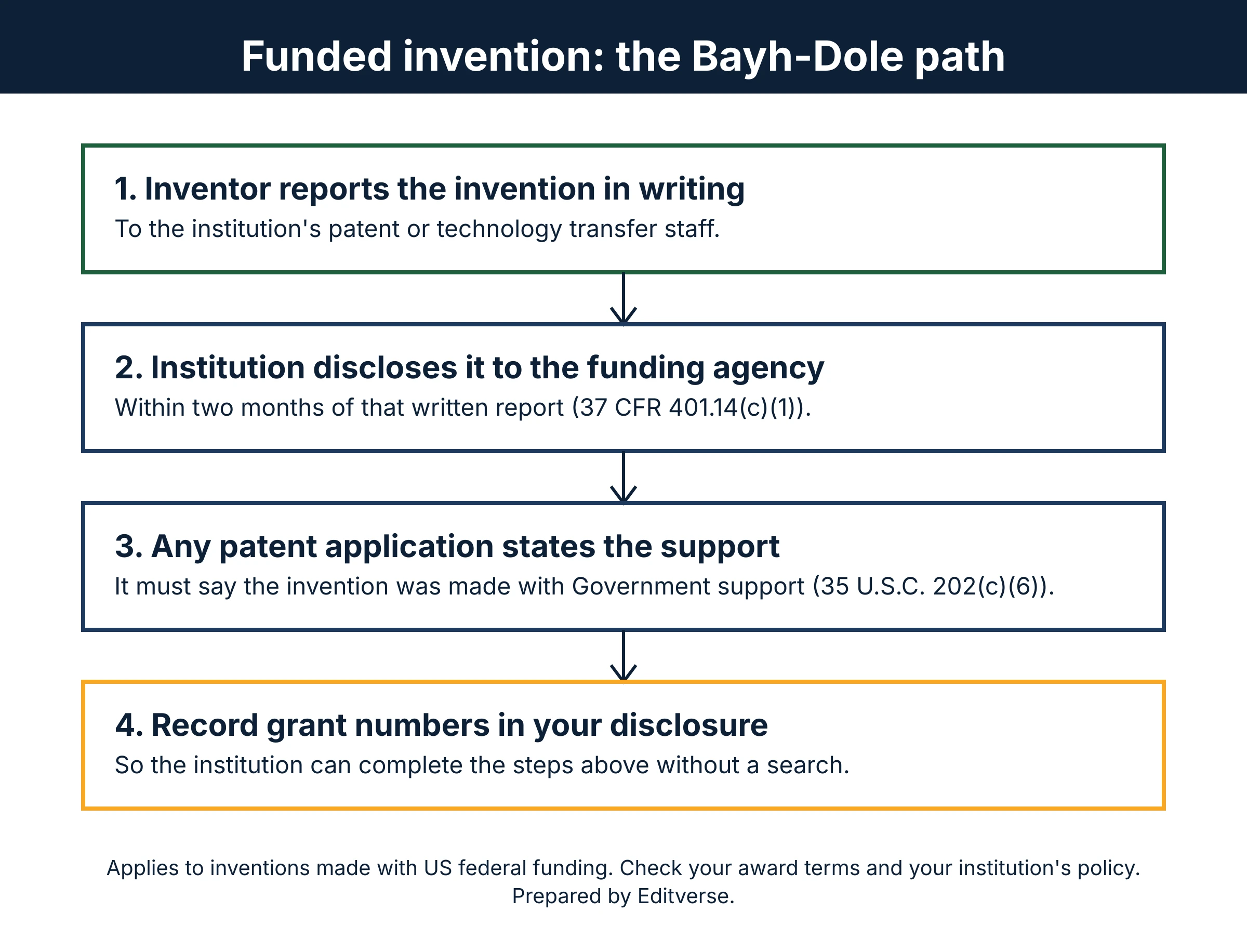
The standard clause at 37 CFR 401.14(c) sets out what that means in practice.
- The institution discloses each subject invention to the funding agency within two months after the inventor discloses it in writing to the people responsible for patent matters.
- The report identifies the contract and the inventors, is technically complete to the extent known, and identifies any publication, sale or public use, and whether a manuscript describing the invention has been submitted or accepted.
- After disclosure, the institution promptly notifies the agency when a manuscript describing the invention is accepted for publication, or when a sale or public use is planned.
- The institution elects in writing whether to retain title within two years of disclosure to the agency, with an earlier deadline where a publication or sale has started the one-year US statutory period.
A patent application on a subject invention must also state that the invention was made with Government support (35 U.S.C. 202(c)(6)). Your funding agreement is the controlling document, so check its terms with your TTO. The practical lesson for the researcher is that grant numbers, publication plans and acceptance dates belong in the disclosure from the start. UCLA’s form says it directly, that accurate and complete funding information is necessary so the university can comply with sponsored research agreements and federal law.
Industry-sponsored work follows the intellectual property terms in the sponsored research agreement, and third-party materials may come with a material transfer agreement. List all of these with agreement references and counterpart names.
How to write an invention disclosure when several people contributed
The statute defines the inventor as the individual who invented or discovered the subject matter of the invention, or the individuals collectively for a joint invention (35 U.S.C. 100(f)). Joint inventors do not have to work together or at the same time, make the same type or amount of contribution, or contribute to every claim (35 U.S.C. 116(a)). Authorship and inventorship are different things. UCLA’s form puts it plainly that inventors are generally those who made a non-trivial intellectual contribution to the invention as claimed, and that contributing only to reduction to practice, such as testing it or building a physical version, is generally not enough.
Describe what each person contributed to the idea, and let your TTO or counsel make the legal determination. If the invention evolved during the project, note which contribution produced which feature, because inventorship follows the claims and claims can change.
The order of operations
- Write the disclosure using the 10-section template.
- Run a prior art search and add the closest references. See our prior art search guide.
- Submit to your TTO or counsel with data, figures and any manuscript drafts attached.
- Counsel decides what to claim and files.
- Publish, present or post your preprint on a schedule that follows the filing date.
If you are planning more than one invention, or the technology area is crowded, a patent landscape analysis shows where activity is concentrated before you decide what to protect first. For projects with industry partners, our guide to academic and industry collaborations covers how ownership conversations tend to start.
Six mistakes that slow disclosures down
| Mistake | Why it slows things | Fix |
|---|---|---|
| Sending the manuscript instead of a disclosure | Papers rarely record alternatives, ranges or failed attempts | Use the 10-section template and attach the paper |
| Describing one configuration | Counsel can only claim what is supported | Add variants, ranges and substitute materials |
| Missing dates | The timeline cannot be checked | Dates with notebook or file references |
| Incomplete disclosure history | A forgotten abstract can change the filing plan | List every talk, poster, abstract and thesis, past and planned |
| Unlabelled figures | Parts cannot be described in the application | Number and name every part in the legend |
| Publishing first | Some rights may no longer be available | Submit the disclosure before any public step |
Tools and resources
Disclosures usually carry data tables, charts and diagrams. These free Editverse tools help you prepare them.
Free Research Tools from Editverse
- GraphPro: build publication-ready charts, 25 types, with built-in t-test, ANOVA, correlation, and chi-square p-values. Free, no signup.
- StatPro: free statistical calculators and a test-selector tool covering group comparisons, categorical outcomes, time-to-event analysis, and diagnostic accuracy.
- Flowchart Pro: generate PRISMA 2020, PRISMA-ScR, CONSORT, STROBE, STARD, MOOSE, and ARRIVE flow diagrams directly in your browser.
Professional Services: Invention Disclosure Support
If you would rather hand the writing over, Editverse prepares the disclosure from your lab notes and data. Every package starts with a signed NDA before any technical detail is shared and ends in a format your own patent attorney, agent or TTO can use. Editverse provides technical documentation, prior-art search reports and writing support, and patent drafting, filing and prosecution stay with your own registered counsel.
Disclosure
$1,490
A structured disclosure covering the problem, prior approaches, the invention, embodiments, supporting data and inventors, with a prior-art summary and figure briefs. 5 to 7 business days, one revision round.
Search
$350
A ranked prior-art search report across six patent databases plus PubMed and Scopus, mapped to the features of your invention. 3 to 5 business days.
Full file
$3,990
Full disclosure with embodiments and variants, a complete figure set, a 6-database search and a landscape summary. 3 to 4 weeks. $2,500 if you start from the Disclosure Package.
For TTOs
$490
A 60-minute session for technology transfer offices, hospitals and R&D teams. Up to 3 inventions reviewed, with a written roadmap within 48 hours.
Ready to get your disclosure written?
The patent services page lists every package and how to start.
Conclusion
To write an invention disclosure that counsel can act on, describe the invention completely, give the dates with records, list every disclosure and funding source, and submit it before you publish. The grace period rules differ by region, which is the strongest reason to treat the filing date as the first public step rather than the last.
- All 10 sections written
- Alternatives, ranges and variants described
- Dates recorded with notebook or file references
- Every disclosure, past and planned, listed with dates
- Grants, sponsors and materials listed with numbers
- Inventors named for their contribution to the idea
- Closest references from a prior art search added
- Submitted before any talk, poster or preprint
Frequently asked questions
How long should an invention disclosure be?
Length follows the invention. A simple device may need 5 to 10 pages with figures, while a complex process or a multi-component system needs more. The test is whether a skilled reader outside your lab could repeat the work from the document and your attachments.
Can I submit an invention disclosure after I publish?
You can, but options may already be limited. A public description of the invention can start clocks in the United States and Japan and may close the door in regions such as Europe, where the exceptions in Article 55 EPC are narrow. Submit before the first public step.
Is an invention disclosure confidential?
Disclosure forms are submitted to your institution’s TTO or to counsel, and UCLA’s form notes that a detailed description should not be shared with companies or others without first consulting the TTO. Use an NDA before sharing unpublished details with any outside party.
Who should be listed as an inventor?
Those who contributed to the conception of the invention as claimed. Running experiments or supervising the group does not by itself make someone an inventor, and counsel makes the legal determination from your description of each contribution.
Do I need a prior art search before writing the disclosure?
It is best to run one first, because the closest references belong in the disclosure alongside what your invention does differently. Our prior art search guide walks through the steps.
Related Editverse resources
References
- United States Code. 35 U.S.C. 100, Definitions. law.cornell.edu/uscode/text/35/100
- United States Code. 35 U.S.C. 102, Conditions for patentability; novelty. law.cornell.edu/uscode/text/35/102
- United States Code. 35 U.S.C. 116, Inventors. law.cornell.edu/uscode/text/35/116
- United States Code. 35 U.S.C. 202, Disposition of rights. law.cornell.edu/uscode/text/35/202
- Code of Federal Regulations. 37 CFR 401.14, Standard patent rights clauses. law.cornell.edu/cfr/text/37/401.14
- European Patent Office. European Patent Convention, Article 55, Non-prejudicial disclosures. epo.org/en/legal/epc/2020/a55.html
- Japan Patent Office. Procedures for Seeking the Application of Exceptions to Lack of Novelty of Invention, corresponding to the Patent Act Article 30. jpo.go.jp
- UCLA Technology Development Group. Invention Disclosure Form (January 2026). tdg.ucla.edu
- UC Santa Barbara. Disclosure and Record of Invention Form (April 2019). mrl.ucsb.edu