
Most EdD dissertation proposals that come back from committee do not fail on method. They fail one step earlier, on the problem. A working principal or district leader arrives with a concern that is real and urgent, such as disengaged ninth graders, uneven reading growth or high teacher turnover, and writes it up at the size it feels in the job. A committee reads the same paragraph and sees a problem with no setting, no baseline, no lever the candidate controls and no outcome anyone could measure inside a doctoral timeline.
This guide is for educators and administrators in practitioner doctorates, especially programmes shaped by the Carnegie Project on the Education Doctorate (CPED). It walks one broad school concern all the way down to an approvable problem of practice, compares the five designs EdD candidates most often use, shows how to tie practice to theory so the work reads as scholarship, sets the traditional five-chapter structure beside the dissertation-in-practice format, and lists the reasons proposals most often come back. If you already have a draft and want a second set of expert eyes on it, Editverse runs dedicated DBA and EdD dissertation help built around exactly these committee checkpoints.
In Simple Words
An EdD dissertation studies a problem in your own workplace that you can actually do something about. Start with a worry, shrink it to one setting, one group of people and one number you can track, then ask a question about a change you can test. Pick the research design only after that, and choose a theory that explains why your change should work. Committees approve problems that are small, local, measurable and clearly linked to what scholars already know.
On this page
- 1. EdD vs PhD dissertation: what changes
- 2. What counts as a problem of practice
- 3. Worked example: from district concern to approvable problem
- 4. Choosing a design for your EdD dissertation
- 5. The practice-to-theory link
- 6. Five-chapter vs dissertation-in-practice structure
- 7. Why EdD proposals come back
- 8. Matching support to this stage
- 9. Frequently asked questions
- 10. The bottom line
1. EdD vs PhD Dissertation: What Actually Changes
The distinction is older than most current programmes. Shulman and colleagues argued in Educational Researcher that education’s doctorates had blurred two purposes, preparing scholars and preparing practitioners, so that neither was done well, and they proposed a distinct practice doctorate with its own scholarly base (Shulman et al., 2006). CPED-influenced programmes grew out of that critique, and the culminating product they settled on is the dissertation in practice (DiP).
A review of dissertations from one online EdD programme describes the DiP as differing from a traditional PhD dissertation in two ways: it addresses a problem of practice, and it explicitly connects theory with practice (Vasconcelos et al., 2024). That is the whole difference in one sentence. A PhD dissertation is judged mainly on its contribution to a body of knowledge. An EdD dissertation is judged on whether it improves, or credibly informs improvement of, a specific practice setting while still meeting scholarly standards of evidence.
Three practical consequences follow for the candidate:
- The setting is usually your own. Most EdD candidates study the organisation they work in, which is a strength for access and relevance and a design issue to plan for, not an afterthought.
- Generalisability is not the main claim. The committee expects transferable insight and local impact, not population-level inference.
- Action is often part of the study. Many formats expect you to design, test and refine a change, not only describe a problem.
The business-school version of this split runs along the same lines; our comparison of a DBA vs PhD dissertation covers the parallel for practitioner doctorates outside education.
2. What Counts as a Problem of Practice in an EdD Dissertation
A problem of practice is a persistent, specific and actionable gap between what is happening in an educational setting and what should be happening, located inside the candidate’s sphere of influence. The research on how candidates actually find these problems is instructive. A document analysis of 28 EdD dissertations from one research-intensive university found that problems came from candidates’ felt difficulties and real-world dilemmas, clustering around supporting marginalised students, improving educator professional development and supporting novices entering the profession; the authors closed with four guidelines to help candidates derive problems (Ma et al., 2018). A second document analysis of 19 dissertations found the problems were largely determined by candidates’ professional roles, and concluded that the concept itself still needs refinement in how programmes and candidates use it (Gillham et al., 2019).
Read together, those findings explain why so many first drafts come back. Candidates start from genuine felt difficulty, which is the right instinct, but the role-shaped view of a problem is usually wider than any single study can handle. The working test Editverse subject-matter experts apply to a draft problem statement has five parts:
- Located: one named setting (a school, a grade band, a department, a programme), not “schools” or “the district” in general.
- Evidenced: local data already show the gap, with a baseline you can quote.
- Actionable: it sits inside your role or your access; you can change something about it.
- Measurable: at least one outcome can be tracked within the study window.
- Solution-neutral: the statement describes the gap, not the fix. “We lack a mentoring programme” is a solution disguised as a problem.
Equity framing matters in many CPED-influenced programmes. In one EdD programme built on critical improvement science, students moved from their initial framing of problems towards a systems approach to diagnosing them, alongside new understanding of how their social identities shaped the problem (Zumpe et al., 2024). Committees in such programmes look for that diagnostic step before any intervention is proposed.
3. Worked Example: From District Concern to Approvable Problem of Practice
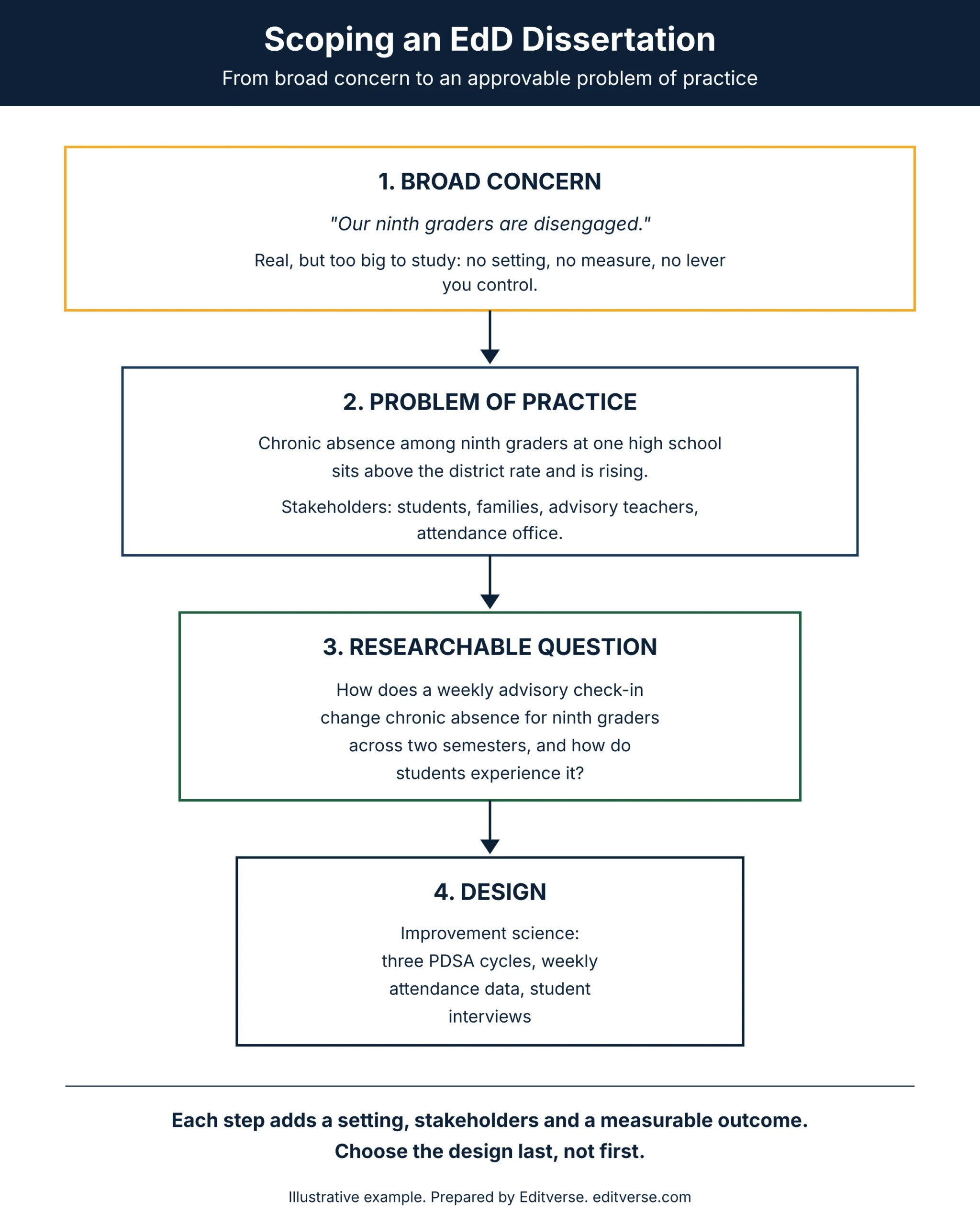
The example below is illustrative, built from the pattern Editverse sees most often in EdD proposal drafts. An assistant principal at a comprehensive high school opens with a concern every educator recognises.
Step 1: The broad concern
“Our ninth graders are disengaged.” This is true and important, but it is not yet researchable. Disengagement could mean attendance, behaviour, grades, belonging or motivation, each with different data and different levers. There is no baseline, and the candidate cannot change “engagement” directly.
Step 2: Pick the indicator you can see and influence
The candidate checks local data and finds that chronic absence among ninth graders at their own school sits above the district rate and has risen over recent years. Attendance is recorded daily, it links to course failure, and the candidate oversees the advisory programme. That makes chronic absence the indicator: visible, local and within the candidate’s sphere of influence.
Step 3: Name the setting and the stakeholders
Setting: one high school, ninth grade only. Stakeholders: students, families, the advisory teachers who will carry any change, and the attendance office that owns the data. Naming stakeholders early tells the committee who will be interviewed, who must agree to the change and whose data you need permission to use.
Step 4: Write the problem statement and the question
Problem of practice: “Chronic absence among ninth-grade students at [School] exceeds the district rate and has increased over the past three years, contributing to first-year course failure. Existing attendance responses are reactive and reach students only after absences accumulate.”
Research questions: (1) How does a weekly advisory check-in routine change the chronic absence rate of ninth-grade students across two semesters? (2) How do students and advisory teachers experience the routine, and what adaptations do they recommend?
| Element | Broad concern | Approvable problem of practice |
|---|---|---|
| Scope | Student engagement, all grades | Chronic absence, ninth grade only |
| Setting | “Our schools” | One named high school, two semesters |
| Stakeholders | Unspecified | Students, families, advisory teachers, attendance office |
| Measurable outcome | None | Chronic absence rate against a quoted baseline; student and teacher experience |
| Lever | Unclear | Advisory routine the candidate already oversees |
| Likely design | Undecidable | Improvement science with PDSA cycles, or action research |
Notice what did not happen: the candidate did not start by choosing “mixed methods” or “a case study.” The design fell out of the question. A question about whether a change moves an indicator over repeated cycles points to improvement science or action research; a question about whether an existing programme meets its goals would point to programme evaluation instead.
4. Choosing a Design for Your EdD Dissertation
Five designs cover most dissertations in practice. In one programme’s review of completed DiPs, most candidates chose a pragmatic paradigm and a mixed methods design, reported an action research intervention in K-12 settings, collected surveys and interviews, and analysed them with descriptive or inferential statistics and thematic analysis (Vasconcelos et al., 2024). Common is not the same as right: each design has to answer a different committee question.
| Design | When it fits | Typical data | Committee question it must answer |
|---|---|---|---|
| Action research | You lead a change in your own setting and study it in cycles of plan, act, observe, reflect | Pre/post measures, observation notes, reflective journals, interviews, artefacts | How will you separate what the intervention did from what you, as its leader, hoped it would do? |
| Improvement science (PDSA cycles) | A system produces a persistent, measurable gap and you can test small changes quickly | Root-cause tools (fishbone, empathy interviews), run charts, process and outcome measures per cycle | What is your theory of improvement, and what will each cycle teach you that changes the next one? |
| Programme evaluation | An existing programme needs a judgement on implementation, outcomes or value | Logic model, administrative records, stakeholder surveys, focus groups, fidelity checks | Who will use the findings, for what decision, and what is your relationship to the programme? |
| Case study | You need to understand how and why something happens in a bounded setting before changing it | Interviews, documents, observations, triangulated across sources | What bounds the case, and how will the findings change practice rather than only describe it? |
| Mixed methods | One strand alone cannot answer the question; you need both the size of a change and the experience of it | Survey or outcome data plus interviews, with a named integration point | Which design type (convergent, explanatory or exploratory sequential), and where exactly do the strands meet? |
Action research
Some programmes have made action research the default. Northeastern University redesigned its EdD so that students implement and evaluate their change work while enrolled, using action research as its signature pedagogy and an alternative DiP format that foregrounds participants’ voices and the results of the initiative (Ewell et al., 2022). If your programme works this way, the committee will expect the cycles themselves to be visible in the write-up. Our primer on action research and how it bridges theory and practice covers the cycle logic in more depth.
Improvement science and PDSA cycles
Improvement science asks you to specify the problem and the aim precisely, then learn through iterative testing. A study of one educational leadership EdD using improvement science as its signature methodology found candidates grew in their capacity to run iterative cycles and to refine problem definitions, and it stressed that this preparation needs learning activities beyond traditional research methods courses (Lozano et al., 2023). For the worked example above, three PDSA cycles of the advisory routine, each with an attendance measure and a short teacher debrief, would be a natural fit.
Programme evaluation
Programme evaluation suits candidates who are asked to judge an initiative that already exists. One programme where it became the preferred DiP option uses a utilisation-focused evaluation framework and flags considerations candidates must settle early: their relationship to the programme being evaluated, the effect on their professional position, support for the evaluation, access to data, consent, and how findings will be used (Varga et al., 2022). A committee will ask about each of those before approving the design.
Case study and mixed methods
Case study suits a problem you need to understand before you can change it, while mixed methods suits a question that genuinely needs both a measured change and an account of how people experienced it. The trap with mixed methods is the same in every practitioner doctorate: two strands collected side by side with no stated integration point. Our guide to choosing quantitative, qualitative or mixed methods works through the design types in detail; the logic transfers directly to the EdD dissertation.
5. The Practice-to-Theory Link: Making the Dissertation Read as Scholarship
The most common reason an otherwise solid EdD dissertation reads as a project report rather than scholarship is a decorative framework: a theory named in Chapter 2 and never used again. Drawing on recommendations from the CPED literature, one recent essay lists what makes scholar-practitioner inquiry rigorous: rigorous data collection, explicit theoretical frameworks, evidence of impact on practice and transparent handling of bias, supported by positionality and reflexivity statements and critical friend groups (Rodriguez López, 2024).
A framework earns its place when it does three jobs:
- It explains the mechanism. Why should the change idea move the outcome? In the attendance example, a theory of school belonging or student motivation explains why a weekly adult check-in might reduce absence; a generic leadership theory does not.
- It shapes the instruments. Interview prompts and survey items should map onto the constructs in the framework, so the reader can see theory in the data collection.
- It frames the discussion. Chapter 5 (or its equivalent) should return to the framework and say what the findings confirm, extend or complicate.
Many programmes also distinguish a theoretical framework (an established theory) from a conceptual framework (your own map of how the problem, the change and the outcomes connect). In improvement science dissertations the conceptual framework is often the driver diagram or theory of improvement. Whichever term your handbook uses, the test is the same: could a reader predict your instruments and your analysis from the framework alone?
Quick check before you submit Chapter 2
Highlight every sentence in Chapters 3 and 5 that uses a construct from your framework. If the highlights are sparse, the framework is decorative and a committee will notice. Rewrite so each research question, instrument section and discussion theme points back to a named construct.
6. Five-Chapter EdD Dissertation vs Dissertation-in-Practice Format
Programmes vary. Some keep the traditional five-chapter structure, some use an alternative DiP format, and some accept article-based or group dissertations. The comparison below shows the most common mapping; always follow your own programme handbook and template, with APA 7 or the institution’s own style guide applied throughout.
| Part | Traditional five-chapter EdD | Dissertation-in-practice format (typical) |
|---|---|---|
| 1 | Introduction: problem, purpose, research questions, significance, definitions | Problem of practice in context: local data, stakeholders, positionality, why it matters here |
| 2 | Literature review and theoretical framework | Root-cause analysis plus review of scholarship and practice knowledge; theory of improvement or framework |
| 3 | Methodology: design, participants, instruments, analysis | Change idea or intervention and the inquiry design: cycles, measures, data sources, analysis |
| 4 | Results by research question | Findings by cycle or by question, including what was adapted and why |
| 5 | Discussion, implications, recommendations for future research | Implications for practice and policy, next cycle, scholar-practitioner reflection, often a practitioner-facing artefact (brief, toolkit, presentation) |
The DiP format is not a lighter version of the five-chapter model. It moves weight from the literature review towards local diagnosis and from future research towards next actions.
7. Why EdD Dissertation Proposals Come Back
Across the EdD proposal drafts Editverse subject-matter experts review, the same patterns recur. Most of them trace back to the scoping steps above.
The problem is the size of the job, not the size of a study
“Improving equity in our district” is a mission, not a problem of practice. Narrow to one setting, one population and one indicator, as in the worked example.
The solution is baked into the problem statement
If the problem reads “there is no coaching programme,” the study can only conclude that coaching is needed. State the gap and let the root-cause analysis justify the change idea.
No local baseline
Committees expect evidence that the problem exists in your setting now. National statistics set context; they do not establish your problem.
Design chosen before the question
Candidates who decide on “a mixed methods study” first often end up writing questions to fit it. Reverse the order and justify the design from the question.
Data access and role not settled
Studying your own organisation means confirming access to records and participants and explaining how your role shapes the inquiry. Programme evaluation literature lists these as items to resolve before the design is approved (Varga et al., 2022).
The format clashes with graduate school expectations
Practice-oriented dissertations can run into the research university’s default epistemology. One account describes how conflicting epistemologies between EdD programmes and graduate schools affected students and faculty, and recommends policies that support doctoral work from a range of epistemological approaches (Kennedy et al., 2018). Check what your graduate school, not only your programme, will accept before you commit to an alternative format.
Many of these issues are the same ones that stall business doctorates; our guide on what it actually takes to get a dissertation proposal approved covers the committee side of the process in more depth.
8. Matching EdD Dissertation Support to This Stage
Scoping is where outside expertise pays back most, because every later chapter inherits the problem statement. Editverse pairs EdD candidates with education subject-matter experts who work through the same sequence shown in this guide: problem scoping against the five-part test, design-to-question alignment, framework integration across chapters, and a pre-submission check against your programme template. Editing follows APA 7 or your institution’s own template, and all work is aligned with COPE, ICMJE and GPP3, with institutional and country-specific ethics followed. Full details of the service line are on the EdD dissertation help page.
Full programme
EdD Completion Package
$5,800
Six months with a dedicated education-expert editor: full editing, research methodology support, committee response help and 2 mock defence sessions.
Ongoing support
1:1 Dedicated Editor: 3 Months
$2,400
Three months of dedicated PhD editor support with weekly calls, chapter editing and statistical consultation.
After feedback
Committee Response Package
$500
Response strategy, revision guidance, letter drafting help and editing of revised sections when a proposal comes back.
Scoping session
Dissertation Coaching Session
$175
60-minute one-on-one session with a PhD coach to pressure-test your problem of practice, with pre-session prep, an action plan and follow-up notes.
Working on a PhD or another doctorate rather than an EdD? The broader dissertation help service covers chapter editing, statistics and defence preparation across disciplines.
9. Frequently Asked Questions
Is a problem of practice the same as a research problem?
No. A research problem is usually a gap in knowledge. A problem of practice is a gap in performance or outcomes in a real setting that the candidate can act on. A good EdD dissertation still identifies what the literature does and does not say about it.
Can I study my own school or district?
Yes, and most EdD candidates do. Plan for it in the design: state your role and positionality, confirm access to data and participants, and explain how you will keep your interpretation honest, for example with a critical friend group.
Does an EdD dissertation need a theoretical framework?
Almost always. Committees expect an explicit framework that explains why the change should work and that visibly shapes the instruments and the discussion.
Is improvement science better than action research for an EdD?
Neither is better in general. Improvement science fits a measurable system-level gap tested through rapid PDSA cycles; action research fits a change you lead and study reflectively in your own setting. Many programmes have a signature methodology, so check your handbook first.
Free Research Tools from Editverse
Run charts for PDSA cycles, pre/post comparisons and participant flow diagrams all come up in a dissertation in practice. These three free tools cover them:
- GraphPro: build publication-ready charts, 25 types, with built-in t-test, ANOVA, correlation, and chi-square p-values. Free, no signup.
- StatPro: free statistical calculators and a test-selector tool covering group comparisons, categorical outcomes, time-to-event analysis, and diagnostic accuracy.
- Flowchart Pro: generate PRISMA 2020, PRISMA-ScR, CONSORT, STROBE, STARD, MOOSE, and ARRIVE flow diagrams directly in your browser.
10. The Bottom Line
An EdD dissertation is approved on the strength of its problem of practice. Narrow a real concern to one setting, named stakeholders and a measurable outcome; state the gap without embedding the fix; let the question choose the design; and pick a framework that explains why your change should work and then use it in every chapter. Candidates who do that work up front spend their committee meetings on substance instead of rescoping.
Problem of practice still too broad?
Education subject-matter experts scope it, align the design and check it against your programme template.
References
- Ewell, S., Childers-McKee, C., Giblin, J., McNabb, J., Nolan, K., & Parenti, M. (2022). Taking action: The dissertation in practice at Northeastern University. Impacting Education: Journal on Transforming Professional Practice, 7(1), 4–8. https://doi.org/10.5195/ie.2022.219
- Gillham, J. C., Williams, N. V., Rife, G., & Parker, K. K. (2019). Problems of practice: A document analysis of education doctorate dissertations. Impacting Education: Journal on Transforming Professional Practice, 4(1). https://doi.org/10.5195/ie.2019.85
- Kennedy, B. L., Altman, M., & Pizano, A. (2018). Engaging in the battle of the snails by challenging the traditional dissertation model. Impacting Education: Journal on Transforming Professional Practice, 3(1). https://doi.org/10.5195/ie.2018.27
- Lozano, M., Garcia, L. W., & Sandoval, C. (2023). Developing leadership for improvement. Impacting Education: Journal on Transforming Professional Practice, 8(2), 16–24. https://doi.org/10.5195/ie.2023.345
- Ma, V. W., Dana, N. F., Adams, A., & Kennedy, B. L. (2018). Understanding the problem of practice: An analysis of professional practice EdD dissertations. Impacting Education: Journal on Transforming Professional Practice, 3(1). https://doi.org/10.5195/ie.2018.50
- Rodriguez López, L. M. (2024). Impact of bias on the scholar-practitioner’s doctoral journey. Impacting Education: Journal on Transforming Professional Practice, 9(2), 34–41. https://doi.org/10.5195/ie.2024.398
- Shulman, L. S., Golde, C. M., Bueschel, A. C., & Garabedian, K. J. (2006). Reclaiming education’s doctorates: A critique and a proposal. Educational Researcher, 35(3), 25–32. https://doi.org/10.3102/0013189X035003025
- Varga, M. A., Green, K. B., & Lindsey, J. G. (2022). Professional and practical considerations for the program evaluation dissertation. Impacting Education: Journal on Transforming Professional Practice, 7(1), 16–19. https://doi.org/10.5195/ie.2022.226
- Vasconcelos, L., Grant, M. M., Tang, H., Ari, F., Arslan-Ari, I., & Qian, Y. (2024). Review of dissertations from an online asynchronous learning design and technologies educational doctoral program. Impacting Education: Journal on Transforming Professional Practice, 9(2), 9–20. https://doi.org/10.5195/ie.2024.406
- Zumpe, E., Uy, P. S., Hakouz, A., & Szczesiul, S. A. (2024). Developing mindsets for equity-focused continuous improvement: Tracing shifts in an Ed.D. program using critical improvement science. Frontiers in Education, 9, 1426126. https://doi.org/10.3389/feduc.2024.1426126