
Published
A CASP checklist gives you a fixed set of questions for judging whether a published study is valid, what it found, and whether the findings help in your own setting. The Critical Appraisal Skills Programme (CASP) publishes eleven current checklists, each matched to a study design, from randomised trials to qualitative research. Choose the wrong one and the appraisal falls apart under a reviewer’s or examiner’s reading. Report it badly and the work looks careless even when the appraisal itself was sound.
This guide maps every design to its checklist, explains the section structure, states what CASP does and does not say about scoring, and walks a hypothetical qualitative study through all three sections. The checklists are licensed under CC BY-NC-SA 4.0, and Editverse is a commercial service, so this guide paraphrases question topics instead of copying question text. Every checklist is linked on the official CASP checklist page. The design-to-checklist decision table and the worked example below are the parts you will not find on the CASP site, because they are Editverse additions built from the 2024 PDFs.
In Simple Words
A CASP checklist is a worksheet for reading a research paper critically. You pick the worksheet that matches how the study was designed, answer each question with Yes, No or Can’t tell, write down why, and then decide how much weight the paper deserves. There is no total score. The value lies in the reasons you record.
What a CASP Checklist Is and What It Does Not Do
CASP states on its how-to-use page why it relies on checklists at all. They help a user carry out a complex task with many steps, keep the user systematic, make decisions more consistent by supplying a framework, and leave a transparent record of the decisions that can be audited later. Each question is answered Yes, No or Can’t tell, and the user records the reasons in the space provided. Short prompts under every question point to the issues worth weighing.
A CASP checklist is an appraisal tool. It is not a reporting guideline, and it is not a domain-based risk-of-bias tool. Reporting guidelines such as COREQ, which Tong, Sainsbury and Craig built as a 32-item checklist for interviews and focus groups, tell authors what to write in a manuscript. CASP tells a reader how to judge a manuscript someone else wrote. Domain-based tools such as RoB 2 for randomised trials or QUADAS-2, which Whiting and colleagues organised around four domains covering patient selection, index test, reference standard, and flow and timing, produce a structured judgement per domain. A CASP checklist sits between teaching tool and screening tool, which is why it suits teaching and qualitative evidence syntheses.
The field has no single agreed standard for appraising qualitative work. Majid and Vanstone reviewed the appraisal tools available for qualitative evidence syntheses and reported that more than 100 had been developed, with diverse methods and purposes and no consensus on what quality criteria should apply. That finding explains why a review protocol should name the tool, justify the choice and state how appraisal results will be used. For a wider comparison of tools across designs, see our guide to quality assessment tools in systematic reviews.
One instruction opens the 2024 checklists and deserves to be treated as the core rule. Never assume what the researchers did. If the paper does not say, tick Can’t tell. When the paper is silent, the appraisal cannot credit the step. A large number of Can’t tell responses is itself a finding, and it should lower your confidence in the study.
The 11 Current CASP Checklist Versions and Their Question Counts
The CASP checklist page lists eleven current checklists plus an archive of older versions. We downloaded each 2024 PDF and counted the numbered questions and the section headings. Several checklists split a numbered question into lettered parts, and those parts are counted once, under the number they sit beneath.
| CASP checklist | Study design it fits | Numbered questions | Section headings in the 2024 PDF |
|---|---|---|---|
| Systematic review | Review that searched for, selected and synthesised studies | 10 | 3 (A valid, B results, C local use) |
| Systematic review with meta-analysis of RCTs | Pooled analysis of randomised trials | 10 | 4 (A to D) |
| Systematic review with meta-analysis of observational studies | Pooled analysis of cohort, case control or similar studies | 10 | 4 (A to D) |
| Randomised controlled trial | Participants allocated to groups by randomisation | 11 | 4 (A to D) |
| Cohort study | Groups followed over time from exposure to outcome | 12 | 3 |
| Case control study | Cases with an outcome compared with controls without it | 11 | 3 |
| Qualitative research | Interviews, focus groups, observation and similar designs | 10 | 3 |
| Diagnostic test study | Accuracy of a test against a reference standard | 12 | 3 |
| Economic evaluation | Costs and consequences of alternatives compared | 12 | 3 (wording differs, see below) |
| Clinical prediction rule | Rule built or tested to predict an outcome | 11 | 3 |
| Cross-sectional (descriptive) study | Data gathered at one point in time | 11 | 1 heading (Section A) in the PDF |

Two patterns stand out. Every checklist stays between ten and twelve questions, so appraising a single paper takes minutes once you know the design. The checklists for randomised trials and for meta-analyses carry a fourth heading that the older three-section format lacked, which the how-to-use page explains by saying that CASP is adding a section asking whether the study is methodologically sound as each checklist is updated.
Choosing a CASP Checklist by Study Design
Appraisers rarely struggle with the questions. They struggle with the first decision, which is what design the paper actually used. Authors label designs loosely, and a paper titled a prospective study may be a cohort, a registry analysis or a single-arm trial. Read the methods section and ask three things. Who decided which participants received the intervention or exposure. In which direction did the study move, from exposure to outcome or from outcome back to exposure. What was the comparator, if any. The table converts those answers into a checklist, then names the tool you would normally pair with it for reporting or domain-level bias judgements.
| What the methods section shows | CASP checklist | Often paired with | Mix-up to avoid |
|---|---|---|---|
| Investigators randomly allocated participants to interventions | Randomised controlled trial | RoB 2 for domain judgements, CONSORT for reporting | Calling a non-randomised comparison a trial because the title says so |
| The paper searched databases, screened records and synthesised studies | Systematic review, or the meta-analysis version for RCTs or for observational studies if results were pooled | PRISMA 2020 for reporting | Using it for a narrative or scoping review that did not appraise studies |
| Exposed and unexposed groups were followed forward in time | Cohort study | STROBE | Using the case control list for a retrospective cohort |
| The study began with people who had the outcome and chose controls without it | Case control study | STROBE | Missing that control selection is the main threat to validity |
| Interviews, focus groups or observation explored experiences and meanings | Qualitative research | COREQ or SRQR for reporting | Applying it to a survey with free-text boxes that were only counted |
| A test was compared with a reference standard in the same patients | Diagnostic test study | QUADAS-2, STARD | Using the cohort list because patients were followed |
| Costs and consequences of two or more options were compared | Economic evaluation | CHEERS | Appraising a cost description as a full evaluation |
| Predictors were combined into a rule and tested for performance | Clinical prediction rule | TRIPOD | Using the diagnostic test list for a multivariable model |
| Data were collected at one time point to describe a population | Cross-sectional study | STROBE | Drawing causal language from a single snapshot |
| Mixed methods, scoping reviews or animal studies | No direct CASP match among the eleven | Design-specific tool for each component | Forcing a poor fit instead of appraising each strand separately |
When a diagnostic paper is your target, our walkthrough of QUADAS-2 in practice shows how a domain-based tool handles the same appraisal, and the two can be run side by side. When a qualitative synthesis is the goal, appraisal is only the first step, because the confidence in each synthesised finding is rated afterwards with GRADE-CERQual.
The Three-Section Structure of a CASP Checklist
CASP says that most of its checklists have three sections. Section A asks whether the results of the study are valid. Section B asks what the results are. Section C asks whether the results will help locally. The order matters, because a study that fails Section A leaves little reason to trust anything in Section B, and a trustworthy result is still useless to you if Section C shows your population differs from the one studied.
Section A, are the results valid
This section holds the design and conduct questions. In the qualitative checklist it covers a clear statement of aims, whether a qualitative approach suits the goal, whether the design and recruitment match the aims, how data were collected and whether collection was justified, and whether the researchers examined their own influence on the data. In the trial checklist the basic-design section covers the focused question, randomisation and accounting for everyone who entered the study, while a separate methodological-soundness section covers blinding and baseline similarity. Most appraisals are decided in these early sections.
Section B, what are the results
In the three-section checklists, Section B asks how large the effect was and how precise it was for quantitative designs. For the qualitative checklist it holds the ethics question, the rigour of analysis and the clarity of the findings. The change in focus is deliberate. In quantitative work you ask for a size and a confidence interval. In qualitative work you ask whether the analysis process is described, whether the data shown support the themes, and whether contradictory data were taken into account.
Section C, will the results help locally
Section C turns from the paper to your own setting. The qualitative checklist closes with a single question about how valuable the research is, prompting you to consider its contribution to existing knowledge, new areas it identifies, and whether the findings transfer to other populations. Other checklists ask whether the results apply to the local population, whether all important outcomes were considered and whether benefits outweigh harms or costs.
Where the structure changes
The trial checklist and both meta-analysis checklists use four headings in the 2024 PDFs. For the trial these are the basic design, methodological soundness, the results and local relevance. The economic evaluation checklist keeps three sections but renames them, asking whether the evaluation is valid, how consequences and costs were assessed and compared, and whether the results help in purchasing for local people. The cross-sectional PDF shows a single Section A heading above its eleven questions. State the version you used and its date in your methods, because the structure differs between checklists.
Each checklist ends with an appraisal summary box. It has three columns for positive or methodologically sound points, negative or relatively poor methodology, and unknowns. That box is the nearest thing CASP offers to an overall verdict, and it is written in words, not numbers.
Why a CASP Checklist Has No Numeric Score
A common question is whether CASP gives a score, and the honest answer is that CASP does not provide one. The how-to-use page describes recording Yes, No or Can’t tell with reasons, and it describes no scoring system. A text search of all eleven 2024 checklist PDFs for the words score and scoring returned nothing. The opening instruction in the PDFs points the other way, telling users to look at the number of Can’t tell responses and to interpret results with caution when there are many.
There is also a methodological reason to resist adding Yes responses together. Jüni and colleagues applied 25 different quality assessment scales to the same 17 trials comparing low-molecular-weight heparin with standard heparin and found that the scale chosen changed the conclusions of the meta-analysis. The Cochrane Handbook, in section 7.1.2, cites that work when it explains why the field moved from quality scales to domain-based judgements, noting that a summary score combining several features is difficult to interpret and that the 2011 Cochrane risk-of-bias tool deliberately had no scoring system.
If a supervisor or journal wants something compact, give a count of Yes, No and Can’t tell responses per study in a table, and keep the written reasons alongside. A count is a description. A total that ranks studies as high, moderate or low quality is a score in disguise, and it invites exactly the problem the 25-scale study demonstrated. Where an appraisal result must feed an analysis, run a sensitivity analysis that removes studies with serious concerns in a named section, and say which concerns triggered removal before you look at the results.
Worked Example Appraising a Qualitative Study Across the Three Sections
The example below is hypothetical and was written by Editverse for teaching. Imagine a paper reporting semi-structured interviews with 14 ward nurses in one regional hospital about night-shift handover. The authors used thematic analysis and present four themes with illustrative quotations. The lead interviewer was the nurses’ own ward manager. The paper reports ethics approval and written consent. It does not say how nurses were approached, why others declined, whether interviews continued until no new ideas appeared, or how themes were checked by a second analyst. We apply the 10-question qualitative checklist, paraphrasing each question topic.
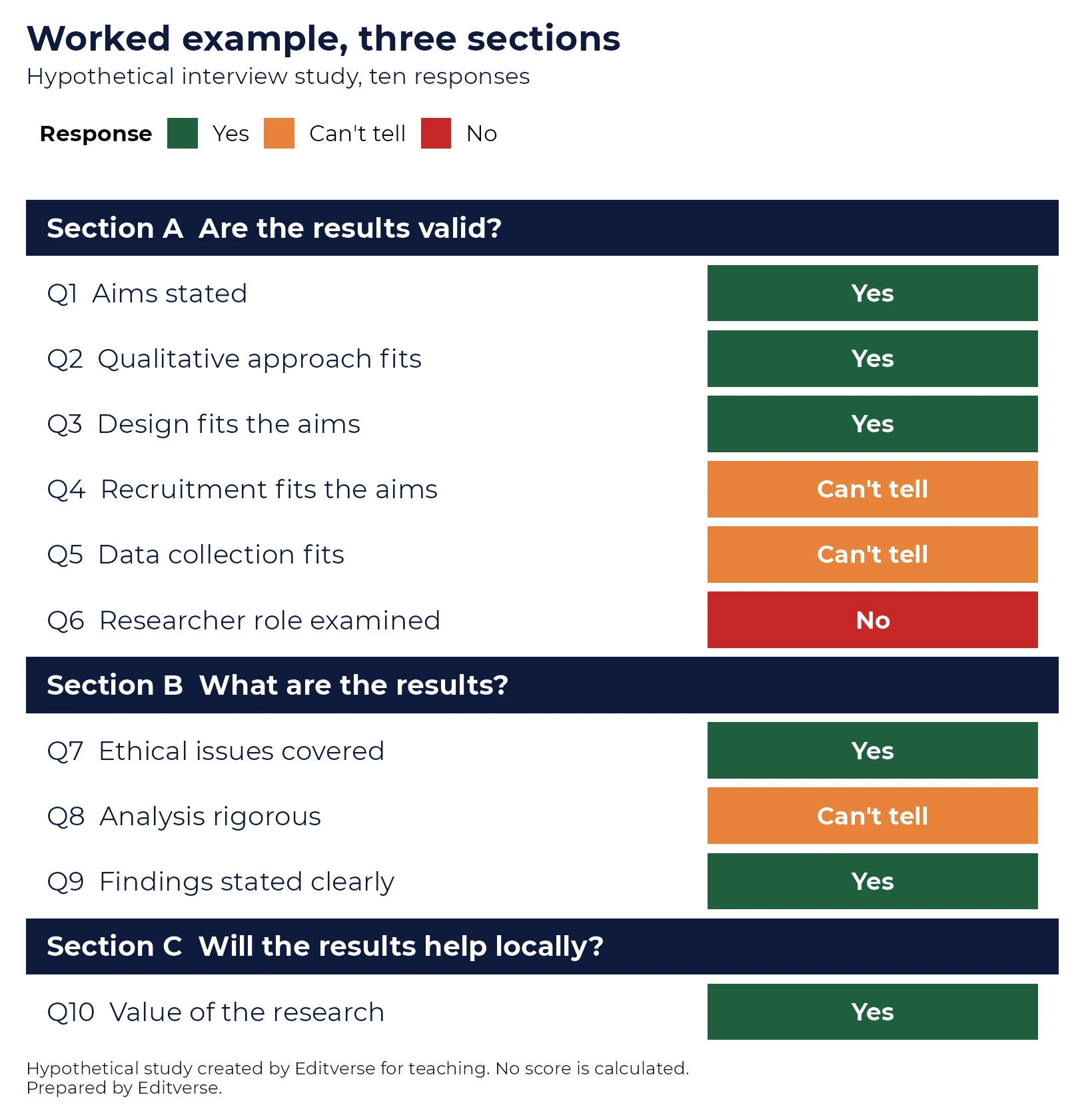
| Section | Question topic (paraphrased) | Response | Reason recorded |
|---|---|---|---|
| A | 1 Aims clearly stated | Yes | The aim, to explore how nurses experience night handover, is stated and linked to patient safety. |
| A | 2 Qualitative approach appropriate | Yes | The aim concerns experience, which interviews can illuminate. |
| A | 3 Design fits the aims | Yes | The authors justify an interview design over observation of handover. |
| A | 4 Recruitment fits the aims | Can’t tell | Selection method is given but there is no account of who declined or why this group suits the question. |
| A | 5 Data collection addressed the issue | Can’t tell | Topic guide is described, but saturation is not discussed and any changes during fieldwork are not reported. |
| A | 6 Researcher and participant relationship considered | No | The interviewer managed the participants and the paper never examines how that power relation could shape answers. |
| B | 7 Ethical issues considered | Yes | Approval and consent are reported with confidentiality arrangements. |
| B | 8 Analysis sufficiently rigorous | Can’t tell | Themes are illustrated with quotations, but derivation is thin, contradictory cases are not discussed and no second analyst is mentioned. |
| B | 9 Clear statement of findings | Yes | Four themes are explicit and tied back to the research question. |
| C | 10 Value of the research | Yes | The paper links findings to existing handover literature and names transferability limits for other hospitals. |
The appraisal summary then reads in words. Positive points are a clear aim, a justified design and explicit findings tied to the question. Negative points are the unexamined manager-interviewer relationship, which directly threatens what nurses were willing to say. Unknowns are recruitment, saturation and the analytic audit trail. Six Yes responses out of ten does not mean the study is 60 percent good. A single No in the section on researcher influence can matter more than five Yes responses elsewhere, which is exactly why a total hides the information a reader needs.
What you do next depends on the purpose. In a qualitative evidence synthesis you would include the study, carry the concerns forward into your confidence rating, and test whether the themes it contributes also appear in better-conducted studies. In a thesis literature review you would cite the study with a clause that flags the single-site, manager-led interviews. In both cases the written reasons are the product, not the tick marks.
CASP Checklist Real Example, Appraising a Published Open-Access Qualitative Study
A hypothetical study shows the mechanics, but a real paper shows what a good result looks like, including the places where a careful appraiser still hesitates. Here is a recent, well-reported qualitative study, a 2023 interview study of general practitioners (GPs) in Ireland, appraised across all three sections of the CASP checklist for qualitative research.
Real example paper
O’Leary H, Robinson K, Glynn L, Lenehan B, McCreesh K. “You’re stuck in the middle here”, a qualitative study of GPs’ experiences of managing knee pain attributed to a degenerative meniscal tear. BMC Primary Care. 2023;24(1):127. doi:10.1186/s12875-023-02075-9. PMID 37344762. PMC10286499.
Licence. Creative Commons Attribution 4.0 International (CC BY 4.0), confirmed against the Crossref record and the PubMed Central open-access metadata. Short quotations below are marked and attributed to the authors, and no figure or table image is copied.
Why this paper. The authors state that COREQ guided the conduct and reporting, the interview guide appears in a table, and the analysis method and software are named. Saturation and a member-checking step are reported, and a reflexivity paragraph covers the interviewer’s own clinical background. Open access under a CC BY licence means you can open the full text and test every row below against the source.
Treat this as an illustrative Editverse appraisal for teaching, not a judgement on the authors. Another appraiser could reasonably answer the rows marked as judgement calls differently, which is exactly why CASP asks you to write the reason next to every response. Question topics are paraphrased, and the official wording is on the CASP checklist page.
| Section | Question topic (paraphrased) | What the paper reports and where | Response | Reason in one sentence |
|---|---|---|---|---|
| A | 1 Aims clearly stated | Abstract and end of Introduction state the aim, which is to explore GPs’ views and experiences of managing knee pain attributed to a degenerative meniscal tear. Introduction explains the gap, since the GP perspective had not been explored. | Yes | Goal, importance and relevance to practice are all stated. |
| A | 2 Fit of a qualitative approach | Introduction and Methods, Study design. GP experience, beliefs and pressures are the subject, not a measurable outcome. | Yes | Experiences and beliefs are what a qualitative approach is built to illuminate, and the aim asks for nothing that a count could answer. |
| A | 3 Research design fits the aims | Methods, Study design and Data collection. Semi-structured interviews built on a piloted six-question guide and a short case vignette (Table 1), with inductive thematic analysis. | Can’t tell Judgement call | The interview design fits the aim, but the paper never says why interviews were chosen over focus groups or another method, which is the one thing this question asks about. |
| A | 4 Recruitment strategy fits the aims | Methods, Setting, participants and recruitment. Emails through professional and research networks, self-referral, snowball sampling, then purposive sampling for practice location, mix of private insurance, gender and years of experience. Sample described in Table 2 (17 GPs). | Yes Judgement call | How GPs were chosen and why variation was sought are explained, but the number approached or declining is not reported, and the authors themselves flag self-selection. |
| A | 5 Data collection addressed the issue | Methods, Data collection, and Results, opening paragraph. Online or telephone interviews from September 2021 to February 2022 because of COVID-19 restrictions, lasting 35 to 62 minutes (mean 46). Recorded, transcribed and checked, with field notes. Saturation reached, then two more interviews. | Yes | Setting, method, topic guide, form of data and saturation are all explicit, and no change to the methods during fieldwork is reported. |
| A | 6 Researcher and participant relationship considered | Methods, Data collection and Data analysis, plus Strengths and limitations. Interviewer was also a practising musculoskeletal physiotherapist, and participants knew it. A reflexivity paragraph describes how this was handled. | Yes | Clinical role of the interviewer is disclosed and examined for its likely effect on both the interviews and the analysis, with team discussion as a check. |
| B | 7 Ethical issues considered | Abstract, Methods, Study design, and the Declarations. Approval from the Irish College of General Practitioners research ethics committee with a reference number, informed consent by email confirmed verbally, pseudonyms and removal of personal information. | Yes Judgement call | Approval, consent and confidentiality steps are stated, but the paper does not say what participants were told and does not discuss any ethical issues the study raised, a modest gap for a low-risk sample of professionals. |
| B | 8 Rigour of the analysis | Methods, Data analysis, and the quotations in Results. Braun and Clarke’s six steps, NVivo 12, two researchers coding a sample of transcripts independently and reconciling, regular team meetings, theme review by the whole team. | Yes Judgement call | Process is described and contrary views are reported (for example on MRI and on private insurance), but the share of transcripts double-coded and a worked path from codes to themes are not shown. |
| B | 9 Clarity of findings | Results (three themes with subthemes), Discussion, Summary of main findings, and Methods, Data analysis for the credibility checks. Member checking with 3 participants, independent coding, debriefing and saturation. | Yes | Findings are explicit and tied to the aim, with evidence for and against, and the credibility steps are named even though member checking covered a small subset. |
| C | 10 Value of the research | Discussion, Comparison with existing literature and implications for practice, Strengths and limitations, and Conclusions. Links to low back pain and osteoarthritis research, and to training, physiotherapy access and online resources for GPs. | Yes | Contribution, practical implications and the limits on transfer to other health systems are all discussed, with further research implied more than listed. |
Three details from the paper make the table easier to follow. On saturation, the authors report “An additional two interviews were carried out after this point” (O’Leary et al., 2023, Methods). On checking their interpretation with participants, they state “Member checking was carried out” with a subset of three GPs. On reflexivity, they write that the researcher “considered potential influences of her physiotherapy background on data analysis and write up”.
Overall appraisal in the CASP summary format
Positive points. Aims are clear and the design fits them. Sampling was deliberately widened to include rural and urban practices, public and private mixes, both genders and a range of experience. Tables 1 and 2 show the interview guide and the sample, so a reader can see what was asked and who answered. Reflexivity is handled specifically, and the authors return to it when they discuss social desirability. Two researchers coded independently, and contrasting views sit beside the dominant ones in the quotations.
Uncertainties. Four rows carry most of the doubt. Interviews are not argued for over other methods, the number of GPs approached or declining is not given, what participants were told and any ethical issues raised are not described, and the share of data double-coded and the path from codes to themes are not shown. Member checking reached 3 of 17 participants, so it supports credibility without settling it. Because the dataset is not public, owing to conditions attached to ethical approval, an outside reader cannot re-read transcripts against the themes.
What this does and does not mean. Nine responses are Yes and one is Can’t tell, but that is not a score and it does not call the study flawless. COREQ tells authors what to report, and the authors state it guided this paper. CASP asks a different question, whether what was reported supports the findings, and here the answer is mostly well-evidenced Yes responses with four flagged judgement calls.
Carrying it into a synthesis. In a qualitative evidence synthesis you would include this study and record the four flagged rows against the themes it contributes, so that confidence in each theme reflects them. Where its themes on patient expectations and service access match those from other studies, the doubts matter little. Where this study is the only source for a theme, they matter more. In a thesis, cite the study with a short clause naming its single-country setting and the self-selected sample of GPs, both of which the authors raise themselves.
How to Report a CASP Checklist Appraisal in a Paper or Thesis
A reader should be able to see which checklist you used, who applied it, how disagreements were settled, and what you did with the result. A methods paragraph that covers those points can be short.
Methods sentence template
Two reviewers independently appraised each included qualitative study with the CASP checklist for qualitative research (Critical Appraisal Skills Programme, 2024). For every question the reviewers recorded Yes, No or Can’t tell together with a written reason, and disagreements were resolved by discussion with a third reviewer. No numerical score was calculated. Appraisal findings were used to describe the methodological strengths and gaps of each study and to inform confidence in the synthesised findings.
In the results, add a table with one row per study and one column per question, coded Yes, No or Can’t tell, and a short narrative paragraph on the patterns. Patterns are more informative than study-level verdicts. If six of eight studies show Can’t tell for recruitment, that is a finding about the literature, and it belongs in your discussion.
For the reference list, CASP recommends Harvard style, with the organisation as author, the year, the checklist name, the web address and the date you accessed it. Its referencing page gives the exact reference for each of the eleven checklists. For the qualitative checklist the pattern is Critical Appraisal Skills Programme (2024), CASP checklist for qualitative research, online, followed by the PDF address and the access date.
On usage terms, CASP states that the checklists are licensed under Creative Commons Attribution NonCommercial ShareAlike. In CASP’s own summary, you may share and adapt the material, you must give appropriate credit and indicate changes, you may not use it for commercial purposes, and anything you build on it must carry the same licence. If you plan to reproduce a full checklist in an appendix or an adapted form in a commercial product, read those terms first and check with CASP when in doubt. Quoting the topic of a question, as this guide does, and linking to the official PDF avoids the issue.
Finally, tie the appraisal to your reporting standard. A systematic review reported to PRISMA 2020 should name the appraisal tool and explain how its results were used. For the qualitative studies you write yourself, a reporting guideline such as COREQ is the right companion, because it governs what your own manuscript discloses.
Common Mistakes With the CASP Checklist
Adding up the Yes responses
Totals look tidy and they mislead. As shown above, scoring conventions changed review conclusions across 25 scales, and CASP itself offers no score. Report counts and reasons instead.
Picking the checklist by title
Papers label designs loosely. Decide from the methods section who allocated the exposure, which direction the study ran and what it was compared with, then use the decision table above.
Working alone and leaving reasons blank
A single appraiser with ticks and no reasons leaves nothing to audit. Two independent appraisers who write one line of reasoning per question produce a record a supervisor or reviewer can follow.
Treating Can’t tell as a polite No
Can’t tell means the paper is silent. Do not guess in the authors’ favour, and do not convert it to No. Count it, explain it and weigh it, as the checklist itself instructs.
Confusing appraisal with reporting
Appraising a published study with CASP does not show that your own manuscript meets a reporting standard. Use the reporting guideline for your design when you write, and the CASP checklist when you read.
Stopping at Section B
Section C is where the appraisal connects to your question. A valid, precise result from a population unlike yours can still be the wrong evidence for your review or your clinic.
Free Tools for Your Appraisal Workflow
Free Research Tools from Editverse
- GraphPro: build publication-ready charts, 25 types, with built-in t-test, ANOVA, correlation, and chi-square p-values. Free, no signup.
- StatPro: free statistical calculators and a test-selector tool covering group comparisons, categorical outcomes, time-to-event analysis, and diagnostic accuracy.
- Flowchart Pro: generate PRISMA 2020, PRISMA-ScR, CONSORT, STROBE, STARD, MOOSE, and ARRIVE flow diagrams directly in your browser.
Professional Support for Critical Appraisal and Evidence Synthesis
Appraisal is a labour-intensive stage, because every included study benefits from two readers and a written reason for each response. Editverse specialists handle that stage as part of a full evidence synthesis or as groundwork for a thesis chapter, and the work aligns with COPE, ICMJE and GPP 2022. Two packages fit this topic directly.
Literature review
$500
Search strategy document, literature matrix, gap analysis and annotated bibliography for a dissertation chapter. 7 to 10 business days.
Systematic review and meta-analysis
$1,800
Protocol, search, screening, extraction and quality assessment, forest plots and a manuscript for up to 15 eligible studies. 10 to 14 weeks from protocol approval.
For larger syntheses, network meta-analysis and journal-specific reporting, see the full systematic review writing service.
Conclusion
A CASP checklist works when three decisions are made well. Match the checklist to the design using the methods section, not the title. Answer each of the ten to twelve questions with Yes, No or Can’t tell and write the reason. Report the tool, the version, the number of appraisers and the way results were used, with no invented score. The worked example shows how one unexamined researcher relationship can outweigh several Yes responses, and why the reasons matter more than the tally.
Download the right PDF from the CASP checklist hub, keep the reasons, and if your appraisal sits inside a larger review, our systematic review team can carry it through to a submission-ready manuscript.
References
- Critical Appraisal Skills Programme. CASP checklists. casp-uk.net/casp-tools-checklists/ (accessed 29 October 2026).
- Critical Appraisal Skills Programme. How to use the CASP checklists. casp-uk.net/how-to-use-checklist/ (accessed 29 October 2026).
- Critical Appraisal Skills Programme. Referencing and Creative Commons. casp-uk.net/referencing/ (accessed 29 October 2026).
- Critical Appraisal Skills Programme (2024). CASP checklist for qualitative research. casp-uk.net/casp-checklists/CASP-checklist-qualitative-2024.pdf. The other ten 2024 checklist PDFs were read from the file names listed on the referencing page.
- Creative Commons. Attribution-NonCommercial-ShareAlike 4.0 International. creativecommons.org/licenses/by-nc-sa/4.0/
- Majid U, Vanstone M. Appraising qualitative research for evidence syntheses, a compendium of quality appraisal tools. Qualitative Health Research. 2018;28(13):2115-2131. PMID 30047306. doi 10.1177/1049732318785358.
- Jüni P, Witschi A, Bloch R, Egger M. The hazards of scoring the quality of clinical trials for meta-analysis. JAMA. 1999;282(11):1054-1060. PMID 10493204. doi 10.1001/jama.282.11.1054.
- Cochrane Handbook for Systematic Reviews of Interventions, chapter 7, section 7.1.2. cochrane.org/authors/handbooks-and-manuals/handbook/current/chapter-07
- Tong A, Sainsbury P, Craig J. Consolidated criteria for reporting qualitative research (COREQ), a 32-item checklist for interviews and focus groups. International Journal for Quality in Health Care. 2007;19(6):349-357. PMID 17872937. doi 10.1093/intqhc/mzm042.
- Whiting PF, Rutjes AWS, Westwood ME, et al. QUADAS-2, a revised tool for the quality assessment of diagnostic accuracy studies. Annals of Internal Medicine. 2011;155(8):529-536. PMID 22007046. doi 10.7326/0003-4819-155-8-201110180-00009.
- Sterne JAC, Savović J, Page MJ, et al. RoB 2, a revised tool for assessing risk of bias in randomised trials. BMJ. 2019;366:l4898. PMID 31462531. doi 10.1136/bmj.l4898.
- O’Leary H, Robinson K, Glynn L, Lenehan B, McCreesh K. “You’re stuck in the middle here”: a qualitative study of GPs’ experiences of managing knee pain attributed to a degenerative meniscal tear. BMC Prim Care. 2023;24(1):127. PMID 37344762. doi:10.1186/s12875-023-02075-9. Licensed under CC BY 4.0.