
Published
Researchers in Doha still search for the QNRF NPRP grant in 2026, yet the fund behind that name now sits inside the Qatar Research, Development and Innovation (QRDI) Council, and its program list has been rebuilt. This guide names the schemes that exist today, says who can apply, shows how reviewers score, and flags the errors that the published rules make fatal. It also covers the university and hospital routes, including Qatar University internal grants and the Hamad Medical Corporation Medical Research Center. Every figure below comes from a funder page we read on 10 October 2026.
Editverse is independent. We are not affiliated with, or endorsed by, QRDI, QNRF, Qatar University, Hamad Medical Corporation, Qatar Foundation or any other funder named here. Call terms change between cycles, so treat this page as a map and the current call document as the authority.
In Simple Words
NPRP was the flagship program of the Qatar National Research Fund (QNRF). QNRF now operates inside the QRDI Council, and the Council’s own list of research programs no longer names NPRP. For an investigator-led project, the nearest route is the Academic Research Grant, which offers up to QAR 900,000 per year for up to three years through an approved institution in Qatar. Projects that serve a ministry or other national body go through the National Research Program. Qatar University and Hamad Medical Corporation run their own internal grants. On 10 October 2026 the only open research call we saw on InnoLight was the Research Top-Up Fund, which needs at least USD 1 million of in-cash co-funding already in hand. Confirm which call is open on the QRDI InnoLight portal before you write anything.
The QNRF NPRP Grant Today and Qatar’s Current Funding Structure
The QRDI Council describes QNRF on its Scientific Research page as the first national competitive research funding agency in the Middle East, and says the QRDI 2030 strategy establishes a dedicated national research fund. In May 2023 the Council announced a revamped portfolio, funded through its QNRF division, built on three programs that still frame the system today.
| Program | Funding initiatives named by QRDI | Published size and duration |
|---|---|---|
| Academic Research Program | Academic Research Grant (ARG) | Up to QAR 900,000 per year, up to three years (2024 request for application) |
| National Research Program | National Research Grant, Bi-lateral Research Grants, and joint calls with national partners | Three-year grants on the program page, with joint-call amounts set call by call |
| Research Talent Program | High School Research Experience (HSREP), Undergraduate Research Experience (UREP), Graduate Student Research Award (GSRA) | UREP projects last 12 months, GSRA covers stipend and tuition, and no amounts are published on the program page |
The Scientific Research page lists eleven named items in total. They are the three programs above plus eight calls, namely ARG, Path Towards Precision Medicine, the QNRF-TUBITAK joint call, the Food Security Call, the Climate Change and Environment Call, Pathways Toward Prosperity, the Economic Sustainability Call and the Modernizing Charitable Sector Call. The page gives no open or closed status for any of them and sends readers to the InnoLight portal for details.
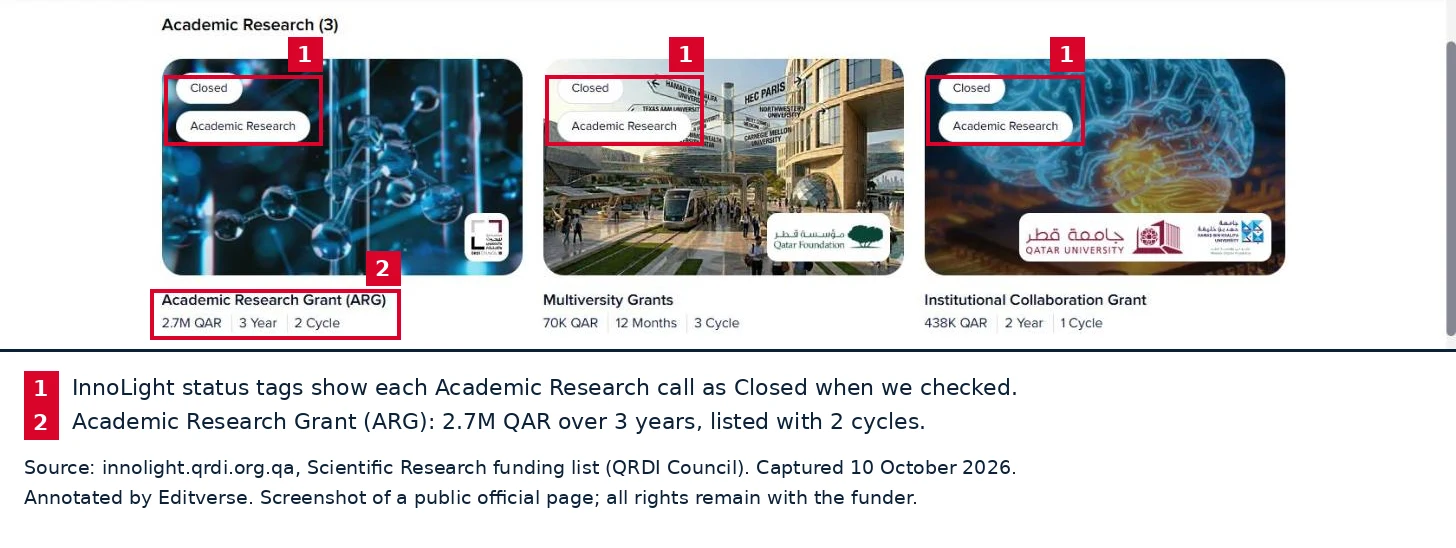
InnoLight does show status. On 10 October 2026 its Scientific Research list tagged the three Academic Research calls (ARG, Multiversity Grants and the Institutional Collaboration Grant) as Closed, and the six National Research cards on the first screen were also Closed. It listed one call under International Research with an Open tag, the Research Top-Up Fund, which is covered below. ARG appears there as QAR 2.7 million over three years with two cycles run so far.
Proposals must also sit inside one of five national RDI priority areas. The Strategic Focus page names them as Energy, Health, Resource Sustainability, Society and Digital Technology. A project that cannot be placed under one of the five will struggle at screening, whatever its scientific merit.
What Happened to the QNRF NPRP Grant
The NPRP was a real and large program. A Qatar News Agency report from November 2017 calls it QNRF’s flagship program and describes the 11th cycle, which introduced two tracks. NPRP-C grouped several sub-projects under a program director, and NPRP-S funded single projects around set themes covering energy and environment, information and communications technology, biomedical and health, and social sciences, arts and humanities. Awards from that cycle were due in 2018.
NPRP does not appear in the 2023 portfolio announcement, and it does not appear in the Scientific Research page we read this month. We found no official page announcing a new NPRP cycle, and no official statement of when the last one closed, so we give no closing date. If a colleague tells you to “apply to the NPRP”, ask for the call document and its date.
This matters because search results still carry old material. Some university research-office pages continue to describe NPRP as the flagship program and link to legacy submission addresses. Cycle numbers, ceilings and rules on those pages do not apply to current calls. A simple test protects you. Any page you rely on should either cite a request for application dated 2024 or later, or sit on the QRDI domain.
Academic Research Grant, the Nearest Counterpart to the QNRF NPRP Grant
QRDI does not call ARG a replacement for NPRP. In our reading it is the route that fills the same practical space, because it funds investigator-led research on a topic of the applicant’s own choosing within the national priority areas. The terms below come from the 2024 request for application (RFA), the most recent ARG RFA we could read. Check InnoLight for the current cycle.
What ARG funds
The RFA offers up to QAR 900,000 per year (stated there as USD 246,561) for up to three years, covering personnel, capital equipment, consumables, materials, services, travel, miscellaneous costs and applicable indirect costs. At least 80 percent of the total annual budget and 65 percent of the effort must be spent inside Qatar. Co-funding and cost-sharing are allowed in cash or in kind.
Who can apply
- The lead principal investigator (LPI) must be a full-time affiliate of an approved submitting institution inside Qatar and hold a terminal degree from the list in the RFA’s document library.
- An LPI may submit only one application per call, and active ARG roles as LPI or PI, across previous and current cycles, must not exceed three.
- Submitting institutions are academic, public, private or other bodies, including non-profits and NGOs, that have a QRDI-approved Research Office.
- Collaborating institutions may sit inside or outside Qatar, and each must include at least one full-time affiliated PI. The RFA text we read does not state a nationality rule.
How applications are judged
Applications move through four stages, namely LPI submission, Research Office vetting, QRDI screening and peer review. In the 2024 cycle the LPI deadline was 7 May and the Research Office vetting deadline was 21 May, with screening notices in June and awards in October or November. Reviewers are at least four international experts who rate each criterion as Excellent, Good, Average, Unsatisfactory or Poor, and a single Poor rating on any criterion disqualifies the proposal.
| Criterion | Weight | What reviewers look for |
|---|---|---|
| Scientific Excellence | 40% | Novelty, potential breakthrough, importance of the problem, sound premise, feasible methodology |
| Implementation | 30% | Measurable objectives, coordinated work plan, adequate resources, qualified team, LPI track record, justified collaboration |
| Budget | 20% | Appropriate and justified costs, realistic co-funding commitments |
| Knowledge Transfer | 10% | Dissemination of outcomes, transfer of knowledge and technology, capacity building |
| Research Compliance | Comments only | Human subjects, children, vertebrate animals, biohazards |
Proposals are then placed in group A (highly competitive), B (moderately competitive) or C (uncompetitive), and funding depends on the available budget. Because one Poor rating ends a proposal, the weakest section matters more than the weights suggest. A brilliant aim paired with an unjustified budget fails.
Worked example from the published rule
Suppose you request the ceiling of QAR 900,000 for a year. The 80 percent rule allows at most QAR 180,000 to be spent outside Qatar that year, which is QAR 540,000 across three years. Now test effort. If the team commits ten person-months in a year, at least 6.5 must be done in Qatar. A collaborator abroad who contributes four of the ten person-months puts 40 percent of the effort outside Qatar and breaks the 65 percent rule, even if the money split is legal. Run both tests before you invite a partner. This arithmetic is ours, applied to the RFA’s stated limits.
Mistakes that sink ARG proposals
- Submitting a resubmission that does not qualify. The RFA allows resubmission only for proposals that passed screening but were not awarded. Proposals already resubmitted, or resubmitted as New, are screened out.
- Missing the Research Office deadline. The RFA treats the application as complete only at Research Office vetting, which closes two weeks after the LPI deadline in the 2024 timeline. Send your institution a final draft well before that date.
- Counting roles badly. Four active ARG roles breaches the three-role cap, and a second application as LPI is not permitted.
- Overseas-heavy budgets. Equipment, subcontracts and collaborator salaries abroad quickly exceed the 20 percent ceiling on spending outside Qatar. See our guide to budget justification for Qatar grants.
- An unscored compliance section. Research Compliance carries comments only, yet a weak ethics plan draws comments that colour the panel’s view of feasibility. Our note on participant protection and safety writing shows what a clean section looks like.
- A knowledge-transfer paragraph written last. It carries 10 percent of the weight, and the knowledge translation plan guide explains how to build it from the start.
Research Top-Up Fund: The One Open QRDI Research Call We Found
On 10 October 2026 the InnoLight Scientific Research list showed exactly one call with an Open tag, the Research Top-Up Fund (RTF), filed under International Research. It is not a substitute for the ARG. It adds money to a project that already has co-funding.

What it funds
The call page describes RTF as a new QRDI mechanism designed to amplify the value and impact of existing grants and co-funding arrangements. It co-invests alongside national and international funders, so the money strengthens a funded project rather than starting one. The page offers up to QAR 3.6 million (USD 1 million) for up to three years, in one cycle. It tags the call to Engineering and Technology, Medical and Health Sciences, and Social Sciences, and names four priority themes: Resource Sustainability, Health and Life Sciences, Digital Technology and Society. The listed user types are Academic and Government Entities.
Who can apply
- The lead principal investigator (LPI) must be affiliated with an approved submitting institution inside Qatar.
- The LPI must hold an approved terminal degree.
- The LPI can submit only one application in this cycle.
- The LPI must provide proof of in-cash co-funding of at least USD 1 million.
Budget rules and dates
At least 80 percent of the total annual budget and 65 percent of the effort must be spent inside Qatar, the same split we saw in the ARG request for applications. The call page lists 1 March 2026 as the opening date and 31 December 2026 as the close for proposal submission. It lists the research-office final submission and vetting step against the same date, so your institution’s internal deadline is likely to fall earlier. Ask your research office for it now. Status and dates are set by QRDI, so re-check the call page before you act.
Who it suits
This is our reading, not QRDI’s. RTF suits a Qatar-based investigator who already holds, or has been awarded, at least USD 1 million in cash co-funding from another national or international funder. Without that co-funding, the ARG or a Qatar University internal grant is the realistic route. The co-funding proof is the item most likely to stop an application, so gather the award letter before you plan the narrative.
National Research Program, Bi-lateral Grants and Joint Calls
What it funds
The National Research Program page describes a National Research Grant as a three-year grant for applied research and early-stage experimental development in priority areas tied to the needs of national research beneficiaries such as ministries and government entities. It also lists Bi-lateral Research Grants, three-year awards that strengthen ties between the Qatari and international research communities around a mutual area of interest within Qatar’s priority areas. The page publishes no amounts. The 2023 announcement added jointly funded calls with national partners, namely Path Towards Precision Medicine with the Qatar Genome Programme, the Food Security Call with the Ministry of Municipality, and the QNRF-TUBITAK Academia-Industry Cooperation Call.
Who can apply
The program page names local universities and research institutions as stakeholders and states no further eligibility rules. Joint calls publish their own. The January 2026 call on neuro and mental health, run with the Ministry of Public Health, is a useful template. Its LPI must hold an approved terminal degree, sit at an approved submitting institution in Qatar, submit one application and hold no more than three active roles in that call series. Ministry of Public Health staff are ineligible.
How applications are judged
That 2026 request for application offers up to QAR 547,500 (USD 150,000) per year for up to two years, with the same 65 percent effort and 80 percent budget rules inside Qatar, and capital equipment bought in Qatar. Its scoring is where national calls differ from ARG. Peer review carries 40 percent of the score and a programmatic review carries 60 percent.
| Review stage | Criterion (weight within stage) | Share of the total score |
|---|---|---|
| Peer review (40%) | Scientific Excellence (30%) | 12 points |
| Peer review (40%) | Implementation (30%) | 12 points |
| Peer review (40%) | Budget (20%) | 8 points |
| Peer review (40%) | Potential Impact (20%) | 8 points |
| Programmatic review (60%) | Relevance for Qatar (25%) | 15 points |
| Programmatic review (60%) | Potential Impact for Qatar (75%) | 45 points |
The point values are our arithmetic on the published weights. They show that Potential Impact for Qatar alone carries 45 points of 100, while scientific excellence carries 12. Weights vary by call, so read each RFA, but expect national-partner calls to reward a named Qatari beneficiary above novelty. The program page also lists the indicators QRDI tracks, including publications with international co-authors, publications in the top 10 percent most cited worldwide, field-weighted citation impact, patent applications granted, projects with industry and PhDs and postdocs trained.
Mistakes that sink national-program proposals
- Pitching an ARG proposal under a partner call. Basic-science framing with no named user in a ministry scores poorly on the 60 percent programmatic side.
- Describing impact in general terms. Name the beneficiary, the decision it informs and the measure that will change.
- Forgetting partner-specific exclusions. In the neuro and mental health call, Ministry of Public Health staff cannot be LPI.
- Ignoring the priority areas. Each call lists its own, and a proposal must fall within them.
- Treating the call as a one-off. The KPIs reward people trained and international co-authorship, so plan both. Our team expertise writing guide covers how to show capability.
Research Talent Program for Students and Early Researchers
The Research Talent Program page aims to develop, retain and attract research talent and names three initiatives. HSREP gives high school students hands-on research experience. UREP offers team-based research mentorship with faculty, postdocs, graduate students and research staff, and its project duration is 12 months. GSRA is an MSc or PhD scholarship that includes stipends and university tuition, and candidates are selected by local academic institutions. The 2023 announcement described GSRA as having local and international tracks. The page publishes no amounts or detailed eligibility rules.
For an academic researcher the relevant role is supervisor or mentor, not applicant. The page tracks the share of UREP recipients who enter research careers and the number of PhDs and postdocs trained, so a mentorship plan with named milestones reads as evidence.
Mistakes in talent-program applications
- Scoping a UREP project as a miniature ARG. Twelve months is short, so define one answerable question with a deliverable a student team can finish.
- Having no mentorship structure. The program is about the student experience, so describe supervision, meetings and skills gained.
- Expecting to apply directly for GSRA. Candidates are selected by local academic institutions, so contact the graduate office first.
Qatar University Internal Grants
Qatar University runs a separate internal system, applied for through its iGrants platform. The Internal Grants 2026 guide documents a call that launched on 2 June 2025 and closed on 15 September 2025, so check the university’s internal grants page for the next cycle. The grant types and ceilings below come from that guide.
| Grant | Ceiling and duration | Key conditions |
|---|---|---|
| National Capacity Building | Stage 1 up to QAR 100,000 for one year, Stage 2 QAR 150,000 to 300,000 for up to two years | Qatari nationals who are assistant or associate professors, research associates or lecturers with a PhD, awarded once per career |
| Collaborative | Up to QAR 300,000 over two years, maximum QAR 150,000 per year | Tracks for assistant professors and for associate professors and professors, students required |
| Governmental and Industrial Collaboration | Up to QAR 200,000 over two years | Government or industry funding of at least 30 percent of the budget plus partner letters of interest, students required |
| Institutional Collaboration | Up to USD 120,000 over two years | Joint projects with another Gulf university, currently Sultan Qaboos University, students required |
| Innovation and Knowledge Transfer | Student track up to QAR 20,000, Innovation Teams up to QAR 200,000 over two years | Innovation Teams work at technology readiness levels 4 to 6 or 7 to 9 |
The lead PI must be a full-time Qatar University faculty member or researcher. Each person may hold one LPI role and up to three PI roles per cycle. Active QRDI grants and earlier internal grants can block LPI eligibility for set periods. Submissions need a research proposal, budget breakdown, team CVs and an endorsement letter from the department, college or center. Review runs through technical review, which typically takes two to four weeks, then the Higher Supervisory Committee for Research Grants, then the Vice President for Research and Graduate Studies.
Mistakes in internal-grant budgets and approvals
- Budgeting items the guide disallows. Laptops, training, food, subscriptions (unless essential) and advertising are not allowable.
- Breaching category caps. Travel may not exceed 20 percent of the annual budget and needs prior approval, and miscellaneous costs may not exceed 5 percent.
- Starting before ethics approval. IRB, IACUC or IBC approval is mandatory before research with humans, animals or hazardous materials begins.
- Skipping the moratorium check. An active QRDI grant can make you ineligible as LPI, so confirm your status before drafting.
- Leaving students out. Several tracks require student participation, so build them into the work plan and timeline using our research timeline guide for Qatar grants.
Hamad Medical Corporation and the QU-HMC Collaboration Grant
The Medical Research Center (MRC) at Hamad Medical Corporation runs two internal routes, described on its funding opportunities page. Routine Continuous Funds allow requests of up to QR100,000, are open throughout the year and are submitted through the ABHATH-E system. The Internal Research Grants Cycle (IRGC) is designed for two cycles a year with Senior Investigators Awards of up to QR1 million for one to three years, New Investigators Awards of up to QR500,000 for clinicians with little research experience who have a senior mentor, and awards of QR250,000 for residents and fellows. The same page says the application cycle was closed when we read it, and the deadlines page we found still shows 2017 and 2018 dates. Treat IRGC as unconfirmed until MRC posts a new call.
For IRGC awards, MRC states that collaborators in Qatar are welcome, that no more than 20 percent of the budget may go to the collaborator’s expenses, and that most of the activity must take place at HMC.
For joint work, the QU-HMC Institutional Collaboration Grant for the 2027 cycle provides up to QAR 180,000 per year, or QAR 360,000 over two years, from each institution. It needs one QU lead PI at assistant professor level or above and one HMC lead PI who is a full-time HMC affiliate with a terminal degree and at least five peer-reviewed publications indexed in Web of Science. Letters of intent are due within three weeks of the call announcement, and full proposals go through HMC’s Abhath system.
Mistakes in hospital-based proposals
- Assuming IRGC is open. Confirm a live call with MRC before investing weeks in a draft.
- Putting the work outside the hospital. The majority of activity must happen at HMC, and collaborator spending is capped at 20 percent.
- Missing the three-week letter of intent window for the joint grant, which starts at announcement, not at your next committee meeting.
- Overlooking the publication threshold. An HMC lead without five indexed publications is ineligible for the joint grant.
Qatar Foundation and Sidra Medicine Routes
Qatar Foundation runs Multiversity Grants for cross-university collaboration. A January 2026 Qatar Foundation story reports that funding was awarded to seven projects, and describes the aim as bringing faculty from different universities in its ecosystem together. The story gives no amounts or eligibility rules, so look for the current call on InnoLight and read its terms.
Sidra Medicine’s research page, as we read it, does not publish an open internal grant program. It lists a Research Services contact at CR*******@***ra.org for collaboration enquiries. Clinicians at Sidra should ask that office which funding routes their institution endorses.
Which QNRF NPRP Grant Successor Fits Your Career Stage
Use the three-question rule before you draft. It is Editverse’s own decision aid, built only from the eligibility rules quoted above.
- Where are you employed? An ARG or national call needs an approved submitting institution in Qatar with a QRDI-approved Research Office. A hospital clinician should also look at MRC, and a Qatar University staff member at the internal grants.
- Who owns the problem? If you chose the question, think ARG. If a ministry or government body needs the answer, think National Research Program or a joint call.
- What is already in your name? Active QRDI grants can block internal LPI status, and ARG has a three-role cap, so count your roles first.
| Profile | Start here | Reason from the published rules |
|---|---|---|
| Qatari national, assistant or associate professor at Qatar University, no major grant yet | QU National Capacity Building | Stage 1 gives up to QAR 100,000 for one year and is awarded once per career |
| Early-career QU faculty building a team with students | QU Collaborative grant, then ARG | Up to QAR 300,000 over two years generates the preliminary data an ARG panel scores under Scientific Excellence |
| Established PI with preliminary data at an approved institution | ARG | Investigator-led, up to QAR 900,000 per year for up to three years |
| PI with a ministry or government partner | National Research Grant or a joint call | Impact for Qatar carries the largest share of the score in the call we examined |
| HMC clinician with little research history | MRC Routine Continuous Funds, or IRGC New Investigators when open | Up to QR100,000 any time, or up to QR500,000 with a senior mentor |
| Joint QU and HMC team | QU-HMC Institutional Collaboration Grant | Each institution contributes up to QAR 180,000 per year |
| Graduate or undergraduate student | GSRA through the institution, UREP through a faculty mentor | Selection runs through local academic institutions or faculty teams |
The sensible sequence for many early-career researchers is an internal grant first, then ARG. That is our judgement rather than a funder rule. Internal funds build the pilot data that the preliminary studies guide describes, and they keep your ARG role count low.
Aligning Proposal Outputs with Publication and Acknowledgment
Funders score what you promise to deliver, and they later count what you deliver. Build an output ledger at proposal stage so that every promised output has a metric, a place in the work plan and a line in the budget. The table maps the criteria and indicators published by QRDI to practical proposal text.
| Output | What the funder publishes | What to write in the proposal | What to do when the paper appears |
|---|---|---|---|
| Journal articles | ARG Knowledge Transfer (10%), plus National Research Program indicators on citation impact and top 10 percent cited papers | Name target journals, the order of papers and who writes each | Cite the award, follow the journal’s funding statement, and see our guide to funding acknowledgment writing |
| International co-authorship | Share of publications with international co-authors | Identify named collaborators and their contribution | Agree authorship roles in writing before analysis |
| Open access | Dissemination under Knowledge Transfer | Budget the article processing charge or name a repository route | Choose a route using our open access explainer |
| Trained people | Number of PhDs and postdocs trained through QRDI grants | State how many students and postdocs, and what they will learn | Record each person’s role and dates |
| Data and methods | Research Compliance comments, feasibility under Implementation | Describe a data plan that matches your analysis plan | Deposit data in line with approvals |
The RFAs we read do not state an acknowledgment wording. Take the exact wording and grant number from your own award agreement, not from a colleague’s earlier paper, because awards made under older QNRF programs and awards made under current Council calls may carry different terms. Keep a one-line acknowledgment template, with the grant number, in your project folder from the first day.
Pre-Submission Checklist for Any Qatar Research Grant
- Confirm the call is open on InnoLight, or on the university or hospital page, and note the closing date and the internal vetting date.
- Read the full RFA or guide, and save a copy with its date.
- Place the project under one national priority area, or the partner’s list for a joint call.
- Check LPI eligibility, including terminal degree, affiliation, application limit and role cap.
- Run the 80 percent budget and 65 percent effort tests if the call has them.
- Remove any cost the call disallows and check category caps.
- Map each criterion and weight to a page of your proposal.
- Write the knowledge-transfer and training plan before the abstract.
- Secure ethics approvals or a dated plan for them.
- Send the Research Office a complete draft at least a week before its internal deadline.
- Read the step-by-step Qatar grant writing guide and the NIH proposal guide for structure, then fit the content to the Qatari rules.
Frequently Asked Questions About the QNRF NPRP Grant
Is the NPRP still open?
We found no current NPRP call. The QRDI Council’s Scientific Research page, read on 10 October 2026, lists three programs and eight calls, and NPRP is not among them. Check InnoLight for live calls. The only open research call we saw there on 10 October 2026 was the Research Top-Up Fund.
How much can I request from the Academic Research Grant?
The 2024 RFA allows up to QAR 900,000 per year for up to three years, with at least 80 percent of the annual budget and 65 percent of effort in Qatar.
Can researchers outside Qatar apply?
The submitting institution must be in Qatar with an approved Research Office. Institutions outside Qatar may join as collaborators if they include at least one full-time affiliated PI. The RFA text we read does not state a nationality rule.
Where do I find open calls?
The QRDI Council directs applicants to its InnoLight portal for call details. Universities and hospitals post internal calls on their own research pages.
Can Editverse guarantee funding?
No honest service can. Awards rest with reviewers and funders. We can edit and structure your proposal so it answers the published criteria.
Free Research Tools from Editverse
- GraphPro: build publication-ready charts, 25 types, with built-in t-test, ANOVA, correlation, and chi-square p-values. Free, no signup.
- StatPro: free statistical calculators and a test-selector tool covering group comparisons, categorical outcomes, time-to-event analysis, and diagnostic accuracy.
- Flowchart Pro: generate PRISMA 2020, PRISMA-ScR, CONSORT, STROBE, STARD, MOOSE, and ARRIVE flow diagrams directly in your browser.
Professional Support for a QNRF NPRP Grant Style Application
Funded proposals answer a specific call document, line by line. Editverse offers grant services that start from the call you send us, and the three below cover the usual starting points. These packages were built around NIH, NSF and EU Horizon criteria. For a QRDI, Qatar University or Hamad Medical Corporation call, you send the RFA and we audit or write against its stated criteria and weights.
Editing and Review
$1,190
Audit of a complete draft against the criteria of your target funder, narrative strengthening and a compliance check. One revision round, 7 to 10 business days.
Resubmission Support
$1,690
Analysis of reviewer feedback, a point-by-point response strategy and targeted rewrites. Two revision rounds, 2 to 3 weeks.
Full Development
Typically from $3,500
End-to-end proposal writing by a published researcher, including a statistical analysis plan and budget justification narrative. Two revision rounds, 2 to 4 weeks.
For anything the packages do not cover, read about our grant proposal development services or request a free quote and tell us the call and your deadline. Prices shown are current catalog prices and scope is confirmed before work begins.
Conclusion on the QNRF NPRP Grant and Its Successors
The QNRF NPRP grant you read about in older sources belongs to an earlier structure. Today the QRDI Council runs the national fund through three programs, and the route you choose depends on who owns the question, where you are employed and how many roles you already hold. Use ARG for investigator-led work, the National Research Program for problems with a national user, the Research Talent Program for students, and the Qatar University and Hamad Medical Corporation schemes for internal pilots and joint projects.
Before you draft, confirm the open call, save the RFA, run the budget and effort tests and plan your outputs against the published indicators. Then fit the proposal to the call, not the other way round.
Sources
Two QRDI program pages that we first read for the National Research Program and Research Talent Program descriptions returned a not-found error when we reopened them in a browser on 10 October 2026. QRDI now points readers to InnoLight for program detail, so confirm those two descriptions there before you rely on them.
Official pages read on 10 October 2026. Grant terms change between cycles, so always confirm against the current call.
- QRDI Council, Scientific Research (program and call list, QNRF description)
- QRDI Council, Strategic Focus (five national RDI priority areas)
- QRDI InnoLight, Scientific Research funding list (call status, amounts and durations)
- QRDI Council, Talent Development (program purpose)
- QRDI InnoLight, Research Top-Up Fund call page
- QRDI Council, Academic Research Grant request for application, March 2024
- QRDI Council and Ministry of Public Health, neuro and mental health call, January 2026
- Qatar News Agency, QRDI Council programs portfolio announcement, May 2023
- Qatar News Agency, QNRF launches NPRP 11, November 2017
- QRDI InnoLight portal
- Qatar University, Internal Grants 2026 guide
- Qatar University and Hamad Medical Corporation, Institutional Collaboration Grant, 2027 cycle
- Hamad Medical Corporation, Medical Research Center funding opportunities
- Qatar Foundation, Multiversity Grants story, January 2026