
Published
Finding UAE research grants is harder than it looks, because the money sits with a small number of funders that behave very differently. Some programmes are university funds that only your own institution can open to you. Others are government or philanthropic calls that open once a year, close without notice, and change name when the funder restructures. This guide was checked against official funder pages on 10 October 2026. It names the routes that currently publish their terms, says what each one funds and who may apply, and states plainly where an official page gives no amount, no deadline or no open call.
In Simple Words
Most UAE research grants are tied to where you work. If you are on faculty at a UAE university, your own university’s internal programme is usually the first and most realistic source. If you are a clinician licensed in Abu Dhabi, the Department of Health call is built for you. If you are a UAE-based biomedical researcher, look at the Al Jalila Foundation. ASPIRE’s competitive faculty awards exist, but we saw no open call on its site on 10 October 2026. Amounts and deadlines change every cycle, so confirm them on the funder page before you write a word of the proposal.
Two ground rules apply to everything below. Every scheme name, amount and eligibility rule comes from an official funder page that we fetched for this review, and anything the page did not state is marked as such. Editverse is an independent editing and grant-writing service and has no affiliation with, or endorsement from, any funder or university named here.
UAE Research Grants at a Glance (Checked 10 October 2026)
The table below puts the published terms side by side. A blank or “not stated” cell means the official page did not give the figure, not that the scheme has none.
| Funder and scheme | Who can apply | Published cap and duration | Status on the official page |
|---|---|---|---|
| Department of Health Abu Dhabi, Healthcare Research and Innovation Grant (DOH-Ma’an) | Abu Dhabi licensed healthcare professionals, and research partners such as university faculty working with them | Not stated | 2026 cycle closed. 2027 cycle to be announced, no date given |
| ASPIRE, ASPIRE Award for Research Excellence (AARE) | Full-time faculty at higher education institutions in Abu Dhabi | Up to AED 1,000,000 (AED 400,000 for Education), up to three years | Terms published, no cycle or deadline shown |
| ASPIRE, ASPIRE Young Investigator Award (AYIA) | Full-time faculty at Abu Dhabi institutions within six years of a PhD or equivalent, with a faculty mentor as Co-PI | Up to AED 200,000 (AED 100,000 for Education), up to two years, per the 2021 call | Figures come from a 2021 call announcement |
| UAE University, UPAR, NFRP, SURE Plus and others | UAEU faculty, national faculty, or undergraduate teams, depending on the programme | No amounts listed | Deadlines vary each year |
| Khalifa University, Faculty Start-Ups, Research and Innovation Grant and others | Not stated on the page | Start-ups run 24 months, other durations vary | No call status stated |
| Zayed University, Research Incentive Fund (RIF) | University faculty, alone or in a team with at least one non-ZU Co-PI | Up to AED 100,000 individual, normally up to AED 300,000 team, one or two years | Two calls a year, typically spring and fall |
| Al Jalila Foundation, Seed Grants | UAE-based researchers (nationals and residents) with an institutional affiliation | Typically up to two years, no per-grant figure | Closed for 2025/2026 |
| University of Sharjah, Research Funding Department | Faculty, students, research groups and centres | Not stated | Forms listed, no terms or deadlines |
How Reviewers Judge UAE Research Grants
The funders behind UAE research grants publish different criteria, but the published lists overlap more than their wording suggests. The Department of Health says proposals are judged on scientific merit, feasibility, collaborative value and relevance to Abu Dhabi’s strategic health priorities. ASPIRE lists novelty and intellectual merit, expected impact and the path to it, fit with Abu Dhabi strategy, the track record of the team, institutional commitment, industry partnership where relevant, and training of human capital. The Al Jalila Foundation sends applications to a Scientific Advisory Committee supported by international peer reviewers, and Khalifa University says its Research and Innovation Grant uses external reviewers.
Read together, the lists reward three things that a purely scientific proposal tends to under-serve. The first is fit to a stated national or emirate priority, argued in the proposal’s own words rather than assumed. The second is evidence that your institution will host the work, which is why ASPIRE names institutional commitment as a criterion. The third is a visible output plan, covering trained people, partners and publications. Our guides to structuring a funding proposal and to writing research impact statements were written with Saudi and Gulf reviewers in mind, and most of the same sections carry over to the UAE routes below.
Department of Health Abu Dhabi Healthcare Research and Innovation Grant

What it funds. The Department of Health Abu Dhabi (DoH) runs the DOH-Ma’an grant, which its website lists as the Abu Dhabi Health Research and Innovation Grant. It funds research and innovation from healthcare researchers, innovators and entrepreneurs. The stated aims include building local clinical research capability, observational studies, multicentre clinical trials, decentralised digital trials, and bench-to-bedside pathways. The 2026 cycle named ten priority areas, among them cell and gene therapy, omics and precision medicine, cancer diagnostics and therapeutics, behavioural and mental health, smart hospitals and telemedicine, and metabolic syndromes including obesity and diabetes. DoH’s announcement of the 2026 Healthcare Research and Innovation Fund is dated 31 December 2025.
Who can apply. Abu Dhabi licensed healthcare professionals, including physicians, scientists, pharmacists, nurses and social workers, and research partners such as university faculty who collaborate with them. Local and international partners may apply only together with licensed Abu Dhabi healthcare providers. A university researcher with no clinical partner in the emirate is not an eligible lead. Among the UAE research grants in this guide, it is the only one anchored to Abu Dhabi healthcare licensure.
How it is judged. Applications first pass an eligibility and completeness review. Those within the priority areas are then evaluated and approved by the DoH IRB Committee and the DOH-Ma’an Steering Committee. Successful applicants are announced, and grant agreements are finalised before the project starts. The grant page states no per-project amount or duration, and the news item says the previous 2024 to 2025 edition drew more than 150 applications. On 10 October 2026 the page said the 2026 cycle was closed and the 2027 cycle would be announced later. The page lists gr*******@*****ov.ae for enquiries.
Mistakes proposals make. Naming the Abu Dhabi licensed clinical partner late, or not at all, is the most common eligibility failure. A second is picking a priority area loosely, for example submitting generic epidemiology under “public health” without showing which listed theme it serves. A third is treating ethics as a later step, when an IRB committee sits inside the evaluation. A closed cycle is the right moment to fix all three, because the partner agreement and a submission-ready protocol are the slow parts.
ASPIRE Awards for Research Excellence and Young Investigators
What it funds. ASPIRE is part of Abu Dhabi’s Advanced Technology Research Council (ATRC). Its AARE programme page describes a competitive award open to all full-time faculty at higher education institutions in the Emirate of Abu Dhabi. It may run up to three years, with a maximum budget of AED 1,000,000 for non-Education proposals and AED 400,000 for Education proposals. The sectors named in the last call we could read were aerospace, environment, food and agriculture, energy, health and biotech, materials and manufacturing, ICT, and STEM-focused education.
Who can apply. AARE is open to full-time faculty at Abu Dhabi higher education institutions. The Young Investigator Award (AYIA) is for full-time faculty at Abu Dhabi institutions within six years of their terminal degree, who must propose a faculty mentor as Co-PI. The AYIA limits of up to two years, AED 200,000 for non-Education and AED 100,000 for Education proposals come from ASPIRE’s 2021 call announcement, which set a 1 November 2021 deadline.
How it is judged. The AARE page lists novelty and intellectual merit, expected impact and the path to it, fit with Abu Dhabi’s strategic priorities, the track record of the lead PI and collaborators, host institution commitment and resources, industry partnership where relevant, and training of human capital.
Status, read carefully. The AARE page shows no current cycle. When we checked on 10 October 2026, ASPIRE’s home page presented its Business Development and House of Challenges work and listed no open research call. These are the largest published caps among the UAE research grants covered here, but treat the figures above as the most recent published terms, not as a live call, and check ASPIRE directly before building a plan on them.
Mistakes proposals make. The costliest is sizing a budget on 2021 numbers for a cycle that has not been announced. Others are describing impact without a path to it, leaving institutional commitment as a one-line letter, and, for AYIA, naming a mentor Co-PI who has no defined role in the work.
UAE University Research Grants: UPAR, NFRP and SURE Plus
What it funds. UAE University (UAEU) lists ten programmes on its Research Grants Opportunities page. The UAEU Program for Advanced Research (UPAR) supports cutting-edge research by UAEU faculty and has two application types with different durations. The National Faculty Research Program (NFRP) is a competitive award for national faculty across colleges. The Strategic Research Program funds interdisciplinary proposals within the focus areas of eight named UAEU research centres. The Research Start-up Competition is a one-time award for recently joined full-time faculty who must show the funding will make a significant difference to their research.
Student and joint routes sit alongside these. Summer Undergraduate Research Experiences (SURE) Plus places undergraduates in teams with graduate students under faculty supervision, although the page’s example refers to a Summer 2020 cycle, so confirm the programme still runs. The Sustainable Development Goals (SDG) Research Program offers seed money, mostly to student groups mentored by faculty. Joint programmes cover the Asian Universities Alliance (an annual fund with an initial, renewable three-year duration), UAEU with Zayed University, and UAEU with Khalifa University, which supports basic or applied research and expects joint publications, graduate training, commercialisation potential or intellectual property.
Who can apply and when. UAEU offers the widest range of internal UAE research grants in this guide, and eligibility depends on the programme, as above. The page lists no amounts and says only that the deadline for submitting grants varies each year. Programmes link to UAEU’s research forms portal.
How it is judged. The page gives no scoring criteria. The one clear signal is the joint programme with Khalifa University, which names its expected outputs. For the others, ask the research office for the evaluation form and write to its headings.
Mistakes proposals make. A frequent error is sending a lab-scale project to UPAR when its scope actually fits the Strategic Research Program’s centre focus areas, or the reverse. Another is leaving the application type undecided, since the two UPAR types differ in duration. Joint-programme proposals that list the partner’s faculty without a defined shared output are weak, and SURE Plus proposals written as faculty projects rather than student-team training miss the point of the scheme. For multi-institution proposals generally, see our guide to multi-institutional grant writing.
Khalifa University Research Funding Programmes
What it funds. Khalifa University’s Office of Research Services manages internally funded, faculty-led research through five funding programmes. Faculty Start-Ups (FSU) are grants for newly recruited faculty, awarded for 24 months. The Research and Innovation Grant (RIG) supports internal collaborative projects aligned with the university’s thematic research areas. Research Centers (RC) funding follows a vertical and horizontal research matrix and is tied to annual key performance indicators. International Research Network Expansion (IRNE) awards vary in amount and duration. Joint and ad hoc calls are mainly co-funded with other academic institutions or funding agencies, and their duration and focus vary.
Who can apply and when. Khalifa’s page gives the least detail of the UAE research grants covered here. It does not state eligibility, amounts, deadlines or whether a call is open. Contact the University Sponsored Research team for those.
How it is judged. RIG uses external reviewers, and research centres face external peer review plus their annual indicators.
Mistakes proposals make. Because RIG is a collaborative scheme, a single-group proposal with token partners reads as a mismatch. Choosing a thematic area after the fact, rather than building the aims around it, is a second error. Joint and ad hoc calls are not standing programmes, so waiting for one to appear without a co-funding partner already in conversation wastes a year.
Zayed University Research Incentive Fund and Related Grants
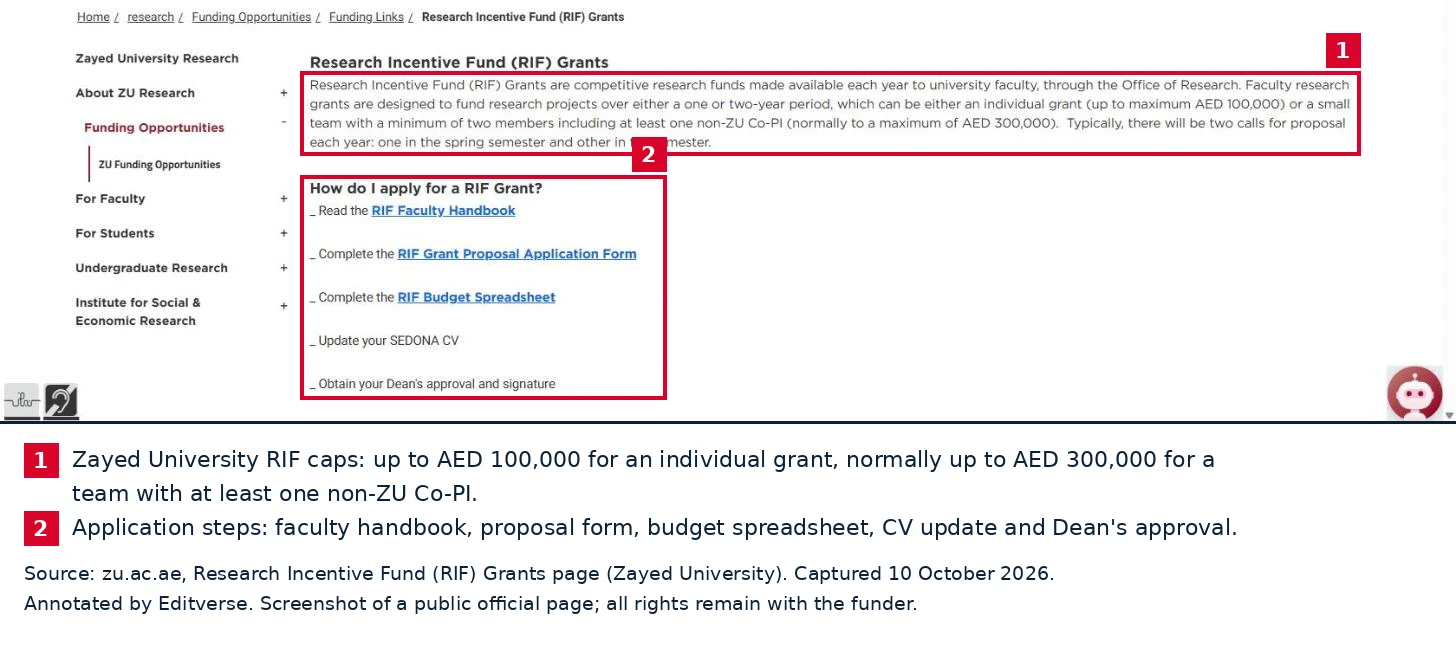
What it funds. The Research Incentive Fund (RIF) makes competitive funds available each year to university faculty through the Office of Research. Individual grants go up to AED 100,000. Team grants are normally capped at AED 300,000. Projects run for one or two years. Zayed University’s wider funding page also lists Start-Up grants for new faculty in their first year of a first contract, the Provost’s Research Fellowship Award, Research Clusters, an Instructor Research Grant, a Short-Term Grant, an Emirati Research Grant, a UAEU-ZU joint grant launched in 2021, and Special Projects tied to institutional or national priorities.
Who can apply and when. RIF is the most fully specified of the university UAE research grants in this guide. Faculty may apply individually or as a team, and team applications need a minimum of two members including at least one non-ZU Co-PI. The page describes two calls a year, typically in the spring and fall semesters. Proposals go through the faculty member’s Dean, who submits endorsed proposals to the Office of Research. Direct faculty submissions are not accepted.
What you must submit and report. Applicants review the RIF Faculty Handbook, complete the proposal form and budget spreadsheet, update their CV on the university’s system, and obtain the Dean’s approval and signature. Principal Investigators then file a progress report every six months, plus a final report at completion. The page states no evaluation criteria.
Mistakes proposals make. The avoidable ones are procedural, namely submitting outside the Dean’s route, forming a team without the required non-ZU Co-PI, and letting the CV lapse. The deeper mistake is writing a two-year plan with no output due at the first six-month report. Reviewers cannot score a plan they cannot track, and you will have to report against it anyway.
Al Jalila Foundation Seed Grants for UAE Research
What it funds. The Al Jalila Foundation’s Seed Grants support health and medicine research with a focus on basic and translational work, favouring projects that could lead to larger studies or wider impact. Funding is typically provided for up to two years, and the page gives no per-grant figure. It reports that since 2014 the Foundation has awarded 112 Seed Grants to 14 UAE research institutions, with a total value of AED 31 million. Priority diseases include diabetes, obesity, cardiovascular diseases, cancer, mental health and communicable diseases, and the page says the list is not exhaustive.
Who can apply. Among UAE research grants for biomedical pilots, this one is open to qualified UAE-based researchers, nationals or residents, with an institutional affiliation. Applicants with a strong publication record are preferred.
How it is judged. A Scientific Advisory Committee assesses each application with the support of international peer reviewers who are experts in the topic, and proposals must meet minimum scientific requirements to be funded. Applications run through the Foundation’s Grant Management System. On 10 October 2026 the page said applications were closed for 2025/2026.
Mistakes proposals make. A seed grant is meant to seed something, so a proposal that never says what larger study it will unlock misreads the scheme. Preliminary data that cannot support the follow-on plan, a priority disease that is only loosely connected to the aims, and an unedited publication record all weaken the file. Our guide to writing specific aims is a useful starting point for the follow-on argument.
Sharjah and Other Emirate-Level UAE Research Grants
The University of Sharjah’s Research Funding Department administers research project funds at both the pre-award and post-award stages for faculty, students, research groups and centres. Its department page lists forms such as a research funding application, student research project support, a faculty development grant, a visiting scholar application, and a research project extension request, but it gives no amounts, eligibility rules or deadlines. The most useful official document we found is its external grants procedure, and it matters for any grant you win anywhere in the UAE, because it shows how much post-award friction to budget for.
The procedure requires Research Ethics Committee and Animal Care and Use Committee approval where humans or animals are involved. Budget changes must be approved by the funder and in writing by the VCRGS office. Equipment bought for under AED 5,000 can be purchased directly by the researcher, equipment from AED 5,001 up to AED 50,000 needs prior approval and then goes through Procurement, and larger purchases need a further senior approval. Publication costs are generally payable from the grant unless the sponsor says otherwise.
What this guide leaves out. We could not verify a current, open, competitive research call from the federal Ministry of Higher Education and Scientific Research on an official page, so we have not listed one. We also found one university-run collaborative award whose only available page was a 2018 call, and we excluded it for the same reason. If you know of a scheme that belongs here, check its official page for a dated, current call before relying on it.
Which of the UAE Research Grants Fits Your Career Stage
This is the decision rule we use when a researcher in the UAE asks where to start. Match your situation to the row to shortlist UAE research grants, then apply the three-question test underneath.
| Your situation | Start here | Why |
|---|---|---|
| New hire, first year at a UAE university | UAEU Research Start-up Competition, Khalifa Faculty Start-Ups, Zayed Start-Up grants | Each is built for recent hires, so competition is limited to your cohort |
| Abu Dhabi faculty within six years of a PhD | ASPIRE AYIA when a cycle is announced, your own university fund meanwhile | AYIA is the only scheme here defined by years since the degree |
| Established faculty, one team, one to three years | UPAR (UAEU), RIF (Zayed), RIG (Khalifa), AARE when open | Duration and caps match a single-team project |
| Clinician or provider licensed in Abu Dhabi | DoH Abu Dhabi, DOH-Ma’an grant | Eligibility is anchored to Abu Dhabi licensure |
| Biomedical researcher in any emirate, pilot stage | Al Jalila Foundation Seed Grants | Open to UAE-based researchers and aimed at projects that can grow |
| Two institutions already working together | UAEU-Zayed and UAEU-Khalifa joint programmes, Khalifa joint calls, Zayed team RIF | Each rewards or requires a second institution |
| Undergraduate or student team with a supervisor | UAEU SURE Plus, UAEU SDG Research Program | Both are structured around student-led work |
The three-question test
- Does an eligibility gate exclude you outright, such as Abu Dhabi licensure, a PhD within six years, or a required non-ZU Co-PI? If yes, drop the scheme today.
- Can you state your aims in one sentence that uses the funder’s own priority wording? If not, you are forcing the fit.
- Can the outputs be produced inside the funded duration and the cap? If not, change the scheme or the plan.
Worked example. Suppose a Zayed University group needs AED 250,000 over two years. An individual RIF award tops out at AED 100,000, so the group needs the team route, which is normally capped at AED 300,000 and requires a non-ZU Co-PI. A request near AED 1,000,000 would belong to a different scheme with different expectations. Sizing the ask to the real need, then choosing the scheme whose cap and duration contain it, is faster than writing a large plan and shrinking it later. For the budget side, see our guide to research grant budgeting.
Aligning UAE Research Grants Outputs With Journal Publication and Acknowledgment
This is the part most proposals leave vague, and the part funders read most closely at the reporting stage. UAE research grants produce papers only if the proposal commits to specific, reportable outputs from the start. The checklist below is Editverse’s working method, not a funder rule, and it assumes you will confirm each funder’s own reporting requirements.
- Name the target journal tier in the proposal. Choose it with our guide to journal selection before you write the output plan, so the promised papers are realistic for the data you will have.
- Match outputs to the reporting rhythm. Zayed’s RIF asks for a progress report every six months, so schedule a dated deliverable before each report, such as an approved protocol, a locked dataset, or a submitted manuscript.
- Budget the publication costs. Sharjah’s procedure treats publication costs as generally payable from a grant unless the sponsor says otherwise. Check your own funder’s rule and write the line item.
- Get ethics approval before enrolment. The DoH evaluation includes an IRB committee, and Sharjah requires committee approval for human and animal work. Journals will ask for the approval number too.
- Write the acknowledgment from the award letter. None of the pages we checked specifies acknowledgment wording, so copy the funder name and grant number exactly as your agreement gives them. Our guide to funding acknowledgments covers the structure, though it was written for Qatar requirements and your funder’s text controls.
- Plan the data record. A short data management plan and a dissemination plan make the output section checkable.
An illustrative 24-month map for a two-year award with six-monthly reporting looks like this. Months 1 to 6 cover ethics approval, protocol and a registered analysis plan. Months 7 to 12 cover data collection and a first manuscript draft. Months 13 to 18 cover submission and the first revision. Months 19 to 24 cover a second paper, the final report and the follow-on proposal. The pattern is a planning template to adapt, and no funder in this guide mandates it.
Mistakes That Sink UAE Research Grants Proposals
- Using stale numbers. Caps and durations in old announcements are not a live call. Reconfirm before you size a budget.
- Missing a hard eligibility gate. Abu Dhabi licensure, years since PhD, and a required external Co-PI are checked before the science is read.
- Writing for a generic reviewer. Each funder above publishes its own priorities. A proposal that does not use them reads as recycled.
- Promising outputs with no dates. Papers, trained students and partners need a month attached.
- Ignoring the route. Zayed proposals go through the Dean, UAEU through its forms portal, and DoH through its online platform. A good proposal sent the wrong way is a failed proposal.
- Weak English at the point of review. Reviewers of UAE research grants often sit outside your subfield and decide on clarity. A language edit before the internal deadline costs little compared with a lost cycle. For a detailed worked model of proposal structure, see our guide to writing an NIH grant proposal and our overview of successful research grant writing.
Professional Services for UAE Research Grants Proposals
Editverse’s grant services were built around NIH, NSF and Horizon Europe style review, and the product pages list those agencies rather than UAE funders. The review criteria for UAE research grants overlap with that model, and the Full Grant Proposal Development page says the same process applies to other national agencies and asks you to confirm the agency on a free strategy call. Send the call document for your UAE scheme so the audit is run against the criteria you will actually be scored on. We cannot guarantee any funding outcome, and neither can any honest service.
Complete draft
$1,190
Grant Proposal Editing and Review. Audit against your funder’s review criteria, narrative strengthening, compliance check, one revision round. 7 to 10 business days.
Declined proposal
$1,690
Grant Resubmission Support. Reviewer critique analysis, response strategy and targeted rewrites, two revision rounds. 2 to 3 weeks.
Idea or aims only
$3,500
Full Grant Proposal Development. The complete proposal written end to end by a published researcher, two revision rounds. 2 to 4 weeks.
After the award
$550
Advanced Editing Package for the papers your grant must produce. Substantive editing, language polishing, reference checks, one free revision round. 7 to 10 business days.
Not sure which service fits? Request a free quote and strategy call and we will confirm scope before you commit. You can also read more about our grant proposal development services.
Free Research Tools from Editverse
- GraphPro: build publication-ready charts, 25 types, with built-in t-test, ANOVA, correlation, and chi-square p-values. Free, no signup.
- StatPro: free statistical calculators and a test-selector tool covering group comparisons, categorical outcomes, time-to-event analysis, and diagnostic accuracy.
- Flowchart Pro: generate PRISMA 2020, PRISMA-ScR, CONSORT, STROBE, STARD, MOOSE, and ARRIVE flow diagrams directly in your browser.
Conclusion
The practical route through UAE research grants starts with your institution, not with the biggest award. Pick the scheme from among the UAE research grants that your eligibility actually allows, size the request to a duration and cap that are published, and write outputs with dates and journals attached. Reconfirm every figure on the funder’s page, because the Department of Health, ASPIRE, the universities and the Al Jalila Foundation each change their terms on their own schedule. If a page shows a closed cycle, use the gap to secure the partner, the ethics approval and the draft. The proposals that reach review in good shape tend to be the ones that started before the call opened.
Sources
These are the official pages behind every figure on the UAE research grants above. All were accessed on 10 October 2026. Check each page for the current cycle before you rely on any figure.
- Department of Health Abu Dhabi, Abu Dhabi Health Research and Innovation Grant. https://www.doh.gov.ae/en/research/Abu-Dhabi-Health-Research-and-Innovation-Grant
- Department of Health Abu Dhabi, The 2026 Healthcare Research and Innovation Fund. https://www.doh.gov.ae/en/news/the-2026-healthcare-research-and-innovation-fund
- ASPIRE, ASPIRE Award for Research Excellence (AARE). https://www.aspireuae.ae/programmes/aspire-award-research-excellence-aare
- ASPIRE, AARE and AYIA call announcement (2021). https://www.aspireuae.ae/news/aspire-award-research-excellence-aare-aspire-young-investigator-award-ayia-announce-opening
- United Arab Emirates University, Research Grants Opportunities. https://uaeu.ac.ae/en/research/research-and-sponsored-projects-office/research-grants-opportunities.shtml
- Khalifa University, University Sponsored Research funding programs. https://www.ku.ac.ae/office-of-research-services/university-sponsored-research/funding-programs
- Zayed University, Research Incentive Fund (RIF) Grants. https://zu.ac.ae/main/en/research/funding_opportunities/_funding_links/rif
- Al Jalila Foundation, Seed Grants. https://aljalilafoundation.ae/en/our-program/discovery/seed-grants/
- University of Sharjah, External Grants Procedures. https://www.sharjah.ac.ae/Research/External-Grants-Procedures