
Anyone comparing a DNP vs PhD in nursing before committing years of a working nursing career to one is usually asking the wrong first question. Which degree sounds more prestigious matters less than which final deliverable you actually want to produce, because that single difference, a practice project built to improve real patient outcomes versus a dissertation built to generate new nursing knowledge, is where the two doctorates genuinely diverge.
A PhD in nursing trains researchers who design studies and build evidence. A DNP trains practice leaders who translate that evidence into better care at the bedside, in a clinic, or across a health system. That split drives nearly every practical difference between the two paths, including a word-choice detail nearly every comparison article glosses over, that the DNP’s culminating work is never actually called a dissertation.
Real program data, official accreditation figures, and the patterns seen most often when nursing doctoral candidates stall partway through all point the same direction. Candidates already committed to the DNP path who want to know which stage of support fits where they are can jump straight to matching support to your path.
On this page
- 1. The short answer
- 2. What actually changes: clinical practice vs original research
- 3. Why a DNP project is not a dissertation
- 4. Timeline and completion reality
- 5. Cost and career outcomes
- 6. Where DNP and PhD candidates actually get stuck
- 7. Matching support to your path
- 8. Frequently asked questions
- 9. The bottom line
1. The Short Answer
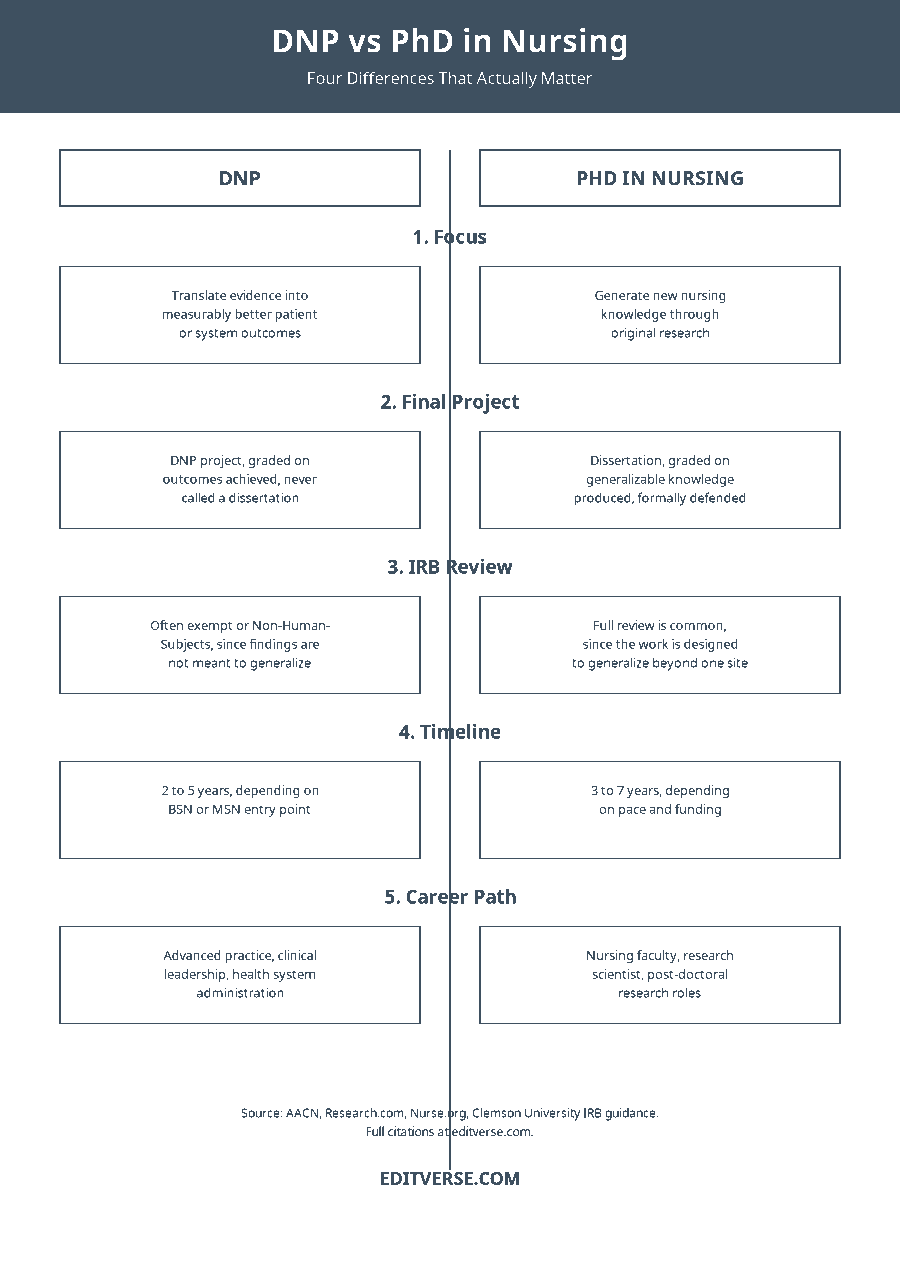
A PhD in nursing is judged on whether it generates new nursing knowledge. A DNP is judged on whether it translates existing evidence into a measurable improvement inside a real clinical or organizational setting. Everything else in this guide traces back to that split. Compared side by side on the dimensions that actually affect a candidate’s day-to-day experience, the two paths look like this.
| Dimension | DNP | PhD in Nursing |
|---|---|---|
| Primary goal | Translate evidence into improved patient or system outcomes | Generate new nursing knowledge through original research |
| Culminating work | DNP project, sometimes called a scholarly project or capstone, never a dissertation | Dissertation based on original research, formally defended |
| Typical length | 2 to 5 years depending on entry point (BSN or MSN) | 3 to 7 years depending on pace |
| Typical entry point | BSN or MSN, both common nationally | BSN or MSN, plus a research-interest statement |
| Typical tuition | Roughly $20,000 to $60,000 total | Commonly reported in the $40,000 to $90,000 range |
| Common destination | Advanced practice, nursing leadership, health system administration | Nursing faculty, research scientist, post-doctoral research roles |
Sources: Research.com program and tuition analysis; Nurse.org. Figures are reported ranges from these sources, not universal guarantees; individual programs vary, and tuition in particular should be confirmed directly with the school.
2. What Actually Changes: Clinical Practice vs Original Research
Every nursing school explains the DNP and the PhD slightly differently, but the underlying split is remarkably consistent once the marketing language is stripped out. The American Association of Colleges of Nursing, the accrediting body that sets the national standard here, describes DNP programs as preparing “nurse leaders at the highest level of nursing practice to improve patient outcomes and translate research into practice,” positioning the degree as “an alternative to research-focused doctoral programs.” UCSF School of Nursing draws the same line from the PhD side, calling it “a research doctoral degree” that prepares “nurse leaders for careers in scientific research,” while the DNP is a “practice doctoral degree” built around applying and translating research into practice.
That difference shows up in the starting question itself before a single section gets written. A PhD candidate typically starts from a gap in nursing science. A DNP candidate typically starts from a real problem inside their own unit, clinic, or health system, then looks for the evidence base that already exists to solve it. Neither path is easier because of this framing. A DNP project still needs a defensible methodology, real outcome data, and a committee that has to be convinced the results are valid, not merely well-intentioned. What changes is what the finished work is trying to prove.
In Simple Words
A PhD in nursing proves you can generate new nursing knowledge. A DNP proves you can take nursing knowledge that already exists and use it to make care measurably better somewhere specific. Same rigor, different finish line.
AACN’s own 2025 data shows how much the DNP has grown as a credential built around that practice audience specifically, reporting 452 schools nationally offering a DNP, spread across 322 post-baccalaureate (BSN-to-DNP) programs, 414 post-master’s (MSN-to-DNP) programs, and 7 entry-level programs for candidates entering nursing from another bachelor’s field, with many schools running more than one pathway at once. That range of entry points matters because it confirms something worth correcting up front, that a DNP is not exclusively a next step after an MSN. Working nurses coming straight from a BSN are, if anything, the larger national pathway.
3. Why a DNP Project Is Not a Dissertation
This is the detail most comparison articles blur, and it is worth being precise about because the word choice reflects a real, substantive difference rather than a stylistic one. Across every nursing program checked for this guide, from the University of Illinois Chicago to the University of Maryland to the University of Kentucky, the DNP’s final deliverable is consistently called a DNP project, sometimes a scholarly project or capstone project depending on the institution, and it is never called a dissertation. The University of Maryland School of Nursing draws the line so clearly it titles the relevant page “Dissertations and DNP Projects,” treating the two as distinct, parallel categories rather than variations on the same thing. The University of Illinois Chicago is just as direct, listing “no dissertation requirement” under the DNP column and “requires a dissertation” under the PhD column of its own comparison page.
The reason the distinction is more than semantic shows up clearly in how each type of work gets classified for research ethics purposes. Clemson University’s Office of Research Compliance defines research, for Institutional Review Board purposes, as “a systematic investigation… designed to develop or contribute to generalizable knowledge.” Its DNP-specific IRB guidance then states plainly that a DNP project is “measured according to contribution to improved outcomes rather than its contribution to generalizable knowledge,” meaning a well-run quality improvement project confined to one unit or one organization is frequently classified as exempt from full IRB review, or receives a formal Non-Human-Subjects Research determination, precisely because it is not designed to produce findings meant to generalize beyond that setting. A PhD dissertation, built from the ground up to generate knowledge that does generalize, is far more likely to require full IRB review whenever it involves human subjects.
That distinction shapes what a DNP committee actually looks like. The University of Kentucky College of Nursing’s published DNP Project Guidelines specify a committee of two doctorally-prepared faculty members, one serving as chair, plus a doctorally-prepared clinical mentor from the practice setting itself, or a fourth doctoral committee member with clinical expertise if no mentor is available on site. The final defense is a public presentation, roughly 20 minutes of student presentation followed by 10 minutes of committee questions, with about an hour total set aside once private committee deliberation is included. A DNP project is graded on outcomes achieved in a real setting with a practice-based reviewer in the room, not purely on theoretical contribution.
4. Timeline and Completion Reality
Program brochures quote the shortest realistic timeline. Actual variation by entry point and pace tells a more useful story for anyone budgeting years against a working nursing career.
DNP timelines split cleanly by entry point. Nurse.org’s program comparison reports MSN-to-DNP candidates typically finishing in about 2 years, while BSN-to-DNP candidates, who are absorbing graduate-level coursework the MSN-to-DNP group already completed, typically need 3 to 4 years. PhD timelines vary more by pace than by entry point, with the same source citing a minimum of 3 years full-time but noting that most candidates actually complete the degree in 5 to 7 years once dissertation research, data collection, and a full-time job or clinical role are all competing for the same hours. A separate comparison from the University of Illinois Chicago puts DNP completion at 3 to 5 years and PhD completion at 4 to 5 years, a narrower spread than Nurse.org’s, which is a useful reminder that these are program-level estimates, not universal guarantees, and the honest range across sources for a PhD in nursing runs roughly 3 to 7 years depending on pace.
The pattern underneath both numbers is the same one that shows up in DBA vs PhD dissertation timelines for business doctorates, that a practice-focused doctorate with a narrower, outcomes-based final project tends to move faster than a research doctorate whose dissertation has to clear a higher generalizability bar before a committee will sign off. Neither path is immune to delay. Working nurses carrying a full clinical schedule alongside either degree lose momentum most often not on the writing itself but on data analysis, since outcome measurement and statistical work are the pieces most easily deprioritized during a demanding shift rotation and the hardest to pick back up cold months later.
5. Cost and Career Outcomes
Research.com’s tuition analysis reports DNP programs running roughly $20,000 to $60,000 total, averaging around $40,000. The same analysis reports PhD programs commonly falling between $40,000 and $90,000, though its own headline average figure for the PhD side did not reconcile cleanly against that stated range, so this guide reports the range rather than a single average and recommends confirming exact tuition directly with any specific program before budgeting against it.
Career compensation is where using the best-sourced figure available matters most, since different sites report meaningfully different numbers for the same roles. For DNP-track compensation, Research.com and Nurse.org independently cite the same ZipRecruiter-sourced range of $91,134 to $128,851 for DNP-holders broadly, while nurse practitioners specifically, the most common DNP-track destination, carry a median annual salary of $129,210 per the Bureau of Labor Statistics’ May 2024 data, cited by Nurse.org. On the PhD side, nursing faculty compensation shows a similar spread across sources, $77,440 from Research.com against $86,530 from the BLS-sourced figure Nurse.org cites for May 2024, a case where the explicitly BLS-attributed number is the safer one to anchor on. Nurse researchers specifically, per Payscale data cited by both sites, average around $81,500.
Grand Canyon University’s comparison, citing Bureau of Labor Statistics data, projects roles across nurse practitioners, nurse anesthetists, and nurse midwives, the cluster of advanced-practice roles a DNP most directly feeds, to grow by about 45% and add roughly 121,400 jobs. That growth rate sits well above typical projections for research-faculty and academic-research roles, the more common PhD destination, where hiring tracks the slower pace of academic budget cycles rather than clinical demand.
6. Where DNP and PhD Candidates Actually Get Stuck
The IRB distinction covered above is not just an ethics-office technicality. It is the single most common source of a stalled DNP project. Candidates who scope their quality improvement project as if it needs to prove something generalizable, rather than simply demonstrating a measurable improvement in one setting, end up building a study design that is more complicated than their committee actually requires, then get sent back to rescope it once a methodologist points out the mismatch. The fix is almost always to narrow the project back to its practice-improvement core, not to make the analysis more sophisticated.
A second pattern shows up on the data side specifically. DNP projects live or die on whether the outcome measurement is credible, a pre- and post-intervention comparison, a control or comparison unit where feasible, and analysis appropriate to a quality improvement design (commonly PDSA-cycle tracking, run charts, or straightforward pre/post statistical comparison) rather than the more elaborate inferential methods a PhD dissertation might require. Reaching for statistical methods that outpace the outcome-measurement design, or under-measuring baseline data before an intervention starts, are the two data missteps that most often force a DNP project back for rework. Editverse’s own DNP-focused editing work is built specifically around that gap, pairing a nursing-background editor with dedicated support for evidence-based practice methodology, quality improvement frameworks like PDSA, Lean, and Six Sigma, and clinical outcome analysis, so the measurement plan is sound before implementation starts rather than after a committee flags it.
On the PhD side, the more familiar research-doctorate pattern applies, that a dissertation chapter rejected once by committee is usually a genuine clarity issue, while the same chapter rejected twice signals a structural misalignment between the research question, the methodology, and the theoretical framework wrapped around it, the same failure mode covered in more depth in DBA vs PhD dissertation for business doctorates. No amount of sentence-level editing fixes a second rejection driven by that kind of misalignment.
7. Matching Support to Your Path
Where Editverse fits: for DNP projects and clinical dissertations, our medical and clinical dissertation help page covers the DNP completion package, reporting-guideline checks and biostatistics support.
Candidates on the DNP path who want one engagement to cover the whole project, from evidence-based practice methodology through defense, are exactly who Editverse’s DNP Completion Package is built for.
DNP Completion Package · $5,800
6 Months, Full DNP Project Support
A dedicated editor with nursing and healthcare background, full DNP project editing across every section, evidence-based practice methodology support, quality improvement framework guidance (PDSA, Lean, Six Sigma), clinical outcome analysis, committee response assistance, and two mock defense sessions, scheduled around clinical shift work.
Not every candidate needs the full six-month engagement. If steady progress already exists and only one specific piece is missing, these sit alongside the package above and can be booked individually.
- Dissertation Statistical Analysis (SPSS, R, STATA), for outcome measurement and pre/post analysis that has to hold up under committee scrutiny
- Dissertation Chapter Editing, for a single section that needs to pass committee on the next round
- Literature Review Support, for tightening the evidence base a DNP project has to stand on
- Committee Response Package, for turning around revisions after a rejected round without losing the structural thread
- Dissertation Coaching Session, for a single strategy conversation before deciding on a full package
- Defense Preparation Package, for candidates approaching the final presentation without a broader engagement in place
Every service on this list, along with the DNP Completion Package above, lives in Editverse’s Dissertation Services category, alongside equivalent completion packages for candidates pursuing a different professional doctorate, including the DBA.
8. Frequently Asked Questions
Is a DNP a real doctorate, or is it easier than a PhD?
A DNP is a terminal practice doctorate, not a lesser credential, and the rigor sits in a different place than a PhD’s. A DNP committee scrutinizes whether the project’s outcome measurement is sound and the improvement is real and sustainable, the same seriousness a PhD committee applies to a dissertation, aimed at a practice question rather than a generalizable research question.
Can a DNP graduate become a nursing professor?
Some do, particularly in clinical or practice-focused teaching tracks, but research-intensive faculty hiring still leans toward PhD holders whose training centers on generating publishable research. A DNP is a stronger fit for candidates aiming at advanced practice, clinical leadership, or administrative roles where the credential opens doors without requiring an academic research career.
Does a DNP project need IRB approval?
Often not in the full sense. A DNP project framed as quality improvement, confined to one practice setting and measured by outcomes rather than generalizable findings, frequently qualifies as IRB-exempt or receives a Non-Human-Subjects Research determination instead. Confirm the classification with your program’s IRB or research compliance office early, since scoping the project incorrectly is one of the more common causes of delay.
How many people sit on a DNP project committee?
A common structure is two doctorally-prepared faculty members, one as chair, plus a doctorally-prepared clinical mentor from the practice site, or a fourth doctoral committee member with clinical expertise when no site mentor is available. Committee composition varies by program, so check your own handbook rather than assuming this structure applies everywhere.
Can I enter a DNP program straight from a BSN, or do I need an MSN first?
Either path is common nationally. AACN’s 2025 data counts 322 post-baccalaureate (BSN-to-DNP) programs and 414 post-master’s (MSN-to-DNP) programs across 452 DNP-granting schools, with a small number of entry-level programs also available for candidates entering nursing from another field. BSN-to-DNP is not a niche option; it is close to as common as the MSN-to-DNP route.
Can I switch from a DNP to a PhD partway through, or the reverse?
Rarely, and not without effectively restarting the culminating project. Because a DNP project and a PhD dissertation are evaluated against fundamentally different standards, outcome improvement versus generalizable knowledge, a project scoped for one rarely converts cleanly to the other. Deciding between them carefully up front is worth the extra research time, since reversing course later is expensive.
Free Research Tools from Editverse
- GraphPro: build publication-ready charts, 25 types, with built-in t-test, ANOVA, correlation, and chi-square p-values. Free, no signup.
- StatPro: free statistical calculators and a test-selector tool covering group comparisons, categorical outcomes, time-to-event analysis, and diagnostic accuracy.
- Flowchart Pro: generate PRISMA 2020, PRISMA-ScR, CONSORT, STROBE, STARD, MOOSE, and ARRIVE flow diagrams directly in your browser.
9. The Bottom Line
A DNP and a PhD in nursing are both legitimate terminal doctorates, evaluated by real committees, held to real standards, just different ones. Choosing honestly between them means asking which final deliverable you actually want to produce, a project that measurably improves care somewhere specific, or a dissertation that adds new knowledge to the field. Everything else, the timeline, the cost, the committee structure, the career path afterward, follows from that one choice.
If that choice already points to the DNP and the project itself is where momentum has stalled, the support options above are the fastest way to find the right level of help for where you are right now.
Stuck on a DNP project section?
Start with an editor who already knows the difference between a quality improvement project and a dissertation, and won’t scope your project like the wrong one.