Most stalled DBA candidates are not stuck because they cannot write. They are stuck because they chose a DBA dissertation topic that could not survive committee review in the first place, usually a topic borrowed from a listicle rather than built from a real organizational problem. A topic that reads well as a headline but has no organization behind it, no data anyone can actually access, and no clear applied problem tends to bounce back from the chair, then the committee, then the prospectus review, sometimes more than once before anyone names why.
The fix is not a longer list of ideas. Editverse’s own pattern across DBA proposal work lines up with what Westcliff University’s Doctoral Writing Center tells candidates directly, that a topic exists to answer one question first, whether the study is “answerable” within the resources and time a candidate actually has. Everything else, the functional area, the industry, the theory, comes after that test is passed. This guide walks through the criteria committees actually use, why topics get sent back, a real bank of properly scoped examples across functional areas, and a worked transformation from a vague idea into a problem statement a committee will approve on the first pass.
On this page
- 1. What makes a DBA topic committee-approvable
- 2. Why DBA topics get rejected or sent back for rework
- 3. DBA dissertation topics by functional area
- 4. From vague idea to approvable problem statement
- 5. How topic choice shapes your timeline and data access
- 6. Common mistakes to avoid
- 7. Matching support to your stage
- 8. Frequently asked questions
- 9. The bottom line
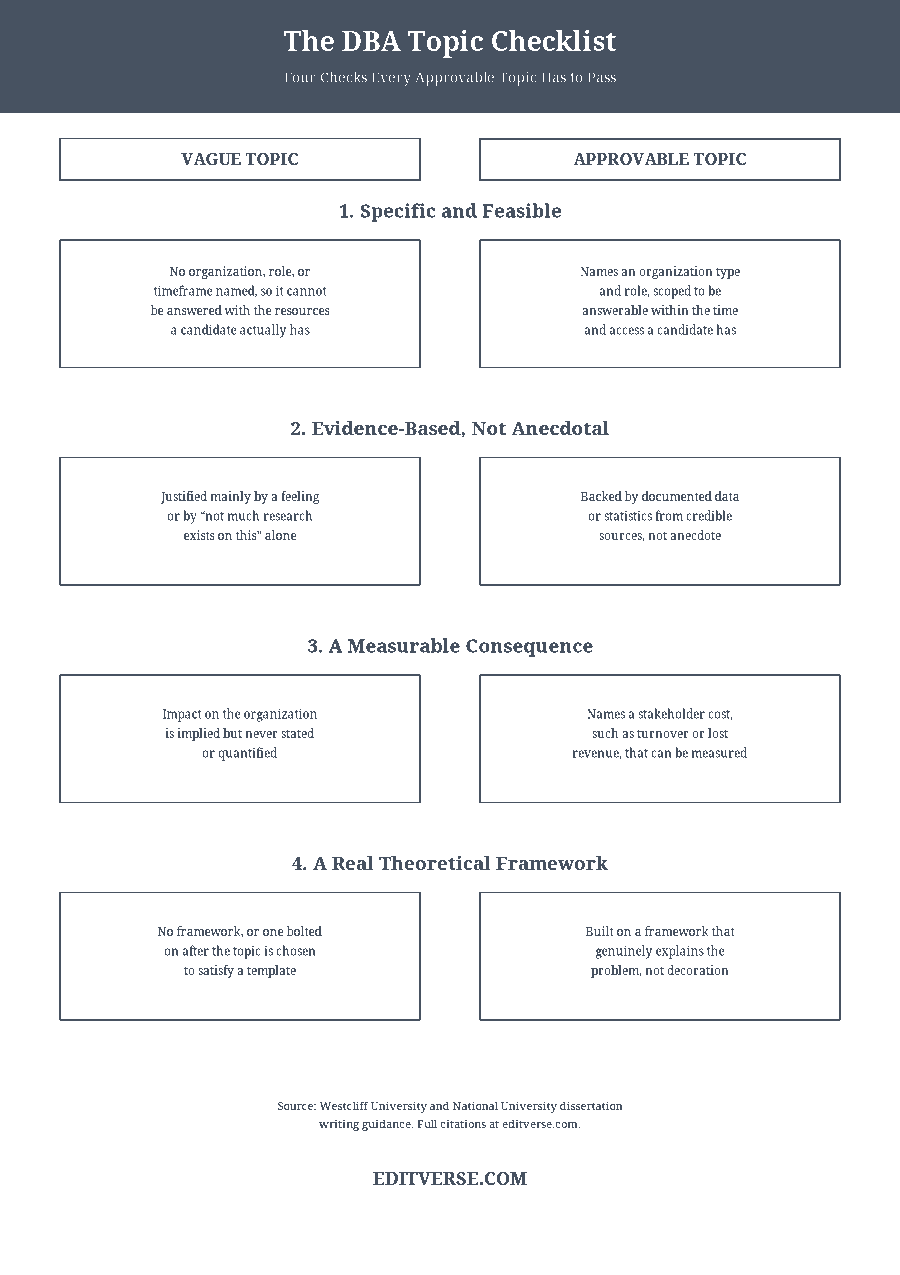
1. What Makes a DBA Topic Committee-Approvable
Every DBA program phrases its topic requirements slightly differently, but the underlying test is consistent once the paperwork language is stripped out. Westcliff University’s Doctoral Writing Center describes the prospectus, the document a committee uses to “verify the viability of a study,” as resting on four pillars. The study has to be feasible within real resources and time, it has to carry genuine significance and contribution to the field, it needs a theoretical or conceptual framework underneath it, and the problem itself, what is being researched, why it matters, and what the research is built on, has to be stated clearly. Miss any one of the four and the topic is not ready yet, no matter how interesting it sounds.
National University’s guidance on the problem statement component sharpens the same test into something a candidate can check against their own draft before a chair ever sees it. A defensible problem statement specifies the problem with citations, provides evidence the problem actually exists rather than relying on anecdote, states the consequences of leaving it unsolved (consequences that can be measured carry more weight than ones that cannot), and names what remains unknown about it. One line from that guidance is worth keeping in view while drafting a topic, the observation that “real-life means that a problem exists regardless of whether research is conducted or not.” A topic justified mainly by “there isn’t much research on this” fails that test immediately, because a literature gap is not the same thing as an organizational problem.
In Simple Words
A committee is not asking whether your topic is interesting. It is asking whether the problem is real, whether you can actually get the data to study it, whether existing theory gives you a lens to interpret it, and whether you can say all of that in one clear paragraph. Four checks, not one.
Put together, that gives a four-part test worth running against any topic before it goes anywhere near a proposal draft, checking whether it is specific enough to be answerable in the time available, whether it is evidence-based rather than anecdotal, whether it points to a measurable consequence for a real organization, and whether it sits on a named theoretical framework rather than free-floating curiosity. The DBA dissertation topics later in this guide are built to pass all four; the functional-area examples name the organization type, the variable being studied, and the consequence in the same sentence, on purpose.
2. Why DBA Topics Get Rejected or Sent Back for Rework
Editors who work across DBA proposals tend to see the same handful of patterns behind a topic that gets sent back, and they rarely have anything to do with writing quality. The most common failure is scope, a topic framed at the level of an entire industry or a broad concept (“employee engagement,” “digital transformation,” “leadership effectiveness”) with no organization, role, or context attached to it. A committee cannot approve a study of a concept. It can approve a study of how a specific variable behaves inside a specific, accessible organizational setting.
The second pattern is a topic shaped like a PhD question wearing a DBA label. Grand Canyon University’s own comparison of the two degrees puts the distinction plainly, noting that PhD research is meant to extend, challenge, or generate scholarly knowledge, while DBA research is meant to apply academic theory to solve a local, organizational problem. If the underlying goal is to extend or test theory for its own sake, the committee will (correctly) ask why the candidate is not in the PhD track, a distinction covered in more depth in DBA vs PhD dissertation. A DBA topic has to apply existing theory to solve a problem a real organization is living with, not generate new theory for its own sake.
The third, and the one that causes the most expensive delay, is a topic chosen before data access is confirmed. Candidates sometimes fall in love with a research question that depends on data from a company that has not agreed to provide it, or that would require access no one has actually secured. That gap does not surface at the topic stage; it surfaces months later at the proposal or IRB stage, discussed in more detail in what a DBA dissertation proposal actually requires, and by then the rework costs far more than it would have at the topic stage. Repeated rejection of the same chapter over multiple rounds is almost never a writing problem by that point; it is a signal that the topic itself, the research question, the methodology, and the applied problem, stopped pointing in the same direction somewhere back at the start.
3. DBA Dissertation Topics by Functional Area
The examples below are built to the four-part test above on purpose, and each one names an organization type, a specific variable, and a real consequence in a single sentence. None of them is meant to be copied verbatim, a topic has to come from a problem the candidate can actually access, but each is meant to show what “specific enough to defend” looks like next to the vague version most candidates start with.
Strategy and Change Management
- Factors influencing post-merger integration success in mid-market manufacturing acquisitions
- Middle-manager change-readiness and its effect on ERP implementation outcomes in regional healthcare systems
- Strategic agility and operational survival among family-owned retail businesses during supply disruption
Leadership and Human Capital
- Servant leadership practices and voluntary turnover among frontline healthcare staff
- Remote work policy design and psychological safety in distributed engineering teams
- Succession planning practices and leadership continuity in second-generation family businesses
Marketing and Customer Strategy
- Customer data platform adoption and personalization return on investment in mid-size B2B firms
- Brand trust recovery strategies following data-breach disclosure at regional financial institutions
- Loyalty program redesign and repeat-purchase behavior in multi-location retail chains
Finance and Risk
- Enterprise risk management maturity and capital allocation decisions in community banks
- The effect of ESG reporting requirements on cost of capital for mid-cap manufacturers
- Working-capital management practices and liquidity resilience in family-owned distributors
Operations and Supply Chain
- Supplier diversification strategies and resilience outcomes following single-source disruption
- Lean implementation barriers in unionized manufacturing environments
- Inventory forecasting accuracy and stockout costs in regional grocery distribution
Technology and Digital Transformation
- Factors predicting employee adoption of generative AI tools in professional services firms
- Legacy system modernization decision criteria among mid-size insurance carriers
- Cybersecurity investment prioritization and perceived risk among small-bank executive teams
Healthcare and Public-Sector Management
- Value-based care contract readiness among independent physician groups
- Budget reallocation decision patterns in municipal government following revenue shortfalls
- Staffing model redesign and patient-satisfaction outcomes in ambulatory surgical centers
Sources for topic-scoping criteria: Westcliff University Doctoral Writing Center; National University Problem Statement guide; representative topic categories cross-checked against SBS Swiss Business School.
4. From Vague Idea to Approvable Problem Statement
Most candidates do not start with a bad topic so much as an unfinished one. Running a single idea through the four-part test shows what “unfinished” actually looks like next to “ready.”
| Check | Vague Version: “Leadership and Employee Engagement” | Refined Version |
|---|---|---|
| Specific | No organization, role, or industry named | Named context: hourly employees, multi-site retail operations |
| Evidence-based | No stated evidence the problem exists anywhere specific | Anchored to above-industry-average attrition, a measurable fact |
| Consequence | Implied but never stated | Turnover cost to the organization, a measurable stakeholder impact |
| Theory/gap | Unclear what specifically is unknown | Isolates one variable, coaching frequency, rather than engagement broadly |
The refined version reads: “How does manager coaching frequency affect voluntary turnover among hourly employees at multi-site retail operations experiencing above-industry-average attrition?” Nothing about the underlying interest changed, leadership behavior and its effect on people still sits at the center of it, but the sentence now names an organization type, a measurable starting condition, a single isolated variable instead of a broad concept, and a consequence a real business cares about. That is the difference a committee is checking for, and it is almost always fixable in an afternoon once a candidate knows which four boxes still need checking.
5. How Topic Choice Shapes Your Timeline and Data Access
The topic a candidate settles on early does more than pass or fail a prospectus review. It sets the ceiling on how fast everything after it can move. A topic that depends on data from a single gatekeeper, one HR director, one hospital system, one regulator, carries real risk if that access is only informally agreed to rather than confirmed in writing before the proposal stage begins. Westcliff’s own program timeline places the prospectus in the second year, during a dedicated research course, precisely so that feasibility gets tested well before a candidate has sunk a full proposal’s worth of writing into an idea that cannot clear IRB or a data-use agreement later.
University of La Verne’s dissertation guidelines frame the same sequencing from the opposite direction, urging candidates to identify the problem to be resolved first and only then select the methodology that actually fits it, rather than picking a favorite method and searching for a topic to attach it to. Once a topic is set, DBA dissertation methodology covers exactly that next step, choosing between quantitative, qualitative, and mixed methods. A topic chosen with data access already confirmed, whether that is an employer willing to provide operational metrics, a professional network willing to complete a survey, or publicly available regulatory filings, removes the single biggest source of delay covered in DBA vs PhD dissertation, where candidates who started data collection before formal approval sometimes discover the committee wants a different analytical approach entirely.
6. Common Mistakes to Avoid
- Choosing a topic before confirming data access. Verify an organization, dataset, or survey population is actually reachable before the topic goes into a prospectus.
- Framing the problem as a literature gap instead of an organizational one. “Not much research exists on X” is not the same claim as “X is costing a real organization something measurable.”
- Picking a topic too close to a current employer’s sensitive data. Confidentiality concerns can quietly stall IRB approval or data-use agreements for months.
- Staying too broad to avoid narrowing choices too early. A topic that could apply to almost any organization in almost any industry is not specific enough for a committee to evaluate feasibility.
- Attaching the topic to a theoretical framework it does not actually fit. A framework bolted on after the fact, rather than genuinely explaining the problem, tends to surface as a weakness at the proposal defense.
7. Matching Support to Your Stage
Topic selection sits right at the start of the proposal stage, the same stretch covered in full in what a DBA dissertation proposal actually requires. Editverse’s DBA Completion Package comes in three tiers built around where a candidate is starting from.
Silver · $1,250
Proposal Stage
3 months of support for chapters 1 through 3, including a diagnostic pass on the topic itself before drafting begins, so the four approval checks are handled before a committee ever sees the document.
Gold · $3,475
Full Draft Stage
4 months covering full editing, methodology, statistics, literature review and committee response for candidates with an approved topic and proposal moving into a full draft.
Platinum · $6,500
To Defense
6 months, one dedicated editor, unlimited committee revision rounds, and two mock defenses for candidates who want a single engagement to carry them from topic through the final oral exam.
Not sure a DBA is the right degree before settling on a topic at all? DBA vs PhD dissertation covers that earlier decision, and a single Dissertation Coaching Session is available for candidates who want a topic stress-tested against the four checks above before committing to a full package. Already well past the topic stage and looking toward the finish line? DBA dissertation defense covers what that final checkpoint actually involves. Every service here lives in Editverse’s Dissertation Services category.
8. Frequently Asked Questions
How narrow does a DBA dissertation topic actually need to be?
Narrow enough that a specific organization type, a specific variable, and a specific measurable consequence all appear in a single sentence. “Leadership in healthcare” is not narrow enough. “Servant leadership practices and voluntary turnover among frontline staff at community hospitals” is.
Can I change my DBA dissertation topic after the prospectus is approved?
Usually yes, within reason. Most programs, Westcliff’s among them, explicitly note the prospectus is a starting point and the focus can evolve as research develops. A full pivot to an unrelated problem after proposal approval is a different matter and typically restarts the review clock.
Should I choose a DBA topic related to my current employer?
Often yes, since data access is usually easiest there, but confirm in writing that the organization will actually provide the data or survey access needed, and screen for confidentiality issues that could complicate IRB approval before the topic is finalized.
What is the difference between a DBA dissertation topic and a problem statement?
The topic is the general subject area. The problem statement is the specific, evidence-based, consequence-driven paragraph built from that topic, typically 250 to 300 words, that a committee formally evaluates. A good topic makes the problem statement almost write itself; a vague one makes every subsequent draft harder.
How long does it take to finalize a DBA dissertation topic?
Programs vary, but most build in a dedicated stretch, often a full course or term, specifically for this stage rather than expecting a topic to arrive fully formed. Rushing past it to start drafting chapters early is one of the more common causes of rework later.
Do I need primary data, or can secondary data support a DBA topic?
Both are common. What matters to a committee is that the data source, whether primary survey data, an organization’s operational records, or public regulatory filings, is confirmed as accessible before the topic is finalized, not assumed.
Free Research Tools from Editverse
- GraphPro: build publication-ready charts, 25 types, with built-in t-test, ANOVA, correlation, and chi-square p-values. Free, no signup.
- StatPro: free statistical calculators and a test-selector tool covering group comparisons, categorical outcomes, time-to-event analysis, and diagnostic accuracy.
- Flowchart Pro: generate PRISMA 2020, PRISMA-ScR, CONSORT, STROBE, STARD, MOOSE, and ARRIVE flow diagrams directly in your browser.
9. The Bottom Line
A DBA dissertation topic earns committee approval on four specific grounds, namely that it is narrow enough to be answerable, it is backed by real evidence rather than anecdote, it points to a consequence a real organization can measure, and it sits on a theoretical framework that actually explains it. Every topic in this guide, and every topic worth building a proposal around, passes that test before it passes anything else.
If a topic idea is close but not quite there yet, the fastest fix is usually not a new idea. It is running the current one through the four checks above and naming, specifically, which one it is still missing.
Not sure your DBA topic will survive committee review?
The week-one diagnostic built into every DBA Completion Package tier checks your topic against all four approval criteria before a single chapter gets drafted.