A DBA dissertation defense is not a formality tacked onto the end of the program. It is a separate, structured evaluation, typically 60 to 90 minutes and conducted over video conference, in which a committee that has already approved the written manuscript decides whether the candidate can defend it live, in real time, without the safety net of another editing pass. Programs vary in exactly how that hour unfolds, but every one of them is testing the same underlying thing: whether the person who wrote the dissertation actually owns the thinking behind it.
Candidates who have already cleared the proposal stage sometimes assume the final defense is a lighter version of the same checkpoint. It is not. The proposal-stage review tests whether a study is worth running. The final defense tests whether the candidate can stand behind what the study actually found, under direct questioning, with no advance notice of which finding a committee member decides to push on first.
Here is what actually happens on defense day, how four real DBA programs structure it differently, what the possible outcomes are, and how candidates prepare for a conversation they only get to have once. Already past the defense and looking for the earlier checkpoint instead? DBA dissertation proposal covers the chapters 1-3 review. Candidates ready for defense-stage support can jump straight to matching support to this stage.
On this page
- 1. The short answer
- 2. The defense you haven’t done yet
- 3. Defense day, start to finish
- 4. The possible outcomes, and why they’re not all the same
- 5. What your committee is actually testing
- 6. Public defense or private? Why DBA programs differ
- 7. How candidates actually prepare
- 8. Why dissertations get sent back
- 9. Matching support to this stage
- 10. Frequently asked questions
- 11. The bottom line
1. The Short Answer
A DBA dissertation defense is the final oral examination on the completed, five-chapter dissertation, conducted after the manuscript has already been approved in writing by the candidate’s committee. It is distinct from the proposal-stage checkpoint, sometimes called a preliminary defense or program review, that most programs require before a candidate is allowed to collect data. The final defense typically runs 60 to 90 minutes, happens over video conference rather than in person, and ends with a private committee deliberation that produces one of a small set of formal outcomes, ranging from an outright pass to a requirement to redo the defense entirely. Still deciding between a DBA and a PhD in the first place? DBA vs PhD dissertation covers that earlier decision, and DBA dissertation topics covers choosing a topic a committee will actually approve before any of this is relevant.
2. The Defense You Haven’t Done Yet
It is easy to conflate the two checkpoints a DBA dissertation passes through, because both involve a committee, a presentation, and a round of questions. They are not the same evaluation, and treating the second like a repeat of the first is a common source of misplaced confidence.
The proposal-stage checkpoint, covered in full in DBA dissertation proposal, tests chapters 1 through 3: the problem, the literature, and the proposed method. Its job is to catch a flawed or unanswerable research design before a candidate spends months collecting data against it. Johnson & Wales University’s DBA program does not even hold an oral defense at this stage. The completed proposal goes through a faculty Program Review instead, and the only oral defense in that program is reserved for the finished, five-chapter dissertation later.
That later defense, the one this article covers, evaluates a different thing entirely: not whether the study was worth running, but whether it was run correctly and whether the candidate can explain what it found under direct, live questioning. The literature review and methodology are no longer proposals to be evaluated on paper. They are decisions the candidate already made, with data already collected, and the committee’s job at this checkpoint is to test whether those decisions hold up out loud. A committee that approved a methodology on paper still gets to ask, in the room, why a candidate chose a regression model over a different one, what a lower-than-expected effect size actually means for the study’s conclusions, or how a stated limitation would change the findings if it were removed. Chapters 1 to 3 having already passed committee scrutiny once does not exempt them from being questioned again at defense, this time against the completed results rather than a plan.
3. Defense Day, Start to Finish
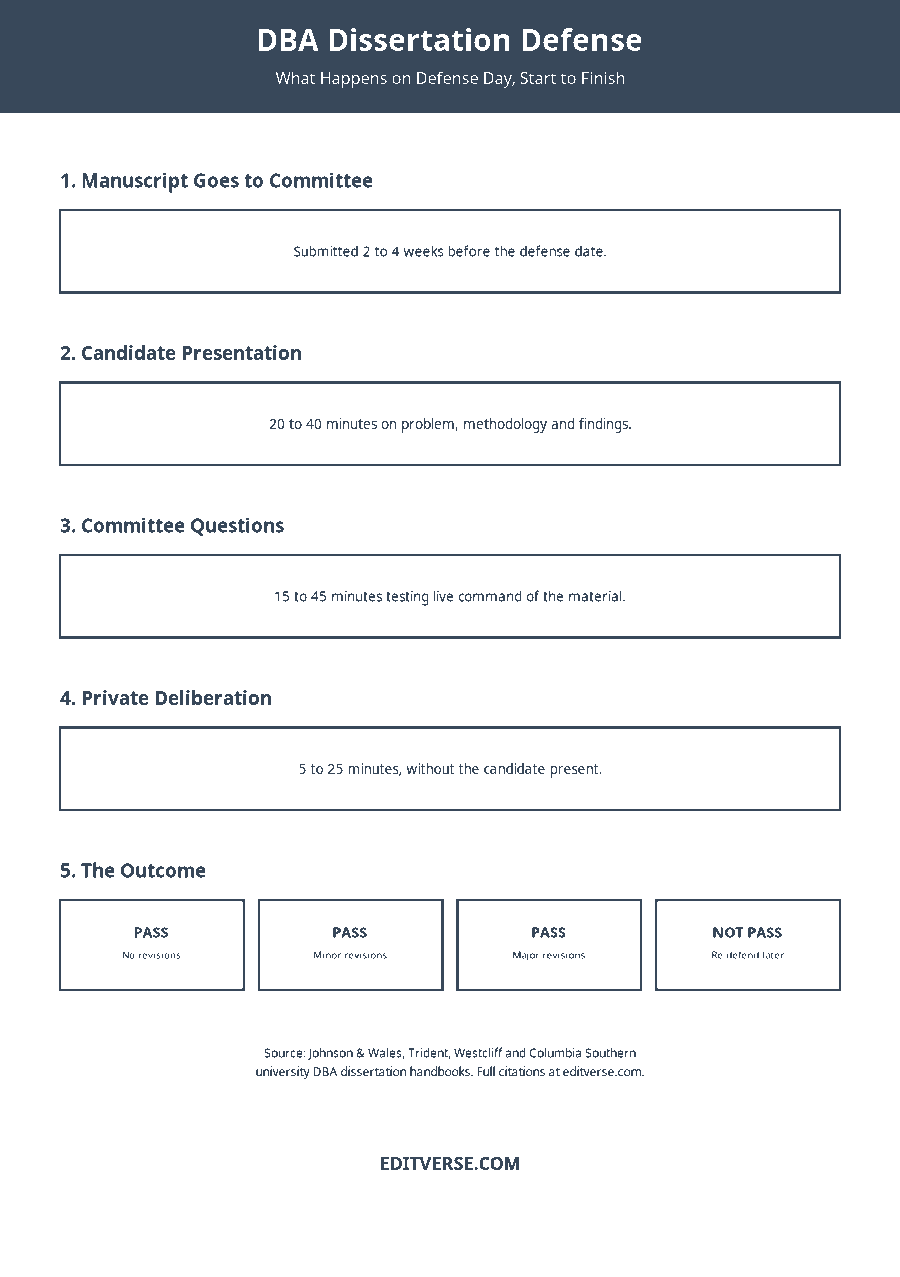
Every DBA program builds its final defense from the same five pieces: the manuscript reaches the committee ahead of time, the candidate presents, the committee questions the candidate, the committee deliberates privately, and the candidate learns the outcome. What differs, sometimes substantially, is how long each piece runs and how much of it is visible to anyone outside the committee. Four published handbooks show the range.
| Program | Presentation | Committee Q&A | Total runtime | Delivery |
|---|---|---|---|---|
| Johnson & Wales University | 25 to 30 min | About 15 min | 60 to 90 min | Not specified |
| Westcliff University | 30 to 40 min | 15 min | About 80 to 90 min | Guests admitted upon approval |
| Trident University | 20 to 30 min | Within the total | 60 to 90 min | Teleconference, restricted then open |
| Columbia Southern University | Not specified | Not specified | Not specified | Remote videoconference (GoToMeeting, Adobe Connect) |
Sources: Johnson & Wales University DBA Dissertation Handbook; Westcliff University Doctoral Writing Center; Trident University DBA Handbook; Columbia Southern University DBA Dissertation Handbook. Ranges are each program’s own published model, not a universal standard.
A few details are worth pulling out individually. Westcliff’s defense is the most granular on paper: 30 to 40 minutes of presentation, 15 minutes of committee questions, 15 minutes for the committee to deliberate privately, then 10 minutes to deliver the result and 10 more to formally close the session. Trident’s defense structures attendance in two phases rather than two time blocks: “the initial portion of the defense is restricted only to participation by the student and members of the DSP Committee,” after which the session opens by teleconference to the Site Facilitator, the Doctoral Studies Director, the Dean, and any friends or colleagues the candidate has invited. Columbia Southern’s handbook is the least specific on timing but the most explicit that attendance can happen in person or remotely, with the notice of defense expected to spell out which.
The manuscript itself typically reaches the committee two to four weeks ahead of the scheduled date, which is also roughly the window most programs expect a candidate to spend on final rehearsal. That timing is not incidental. It is long enough for a committee to actually read a 100-plus page document closely rather than skim it, and short enough that the version being defended is genuinely final rather than a draft still being revised in parallel.
4. The Possible Outcomes, and Why They’re Not All the Same
Every DBA program reduces the defense to a small set of formal outcomes, but the number of tiers, and what separates one from the next, differs by program in ways that matter for how a candidate should read their own result.
| Program | Verdict tiers |
|---|---|
| Westcliff University | Pass · Pass with revisions · Fail |
| Trident University | Pass, revisions approved by chair alone · Pass, revisions approved by chair and committee · No pass, retake the course |
| Columbia Southern University | Accept without revision · Accept with minor revisions · Accept with substantial revisions (committee review required) · Reject |
Sources: same handbooks cited in the table above.
Westcliff and Trident both collapse the decision to three outcomes, but along different axes. Westcliff splits by revision severity; Trident splits its middle outcome by who has to sign off on the fix, the chair alone or the full committee, which is really a statement about how much the committee trusts the candidate to self-correct without further oversight. Columbia Southern is the only one of the four that formally separates minor from substantial revisions into two distinct tiers, which is the four-way split shown in the figure above. None of the four programs uses identical language for what is, underneath the wording, the same decision: pass clean, pass with something to fix, or come back and do this again.
In Simple Words
A clean pass with zero revisions is the least common outcome, not the default one. Across every program above, some form of “pass with revisions” is the modal result. Walking in expecting to be asked to fix something is a more accurate mental model than walking in expecting a rubber stamp.
5. What Your Committee Is Actually Testing
The conventional framing of a DBA versus a PhD treats the two as testing different things by design. AACSB’s own comparison describes DBA candidates as “practice oriented,” bringing “both practice and scholarly research to the university,” against PhD candidates whose work is “often more theoretical or conceptual in nature.” Under that framing, a DBA defense should spend more time on organizational application and a PhD defense more time on theoretical contribution.
A peer-reviewed content analysis published in the Journal of Education for Business complicates that clean split. Comparing actual DBA and PhD dissertations in business rather than program marketing language, MacLennan, Piña, and Gibbons found the two did not separate as sharply along methodology and research-type lines as the practice-versus-theory framing implies. In practice, a DBA committee asking a candidate to defend a regression model or a coding scheme for qualitative data is not asking an easier or more applied version of a PhD question. It is very often asking the same question. DBA dissertation methodology covers how that choice gets made in the first place, and why the rigor standard it sets does not loosen by the time a candidate reaches this room.
What that means for a candidate preparing to defend: do not assume the bar is lower because the degree is labeled practice-focused. A committee member with a quantitative background will still expect a defensible sampling rationale. A committee member with a qualitative background will still expect a defensible coding and trustworthiness argument. The organizational-application framing that distinguishes a DBA’s purpose statement from a PhD’s does not extend to a lower standard for how rigorously the method has to be defended once the room asks about it directly.
6. Public Defense or Private? Why DBA Programs Differ
Candidates who picture a dissertation defense from a traditional PhD program, an open room, a public announcement, anyone from the department free to sit in, are often picturing a different institutional culture than the one most DBA programs actually run. Some research universities do hold defenses that way. Arizona State University’s graduate policy states plainly that “thesis and dissertation defenses are open to all members of the university community and the general public,” framed explicitly around fostering “a broader awareness of the state of graduate research.”
The DBA programs whose handbooks are cited throughout this article run a narrower model. Trident’s defense begins restricted to the candidate and committee only, then opens by teleconference to program staff and any guests the candidate specifically invites, not the general public. Westcliff’s defense allows the Program Chair, Dissertation Coordinator, and guests, but only “upon approval,” meaning attendance is controlled rather than open. Columbia Southern’s handbook describes remote delivery with attendance procedures set by the notice of defense, again a controlled list rather than an open invitation.
Neither model is more rigorous than the other. The difference reflects what each type of program is built around. A traditional research-doctorate defense is partly a public scholarly event, consistent with a PhD’s orientation toward contributing to an open academic literature. A practice-doctorate defense conducted by video conference for working professionals, often scattered across time zones with day jobs to return to immediately afterward, is built for efficiency and privacy rather than as a public forum. Confirm which model your own program uses before assuming either one; a candidate who invites colleagues expecting a Westcliff-style approval process to work like Trident’s can end up asking for permission from the wrong office at the wrong time.
7. How Candidates Actually Prepare
No DBA program handbook and no accrediting body publishes a recommended number of mock defenses to run before the real one. That absence surprises candidates who assume there is a documented best practice somewhere. There is not. What exists instead is a wide range of individual habits, some candidates rehearse with a single practice run through their slides, others rehearse the Q&A portion repeatedly with colleagues standing in for the committee, and program guidance rarely specifies which approach its own graduates actually used.
What the handbooks do agree on is what the rehearsal should target. It is not the presentation. Every timing table above gives the presentation, the part most candidates over-rehearse, less time than it gives the committee’s questions. A defense is lost or won far more often in the unscripted fifteen to forty minutes of questioning than in the scripted twenty to forty minutes of slides. Rehearsing the presentation until it is smooth and rehearsing the defense until unexpected questions stop being destabilizing are two different skills, and only the second one is actually being tested on defense day.
Editverse’s own Defense Preparation Package is built around that distinction specifically: two 90-minute mock defense sessions, scheduled two to four weeks before the real date, that simulate the questioning rather than the slides, with an anticipated-question list built from the candidate’s own methodology and findings rather than a generic bank. Candidates already working with Editverse’s DBA Completion Package Platinum tier for the full dissertation have two live mock defenses with written feedback built into that engagement already, at no additional cost.
8. Why Dissertations Get Sent Back
Editors who sit in on defense preparation across dissertations see the same handful of failure points recur far more than any single bad slide or nervous stumble. A candidate who can explain a finding but not the decision behind it, why this statistical test rather than a comparable one, why this sample size, why this specific coding scheme, reads to a committee as someone defending a document rather than defending research they actually own. A candidate who cannot state their study’s limitations plainly, without hedging or minimizing, reads as someone who has not fully absorbed what their own data can and cannot support. And a candidate who treats a pointed question as an attack, rather than as the actual evaluation instrument it is, tends to get defensive in a way that reads worse than the gap the question was probing for in the first place.
Hard numbers on how often DBA defenses specifically end in an outright fail do not exist anywhere. No US DBA program, accrediting body, or association publishes that figure. The closest thing to real data comes from outside the DBA world entirely. A 2019 study in Higher Education examining Swedish doctoral rejections across humanities, law, and social science faculties from 1984 to 2017 found only 18 rejected dissertations out of 15,477 examined. Worked out correctly, that is about 0.12 percent, not the 0.0012 percent the paper’s own abstract states, an apparent decimal slip in an otherwise carefully documented dataset. Either way, outright rejection at the final defense is rare almost everywhere it has been measured. The real risk for most candidates is not failing outright. It is walking in prepared for a pass and walking out with a revision list that adds another two to four months before the degree is actually final.
9. Matching Support to This Stage
Candidates heading into the final defense, manuscript complete, committee review ahead, and a live Q&A the last real obstacle between them and the degree, are exactly who Editverse’s DBA Completion Package Platinum tier is built for.
Platinum · $6,500
To Defense, Complete
Six months of end-to-end support covering every chapter, unlimited committee rounds, full statistical and qualitative analysis support, and two live 90-minute mock defenses with written feedback built directly into the fee.
Defense Preparation · $450
Defense Coaching Only
For candidates whose dissertation is already finished elsewhere and who need the live rehearsal specifically: two 90-minute mock defenses, an anticipated-question list, and delivery coaching, scheduled two to four weeks out.
Earlier in the process? The Silver tier covers the chapters 1-3 proposal stage and the Gold tier covers a full draft with analysis once a proposal is already approved; see DBA dissertation proposal for how that earlier checkpoint works. Every service on this page lives in Editverse’s Dissertation Services category alongside standalone support for candidates who need one specific piece rather than a full package.
10. Frequently Asked Questions
How long is a DBA dissertation defense?
Most published handbooks put the full session at 60 to 90 minutes, including a 20 to 40 minute presentation, roughly 15 minutes of committee questions, and a private deliberation before the committee delivers a result. Exact timing varies by program.
Is a DBA dissertation defense open to the public?
Usually not in the way a traditional PhD defense can be. Most DBA-specific programs run the defense by video conference with controlled attendance, guests admitted only with prior approval, rather than as an open public event. Confirm your own program’s policy rather than assuming either model.
What happens if I fail my DBA dissertation defense?
Outright fail is the least common outcome and handbook language for it varies, from retaking a specific course to a formal reject requiring a full second defense. A revision request, not outright failure, is by far the more common result across every program reviewed here.
How many mock defenses should I do before my DBA defense?
No program handbook or accrediting body publishes a recommended number. Two full mock sessions with written feedback, scheduled two to four weeks out, is common practice among defense-preparation services, but it is a practice, not a published standard.
Is the final defense harder than the proposal defense?
They are hard in different ways rather than directly comparable. The proposal defense tests whether a planned study is sound. The final defense tests whether a completed study, data and all, holds up under direct questioning, which most candidates experience as higher-stakes since there is no more data left to collect if a flaw surfaces.
Can I pass with revisions without doing a second defense?
In most of the programs reviewed here, yes. Minor and even substantial revisions are typically reviewed and approved on paper by the chair or full committee rather than triggering a second live defense. A second full defense is generally reserved for the most severe outcome tier.
Free Research Tools from Editverse
- GraphPro: build publication-ready charts, 25 types, with built-in t-test, ANOVA, correlation, and chi-square p-values. Free, no signup.
- StatPro: free statistical calculators and a test-selector tool covering group comparisons, categorical outcomes, time-to-event analysis, and diagnostic accuracy.
- Flowchart Pro: generate PRISMA 2020, PRISMA-ScR, CONSORT, STROBE, STARD, MOOSE, and ARRIVE flow diagrams directly in your browser.
11. The Bottom Line
A DBA dissertation defense is judged on one question underneath all the procedural variation: can the candidate defend, live and unscripted, the decisions already made on paper. Timing, attendance rules, and the exact number of outcome tiers all differ by program, but that core test does not. Rehearse the questioning, not just the slides, and the checkpoint that ends the program stops being the part candidates fear most.
Manuscript approved, defense date on the calendar?
Start with the two mock defenses built into full defense-stage support.