
Published
“The secret of getting ahead is getting started. The secret of getting started is breaking your complex overwhelming tasks into small manageable tasks, and then starting on the first one.” – Mark Twain
Changing behavior can seem overwhelming, but the right tools make it easier. The transtheoretical model (TTM) helps understand and support behavior change. Developed by James Prochaska and Carlo DiClemente in the late 1970s, it’s used in many health areas, like quitting smoking and managing weight.
The transtheoretical model sees change as a step-by-step journey. People go through stages like precontemplation, contemplation, and action. Knowing where someone is in their change helps professionals tailor their help.
Key Takeaways
- The transtheoretical model (TTM) outlines the stages of behavior change, from precontemplation to maintenance.
- TTM recognizes that change is a gradual process, with the acknowledgment that relapses are a normal part of the journey.
- Assessing an individual’s readiness for change is crucial to providing tailored interventions that support their progression through the stages.
- TTM has been effectively applied across a wide range of health behaviors, from smoking cessation to weight management and physical activity.
- Understanding the key components of TTM, such as decisional balance and self-efficacy, can enhance the effectiveness of behavior change interventions.
Introduction to the Transtheoretical Model
The transtheoretical model (TTM) was created by James Prochaska and Carlo DiClemente in the late 1970s. It’s a well-known theoretical framework for understanding how people change their behaviors. The model says people go through five distinct stages when changing their ways: precontemplation, contemplation, preparation, action, and maintenance.
Definition and Overview
The transtheoretical model is a detailed behavior change model. It combines different theories to help people move through the stages of change. It helps figure out when someone is ready to change and how to help them.
Importance in Behavioral Change
The transtheoretical model is very useful in health psychology and behavior change. It’s used in many areas like smoking cessation, weight management, physical activity, and medication adherence. Knowing the stages of change helps make behavior change interventions more effective.
“The transtheoretical model provides a framework for understanding the process of behavior change, allowing for more tailored and effective interventions.”
The Five Stages of Change
The Transtheoretical Model (TTM) explains the five stages of changing behavior. These are precontemplation, contemplation, preparation, action, and maintenance. Knowing these stages helps you support and guide people in changing their behavior.
Precontemplation Stage
In the precontemplation stage, people are not ready to change yet. They might not see the need for change or have tried and failed before. This makes them feel like giving up. Only a small percentage of people are ready to change at any time.
Contemplation Stage
The contemplation stage is when people start to see the need for change. They think about changing in the next 6 months. They are weighing the good and bad sides of changing but haven’t decided yet.
Preparation Stage
In the preparation stage, people are getting ready to change in the next 30 days. They might have already started small changes and are planning more. This stage is key to moving from thinking about change to actually doing it.
Action Stage
The action stage is when people have actually changed their behavior in the last 6 months. This stage requires a lot of effort and commitment. People are working hard to keep their new, healthier habits.
Maintenance Stage
The maintenance stage starts after 6 months of keeping up with the changes. Here, people focus on staying changed and preventing going back to old ways. It’s hard, but with the right support, they can stay on track.
Understanding the stages of change helps you know when someone is ready to change. You can then tailor your help to fit their needs. This is very helpful in guiding people through the change process.
Processes of Change
The transtheoretical model shows 10 key “processes of change” for moving through behavior modification stages. These steps are vital for keeping behavior change going as you move through the model.
These 10 processes fall into two main categories. There are cognitive and affective processes, and behavioral ones. They help people go through the five stages of change, from starting to change to keeping it up.
- Consciousness Raising makes you more aware of why, what happens, and how to fix a problem behavior.
- Self-Reevaluation is about looking at how you see yourself with and without the problem behavior.
- Social Liberation is about seeing how the world around you can help you change for the better.
- Emotional Arousal lets you feel and deal with the emotions tied to a problem behavior.
- Self-Liberation is about making choices and promises to yourself to change.
The behavioral processes of change include:
- Counterconditioning is about replacing old, unhealthy ways with new, healthy ones.
- Stimulus Control is about using reminders and cues to help you stay on track with healthy behavior.
- Helping Relationships are about finding people who support your new healthy habits, like friends or professionals.
- Reinforcement Management uses rewards to encourage good behavior change.
- Contingency Management uses incentives and consequences to keep you motivated and on track.
Knowing and using these processes of change helps you move through the stages of behavior change more smoothly.
“The Processes of Change are the ‘how’ of changing; the Stages of Change are the ‘when.'”
Decisional Balance
The transtheoretical model highlights the importance of decisional balance. It looks at how people weigh the pros and cons of changing their behavior. As they move through the stages, they start to see the benefits of change more than the drawbacks.
In the Contemplation stage, people often feel torn. They see both the good and bad sides of changing their ways. This struggle is a key part of the change journey. Overcoming this ambivalence is essential to progress to the Preparation and Action stages.
To help clients choose change, we use motivational counseling strategies. We focus on personal choice, reframe negative thoughts, and look at life goals and values. This boosts their motivation to change.
| Pros of Behavior Change | Cons of Behavior Change |
|---|---|
| Improved health and well-being | Difficulty breaking established habits |
| Increased self-confidence and self-esteem | Potential social stigma or judgment |
| Enhanced relationships and social connections | Emotional discomfort or stress during the change process |
| Greater sense of accomplishment and purpose | Perceived loss of enjoyment or pleasure |
By understanding the pros and cons of change, people can make better choices. This increases their chances of lasting success in changing their behavior.
The Transtheoretical Model shows that behavioral change is a journey. People may go back and forth through the stages before reaching lasting change. Knowing about decisional balance helps us tailor support for lasting behavior change.
Self-Efficacy
In the transtheoretical model, self-efficacy is key for starting and keeping up behavior changes. It’s about how confident someone is in doing something, especially when it’s hard or they might slip back.
Studies show self-efficacy’s big role in changing behavior. Bandura (2004) found a big link between believing in oneself and changing, with big improvements. Aro et al. (2018) also saw a big jump in reading skills thanks to self-efficacy.
Self-efficacy can also boost the effect of planning on changing behavior. Luszczynska et al. (2011) found it made a big difference in starting to be more active. Brockway et al. (2017) saw a huge rise in breastfeeding thanks to self-efficacy work.
So, boosting someone’s self-efficacy is key for lasting behavior changes. The transtheoretical model helps by focusing on building confidence in changing.
| Study | Behavior Change Context | Increase in Self-Efficacy |
|---|---|---|
| Bandura (2004) | Health promotion | 143% to 164% |
| Aro et al. (2018) | Reading fluency | 53% to 66% |
| Luszczynska et al. (2011) | Physical activity | 151% to 166% |
| Brockway et al. (2017) | Breastfeeding | 486% to 499% |
| French et al. (2014) | Older adults’ physical activity | 225% to 234% |
“Enhancing an individual’s self-efficacy is a critical component of successful behavior change interventions.”
Applying the Transtheoretical Model
The transtheoretical model (TTM) helps healthcare providers and health experts. It helps them understand when someone is ready to change their behavior. This way, they can create specific plans to help people change for good.
Assessing Readiness for Change
The first thing to do is figure out if someone is ready to change. You need to know if they are in the precontemplation, contemplation, preparation, action, maintenance, or termination stage. Knowing this lets you pick the right strategies to help them move forward.
Tailoring Interventions
After figuring out someone’s readiness, you need to make your plan fit their needs. You might use different techniques like raising awareness or building support. By making your plan match their stage, you can help them change more effectively.
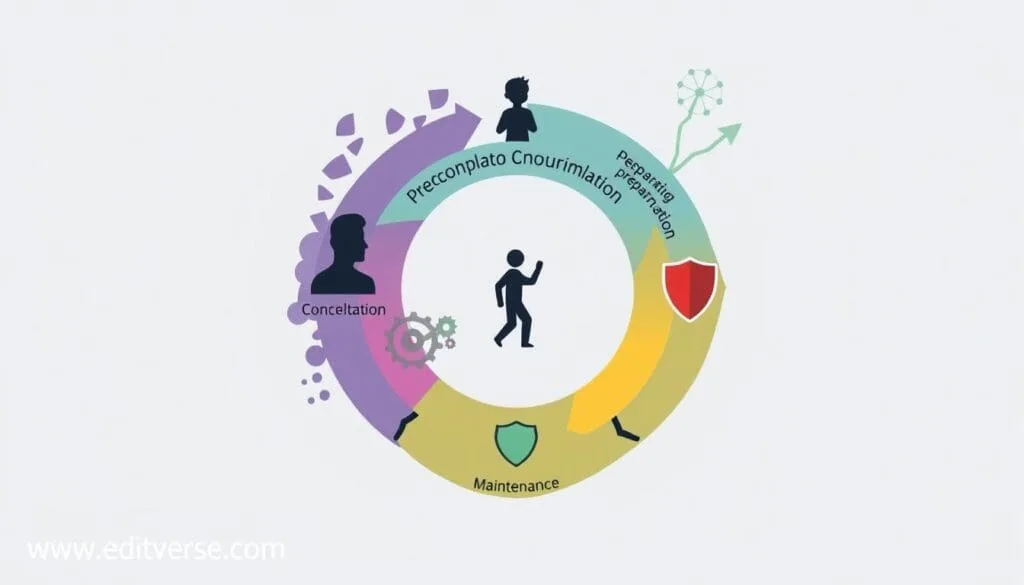
“The Transtheoretical Model posits that individuals move through six stages of change: precontemplation, contemplation, preparation, action, maintenance, and termination.”
stages of change, behavioral intervention, motivation assessment
The transtheoretical model (TTM) helps us understand and support behavior change in areas like smoking cessation, weight management, and physical activity. It shows that changing behavior is a process, not just one event. This model helps health professionals tailor their help to match a person’s readiness and stage of change.
The Stages of Change model has five stages: precontemplation, contemplation, preparation, action, and maintenance. People can move forward or backward through these stages. They often go through them several times before they fully change.
It’s important to know how ready someone is to change. The Readiness-to-Change Ruler helps figure out where someone is on the change spectrum. It looks at how important the change is to them and how confident they are in making it happen.
| Stage of Change | Description |
|---|---|
| Precontemplation | The individual is not considering change and may be unaware of the need to change. |
| Contemplation | The individual is aware of the problem and is seriously considering making a change, but has not yet made a commitment. |
| Preparation | The individual is ready to take action and has made a plan to change their behavior. |
| Action | The individual has made specific overt modifications to their behavior and is actively engaged in the change process. |
| Maintenance | The individual has sustained the behavior change for a significant period and is working to prevent relapse. |
Studies show that matching treatment to the patient’s stage of change works well. Understanding someone’s readiness and tailoring help can lead to lasting behavior changes. This makes healthcare more effective.
Examples and Case Studies
The transtheoretical model has been widely used in health behavior studies. It shows strong results in smoking cessation and weight management programs.
Smoking Cessation
The model helps guide efforts to stop smoking. Studies show that those in the preparation or action stages are more likely to quit. Tailored interventions are more effective than generic ones.
Weight Management
The transtheoretical model is also useful for weight management. People in the action or maintenance stages tend to lose and keep off weight better. Early stages need more support and guidance. Using stage-specific strategies can improve weight loss programs.
| Behavior Change Scenario | Transtheoretical Model Stage | Intervention Approach |
|---|---|---|
| Smoking Cessation | Preparation | Provide information on quit methods, identify triggers, and develop a personalized action plan. |
| Weight Management | Action | Implement a structured diet and exercise program, offer ongoing support and accountability. |
The transtheoretical model captures the changing nature of behavior change. It’s useful for many health behaviors, like smoking cessation and weight management. Tailoring support to an individual’s stage can lead to better behavior change.
Challenges and Limitations
The transtheoretical model is well-known for helping people change their behavior. Yet, it faces challenges and has its limits. Some key issues include:
- Oversimplification of the change process: The model’s simple, stage-based approach might not fully capture the complex nature of change. It often involves setbacks and doesn’t always follow a straight line.
- Difficulty in accurately assessing stages: Figuring out where someone is in the change process can be tricky. This can lead to mistakes in how we help them.
- Lack of emphasis on social and environmental factors: The model mainly looks at individual factors. It doesn’t consider how social, cultural, and environmental factors can also influence change.
- Limitations in predicting long-term outcomes: Some question if the model can really help people keep changing over time. People might go back to old ways or not keep up with new habits.
- Inability to address complex behaviors: The model might not work as well for complex behaviors. This includes things like addiction or managing chronic diseases, which involve many factors.
These transtheoretical model limitations, behavior change challenges, and behavior change model critiques show we need a deeper understanding of change. Using the transtheoretical model with other theories could help. It could give us a better way to support people in changing their behavior.
Integrating with Other Theories
The transtheoretical model is a key tool for understanding behavior change. It works best when combined with other theories and models. This mix helps create more effective behavior change interventions.
The Health Belief Model (HBM) is one theory that pairs well with the TTM. It says a person’s belief in a health threat and the belief in the behavior’s effectiveness can predict their actions. The HBM has six parts: Perceived susceptibility, Perceived severity, Perceived benefits, Perceived barriers, Cue to action, and Self-efficacy.
The Theory of Planned Behavior (TPB) also complements the TTM well. It has six parts: Attitudes, Behavioral intention, Subjective norms, Social norms, Perceived power, and Perceived behavioral control. This theory helps predict and explain behaviors like smoking and drinking.
Using many theoretical frameworks together helps create better behavior change plans. These plans tackle the complex factors that influence our actions.
“Integrating multiple behavior change theories can lead to more holistic and effective interventions.”
Research and Future Directions
The transtheoretical model has been studied for over 40 years. It shows it can help change behavior in many health areas. Yet, there are still new paths to explore in transtheoretical model research and behavior change research:
- Looking into how accurate stage assessments are and finding new views on readiness for change. Recent studies have questioned the order of the stages, needing more research.
- Mixing the transtheoretical model with other theories like self-determination theory. This could lead to better and more effective methods.
- Studying how ambivalence, present bias, and self-control affect our decisions and change process.
- Using brain imaging and neuroscience to understand the brain’s role in changing behavior.
- Applying the transtheoretical model to bigger levels, like organizations and policies, to support healthy behaviors.
By focusing on these future directions, we can learn more about changing behavior. This will help us create better ways to improve health for everyone.
| Key Insights from Recent Research | Potential Impact |
|---|---|
| Failures in enacting healthy behaviors account for nearly half of premature deaths in the United States. | Shows how crucial effective behavior change is for major health issues. |
| Behavior change can lead to significant healthcare cost savings for organizations. | Points out the economic benefits of behavior change, not just health gains. |
| Individuals often possess health information but struggle to translate it into sustained behavioral change. | Points out the need to tackle psychological, social, and environmental factors, not just knowledge. |
By tackling these research gaps and exploring new future directions, we can keep improving. This will lead to better ways to support lasting behavior change and better health for all.
“The process model of behavior change outlines a recursive cycle in which impulses to act develop over time, impacting behavioral responses.”
Conclusion
The transtheoretical model (TTM) is a key tool for helping people change their behavior. It shows how change happens in stages, helping experts tailor health plans for each person. This makes it easier to help people change their health habits.
Studies show the TTM works well for many health issues, like quitting smoking or losing weight. It helps people make lasting changes in their lives. Healthcare teams can use the TTM to better connect with patients and help them take care of their health.
The future looks bright for the TTM as it combines with other theories and new tech. This could lead to even better ways to help people change their behavior. By using the TTM, we can help more people improve their health and well-being.
FAQ
What is the transtheoretical model (TTM) of behavior change?
The transtheoretical model (TTM) helps us understand how people change their behavior. It says people go through five stages: precontemplation, contemplation, preparation, action, and maintenance.
What are the five stages of change in the transtheoretical model?
The five stages are:
- Precontemplation: The person hasn’t thought about changing yet.
- Contemplation: They’re thinking about changing but haven’t decided.
- Preparation: They’re getting ready to make a change.
- Action: They’re actually changing their behavior.
- Maintenance: They’re keeping the change going over time.
What are the key processes of change in the transtheoretical model?
The model has 10 key processes for changing behavior. These include:
- Consciousness raising
- Dramatic relief
- Environmental reevaluation
- Self-reevaluation
- Self-liberation
- Social liberation
- Counterconditioning
- Helping relationships
- Reinforcement management
- Stimulus control
What is the concept of “decisional balance” in the transtheoretical model?
“Decisional balance” is a key idea in the model. It’s about weighing the good and bad of changing a behavior. As people move through stages, they see more benefits than drawbacks.
What is the role of self-efficacy in the transtheoretical model?
Self-efficacy is very important in the model. It’s about believing you can do something, even when it’s hard. It helps people start and keep changing their behavior.
How can the transtheoretical model be applied in practice?
The model helps health professionals tailor their help to each person. They can see where someone is in the change process and help them move forward.
What are some examples of the transtheoretical model’s application?
The model has been used a lot in health areas. It’s especially good for helping people stop smoking and manage their weight.
What are some of the challenges and limitations of the transtheoretical model?
While the model is widely used, it has some issues. Some problems include:
- It assumes a linear process, but change isn’t always that simple.
- It can be hard to accurately figure out where someone is in the process.
- It might not work for all behaviors.
- It doesn’t always consider the environment and social factors.
How can the transtheoretical model be integrated with other theories?
The model works best when combined with other theories. This way, it can be even more effective in helping people change their behavior.
What are some future research directions for the transtheoretical model?
The model has been studied a lot, but there’s still more to do. Some areas to explore include:
- Using the model with different groups and in different cultures.
- Combining the model with other theories for better results.
- Creating better ways to measure change and the processes behind it.
- Looking at how long-lasting the changes supported by the model are.
Source Links
- https://www.verywellmind.com/the-stages-of-change-2794868
- https://r1learning.com/blog/2020/5-stages-of-change
- https://thedecisionlab.com/reference-guide/psychology/the-transtheoretical-model-ttm
- https://www.ncbi.nlm.nih.gov/pmc/articles/PMC6390443/
- https://blog.changecompanies.net/stages-of-change
- https://online.yu.edu/wurzweiler/blog/prochaska-and-diclementes-stages-of-change-model-for-social-workers
- https://medicine.llu.edu/academics/resources/stages-change-model
- https://r1learning.com/blog/2021/10-processes-of-change
- https://www.ncbi.nlm.nih.gov/books/NBK571064/
- https://www.habitweekly.com/models-frameworks/the-transtheoretical-model-stages-of-change
- https://www.cambridge.org/core/books/handbook-of-behavior-change/selfefficacy-interventions/D4EC41A2F16CB6171058C5B00AE575AB
- https://sphweb.bumc.bu.edu/otlt/mph-modules/sb/behavioralchangetheories/behavioralchangetheories6.html
- https://www.ncbi.nlm.nih.gov/books/NBK556005/
- http://adultmeducation.com/FacilitatingBehaviorChange.html
- https://transformationsllc.net/wp-content/uploads/2012/06/stages_of_change.pdf
- https://sphweb.bumc.bu.edu/otlt/mph-modules/sb/behavioralchangetheories/BehavioralChangeTheories_print.html
- https://implementationscience.biomedcentral.com/articles/10.1186/s13012-017-0605-9
- https://www.mdpi.com/2071-1050/13/18/10116
- https://pmc.ncbi.nlm.nih.gov/articles/PMC7946166/
- https://implementationscience.biomedcentral.com/articles/10.1186/1748-5908-6-42
- https://www.eufic.org/en/healthy-living/article/motivating-behaviour-change
- https://www.pdhi.com/workplace-wellness-programs/3-ways-to-measure-behavior-change/
- https://www.uspreventiveservicestaskforce.org/uspstf/about-uspstf/methods-and-processes/behavioral-counseling-interventions-evidence-based-approach