
Published | Last updated
.evrob-wrap{overflow-x:auto !important;margin:22px 0 !important;}.evrob-table{border-collapse:collapse !important;width:100% !important;min-width:520px !important;}.evrob-table th{background-color:#0d2137 !important;color:#ffffff !important;padding:10px 12px !important;text-align:left !important;border:1px solid #cddaea !important;font-size:0.92rem !important;}.evrob-table td{background-color:#ffffff !important;color:#1a1a1a !important;padding:9px 12px !important;border:1px solid #cddaea !important;vertical-align:top !important;font-size:0.92rem !important;}.evrob-table tr:nth-child(even) td{background-color:#f0f5fa !important;}.evrob-cap{margin:6px 0 0 0 !important;font-size:0.85rem !important;color:#1a1a1a !important;}
The RoB 2 risk of bias tool is the revised Cochrane instrument for judging whether the result of a randomized trial can be trusted. Sterne and colleagues published it in the BMJ in 2019 (BMJ 2019;366:l4898). It looks at five domains, asks a fixed set of questions in each, and converts the answers into one of three judgements, Low risk of bias, Some concerns or High risk of bias. This guide explains the RoB 2 signalling questions domain by domain, shows how the algorithms reach a judgement, walks one hypothetical trial from first answer to overall rating, and sets out how to report the result in a systematic review.
In Simple Words
RoB 2 does not give a trial a single quality score. For each result you pull from a trial, you answer short factual questions about five parts of how the trial was run and reported. Those answers produce a rating for each part, and the worst rating drives the overall rating. A result is Low only when every domain is Low. One High domain makes the whole result High.
What the RoB 2 Risk of Bias Tool Assesses
RoB 2 assesses a single trial result, not a whole trial. The Cochrane guidance defines that result as an estimate of the relative effect of two interventions on a particular outcome. A trial that reports pain, function and adverse events therefore needs several assessments. The guidance adds that these decisions are likely to line up with the outcomes in your Summary of Findings table, although it has not yet issued a formal rule on how many results to assess (riskofbias.info).
Three design features are worth fixing before you open the first paper.
- The domains are mandatory. The guidance states that the five domains cover all types of bias that can affect randomized trials, so each is required and no further domains should be added.
- The names describe causes. The authors avoided the version 1 labels selection bias, performance bias, attrition bias and detection bias because those labels did not describe the specific issues assessed.
- The effect of interest must be declared. You choose between the effect of assignment to intervention (the intention-to-treat effect) and the effect of adhering to intervention (the per-protocol effect). Only domain 2 changes with this choice, and the choice is unrelated to whether you pool odds ratios or risk differences.
Handbook chapter 8 warns that naive per-protocol and as-treated analyses may be seriously biased, and valid per-protocol estimation needs specialised methods, so most reviews specify the assignment effect. Our guide to intention-to-treat versus per-protocol analysis explains why that distinction matters before you start answering questions.
The evidence behind the domains is empirical. In the ROBES meta-epidemiological study, which covered 2,443 randomized trials in 228 Cochrane meta-analyses, intervention effect estimates were on average exaggerated in trials with high or unclear (versus low) risk-of-bias judgements for sequence generation, with a ratio of odds ratios of 0.91 (95% credible interval 0.86 to 0.98) (Savović et al., Am J Epidemiol 2018). That study used the older judgements rather than RoB 2, but it illustrates why the tool asks about the randomization process at all.
The Five Domains and Their RoB 2 Signalling Questions
The table below gives the five domains for an individually randomized parallel-group trial, the core issue each one tests, and the number of signalling questions in the template for the effect of assignment to intervention.
| Domain | Name in the tool | Core issue it tests | Questions |
|---|---|---|---|
| D1 | Bias arising from the randomization process | Was the allocation sequence random and concealed, and do baseline differences suggest a problem? | 3 (1.1 to 1.3) |
| D2 | Bias due to deviations from intended interventions | Did awareness of assignment cause departures from protocol, and was the analysis appropriate? | 7 (2.1 to 2.7) |
| D3 | Bias due to missing outcome data | Are outcome data available for nearly all randomized participants, and could missingness depend on the true value? | 4 (3.1 to 3.4) |
| D4 | Bias in measurement of the outcome | Was the measurement appropriate and comparable across groups, and could assessors’ knowledge have influenced it? | 5 (4.1 to 4.5) |
| D5 | Bias in selection of the reported result | Was the reported result chosen from several outcome measurements or analyses? | 3 (5.1 to 5.3) |
Table 1. RoB 2 domains and question counts. Source: Cochrane RoB 2 guidance, 22 August 2019. The effect of adhering to intervention uses a different question set in domain 2.
How RoB 2 Signalling Questions Are Answered
Each of the RoB 2 signalling questions is written to be reasonably factual. You answer with one of five options, Yes, Probably yes, Probably no, No or No information. Yes and Probably yes carry the same implication for risk of bias, as do No and Probably no. Questions are phrased so that a Yes can point to either a low or a high risk of bias, which is why you must read the algorithm and never assume that Yes is the good answer.
Four rules prevent most answering errors.
- Use No information sparingly. The guidance reserves it for cases where the report is too thin to support Probably yes or Probably no and where a guess would be unreasonable. A large trial run by an experienced trials unit that does not describe sequence generation in a word-limited paper is more likely a Probably yes.
- Know what a missing detail means. If a question looks for evidence of a problem, No information means no evidence of that problem. If it concerns something that should be reported, such as losses to follow-up, silence raises concern.
- Answer each question independently. A baseline imbalance must not change your answers to the sequence generation or concealment questions. It is recorded under question 1.3 only.
- Quote the report. The free-text box beside each question should hold brief direct quotations whenever possible.
The algorithms then map answers to a proposed domain judgement. Treat that output as a proposal. The guidance says users should verify it, may change it, and must explain any departure. It also tells assessors to read “risk of bias” as “risk of material bias”, so concerns belong only where an issue is likely to affect the ability to draw reliable conclusions.
Reliability needs attention in practice. In an inter-rater reliability study by Minozzi and colleagues, four raters applied RoB 2 to 80 results covering seven outcomes from 16 trials in a Cochrane review. During the calibration exercise they reached no agreement on the overall judgement (Fleiss kappa of -0.15), and the mean time to apply the tool was 168.5 minutes per study. The team then wrote a topic-specific implementation document and measured agreement again, and the paper reports that reliability improved (Minozzi et al., J Clin Epidemiol 2022). The practical lesson is to agree your interpretation rules, such as what counts as “nearly all” outcome data, before extraction starts.
Domain 1 RoB 2 Signalling Questions, Randomization Process
The RoB 2 signalling questions in domain 1 ask whether the allocation sequence was random (1.1), whether it was concealed until participants were enrolled and assigned (1.2), and whether baseline differences suggest a problem with randomization (1.3). Differences compatible with chance do not create risk, and a small number of differences significant at the 0.05 level are usually compatible with chance. A Low judgement requires adequate concealment and no concern about sequence generation.
| 1.1 Random sequence | 1.2 Concealed | 1.3 Imbalance suggests problem | Default judgement |
|---|---|---|---|
| Y / PY / NI | Y / PY | N / PN / NI | Low |
| Y / PY | Y / PY | Y / PY | Some concerns |
| N / PN / NI | Y / PY | Y / PY | Some concerns |
| Any | NI | N / PN / NI | Some concerns |
| Any | NI | Y / PY | High |
| Any | N / PN | Any | High |
Table 2. Domain 1 RoB 2 signalling questions and default mapping. Y = Yes, PY = Probably yes, N = No, PN = Probably no, NI = No information. Source: RoB 2 guidance, Table 4.
Domain 2 RoB 2 Signalling Questions, Deviations from Intended Interventions
The RoB 2 signalling questions in domain 2 are the most complex, and they split into two parts for the effect of assignment. Part 1 covers questions 2.1 to 2.5. It asks whether participants (2.1) and carers or people delivering the intervention (2.2) were aware of assignment, and, if so, whether deviations arose because of the trial context (2.3), whether they affected the outcome (2.4) and whether they were balanced between groups (2.5). “Trial context” means effects of recruitment and engagement, such as a participant who feels unlucky after being assigned to the comparator and seeks the experimental treatment. Non-adherence that mirrors what would happen outside the trial is answered No or Probably no.
Part 2 covers questions 2.6 and 2.7 and asks whether an appropriate analysis estimated the effect of assignment. Intention-to-treat analyses and modified intention-to-treat analyses that exclude only participants with missing outcome data are appropriate. Naive per-protocol and as-treated analyses are inappropriate. Question 2.7 then asks whether analysing people in the wrong group could have had a substantial impact, and the guidance notes that this can be true even when fewer than 5% were affected if the outcome is rare.
| Part | Answers | Part judgement |
|---|---|---|
| Part 1 (2.1 to 2.5) | 2.1 and 2.2 both N / PN | Low |
| Part 1 | Either 2.1 or 2.2 Y / PY / NI, and 2.3 N / PN | Low |
| Part 1 | Either aware, and 2.3 NI | Some concerns |
| Part 1 | Either aware, 2.3 Y / PY, and 2.4 N / PN | Some concerns |
| Part 1 | Either aware, 2.3 Y / PY, 2.4 Y / PY / NI, and 2.5 Y / PY | Some concerns |
| Part 1 | Either aware, 2.3 Y / PY, 2.4 Y / PY / NI, and 2.5 N / PN / NI | High |
| Part 2 (2.6, 2.7) | 2.6 Y / PY | Low |
| Part 2 | 2.6 N / PN / NI and 2.7 N / PN | Some concerns |
| Part 2 | 2.6 N / PN / NI and 2.7 Y / PY / NI | High |
| Domain 2 | Both parts Low, or Some concerns in either part with neither High, or High in either part | Low, Some concerns, High respectively |
Table 3. Domain 2 RoB 2 signalling questions and default mapping for the effect of assignment. Source: RoB 2 guidance, Table 6.
Domain 3 RoB 2 Signalling Questions, Missing Outcome Data
The RoB 2 signalling questions in domain 3 begin with a simple test. Were data for this outcome available for all, or nearly all, randomized participants (3.1)? The guidance says availability from 95% of participants will often be sufficient for a continuous outcome, while for a dichotomous outcome the threshold depends on event risk. Imputed values count as missing data. If data are incomplete, you ask whether there is evidence that the result was not biased by the missingness (3.2), whether missingness could depend on the true value (3.3), and whether it is likely that it did (3.4). Reasons for a Yes at 3.4 include different proportions missing between arms, different reasons between arms, and censoring at treatment discontinuation in time-to-event analyses.
| 3.1 Complete data | 3.2 Evidence of no bias | 3.3 Could depend on true value | 3.4 Likely depends | Default judgement |
|---|---|---|---|---|
| Y / PY | NA | NA | NA | Low |
| N / PN / NI | Y / PY | NA | NA | Low |
| N / PN / NI | N / PN | N / PN | NA | Low |
| N / PN / NI | N / PN | Y / PY / NI | N / PN | Some concerns |
| N / PN / NI | N / PN | Y / PY / NI | Y / PY / NI | High |
Table 4. Domain 3 RoB 2 signalling questions and default mapping. NA = Not applicable. Source: RoB 2 guidance, Table 10.
Domain 4 RoB 2 Signalling Questions, Measurement of the Outcome
The RoB 2 signalling questions in domain 4 ask whether the measurement method was inappropriate (4.1), whether measurement or ascertainment could have differed between groups (4.2), whether assessors knew the intervention received (4.3), whether knowledge could have influenced the assessment (4.4), and whether it likely did (4.5). For participant-reported outcomes the assessor is the participant. Knowledge of assignment can influence self-reported symptoms and judgement-based ratings, but the guidance notes it is unlikely to influence outcomes such as all-cause mortality.
| Answers | Default judgement |
|---|---|
| 4.1 N / PN / NI, 4.2 N / PN, and either 4.3 N / PN or 4.4 N / PN | Low |
| 4.1 N / PN / NI, 4.2 N / PN, 4.3 Y / PY / NI, 4.4 Y / PY / NI, 4.5 N / PN | Some concerns |
| 4.1 N / PN / NI, 4.2 N / PN, 4.3 Y / PY / NI, 4.4 Y / PY / NI, 4.5 Y / PY / NI | High |
| 4.2 answered NI with otherwise sound answers | Some concerns (High if 4.5 is Y / PY / NI) |
| 4.1 Y / PY, or 4.2 Y / PY | High |
Table 5. Domain 4 RoB 2 signalling questions and default mapping, condensed. Source: RoB 2 guidance, Table 12.
Domain 5 RoB 2 Signalling Questions, Selection of the Reported Result
The RoB 2 signalling questions in domain 5 ask whether the data were analysed in line with a pre-specified plan finalized before unblinded outcome data were available (5.1), and whether the result is likely to have been selected from multiple eligible outcome measurements (5.2) or multiple eligible analyses (5.3). Examples of multiple measurements include several scales or time points for one outcome. Examples of multiple analyses include adjusted and unadjusted models or different cut-points. You need the protocol or statistical analysis plan to answer with confidence.
| 5.1 Followed plan | 5.2 Selected from measurements | 5.3 Selected from analyses | Default judgement |
|---|---|---|---|
| Y / PY | N / PN | N / PN | Low |
| N / PN / NI | N / PN | N / PN | Some concerns |
| Any | N / PN | NI | Some concerns |
| Any | NI | N / PN or NI | Some concerns |
| Any | Y / PY | Any | High |
| Any | Any | Y / PY | High |
Table 6. Domain 5 RoB 2 signalling questions and default mapping. Source: RoB 2 guidance, Table 14.
From Domain Judgements to an Overall Rating
The overall judgement uses the same three labels as the domains. A result is Low only if all domains are Low. It is Some concerns if at least one domain raises some concerns and none is High. It is High if at least one domain is High, or if there are Some concerns in multiple domains in a way that substantially lowers confidence in the result. That final clause is a judgement call, so record your reasoning whenever you use it.

The guidance also says a High judgement in any one domain should carry the same implication for the result as a whole, whichever domain it comes from. It discourages stopping once one domain is High when you are running a full systematic review, because transparent domain-level records help readers and future trial design. Stopping rules are acceptable only when your protocol states that High risk trials will play no role in the synthesis.
RoB 2 Signalling Questions in Practice, a Worked Example
The following trial is hypothetical, and the RoB 2 signalling questions below are answered for it in full. It exists only to show the mechanics. It is an open-label, two-arm randomized trial of a structured exercise programme versus usual care in adults with chronic low back pain. A total of 240 adults were randomized, 120 per arm. The outcome is pain intensity on a 0 to 10 numeric rating scale at 12 weeks, reported by the participant. The review asks about the effect of assignment to intervention.
| Domain | Answers to the signalling questions | Judgement |
|---|---|---|
| D1 Randomization | 1.1 Y (computer-generated sequence). 1.2 Y (central web allocation). 1.3 N (baseline pain scores similar). | Low |
| D2 Deviations | 2.1 Y and 2.2 Y (exercise cannot be blinded). 2.3 PN (some usual-care participants sought physiotherapy, which would also happen outside a trial). 2.4 and 2.5 NA. 2.6 Y (all randomized participants with data analysed as assigned). 2.7 NA. | Low (Part 1 Low, Part 2 Low) |
| D3 Missing data | Data available for 212 of 240 (88%), with 15 missing in the exercise arm and 13 in usual care. 3.1 N. 3.2 N (no sensitivity analysis). 3.3 Y (people with worse pain may drop out). 3.4 PN (similar proportions, 12.5% versus 10.8%, and similar recorded reasons). | Some concerns |
| D4 Measurement | 4.1 N (a numeric rating scale is suitable). 4.2 N (same scale and time point). 4.3 Y (the participant is the assessor and knows the arm). 4.4 Y. 4.5 PY (participants who expect benefit from exercise may report lower pain). | High |
| D5 Reported result | 5.1 Y (registered protocol and analysis plan finalized before unblinding). 5.2 N (one pain scale at one pre-specified time). 5.3 N (one pre-specified analysis). | Low |
| Overall | One High domain (D4). | High |
Table 7. Worked example of the RoB 2 signalling questions for a hypothetical trial. All trial details are invented for illustration.
The overall rating is High because domain 4 is High, whatever the other four domains say. Notice that the verdict hinges on one answer, question 4.5. Reviewers should record why they chose Probably yes, quoting the report where possible. The next table shows how the rating moves when one answer or one design feature changes.
| Scenario | Domain 4 | Domain 3 | Overall rating |
|---|---|---|---|
| As reported (open-label, self-reported pain, 4.5 PY) | High | Some concerns | High |
| Reviewers answer 4.5 PN (no reason to think reporting was influenced) | Some concerns | Some concerns | Some concerns, or High if the two together substantially lower confidence. Document the choice. |
| Same trial, but pain replaced by a walking test timed by a blinded assessor (4.3 N) | Low | Some concerns | Some concerns |
| As reported, but dropout is higher in the exercise arm for pain flare-ups (3.4 Y) | High | High | High |
Table 8. Decision table showing how the overall rating responds to changes in the hypothetical trial. Domains 1, 2 and 5 stay Low in every scenario.
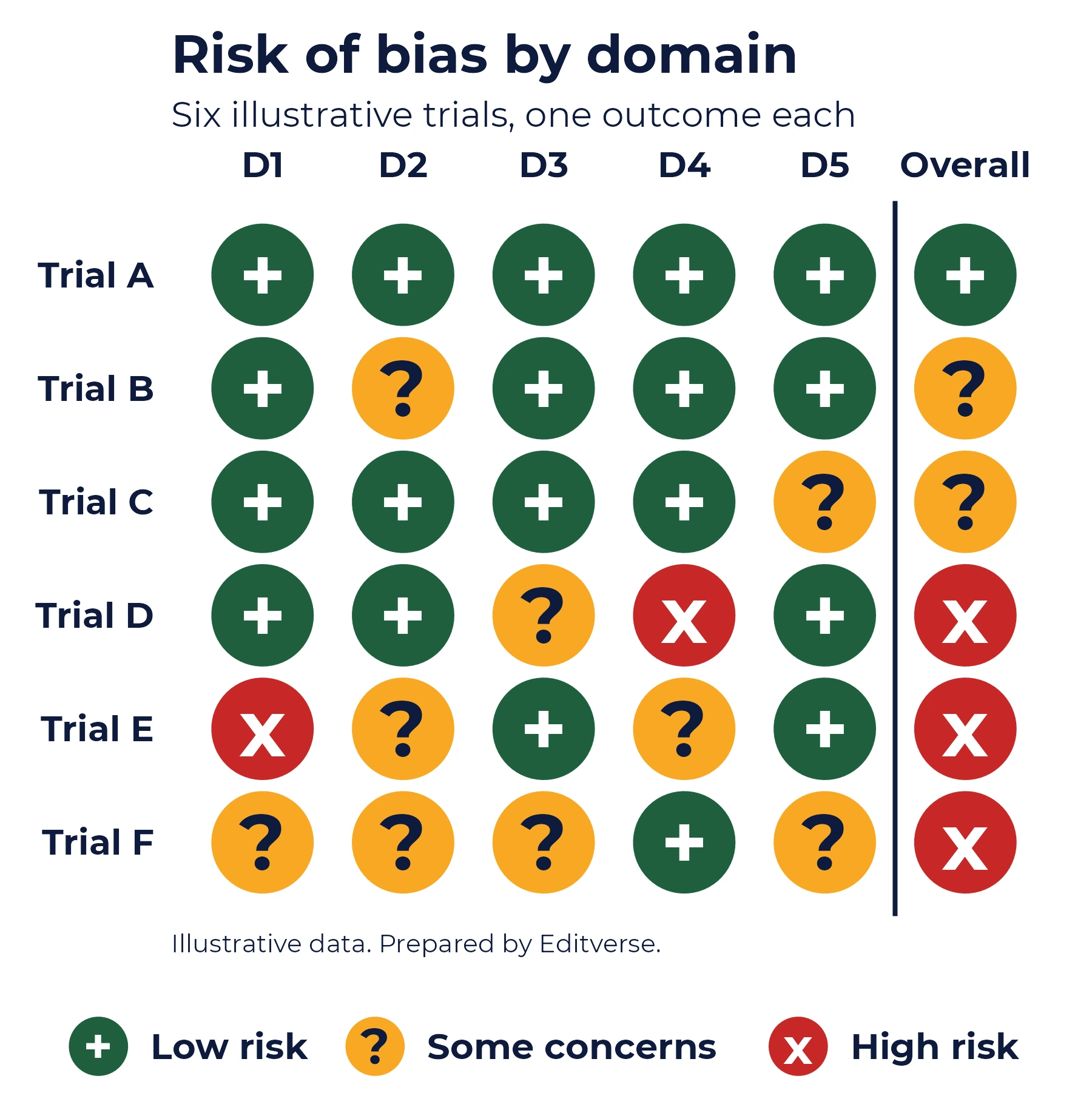
Plots like Figure 2 are conventional in systematic reviews. McGuinness and Higgins built the robvis R package and Shiny web app so that review teams can produce publication-quality risk-of-bias figures quickly (Res Synth Methods 2021). For a broader look at drawing trial and meta-analysis plots, see our guide to clinical research graphs.
A Real Example, RoB 2 Signalling Questions Applied to the ARTHROL Trial
The invented trial above shows the mechanics, but it cannot show how the RoB 2 signalling questions behave against a real report. This section applies the tool to a published randomized trial, ARTHROL, which tested oral resveratrol against placebo in adults with painful knee osteoarthritis. The effect of interest is the effect of assignment to intervention (intention-to-treat), and the result assessed is the change in knee pain on a 0 to 100 numeric rating scale at 3 months. Tables 9 to 11 and Figure 3 show the appraisal.
Illustrative Editverse appraisal for teaching
This appraisal is an Editverse teaching illustration of how the signalling questions are answered from a published report. It is not a judgement on the authors or on the quality of their work. Reviewers who assess the same trial may answer the rows tagged as judgement calls differently, and the guidance expects that.
| Item | Detail |
|---|---|
| Citation (Vancouver) | Nguyen C, Coudeyre E, Boutron I, Baron G, Daste C, Lefèvre-Colau MM, et al. Oral resveratrol in adults with knee osteoarthritis: a randomized placebo-controlled trial (ARTHROL). PLoS Med. 2024;21(8):e1004440. DOI 10.1371/journal.pmed.1004440 |
| Identifiers | PMID 39137167. PMCID PMC11321588. |
| Registration and protocol | ClinicalTrials.gov NCT02905799, registered before the trial started. Protocol published before the first participant was enrolled (Nguyen C, Boutron I, Baron G, et al. BMJ Open. 2017;7(9):e017652. DOI 10.1136/bmjopen-2017-017652). |
| Licence | Open access under CC BY 4.0 (creativecommons.org/licenses/by/4.0). Short quotations and one figure are reused here with attribution, and everything else is paraphrased. © 2024 Nguyen et al. |
| Why this trial | It is a two-arm, parallel-group, double-blind, placebo-controlled trial reported against CONSORT, with a registration, a published protocol and a statistical analysis plan. The flow diagram gives every count needed for domains 2 and 3, and the primary outcome is participant-reported, which makes domain 4 worth studying. |
Table 9. Trial selected for the real example, with identifiers and licence.
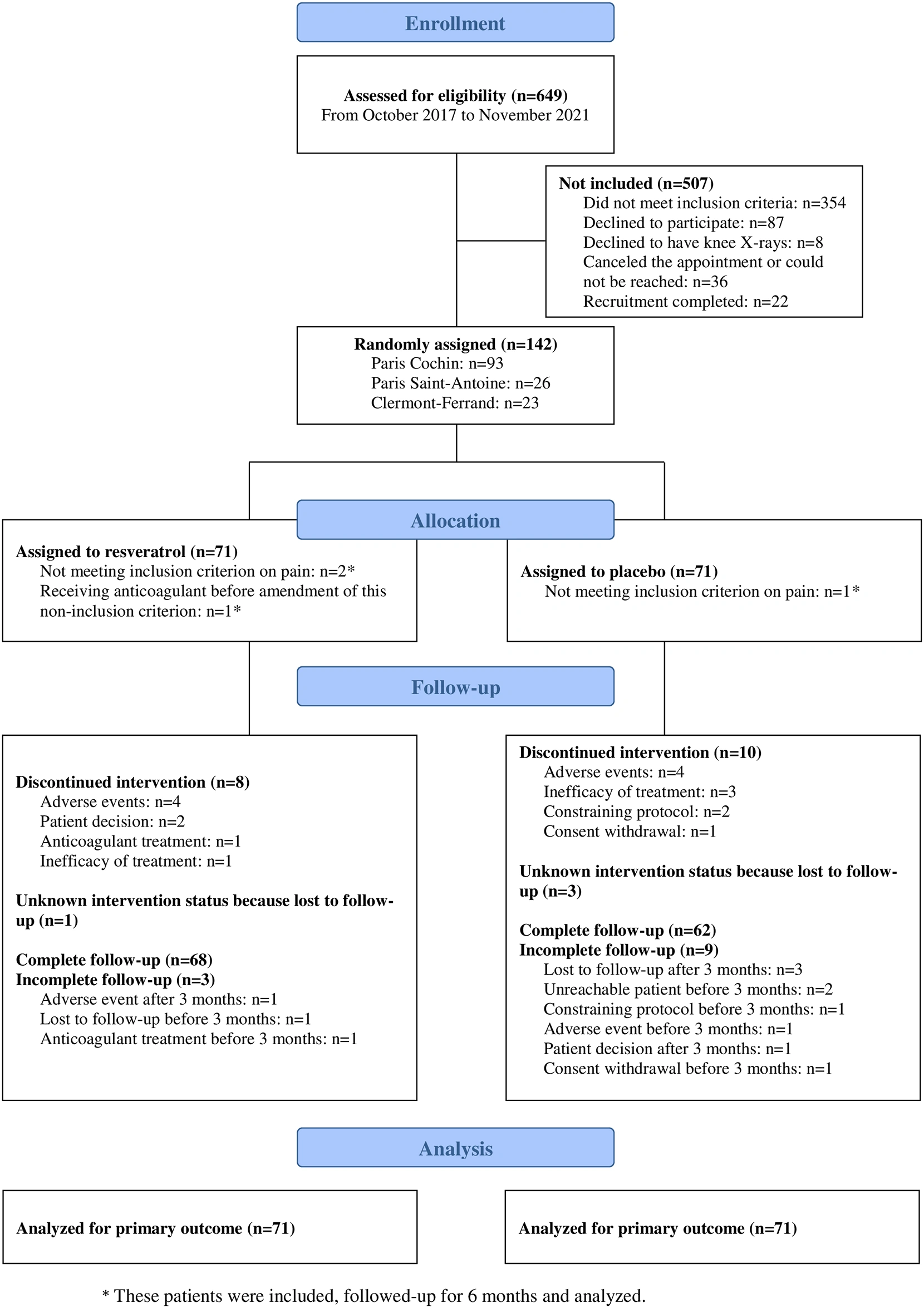
The table below follows the trial report, the protocol and the analysis plan in the order of the five domains. Each row names where the evidence sits, so a second reviewer can check the answer in a minute. The domain judgements come from the algorithm tables in the Cochrane guidance of 22 August 2019, and the algorithm is only a proposal that an assessor may override with a stated reason.
| Question | Evidence in the paper and where to find it | Answer |
|---|---|---|
| Domain 1, randomization process. Judgement Low. Algorithm (guidance Table 4) with 1.1 Y, 1.2 Y and 1.3 PN gives Low. | ||
| 1.1 Random sequence? | A computer-generated list from an independent statistician, stratified by centre, with permuted blocks of 2, 4 or 6 (Methods, Randomization and masking). | Y |
| 1.2 Sequence concealed? | Allocation ran through secured randomization software, and the protocol states the sequence was concealed by a computer interface in the e-CRF. Caplets were pre-labelled by the supplier (Methods; protocol, S1 Method). | Y |
| 1.3 Baseline imbalance suggests a problem? | Groups were 71 and 71 under 1:1 allocation and mean baseline knee pain was 56.9 and 55.5 (Table 1). Some covariates differ, for example previous NSAID use 46% versus 31% and mean age 59.8 versus 63.0 years, but the size is plausible by chance with 71 per arm and about 25 characteristics compared. JUDGEMENT CALL | PN |
| Domain 2, deviations from intended interventions (effect of assignment). Judgement Low. Part 1 Low (2.1 and 2.2 both PN or N) and Part 2 Low (2.6 Y), so the domain is Low (guidance Table 6). | ||
| 2.1 Participants aware of assignment? | The paper states participants were masked and the caplets had identical size, colour and taste (Methods). No blinding-success test is reported. | PN |
| 2.2 Carers and deliverers aware? | “Participants, investigators, statisticians, and treating physicians were masked to the allocation group” (Methods, Randomization and masking). | N |
| 2.3 to 2.5 Trial-context deviations | Not applicable because neither 2.1 nor 2.2 was answered Y, PY or NI. | NA |
| 2.6 Appropriate analysis? | The constrained longitudinal model includes every randomized participant with at least one baseline or post-baseline value, and the flow diagram shows 71 per arm analysed for the primary outcome, including four participants flagged at randomization for eligibility problems (Figure 1 footnote; Statistical analysis). The 15% who did not complete the allocated intervention (120 of 142 did) are analysed as randomized. | Y |
| 2.7 Impact of analysing in the wrong group? | Not applicable because 2.6 was Y. | NA |
| Domain 3, missing outcome data. Judgement Low. 3.1 PY gives Low without further questions (guidance Table 10). | ||
| 3.1 Data for all or nearly all? | Three-month pain data were available for 67 of 71 and 68 of 71, so 135 of 142 (95.1%), with 4 and 3 missing (Table 2 footnote; Discussion, limitations). The guidance says 95% will often be enough for a continuous outcome, so this sits right at the rule of thumb. JUDGEMENT CALL | PY |
| 3.2 to 3.4 | Not applicable. If an assessor preferred N for 3.1, question 3.2 would turn on the worst-case and best-case sensitivity analyses in S5 Appendix, which this appraisal did not open. | NA |
| Domain 4, measurement of the outcome. Judgement Low. 4.1 PN, 4.2 PN and 4.3 PN follow the first row of guidance Table 12, which is Low. | ||
| 4.1 Method inappropriate? | A self-administered 0 to 100 pain numeric rating scale, chosen to follow OMERACT and OARSI recommendations for knee osteoarthritis trials (Methods, Outcomes). | PN |
| 4.2 Measurement differed between groups? | Both arms completed the same questionnaire at home before the scheduled visit, “to minimize the data collectors’ influence on participants’ answers” (Methods, Outcomes). | PN |
| 4.3 Assessors aware of the intervention? | For a participant-reported outcome the assessor is the participant, and participants were masked (see 2.1). No blinding-success test is reported. | PN |
| 4.4 and 4.5 | Not applicable because 4.3 was PN. | NA |
| Domain 5, selection of the reported result. Judgement Low. 5.1 PY with 5.2 N and 5.3 PN gives Low (guidance Table 14). | ||
| 5.1 Pre-specified plan finalized before unblinded data? | The trial was registered before it started (NCT02905799), and protocol version 1.1 of 14 December 2016, still current in version 7.0 of 23 March 2021, fixed the primary outcome, the 3-month time point and the constrained longitudinal analysis (S1 Method, sections 7 and 8.2). The authors write that “All outcomes prespecified in the protocol were reported.” The separate analysis plan files are dated 3 and 4 October 2022, after the last follow-up on 12 May 2022, and the paper does not say when the data were unblinded, so this answer rests on the protocol. JUDGEMENT CALL | PY |
| 5.2 Selected from several measurements? | One primary measure (pain numeric rating scale) at one pre-specified time point (3 months). Other scales are labelled secondary. | N |
| 5.3 Selected from several analyses? | The reported model is the constrained longitudinal model fixed in the protocol and analysis plan. The protocol listed centre as a random effect and the analysis plan and paper use a fixed effect. The authors state that they did not use the planned GEE approach for the dichotomous outcomes because only three centres took part, a reason unrelated to the results. Sensitivity analyses (ANCOVA, two-time-point model, worst and best case) are labelled as such (Statistical analysis). JUDGEMENT CALL | PN |
| Overall judgement Low. All five domains are Low, which is the only route to Low in guidance Table 1. | ||
Table 10. RoB 2 signalling questions for the ARTHROL primary result (change in knee pain at 3 months, resveratrol versus placebo, effect of assignment to intervention). Y is yes, PY probably yes, PN probably no, N no and NA not applicable. Section pointers refer to Nguyen et al. 2024 unless stated. Rows tagged as judgement calls are those where reasonable assessors could answer differently. Algorithms follow the Cochrane RoB 2 guidance of 22 August 2019 (its Tables 1, 4, 6, 10, 12 and 14).
The summary below collects the judgements and the answers that decided each one.
| Domain | Judgement | Answers that decided it | Deciding evidence |
|---|---|---|---|
| D1 Randomization | Low | 1.1 Y, 1.2 Y, 1.3 PN | Computer-generated stratified blocks, software-controlled concealment, balanced arms |
| D2 Deviations | Low | Part 1 Low, Part 2 Low | Masked participants and clinicians, all randomized participants analysed as assigned |
| D3 Missing data | Low | 3.1 PY | 135 of 142 with 3-month data (95.1%) |
| D4 Measurement | Low | 4.1 PN, 4.2 PN, 4.3 PN | Same self-reported scale in both arms, completed by masked participants |
| D5 Reported result | Low | 5.1 PY, 5.2 N, 5.3 PN | Registered, protocol fixed the outcome and model, one primary measure |
| Overall | Low | Low in all five domains | Guidance Table 1 |
Table 11. Domain and overall judgements for the ARTHROL primary result. The rules come from the Cochrane RoB 2 guidance of 22 August 2019.
What a Low Rating Does and Does Not Tell You
The primary result was a mean change in knee pain of -15.7 points with resveratrol and -15.2 with placebo, a difference of -0.6 (95% CI -8.0 to 6.9). RoB 2 rates this result Low because the trial was run and reported in a way that protects against bias. It says nothing about precision. The authors randomized 142 of a planned 164 participants and describe the study as under-powered, and that limitation belongs to the imprecision judgement in a GRADE assessment, not to a RoB 2 domain.
Why Non-Adherence Did Not Count Against the Trial
Only 120 of 142 participants (85%) completed the allocated intervention, which looks worrying until you recall the question being asked. For the effect of assignment, departures from the protocol only matter when they arise from the trial context, and an analysis of everyone as randomized is appropriate. A review that asked about the effect of adhering to intervention would use a different set of questions in domain 2 and would need a more specialised analysis than the one reported here.
Where Two Assessors Might Differ
Four rows carry a judgement-call tag. Row 1.3 depends on how much baseline difference you accept as chance, row 3.1 sits on the 95% rule of thumb, and rows 5.1 and 5.3 depend on how you treat an analysis plan dated after follow-up and a change in the centre term. Under the algorithm, a less favourable answer to 1.3 (PY), 5.1 (PN or NI) or 5.3 (NI) would lower that domain, and with it the overall rating, to Some concerns, and a Y or PY on 5.3 would give High. An N on 3.1 would send the assessor to question 3.2 and the sensitivity analyses. Whichever way you answer, record the quotation and section that justified your choice. That record is what makes a RoB 2 assessment checkable by a second reviewer.
Compare this outcome with the hypothetical open-label trial earlier in this guide. There, a participant-reported outcome in an unblinded trial drove domain 4 to High. Here, the same kind of outcome sits in a masked, placebo-controlled design, so domain 4 stays Low. The outcome type did not change the rating, the masking did. The full signalling-question set is in the Cochrane RoB 2 guidance and the trial details are in the original article.
Cluster and Crossover Variants in Brief
The 2019 guidance supplies three templates, one each for individually randomized parallel-group trials, cluster-randomized parallel-group trials (including stepped-wedge designs) and randomized crossover trials and other matched designs. The five domains above apply to individually randomized trials including crossover trials. Cluster-randomized trials receive an additional domain, 1b, which covers bias arising from identification or recruitment of individual participants within clusters. The guidance states that no version exists yet for cluster crossover trials. The Cochrane Handbook summarises both variants in its Chapter 23, and the official templates sit on riskofbias.info. If you meet a crossover trial, our article on crossover design and washout periods explains the design features you will need to judge.
Reporting RoB 2 Signalling Questions and Judgements
Reporting should let a reader reproduce your judgements. The guidance recommends presenting consensus domain-level judgements in the main review, as a table, a figure or within a forest plot, and placing the signalling answers with their supporting text in an appendix. Individual assessor records belong in a supplement and should not be prominent. Cover the following points in your methods.
- Name the tool and its version, and state which design template you used for each trial.
- State the effect of interest, and for adherence, which deviations you assessed.
- List the outcomes and time points assessed, and say which result from each trial you chose when several were reported.
- Describe how assessors worked and how disagreements were resolved.
- Explain every override of an algorithm proposal and any use of the multiple Some concerns clause.
- Cite the sources you used for each trial, including protocols and registry entries, because domain 5 depends on them.
Methods sentence you can adapt
Risk of bias in each included randomized trial was assessed for [outcome] at [time point] using RoB 2 (guidance of 22 August 2019) for the effect of assignment to intervention. Two reviewers answered the signalling questions independently, resolved differences by discussion, and recorded supporting quotations. Domain-level and overall judgements (Low, Some concerns, High) were reached using the published algorithms, and any override is documented in the supplement.
Report the review itself against PRISMA 2020, and place your risk-of-bias figure beside the forest plot. Our PRISMA 2020 flow diagram generator handles the flow diagram, and the GRADE evidence table calculator supports the step that follows. If you are writing this section inside a thesis, the article on matching reporting guidelines to thesis chapters shows where each item belongs.
Common Mistakes When Applying RoB 2
- Rating the trial instead of the result. Randomization problems affect the whole study, but deviations, measurement and selection of the reported result attach to the specific outcome.
- Trusting the label “intention-to-treat”. The guidance notes that the term has no consistent definition in study reports. Check the actual analysis against question 2.6.
- Treating covariate adjustment as a fix for broken randomization. The guidance says a trial that controlled for baseline imbalances to mitigate failures of randomization should be assessed with ROBINS-I instead (Sterne et al., BMJ 2016).
- Letting one answer drive another. Answer each question on its own evidence.
- Defaulting to No information. Use Probably yes or Probably no when the circumstances support a reasonable judgement.
- Skipping the implementation note. The reliability results above show why a short, topic-specific rule sheet is worth the time.
- Presenting algorithm output without reasoning. A bare colour grid invites doubt. Add abridged justifications.
Several of these mistakes also appear in the wider list in our guide to common mistakes in meta-analysis. If you are unsure how many trials your synthesis needs once the High risk ones are set aside, read the minimum number of studies for a meta-analysis. For the study-design hierarchy behind these decisions, see levels of evidence in clinical research, and for the next step after risk of bias, see our GRADE methodology guide. Our earlier overview of the Cochrane Risk of Bias Tool 2.0 gives a broader introduction, and our meta-analysis masterclass covers pooling, heterogeneity and publication bias.
Tools and Resources
Three free Editverse tools support the work around a risk-of-bias assessment. Use them to draw figures, choose tests and build flow diagrams.
Free Research Tools from Editverse
- GraphPro: build publication-ready charts, 25 types, with built-in t-test, ANOVA, correlation, and chi-square p-values. Free, no signup.
- StatPro: free statistical calculators and a test-selector tool covering group comparisons, categorical outcomes, time-to-event analysis, and diagnostic accuracy.
- Flowchart Pro: generate PRISMA 2020, PRISMA-ScR, CONSORT, STROBE, STARD, MOOSE, and ARRIVE flow diagrams directly in your browser.
Professional Support for Risk-of-Bias Assessment and Systematic Reviews
A defensible RoB 2 assessment starts with the review protocol, because the effect of interest, the outcomes and the rule sheet are all decided there. Editverse supports systematic reviews from protocol to manuscript, with reporting work aligned with COPE, ICMJE and GPP 2022. The packages below are the closest fit to the risk-of-bias workflow in this article.
Protocol
$500
PROSPERO-ready protocol with eligibility criteria, search strategy, data extraction plan and guidance on selecting the risk-of-bias tool. Standard delivery is 2 to 3 weeks.
Systematic review plus meta-analysis
$1,800
Full review and meta-analysis for up to 15 eligible studies, with quality assessment, risk of bias figures, forest plots and PRISMA 2020 compliance.
Not sure which package fits your question? Our systematic review writing service page explains how the process works, and our manuscript writing services cover the write-up once your assessments are complete.
Conclusion
The RoB 2 risk of bias tool rewards a disciplined routine. Decide the effect of interest and the results to assess, write a short rule sheet, answer each of the RoB 2 signaling questions from the report and the protocol, and let the algorithms propose domain ratings that you then verify. The overall rating follows the worst domain, with one judgement-based exception for several Some concerns. Report consensus judgements in the main text and the supporting answers in a supplement. Done this way, the assessment becomes a transparent record that readers, peer reviewers and GRADE panels can follow.
References
- Sterne JAC, Savović J, Page MJ, et al. RoB 2: a revised tool for assessing risk of bias in randomised trials. BMJ. 2019;366:l4898. DOI 10.1136/bmj.l4898. PMID 31462531. Open source
- Higgins JPT, Savović J, Page MJ, Elbers RG, Sterne JAC, editors. Revised Cochrane risk-of-bias tool for randomized trials (RoB 2). Guidance document, 22 August 2019. Open source
- Cochrane Handbook for Systematic Reviews of Interventions, Chapter 8, Assessing risk of bias in a randomized trial. Open source
- Sterne JA, Hernán MA, Reeves BC, et al. ROBINS-I: a tool for assessing risk of bias in non-randomised studies of interventions. BMJ. 2016;355:i4919. DOI 10.1136/bmj.i4919. PMID 27733354. Open source
- Savović J, Turner RM, Mawdsley D, et al. Association between risk-of-bias assessments and results of randomized trials in Cochrane reviews: the ROBES meta-epidemiologic study. Am J Epidemiol. 2018;187(5):1113-1122. DOI 10.1093/aje/kwx344. PMID 29126260. Open source
- Minozzi S, Dwan K, Borrelli F, Filippini G. Reliability of the revised Cochrane risk-of-bias tool for randomised trials (RoB2) improved with the use of implementation instruction. J Clin Epidemiol. 2022;141:99-105. DOI 10.1016/j.jclinepi.2021.09.021. PMID 34537386. Open source
- McGuinness LA, Higgins JPT. Risk-of-bias VISualization (robvis): an R package and Shiny web app for visualizing risk-of-bias assessments. Res Synth Methods. 2021;12(1):55-61. DOI 10.1002/jrsm.1411. PMID 32336025. Open source
- Page MJ, McKenzie JE, Bossuyt PM, et al. The PRISMA 2020 statement: an updated guideline for reporting systematic reviews. BMJ. 2021;372:n71. DOI 10.1136/bmj.n71. PMID 33782057. Open source
- Nguyen C, Coudeyre E, Boutron I, Baron G, Daste C, Lefèvre-Colau MM, et al. Oral resveratrol in adults with knee osteoarthritis: a randomized placebo-controlled trial (ARTHROL). PLoS Med. 2024;21(8):e1004440. DOI 10.1371/journal.pmed.1004440. PMID 39137167. Open source
- Nguyen C, Boutron I, Baron G, Coudeyre E, Berenbaum F, Poiraudeau S, et al. Evolution of pain at 3 months by oral resveratrol in knee osteoarthritis (ARTHROL): protocol for a multicentre randomised double-blind placebo-controlled trial. BMJ Open. 2017;7(9):e017652. DOI 10.1136/bmjopen-2017-017652. PMID 28965100. Open source