
Researchers searching for Malaysia research grants in 2026 meet three ministries, three portals and one naming problem. The Fundamental Research Grant Scheme (FRGS) has been the long-running Ministry of Higher Education grant, a newer scheme called GET opened in 2026, and the Ministry of Science, Technology and Innovation (MOSTI) and the Ministry of Health (MOH) run separate funds with their own rules. This guide maps each route, says who can apply, and marks every figure we could confirm on an official page. It also lists what we could not confirm, including whether GET replaces FRGS.
Editverse is independent. We are not affiliated with, or endorsed by, the Ministry of Higher Education, MOSTI, the Ministry of Health or any Malaysian university. Call terms change between cycles, so treat this page as a map and the current guideline as the authority. We read the funder pages on 10 October 2026.
In Simple Words
Most Malaysian academics apply for government grants through their university’s research management centre. The Ministry of Higher Education funds FRGS and the newer GET scheme, both with a ceiling of RM250,000 over 2 or 3 years as published by universities. MOSTI funds larger, technology-ready projects through the PEMACU 2.0 programme, with ceilings of RM4 million and RM10 million. The Ministry of Health research grant is for ministry staff. Confirm which call is open on the right portal before you write anything.
How Malaysia Research Grants Are Organised in 2026
The higher education ministry is now Kementerian Pendidikan Tinggi (KPT), and MOSTI is Kementerian Sains, Teknologi Dan Inovasi. Some official portals, including the MyGRANTS home page, still use the older name Kementerian Pengajian Tinggi. Old names appear in search results too, so check the date of any document you rely on.
| Ministry | Main route | Portal | Who usually applies |
|---|---|---|---|
| Higher Education (KPT / MOHE) | FRGS, GET and other schemes listed on MyGRANTS | MyGRANTS, run under the ministry’s Division of Research Excellence | Academics at public and private universities, endorsed by the university |
| Science, Technology and Innovation (MOSTI) | PEMACU 2.0, with the Technology Development Fund and Strategic Research Fund | Sistem Dana Bersepadu (SDB) | Universities, government research institutes, SMEs and start-ups |
| Health (MOH) | MOH Research Grant (MRG) | National Medical Research Register (NMRR) | Ministry of Health personnel |
We found no portal that covers all three ministries. Plan to track each one separately.
FRGS, the Long-Running Higher Education Grant
The Fundamental Research Grant Scheme (Skim Geran Penyelidikan Fundamental) is run by the ministry and administered by its Department of Higher Education (JPT). A 2025 FRGS guideline hosted by a university research centre names JPT as the grant administrator. The older MASTIC listing describes the purpose as generating new theories, concepts and ideas and developing good-quality human capital.
We read the rules from two university-hosted copies of the guidelines, so treat the figures as published by universities rather than read on the ministry’s own site. The 2024 amended guideline sets these terms.
- The project leader must be full-time academic staff (Professor, Associate Professor, Senior Lecturer or Lecturer) with at least a Master’s degree.
- The leader needs at least one year of remaining service from the closing date.
- A Malaysian leader needs at least one Malaysian permanent co-researcher.
- The individual applies as project leader, the university’s research management centre director evaluates and endorses the application, and the grant is paid to the institution.
- Each applicant may submit one application per phase.
- The ceiling is RM250,000 unless JPT grants an exception, and the duration is 2 or 3 years only. The 2025 guideline repeats both figures.
FRGS has no fixed calendar. The 2024 guideline says JPT announces each opening by official letter to institutions. The last call we could confirm was FRGS 2025, shown on the MyGRANTS portal text as open from 2 January to 28 February 2025. Universities set earlier internal deadlines. We found no FRGS 2026 call on any readable page, so we cannot say whether FRGS will reopen.
GET, the 2026 Exploratory and Transformative Research Grant
In 2026 the ministry opened a scheme called GET (Geran Penyelidikan Eksploratori dan Transformatif) under its Dana Kelestarian Penyelidikan fund. The Higher Education Department’s briefing slides of 26 February 2026 and its guideline, both hosted on the USM research site, show GET opening on 1 March 2026 and closing on 15 April 2026. University pages add local detail, and you should confirm everything with your research management centre.
- Universities report a ceiling of RM250,000 per project, for 2 or 3 years (USM notice and IIUM notice).
- Themes follow the mega trends in the 13th Malaysia Plan. Examples named include shifts between economic blocs, digital and technology change, demographic change, planetary health crisis, education, national security and heritage.
- IIUM states that all MOHE projects must be completed and officially closed before you apply. The ministry guideline says the same for earlier grants, including their KPIs, verified by your research management centre.
- The guideline also requires at least two years of remaining service from the closing date, a mentor for lecturers, senior lecturers and associate professors, an industry or agency collaborator, a patent search, a risk assessment and a return-on-value plan. A researcher may lead at most three projects over a career under GET and FRGS combined, with no more than five co-researchers or collaborators.
- Applications were evaluated at faculty level and then by the university research centre, and the USM notice mentions a shared folder rather than MyGRANTS.
- The official closing date was 15 April 2026, internal university deadlines fell in March 2026, and Unisel reported GET Phase 1 2026 awards on 10 July 2026.
The ministry’s GET guideline treats GET as the equivalent of FRGS for its three-project career cap, and no page we found says FRGS has ended. A March 2026 opinion piece by a UPM lecturer says GET is not merely a name change. If you plan a 2027 application, ask your research office whether FRGS will return, and write the proposal so that it can serve either scheme.
Other Ministry of Higher Education Schemes
The MyGRANTS page lists nine schemes by name, which are FRGS, ERGS, PRGS, TRGS, LRGS, RAGS, GSP-KPM, RACE and MyLAB. It gives no eligibility, amounts or call dates. The portal text we could read showed older windows only, such as MyLAB 1/2024 from 19 August to 30 October 2024. We could not confirm current terms for any of them.
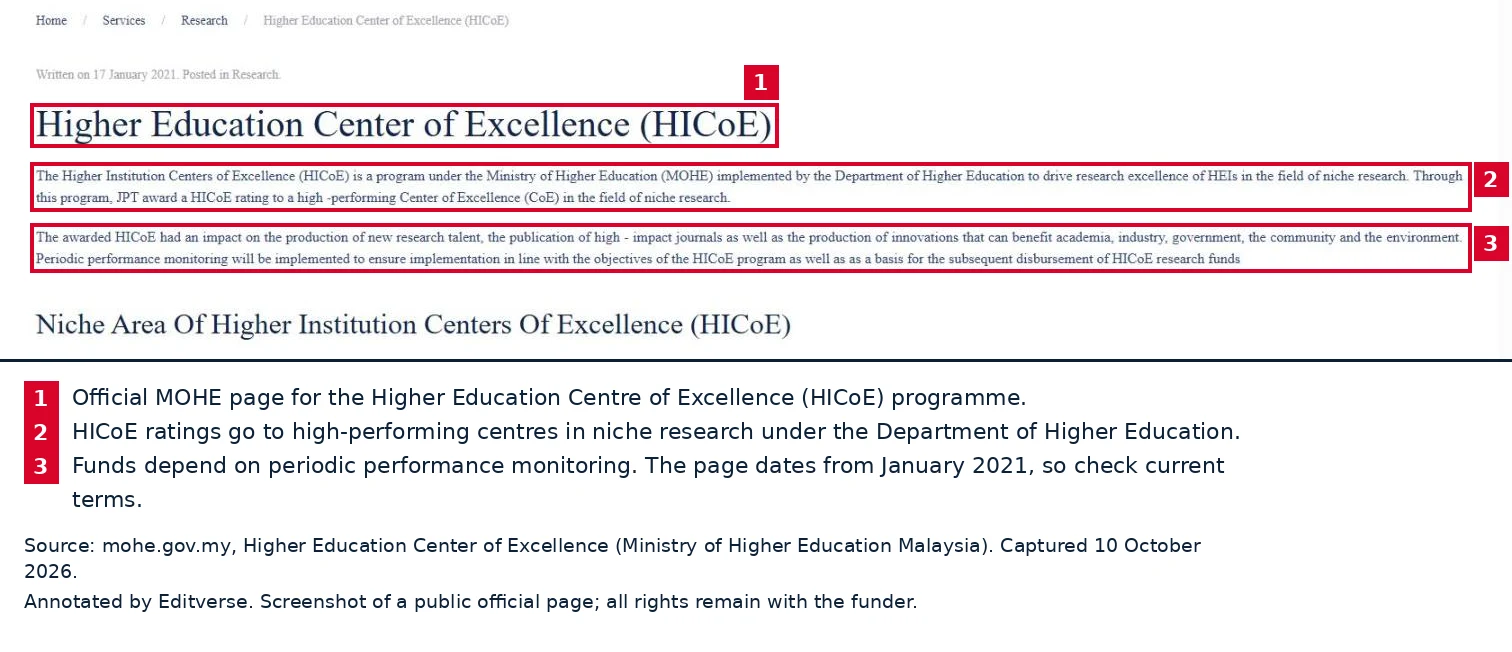
Two further ministry pages are readable. Higher Education Centre of Excellence (HICoE) is a rating programme for research centres and not an individual grant. A centre must be established for at least five years, with at least five full-time permanent academics in its research thrust and more than 70 percent of activity in research and innovation. The page lists eight batches, the latest in 2022.
The Public-Private Research Network (PPRN) offers a matching grant of up to RM350,000 for demand-driven industry projects. The company must be registered with SSM, majority Malaysian-owned, with sales above RM100,000 and at least one year of operation. The researcher lead must be a permanent Malaysian staff member with at least 24 months of service left. The page gives no call window, and the secretariat is pp**@******ov.my.
MOSTI Funding Through PEMACU 2.0
MOSTI funds projects through its Sistem Dana Bersepadu portal. The current flagship is PEMACU 2.0, described in a guideline dated February 2026. It has two funds. The Technology Development Fund (TeD) is bottom-up, and the Strategic Research Fund (SRF) is top-down, with themed calls in areas such as nuclear, biotechnology, space, hydrogen and advanced materials.
| Item | TeD | SRF |
|---|---|---|
| Ceiling per product page | Up to RM4,000,000 | Up to RM10,000,000 |
| Duration | Up to 36 months | Up to 36 months |
| Who may apply | Public and private universities, government research institutes, SMEs and start-ups | Same entities |
| Technology readiness | At least TRL 4 at entry, with TRL 7 as the end-of-project target | SRF-RFP calls may set a lower entry level, and one health call set TRL 3 |
| Cost sharing | SMEs and start-ups match at least 15% in cash, universities and institutes are fully funded | Same |
The guideline adds that universities and government research institutes must collaborate with an SME or start-up and support the application with a Letter of Acceptance. The organisation signs the agreement, and the project leader is an individual from that organisation who may lead only one project at a time. Unsuccessful applicants may reapply after six months. The ceilings come from the PEMACU 2.0 product page.
One SRF request for proposals, on a large language model for the health sector, shows the scale of a themed call. It gave an estimated RM15 million, 33 months and a minimum TRL of 3, and showed no closing date (request for proposals). The SDB site also shows a banner for a second cycle, with no dates, so we cannot say whether PEMACU 2.0 is open.
A conflict inside the MOSTI site
The SDB frequently asked questions page shows no visible date, although its metadata shows a last edit in January 2026, before the February 2026 guideline. It lists older fund names with ceilings from RM500,000 to RM15 million, says there is no closing date, and says one fund is open to individuals including lecturers without going through the research management centre. The 2026 guideline conflicts with it on amounts. We rely on the 2026 guideline and suggest you do not quote the older figures without checking with MOSTI.
Health Research and the MOH Research Grant
The Ministry of Health Research Grant (MRG) appears on the MASTIC incentives page, with an entry dated 19 July 2024. It generates new scientific knowledge, runs up to three years, and is submitted through the National Medical Research Register (NMRR) at any time of year. The principal investigator must be MOH personnel, applicants may hold at most two applications at a time, and staff on study leave cannot be principal investigator. The page states no amount.
This means university researchers outside the ministry cannot lead an MRG. NMRR is the web-based register that streamlines application, review and approval of research in MOH, managed by secretariats at the National Institutes of Health. Its FAQ notes that clinical trials in Malaysia need prospective registration, which is an NPRA requirement.
Which of the Malaysia Research Grants Fits You
This table is Editverse’s reading of the published rules. It is a starting point for a conversation with your research management centre, not a ruling.
| Your situation | Route to check first | Why |
|---|---|---|
| Academic at a Malaysian university with exploratory, fundamental research | GET, or FRGS if it reopens | RM250,000 over 2 or 3 years as published by universities, and earlier ministry grants must be completed first |
| University team with a working prototype and an industry partner | MOSTI PEMACU 2.0 (TeD) | TRL 4 at entry, an SME or start-up partner and a Letter of Acceptance |
| Industry-demand project with a company partner | MOHE PPRN | Matching grant up to RM350,000, company must meet SSM and sales tests |
| Ministry of Health clinician or scientist | MRG through NMRR | Open to MOH personnel only, up to 3 years |
| University researcher without MOH employment who needs health funding | Check university and ministry calls | MRG is closed to non-MOH staff |
| Research centre seeking recognition | HICoE rating | A rating programme, not an individual grant |
Compare these routes with our guides to Singapore research grants, Saudi Arabia research grants and UAE research grants. Malaysia differs because three ministries each run their own system, and the university research centre sits inside the ministry routes.
Writing a Proposal That Fits Malaysian Funders
Editverse cannot read your reviewers’ minds, but the published rules give clear levers. The points below are our judgement on how to use them.
- For GET, name the 13th Malaysia Plan theme your project serves in the first paragraph, because the call is organised around those themes.
- For PEMACU 2.0, state your current TRL, your target TRL and your SME partner’s role in plain numbers, since TRL 4 at entry is required and TRL 7 is the end-of-project target.
- Build a budget justification and research timeline that fit 2 or 3 years and the ceiling, with no cost the guideline excludes.
- Show feasibility with preliminary studies, and give each team member a role, as our team guide explains.
- Describe how results will reach users, using the knowledge translation approach, and plan the sustainability of the work beyond the grant.
- Send your research management centre a complete draft well before its internal deadline, because it evaluates and endorses before submission.
Pre-Submission Checklist for Malaysia Research Grants
- Confirm the call is open on MyGRANTS, SDB or NMRR, and note the closing date.
- Ask your research management centre for its internal deadline and endorsement steps.
- Check leader eligibility, remaining service, co-researcher and active-grant rules.
- Save a dated copy of the guideline you wrote against.
- Check the ceiling, duration and any matching or cash-contribution rule.
- Map each evaluation criterion to a section of your proposal.
- Prepare ethics approvals, or NMRR registration for health projects, or a dated plan for them.
- Plan how you will cite the award, using our funding acknowledgment guide.
- Read our grant writing guide and the NIH proposal guide for structure, then fit the content to the Malaysian scheme.
Frequently Asked Questions About Malaysia Research Grants
Is FRGS still open?
We found no FRGS 2026 call on any readable page. The last call we could confirm opened on 2 January 2025 and closed on 28 February 2025. Ask your research management centre whether FRGS will return.
Does GET replace FRGS?
No page we read says so. The ministry’s GET guideline treats GET as the equivalent of FRGS for its career cap, and we found no statement that FRGS has ended.
How much can I request from FRGS or GET?
University-hosted guidelines and notices give a ceiling of RM250,000 for a 2 or 3 year project, with exceptions only by JPT approval for FRGS.
Can I apply for the MOH Research Grant from a university?
The MASTIC entry says the principal investigator must be MOH personnel, so non-MOH university researchers are not eligible.
Can Editverse guarantee funding?
No honest service can. Awards rest with evaluators and funders. We can edit and structure your proposal so that it answers the published criteria.
Free Research Tools from Editverse
- GraphPro: build publication-ready charts, 25 types, with built-in t-test, ANOVA, correlation, and chi-square p-values. Free, no signup.
- StatPro: free statistical calculators and a test-selector tool covering group comparisons, categorical outcomes, time-to-event analysis, and diagnostic accuracy.
- Flowchart Pro: generate PRISMA 2020, PRISMA-ScR, CONSORT, STROBE, STARD, MOOSE, and ARRIVE flow diagrams directly in your browser.
Professional Support for Malaysia Research Grants Applications
Funded proposals answer a specific guideline, line by line. Editverse grant services start from the call you send us. The packages below were built around NIH, NSF and EU Horizon criteria, so for a GET, FRGS or PEMACU 2.0 application you send the guideline and we audit or write against the criteria and limits it states.
Editing and Review
$1,190
Audit of a complete draft against the criteria of your target funder, narrative strengthening and a compliance check. One revision round, 7 to 10 business days.
Resubmission Support
$1,690
Analysis of reviewer feedback, a point-by-point response strategy and targeted rewrites. Two revision rounds, 2 to 3 weeks.
Full Development
Typically from $3,500
End-to-end proposal writing by a published researcher, including a statistical analysis plan and budget justification narrative. Two revision rounds, 2 to 4 weeks.
For anything the packages do not cover, read about our grant proposal development services or request a free quote and tell us the scheme and your deadline. Prices shown are current catalog prices and scope is confirmed before work begins.
Conclusion on Malaysia Research Grants
Malaysia Research Grants run through three ministries. The Ministry of Higher Education route (GET, and FRGS if it returns) suits exploratory academic work at RM250,000 over 2 or 3 years as published by universities. MOSTI suits technology-ready projects with an SME partner, and the MOH grant is for ministry staff.
Before you draft, confirm the open call on the right portal, save the guideline, check leader and active-grant rules, and ask your research management centre for its internal deadline. Then write to the theme and the numbers the guideline sets.
Sources
Official and university-hosted pages read on 10 October 2026. Grant terms change between cycles, so always confirm against the current call.
- Ministry of Higher Education (KPT)
- Ministry of Science, Technology and Innovation (MOSTI)
- MOHE, MyGRANTS
- MyGRANTS portal
- FRGS 2025 guideline (hosted by UTHM)
- FRGS amended guideline 2024 (hosted by USM)
- MASTIC, FRGS listing
- USM, national external grants
- USM, GET 2026 notice
- IIUM, GET call for proposals
- Unisel, GET award news
- UPM, from FRGS to GET
- MOHE, Higher Education Centre of Excellence
- MOHE, Public-Private Research Network
- MOSTI, Sistem Dana Bersepadu
- MOSTI, PEMACU 2.0 guideline, February 2026
- MOSTI, PEMACU 2.0 product page
- MOSTI, SRF request for proposals on a health-sector language model
- MOSTI SDB, frequently asked questions
- MASTIC, Ministry of Health Research Grant
- NMRR, general FAQ