
Publisert
Ocuco CHERRIES checklist, short for Checklist for Reporting Results of Internet E-Surveys, is the reporting guideline for questionnaires that people complete on the web. Gunther Eysenbach published it in the Journal of Medical Internet Research in 2004 as a table of 30 items in eight categories, and a 2012 correction fixed the formulas for three response measures.1,2 We found no revised or extended version, so those two papers remain the working record.
Most guides stop at listing the items. This guide goes further. After the checklist itself, we score all 30 items against a real open-access web survey, published in JMIR Cancer in 2026, that states it followed CHERRIES, with the article section beside every verdict.3 The scoring shows where a paper that cites the CHERRIES checklist still leaves readers unable to find an answer, how easily the three response rates are mislabelled, and how many answers sit only in an appendix.
Med enkle ord
The CHERRIES checklist tells you what to write about a survey that people filled in on the web. It has 30 items in eight groups, and they cover who could see the survey, how it was built and tested, how people were kept from answering twice, and how many people saw it, agreed and finished. Write one clear sentence for every item, work out the three response rates with the corrected 2012 formulas, and say plainly when a number cannot be known. Then check that the figures in your abstract, text and tables agree.
What the CHERRIES Checklist Is and What Changed Since 2004
Eysenbach defined an e-survey as an electronic questionnaire administered on the Internet or an Intranet. The CHERRIES checklist focuses on web-based surveys, although many items also suit e-mail surveys.1 Its aim is to let reviewers and readers see how the sample was selected and how it may differ from a representative one. Bias from a non-representative internet population and from self-selection is the problem the CHERRIES checklist is built around, and the paper says that conclusions drawn from a convenience sample need to be qualified in the discussion.1 When the statement appeared, JMIR told authors that its editors and peer reviewers expected web survey reports to follow it.1
CHERRIES is a reporting checklist and not a quality score. The CHERRIES checklist asks whether a reader can find out how the survey ran, and it does not judge whether the survey was good. The original paper is blunt about response measures, noting that "there is no single response rate" in online surveys, and it advises authors to avoid the term altogether.1 The checklist is listed on the EQUATOR-nettverket området.
The 2012 correction and other versions
In 2012 the author corrected Table 1 of the original paper. The correction notice says that, in the recommendations on how view rate, participation rate and completion rate should be calculated, "denominators and numerators were flipped".2 It also warns that "incorrect versions may exist on other sites". The Europe PMC copy of the 2004 paper that we read carries the corrected formulas, and Table 2 below uses them. Authors who copied the CHERRIES checklist from a repository or a slide deck should check which version they hold.
We searched PubMed, Europe PMC and Crossref on 1 November 2026 and found no revised, extended or numbered second version of CHERRIES. Related items include two that matter here. A Spanish adaptation of the checklist appeared in 2019, and a broader consensus-based checklist for survey studies, CROSS, was published in 2021.4,5 Neither replaces the original CHERRIES checklist, so authors can still cite CHERRIES, as the example in this guide does. A 2026 survey of European residents in JMIR mHealth and uHealth, for instance, reports following CHERRIES for the online survey and STROBE for the cross-sectional design.6
The 30 CHERRIES Checklist Items in Eight Categories
Table 1 groups the CHERRIES checklist items as the original table does, with shortened category names. We paraphrase here, and the full wording of each item with its explanation sits in Table 1 of the open-access original, which is licensed CC BY 2.0.1
Table 1. The eight CHERRIES categories and what a reviewer checks. Content summarised from Eysenbach, 2004.
| Kategori | elementer | What a reviewer checks |
|---|---|---|
| 1 Design | 1 | The target population, the sample frame and whether the sample is a convenience sample. |
| 2 IRB approval and consent | 3 | Ethics approval, the consent process (purpose, length, data stored, investigator) and protection of personal data. |
| 3 Development and pre-testing | 1 | How the survey was built and whether usability and technical function were tested before fielding. |
| 4 Recruitment | 3 | Open or closed survey, whether first contact was online, and how the survey was advertised. |
| 5 Survey administration | 11 | Web or e-mail, the context of the site, mandatory or voluntary, incentives, timeframe, randomisation, adaptive questioning, items per page, number of screens, completeness check and review step. |
| 6 Response rates | 4 | How a unique visitor was defined, then view rate, participation rate and completion rate. |
| 7 Preventing multiple entries | 4 | Cookies, IP check, log file analysis and registration. |
| 8 Analyse | 3 | Handling of incomplete questionnaires, atypical timestamps and statistical correction. |
Category 5 carries 11 of the 30 items, so most of the work sits in describing the administration of the survey. Two items in the CHERRIES checklist hold advice that authors often miss. The completeness check item recommends that every question offer a non-response option such as not applicable or rather not say, with one option required. The unique site visitor item says that if view or participation rates are given, the way a unique visitor was identified must be defined, whether by IP address, cookie or both.1 Figure 1 shows the eight categories in one view.

Response Rates in the CHERRIES Checklist After the 2012 Correction
The response-rate block is the part of the CHERRIES checklist most often misapplied, because online surveys have no single denominator. The CHERRIES checklist defines three measures instead, and Table 2 gives them in their corrected form.1,2
Table 2. View, participation and completion rates as corrected in 2012.
| Måle | teller | Nevner | Enkel betydning |
|---|---|---|---|
| Seerfrekvens | Unique visitors to the first survey page | Unique site visitors, not page views | Share of site visitors who reached the survey |
| Deltakelsesgrad | Unique visitors who agreed to take part | Unique visitors to the first survey page, or the consent page if there is one | Share who consented, also called a recruitment rate |
| Gjennomføringsgrad | People who submitted the last page | People who agreed to take part | A measure of attrition and not of how completely forms were filled |
A short hypothetical shows the arithmetic. Suppose 10,000 unique visitors reach a site, 800 open the first survey page, 500 agree to take part and 400 submit the last page. The view rate is 800 / 10,000, or 8.0%. The participation rate is 500 / 800, or 62.5%. The completion rate is 400 / 500, or 80.0%. The original paper adds that a view rate below 0.1% is not unusual for a voluntary survey, and that completion can involve leaving items blank, so authors who want to describe how fully forms were answered should call that a completeness rate.1
Closed surveys raise a practical problem. If invitations go only to a panel or a mailing list, there may be no public site visitors to count, and a view rate may be undefined. The sensible course is to say so in the Methods, give the counts that do exist, and name each ratio by what its numerator and denominator really are. The worked example below shows what happens when that discipline slips.
Choosing the CHERRIES Checklist Alongside STROBE and Other Guidelines
A cross-sectional web survey is also an observational study, so journals may ask for the STROBE-retningslinjer as well. The two cover different ground. STROBE addresses design, variables, bias and statistical methods, while CHERRIES addresses how the electronic questionnaire reached people and how entries were counted. If you are unsure which guideline fits your design, our beslutningstre for valg av rapporteringsretningslinjer sets out the choice.
Other guides in this series use the same row-by-row method on other designs, for example the PRISMA-DTA worked example for diagnostic accuracy reviews. If patients helped to shape the questionnaire, the GRIPP2 short form covers how to report that involvement. Before fielding, two Editverse guides cover the instrument itself, namely survey design and questionnaire writing og questionnaire design in epidemiological studies. The consent and approval items link naturally to our guide on informed consent for transparent research. Students whose survey sits inside a thesis can see how guidelines map onto chapters in our retningslinjer for rapportering av medisinske avhandlinger guide.
Worked Example of the CHERRIES Checklist on a Real Open-Access Web Survey
The article we scored
We chose Hirayama, Kasai and Tabei, published in JMIR Cancer on 28 May 2026 under the title “Information-Seeking Patterns and Communication Preferences Among Japanese Survivors With Cancer”, with the subtitle Cross-Sectional Analysis.3 The authors surveyed 350 Japanese cancer survivors recruited from two online panels in December 2024, then used exploratory factor analysis and latent class analysis to describe three groups. The questionnaire ran over 21 screens and 52 items. The abstract calls it a CHERRIES-compliant web survey, the Methods say it was "conducted on the basis of the CHERRIES", and the authors supply their completed form as Checklist 1.
The licence is CC BY 4.0. The Europe PMC licence field reads cc by, the PMC open-data record gives the licence code CC BY, and the article XML states that the article is distributed under the Creative Commons Attribution License 4.0. Crossref returns no licence element for this DOI, so that source is silent and we relied on the other three. The JMIR page we read points to the 2.0 version in its general licence wording, which differs in version from the 4.0 statement in the article XML. Both are CC BY, and we quote at most 25 words at a time with attribution.
We reproduce no figure from the article, because its Figure 1 is a 799-pixel image. Our Figure 2 redraws the counts from the text and the flowchart instead.
How we scored it
Two points about fit. We score what a reader can find in the article and in Checklist 1, the authors’ completed CHERRIES checklist. We confirmed that the Checklist 1 file we read is identical, by checksum, to the supplement held in PMC. Where an answer sits only in Checklist 1, the table says so. A row marked Not reported also means we could not find the information, and the authors may have recorded it elsewhere.
Each row carries one of four verdicts. rapportert means the information is present and clear. Partly reported means some of it is present. Domsavgjørelse means reasonable readers could score the row either way, and we explain our reading. ikke rapportert means we found nothing, and in this example both such rows are disclosed by the authors as unavailable.
Table 3. CHERRIES checklist applied to Hirayama et al., JMIR Cancer 2026 (CC BY 4.0). Quotations are verbatim and no longer than 25 words.
| Item and category | What the article and Checklist 1 report | Hvor du finner den | Kjennelse |
|---|---|---|---|
| 1 Describe survey design Design | A cross-sectional web survey of survivors with cancer aged 20 to 89 years, at least 1 year after diagnosis, drawn from the registered members of two online research panels run by one market-research company. Figure 1 of the article gives 4,183 members on the two platforms. Checklist 1 calls the approach closed and convenience sampling, wording that the article body does not use, although the Limitations say "the sampling was not stratified by age or cancer stage". | Research Design, Targeting and Survey Distribution, Figure 1, Strengths and Limitations, Checklist 1 | rapportert |
| 2 IRB approval IRB approval and consent | Approval by the Research Safety and Ethics Committee of Tokyo Metropolitan University of Industrial Technology, approval number 23020, with a statement of compliance with the Declaration of Helsinki. | Ethical Considerations, Checklist 1 | rapportert |
| 3 Informed consent IRB approval and consent | The article gives one sentence, namely that only those who gave informed consent took part. Checklist 1 supplies the detail CHERRIES asks for, which is the purpose, the 25-minute duration, the data collected, where and for how long they are stored, the investigator’s affiliation and a consent button. | Ethical Considerations, Checklist 1 (detail in Checklist 1) | rapportert |
| 4 Data protection IRB approval and consent | Data were kept in a password-protected database open only to the research team. Checklist 1 adds that responses were anonymised and held no personally identifiable information. | Ethical Considerations, Checklist 1 | rapportert |
| 5 Development and testing Development and pre-testing | Items were adapted from an earlier ovarian cancer information-needs survey and a national patient experience survey, three researchers reviewed content validity, and a test page confirmed that display and skip logic worked. The Limitations add that "no formal pilot testing or test-retest reliability verification was conducted before the survey". Usability and function were tested, and respondent pilot testing was not done. | Research Design, Strengths and Limitations, Checklist 1 | rapportert |
| 6 Open survey versus closed survey Rekruttering | Checklist 1 states "This was a closed survey." The article body says only that the survey ran privately through the panel company’s list of questionnaires. | Checklist 1 only | rapportert |
| 7 Contact mode Rekruttering | Panel members were invited on the two panel platforms and nobody was contacted by post or telephone. The article names the platforms but does not describe the invitation itself. | Checklist 1 only | rapportert |
| 8 Advertising the survey Rekruttering | Checklist 1 says there were no public advertisements, banners or offline announcements, and the article says the survey sat in a list of available questionnaires. The wording a panel member saw is not given, and CHERRIES asks for it, ideally as an appendix. | Targeting and Survey Distribution, Checklist 1 | Partly reported |
| 9 Web or e-mail Survey administration | A web survey on the D-style web and Monitas platforms, with data saved automatically to a database. Checklist 1 names the survey system as ORCA, a name the article does not use. | Targeting and Survey Distribution, Checklist 1 | rapportert |
| 10 Kontekst Survey administration | The company runs a panel with over 16 million registered members who give demographic information and medical history when they register. We found no passage that discusses how panel membership or point rewards could pre-select respondents, which is the second half of this item. | Targeting and Survey Distribution, Checklist 1 | Partly reported |
| 11 Mandatory or voluntary Survey administration | Checklist 1 says participation was voluntary and members chose to log in and answer. The article uses the word mandatory only for individual questions, so a reader of the body alone could confuse the two. | Checklist 1 only | rapportert |
| 12 Incentives Survey administration | "Participants were compensated with reward points according to the regulations of each platform." Points were 2 plus 15 on D-style web (17 in total) and 2 plus 9 on Monitas (11 in total), and the totals check out. | Ethical Considerations, Checklist 1 | rapportert |
| 13 Time and date Survey administration | Data were collected from 10 to 12 December 2024. | Abstract, Targeting and Survey Distribution | rapportert |
| 14 Randomization of items Survey administration | Neither the order of questions nor the whole questionnaire was randomised. | Checklist 1 only | rapportert |
| 15 Adaptive questioning Survey administration | Skip logic is described in detail. Respondents who had never searched for cancer information skipped the questions on sources, devices and apps and went straight to the difficulties question, and only those who answered yes on hospital-recommended services reached the advantages question. | Forskningsdesign | rapportert |
| 16 Number of items Survey administration | The questionnaire had 52 items. Checklist 1 adds that each page held 1 to 15 items. | Research Design, Checklist 1 | rapportert |
| 17 Number of screens Survey administration | The questionnaire ran over 21 screens, and Checklist 1 says 21 pages. | Research Design, Checklist 1 | rapportert |
| 18 Completeness check Survey administration | "To prevent missing data, all questions were set as mandatory in the web-based questionnaire." Checklist 1 adds that a respondent could not move to the next page until every question was answered, with unanswered fields highlighted at once. Several multiple-choice items offered exclusive options such as did not search and not applicable. | Research Design, Checklist 1 | rapportert |
| 19 Review step Survey administration | Respondents could go back to review and change answers and could not change them after submission. | Checklist 1 only | rapportert |
| 20 Unique site visitor Svarprosent | Neither the article nor Checklist 1 defines a unique visitor. Checklist 1 says the survey system’s data retention period had expired, so the count could not be made. | Checklist 1 only (disclosed as unavailable) | ikke rapportert |
| 21 View rate Svarprosent | Not given. Checklist 1 explains that "the number of unique visitors to the first page of the survey is unknown". A closed panel survey has no public site visitors, so a true view rate would be hard to define in any case. | Checklist 1 only (disclosed as unavailable) | ikke rapportert |
| 22 Participation rate Svarprosent | The Results state that "627 individuals responded" and label the resulting 57.3% a participation rate, which is 627 screening respondents out of 1,095 panel members selected from their profile. Under the corrected CHERRIES formula, participation rate is the number who agreed to take part divided by unique visitors to the first survey page. The paper’s numerator and denominator are different quantities, so the label and the CHERRIES measure do not match. | Participant Characteristics, Figure 1, Checklist 1 | Domsavgjørelse |
| 23 Completion rate Svarprosent | Checklist 1 states 100% completion among people who started, because every question was mandatory and attrition was 0%. Its completion-rate row instead reports 350 of 1,095 (31.9%), which is yield from the targeted list and not finishers divided by those who agreed. The number who started the main survey is not given, so the CHERRIES completion rate cannot be recomputed. | Participant Characteristics, Checklist 1 | Domsavgjørelse |
| 24 Cookies used Preventing multiple entries | "No use of cookies." | Checklist 1 only | rapportert |
| 25 IP check Preventing multiple entries | The Methods treat responses with the same IP address, sex, age and place of residence as one respondent and keep "only the first response was included in the analysis". No time window is given, and Checklist 1 words its answer as “Use of IP address is available”, which does not say whether the rule was applied. Reasonable readers could score this row either way. | Research Design, Checklist 1 | Domsavgjørelse |
| 26 Log file analysis Preventing multiple entries | "No use of log file analysis." | Checklist 1 only | rapportert |
| 27 Registrering Preventing multiple entries | Users had to log in, and "Once a user entered the survey, they were unable to enter it again." A person registered on both platforms would hold two logins, which may be why the extra IP and demographic matching rule exists, although the article does not say so. | Checklist 1 only | rapportert |
| 28 Handling of incomplete questionnaires Analyse | The Statistical Analysis section says "only data for participants with responses to all questions were included". Because every item was mandatory, no partial responses arose. | Statistical Analysis, Checklist 1 | rapportert |
| 29 Questionnaires with an atypical timestamp Analyse | "We did not measure response times." | Checklist 1 only | rapportert |
| 30 Statistical correction Analyse | No weighting or propensity adjustment was applied. Checklist 1 says an equal allocation of men and women was set at design, giving 175 men and 175 women, whereas the Results present the 50% split as a participant characteristic without saying it was designed. The Limitations discuss the lack of stratification by age and stage. | Participant Characteristics, Strengths and Limitations, Checklist 1 | rapportert |
Across 30 rows the tally is 23 Reported (9 of them found only in Checklist 1), 2 Partly reported, 3 Judgement call and 2 Not reported. The paper is strong on design, ethics, questionnaire mechanics and the incentive schedule. The weak spots are the response measures and the labels attached to them, and a good deal of the evidence sits in an appendix and not in the article body.
Where the paper and its checklist do not line up
The points below come from our own arithmetic and reading, and several are probably typographical. We list them because a reviewer or reader would meet the same questions.
- Age range. The Methods give eligibility as 20 to 89 years and Table 1 lists five respondents aged 80 to 89, whereas Checklist 1 says 20 to 80.
- Selskapsnavn. The panel company appears as Asmarc, Asmark and Asmarq across the Methods, Figure 1 and Checklist 1. The survey system is called ORCA in Checklist 1 and is not named in the article, which names the D-style web and Monitas platforms.
- Final yield. 350 / 1,095 is 31.96%, which rounds to 32.0% on our arithmetic, while the article prints 31.9%. The difference is probably truncation.
- Table 1 columns. In the Area rows, Chugoku and Shikoku shows 22 in total with 19 Yes and 2 No, and the No column then sums to 67 and not 68. A No count of 3 would also match the printed 0.9%. In the device rows, Other shows 32 in total with 14 Yes and 8 No, and 18 would match both the printed 5.1% and a No column that sums to 68. We compared the Area rows on the publisher page, which match the Europe PMC copy.
- Figure 1 exclusions. The exclusion counts in the flowchart are 17, 5, 49, 174 and 223, which sum to 468. That equals 1,095 minus 627, and the Results say that 350 of the 627 screening respondents met the criteria, which leaves 277. The flowchart labels also read within 10 years and more than 11 years, whereas the Methods exclude those more than 10 years after treatment and the abstract requires treatment to have ended within 5 years. A reader cannot tell from the figure which step the exclusion counts belong to.
What the example teaches
Name each rate by its CHERRIES definition. The paper reports 627 of 1,095 (57.3%) as a participation rate, 350 of 627 (55.8%) as a transition rate and 350 of 1,095 as a final yield. None of the three is the corrected view, participation or completion rate, because the panel list is not a count of unique site visitors and the first-page count is missing. Figure 2 lays the counts out. Relabelling the first ratio a screening response rate would have kept the arithmetic and avoided a clash with the checklist.
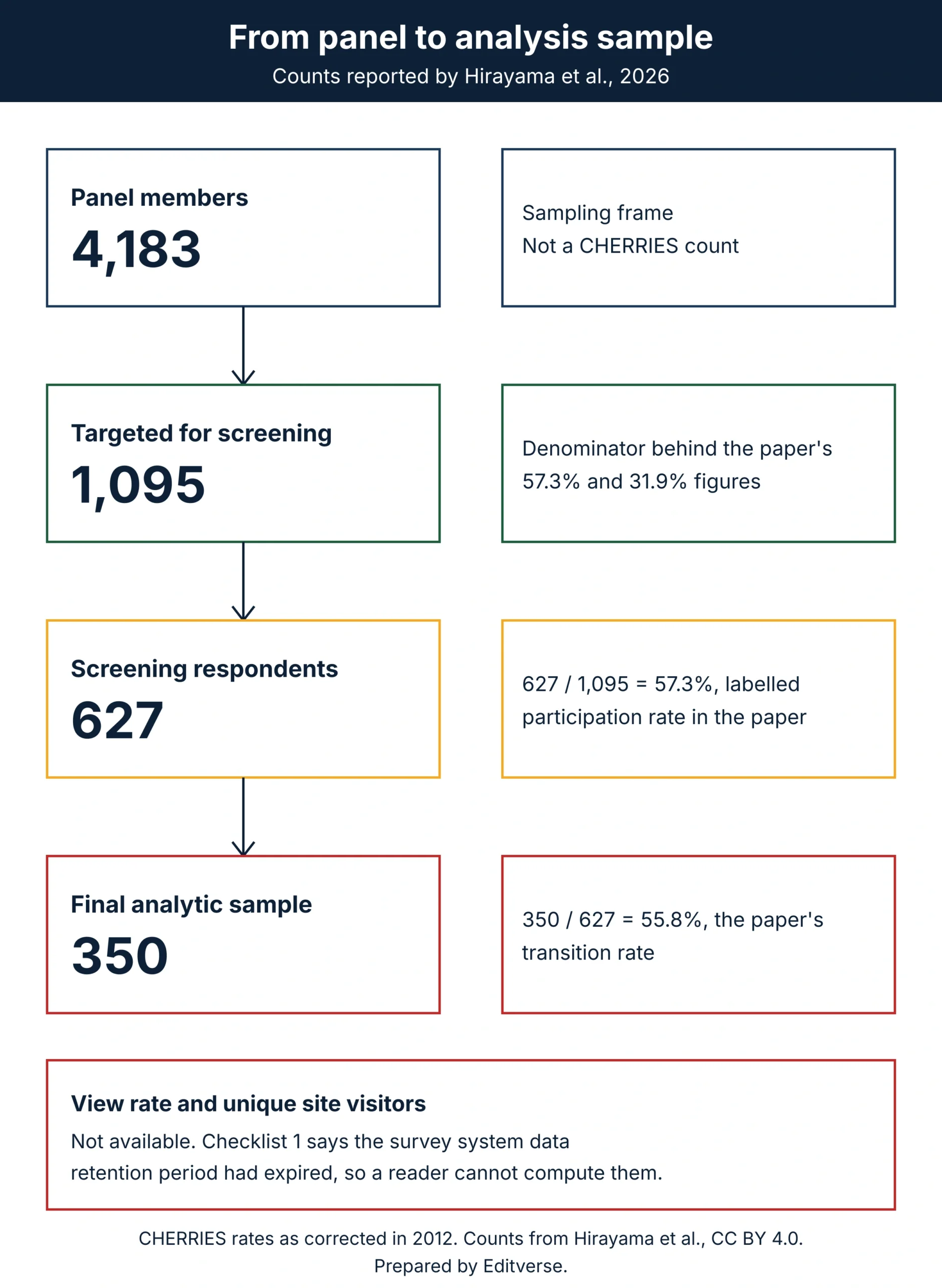
Say in the body when a number cannot be known. The view rate and unique site visitors are missing, and the reason, an expired data retention period, appears only in Checklist 1. A single sentence in the Methods would let a reader judge the sample without opening an appendix.
Bring the CHERRIES checklist answers into the paper. Nine rows were answered only in Checklist 1, among them the closed design, the contact mode, the review step and the absence of cookies. Editors and readers who see only the article cannot find them. A short survey-methods paragraph or a small table with the item names costs little and removes the problem.
Keep numbers and names consistent. The three spellings of the panel company, the two age ranges and the table cells that do not sum are the kind of detail reviewers check first. Reconcile every count, date and name across the abstract, text, tables, figure and checklist before submission, and see our guides on undersøkelsesdataanalyse og om hvordan survey weights change an estimate for what comes after fielding.
How to Write Your Own CHERRIES Checklist Statement
A CHERRIES checklist statement can be a single short paragraph per category, placed in the Methods or in a supplementary table, with a pointer in the Results where a rate is reported. Adapt the skeleton below to any web survey.
- Design. State the target population and sample frame, and say plainly if the sample is a convenience sample.
- IRB approval and consent. Give the approving body and number, what respondents were told on the consent screen and how personal data were protected.
- Development and pre-testing. Say how items were chosen, who reviewed them and what was tested before launch, such as display, skip logic and usability.
- Rekruttering. Say whether the survey was open or closed, how first contact was made and where it was announced, and put the announcement text in an appendix.
- Survey administration. Give the platform, dates, incentives, items per page, number of screens, randomisation, adaptive questions, completeness checks and whether respondents could go back.
- Response rates. Define a unique visitor, then give view, participation and completion rates with their numerators and denominators, or state that a measure is unavailable and why.
- Preventing multiple entries. Report cookies, IP checks, log file analysis and registration, the time window used and which entry was kept.
- Analyse. Say how incomplete forms and very fast submissions were handled and whether any weighting or other correction was applied.
Common mistakes with the CHERRIES checklist
- Calling the share of a panel list who answered a participation rate when the denominator is not first-page visitors.
- Using the flipped 2004 formulas from an uncorrected copy of the checklist.
- Leaving answers in a supplementary checklist that the article body never mentions.
- Reporting a duplicate-entry rule without the time window or the entry that was kept.
- Letting counts, dates and names drift apart between the abstract, the text, the tables and the checklist.
Gratis forskningsverktøy fra Editverse
- GraphPro. Build publication-ready charts, 25 types, with built-in t-test, ANOVA, correlation, and chi-square p-values. Free, no signup.
- StatPro. Free statistical calculators and a test-selector tool covering group comparisons, categorical outcomes, time-to-event analysis, and diagnostic accuracy.
- Flytskjema Pro. Generate PRISMA 2020, PRISMA-ScR, CONSORT, STROBE, STARD, MOOSE, and ARRIVE flow diagrams directly in your browser.
Professional Support for Web Survey Reporting
Most CHERRIES items are decisions made before the first invitation goes out, such as how visitors will be counted, whether IP addresses will be logged and which entry is kept when two arrive. Two Editverse services map onto that. A methodology consultation suits the planning stage of a survey study, covering sampling, data collection and validity. Substantive editing suits the write-up, including the survey methods paragraph. Editverse editing and writing support aligns with ICMJE, COPE and GPP 2022, and with the ethics requirements of your institution and country.7,8
Metodikkkonsultasjon
$400
Three 45-minute sessions with PhD methodologists covering research design review, sampling, data collection and validity, with a written methodology framework. Survey designs are among the quantitative types supported. Scheduled over 4 to 6 weeks.
Avansert redigering
$550
Substantive editing, scientific language polishing, APA, AMA or Vancouver style editing and reference list verification. Flat fee, 7 to 10 business days, one free revision round.
Konklusjon
The CHERRIES checklist asks 30 things of any paper that reports a web survey, grouped in eight categories from design and consent to response rates and analysis. Use the 2012 corrected formulas for the three response measures, and say plainly when one of them cannot be calculated. Our worked example shows what scoring against the CHERRIES checklist looks like in practice. A recent open-access paper can describe its questionnaire mechanics, incentives and skip logic clearly and still leave a reader unsure how its rates were defined, where its exclusions went and why its tables do not sum. Plan the survey with the eight CHERRIES checklist categories in view, write one short paragraph for each, and run a consistency pass before you submit.
Ofte Stilte Spørsmål
How many items does the CHERRIES checklist have?
Table 1 of the 2004 paper lists 30 items in eight categories, on our count. Category 5, survey administration, holds 11 of them.
What does CHERRIES stand for?
Checklist for Reporting Results of Internet E-Surveys. It was published by Gunther Eysenbach in the Journal of Medical Internet Research in 2004.
Has the CHERRIES checklist been updated?
A 2012 correction fixed the formulas for view rate, participation rate and completion rate. In our searches of PubMed, Europe PMC and Crossref on 1 November 2026 we found no revised or extended version. A Spanish adaptation (2019) and the broader CROSS checklist (2021) exist as separate items.
How are view rate, participation rate and completion rate calculated?
View rate is unique survey visitors divided by unique site visitors. Participation rate is those who agreed to take part divided by unique first-page visitors. Completion rate is those who finished divided by those who agreed.
Do authors need CHERRIES and STROBE together?
There is no single rule, because the two cover different ground. CHERRIES covers the mechanics of the web survey and STROBE covers observational design, so some authors report both. Check the journal instructions.
What should authors do when the view rate cannot be calculated?
State in the Methods that the measure is unavailable and give the reason, for example a closed panel with no public site visitors. Report the counts that do exist and label each ratio by its real numerator and denominator.
Where is the official CHERRIES checklist published?
It is Table 1 of the open-access 2004 paper in the Journal of Medical Internet Research, with the 2012 correction published alongside it, and it is listed on the EQUATOR Network website.
Referanser
- Eysenbach G. Improving the quality of web surveys: the Checklist for Reporting Results of Internet E-Surveys (CHERRIES). J Med Internet Res. 2004;6(3):e34. doi:10.2196/jmir.6.3.e34. PMID: 15471760. PMCID: PMC1550605. CC BY 2.0. PMCs fulltekst.
- Eysenbach G. Correction: Improving the Quality of Web Surveys: the Checklist for Reporting Results of Internet E-Surveys (CHERRIES). J Med Internet Res. 2012;14(1):e8. doi:10.2196/jmir.2042. PMCID: PMC4220447. PMCs fulltekst.
- Hirayama M, Kasai D, Tabei K. Information-Seeking Patterns and Communication Preferences Among Japanese Survivors With Cancer: Cross-Sectional Analysis. JMIR Cancer. 2026;12:e79065. doi:10.2196/79065. PMID: 42207161. PMCID: PMC13218279. CC BY 4.0. PMCs fulltekst.
- Sharma A, Minh Duc NT, Luu Lam Thang T, Nam NH, Ng SJ, Abbas KS, et al. A Consensus-Based Checklist for Reporting of Survey Studies (CROSS). J Gen Intern Med. 2021;36(10):3179-3187. doi:10.1007/s11606-021-06737-1. PMID: 33886027. PMCID: PMC8481359. PMCs fulltekst.
- Lopez-Rodriguez JA. Improving the quality of Spanish web surveys: Spanish adaptation of the checklist for reporting results of internet e-surveys (CHERRIES) to the Spanish context. Aten Primaria. 2019;51(9):586-589. doi:10.1016/j.aprim.2019.03.005. PMID: 31060751.
- Shokralla M, Willemsen RF, Kasteleyn MJ, Chavannes N, Talboom-Kamp E. Trust and Use of Recommendations for Health Apps Among European Residents: Cross-Sectional Survey. JMIR Mhealth Uhealth. 2026;14:e64468. doi:10.2196/64468. PMCID: PMC13064958. Facts only are cited.
- International Committee of Medical Journal Editors. Recommendations for the Conduct, Reporting, Editing, and Publication of Scholarly Work in Medical Journals. Available at icmje.org/recommendations.
- DeTora LM, Toroser D, Sykes A, Vanderlinden C, Plunkett FJ, Lane T, et al. Good Publication Practice (GPP) guidelines for company-sponsored biomedical research, 2022 update. Ann Intern Med. 2022;175(9):1298-1304. doi:10.7326/M22-1460. PMID: 36037471.