According to a landmark survey published in BMJ Open, 74% of biomedical researchers have been involved in at least one study where someone was added as an author without substantial contribution—a practice known as honorary authorship. Even more concerning, only 19% of researchers reported never experiencing any form of authorship misappropriation. These statistics underscore a critical challenge facing academics worldwide: how do you find ethical manuscript writing services that support your research without compromising your integrity?
Whether you’re a non-native English speaker seeking language support, a busy clinician needing help with manuscript preparation, or a researcher looking for statistical analysis assistance, the landscape of academic writing services can be confusing—and potentially dangerous to your career. This comprehensive guide will help you identify legitimate, ethical services while avoiding predatory providers that could jeopardize your academic reputation.
In this article, you’ll learn the key differences between ethical writing assistance and ghostwriting, discover 8 red flags that signal unethical services, understand ICMJE authorship guidelines, and get a practical checklist for evaluating any manuscript writing service before you hire them.
Understanding Ethical Manuscript Writing Services
Before diving into how to choose the right service, it’s essential to understand what makes manuscript writing assistance “ethical” in the first place. The academic publishing ecosystem recognizes that researchers often need support—what matters is how that support is provided and how it’s disclosed.
Ethical manuscript writing services operate on a spectrum of legitimate assistance:
- Language editing and proofreading: Correcting grammar, syntax, and clarity without altering scientific content
- Substantive editing: Improving structure, flow, and argumentation while preserving the author’s voice and ideas
- Statistical support: Assisting with data analysis under the researcher’s direction and interpretation
- Formatting and reference management: Ensuring compliance with journal guidelines
- Medical writing with disclosure: Professional writing support that is properly acknowledged
The key principle underlying ethical writing services is transparency. When you work with an ethical provider, you remain the intellectual author of your work. The service enhances your manuscript’s presentation without contributing original ideas, interpretations, or conclusions that would merit authorship.
Many researchers are surprised to learn that major journals, including those published by Elsevier, Springer Nature, and Wiley, explicitly permit and sometimes recommend professional editing services—provided they are properly disclosed. Understanding this distinction between prohibited ghostwriting and permitted assistance is crucial for protecting your academic career.
The Critical Difference: Ethical Manuscript Writing Services vs. Ghostwriting
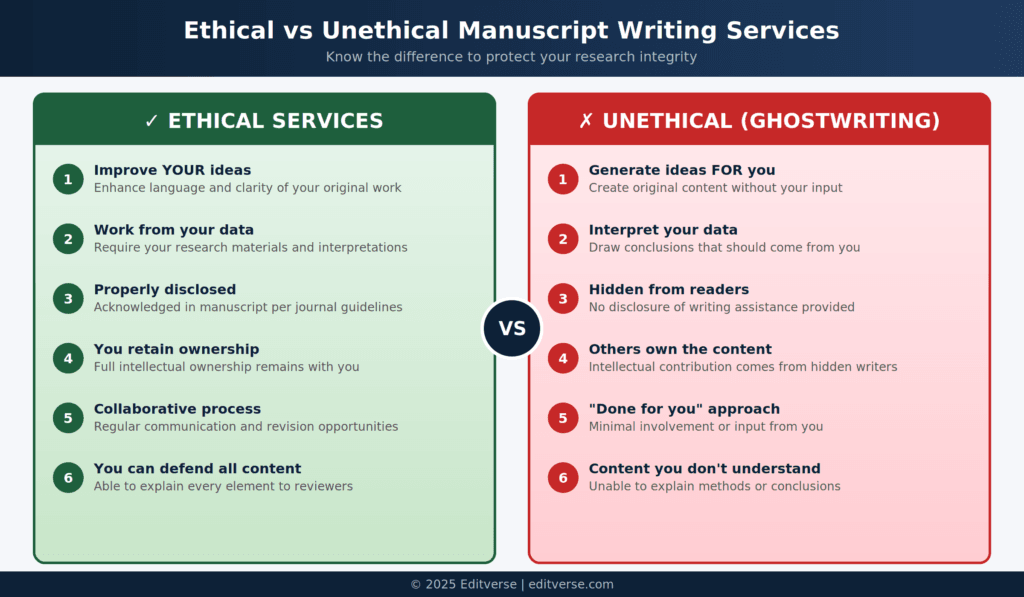
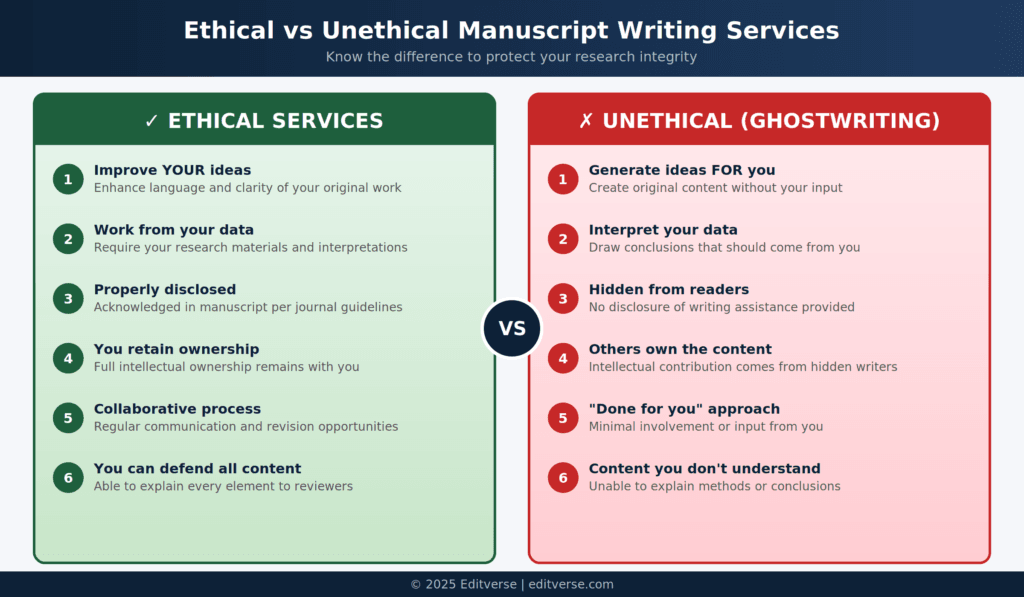
The line between legitimate writing assistance and unethical ghostwriting can seem blurry, but understanding this distinction is vital for your academic integrity. Let’s clarify the differences:
What Is Ghostwriting?
Ghostwriting in academic publishing refers to situations where someone makes substantial contributions to a manuscript—including writing, data interpretation, or intellectual content—but is not acknowledged as an author or contributor. According to research published in Current Medical Research and Opinion, ghostwriting prevalence in biomedical literature has been reported anywhere from less than 1% to 91%, depending on the study methodology and definitions used.
The practice becomes particularly problematic when:
- Industry-funded writers draft manuscripts that appear to be independent academic work
- The named authors did not substantially contribute to the research or writing
- Conflicts of interest are hidden from readers and journal editors
- The true intellectual origins of the work are obscured
What Makes Writing Assistance Ethical?
In contrast, ethical manuscript writing services maintain clear boundaries:
| Ethical Services | Ghostwriting (Unethical) |
|---|---|
| Improve language and clarity of YOUR ideas | Generate ideas and content for you |
| Work from your data and interpretations | Interpret data or draw conclusions |
| Properly disclosed in acknowledgments | Hidden from readers and editors |
| You retain full intellectual ownership | Someone else owns the intellectual content |
| Collaborative, iterative process | “Done for you” with minimal input |
| You can explain and defend all content | Content you may not fully understand |
For researchers interested in understanding how AI tools fit into this ethical framework, our guide on ethical use of ChatGPT in academic writing provides additional context on navigating these modern challenges.
8 Red Flags of Unethical Manuscript Writing Services
Identifying predatory or unethical writing services before you engage them can save your career. Here are the warning signs that should make you walk away:
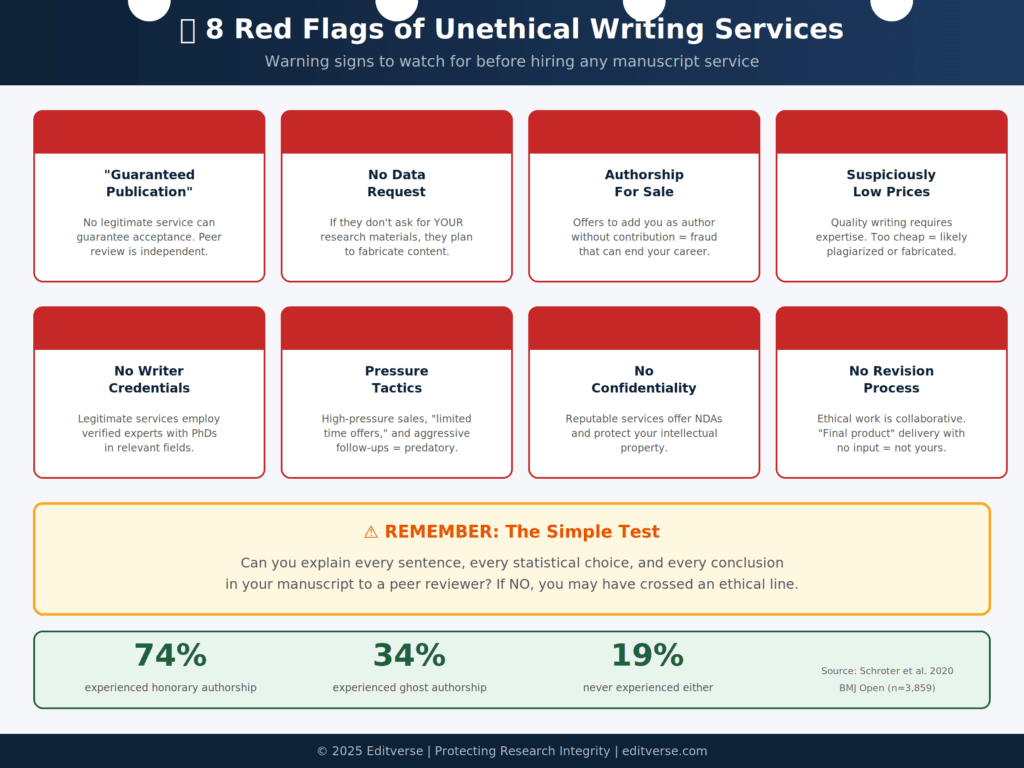
1. Promises of “Guaranteed Publication”
No legitimate service can guarantee publication in a peer-reviewed journal. The peer review process is independent and unpredictable. Any service claiming they can guarantee acceptance is either lying or has unethical relationships with predatory journals. Given that journal rejection rates in competitive fields can exceed 90%, such promises are not just unrealistic—they’re impossible.
2. No Request for Your Research Data
Ethical manuscript writing requires your data, your methodology, and your intellectual input. If a service offers to write your manuscript without asking for your research materials, they’re planning to fabricate content or provide generic, plagiarized material.
3. Offering to Add You as Author Without Contribution
This is a direct violation of authorship ethics. Services that offer to conduct research and “add your name” as author are facilitating fraud. This practice can result in journal retractions, institutional sanctions, and permanent damage to your reputation.
4. Unusually Low Prices
Quality manuscript writing requires subject matter expertise, time, and skill. If prices seem too good to be true, the service likely uses unqualified writers, produces plagiarized content, or operates as a paper mill. Professional medical and scientific writing is a specialized skill that commands appropriate compensation.
5. No Credentials or Expertise Verification
Legitimate services employ writers with relevant academic backgrounds, often holding PhDs in specific fields. They should be willing to share writer qualifications and match your project with someone who understands your discipline. Services that are vague about their team’s credentials are hiding something.
6. Pressure Tactics and Artificial Urgency
Ethical services understand that academic decisions require careful consideration. High-pressure sales tactics, “limited time offers,” or aggressive follow-up emails are hallmarks of predatory operations more concerned with your money than your success.
7. No Confidentiality Agreements
Your research is valuable intellectual property. Any legitimate service should offer clear confidentiality protections and be willing to sign non-disclosure agreements. Services that won’t commit to protecting your work may resell or repurpose your research.
8. No Revision or Communication Process
Ethical manuscript development is collaborative. Services that deliver a “final product” without opportunities for your input, revision requests, or ongoing communication are not providing legitimate assistance—they’re selling a product that isn’t truly yours.
How Ethical Manuscript Writing Services Operate
Understanding the workflow of legitimate services helps you recognize quality providers and set appropriate expectations. Here’s what an ethical engagement typically looks like:
Initial Consultation and Scoping
Ethical services begin with a detailed discussion of your research, goals, target journals, and specific needs. They should ask probing questions about your data, methodology, and conclusions. This consultation helps match you with an appropriate expert and ensures the service can actually meet your needs.
Clear Agreement and Expectations
Before work begins, you should receive:
- A detailed scope of work specifying exactly what services will be provided
- Clear pricing with no hidden fees
- Timeline with milestones and delivery dates
- Confidentiality agreement protecting your research
- Revision policy explaining what’s included
- Guidance on proper acknowledgment language for your manuscript
Collaborative Development Process
The writing process should involve regular communication and your active participation. Ethical services don’t disappear with your materials and return a finished product. Instead, they:
- Share outlines and drafts for your review and approval
- Ask clarifying questions about your research
- Incorporate your feedback throughout development
- Ensure you understand and can defend all content
Quality Assurance and Verification
Reputable services include quality checks such as:
- Plagiarism screening using industry-standard tools
- Reference verification to ensure citation accuracy
- Journal guideline compliance review
- Scientific accuracy review by subject matter experts
Proper Acknowledgment Guidance
Ethical services help you craft appropriate acknowledgment language that satisfies journal requirements and maintains transparency. They should provide suggested text and be willing to be named in your manuscript’s acknowledgments section.
ICMJE Authorship Guidelines: What You Need to Know
The International Committee of Medical Journal Editors (ICMJE) provides the most widely accepted framework for determining authorship. Understanding these guidelines helps you evaluate whether any assistance you receive crosses ethical lines.
The Four Criteria for Authorship
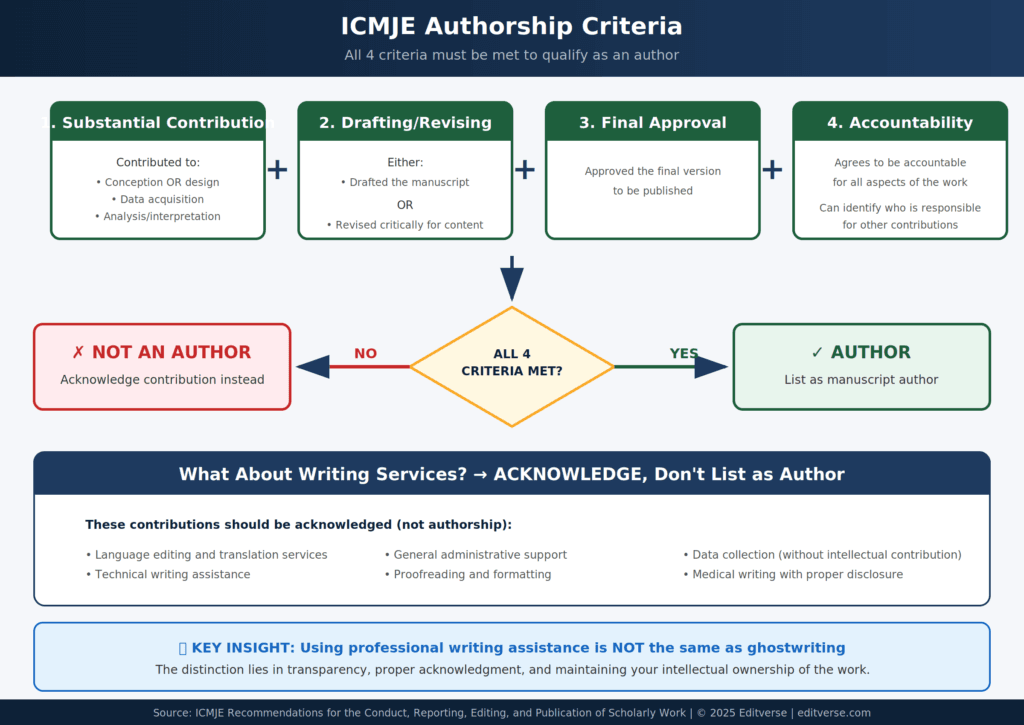
According to ICMJE recommendations, authorship requires meeting ALL four of the following criteria:
| # | Criterion | What It Means |
|---|---|---|
| 1 | Substantial contributions | Contributed to conception OR design OR acquisition of data OR analysis/interpretation of data |
| 2 | Drafting or revising | Drafted the work OR revised it critically for important intellectual content |
| 3 | Final approval | Approved the final version to be published |
| 4 | Accountability | Agrees to be accountable for all aspects of the work and can identify who is responsible for other contributions |
When Writing Assistance Doesn’t Qualify for Authorship
The ICMJE explicitly states that individuals who provide certain types of assistance should be acknowledged but not listed as authors. This includes:
- Language editing and translation services
- Technical writing assistance
- General administrative support
- Proofreading and formatting
- Data collection without intellectual contribution
This distinction is crucial: using professional writing assistance is not the same as ghostwriting, provided the assistance is properly acknowledged and doesn’t include intellectual contributions that would merit authorship.
For researchers working on systematic reviews, understanding these authorship principles is especially important given the collaborative nature of such projects. Our guides on PRISMA 2020 guidelines and PROSPERO registration provide additional context for navigating authorship in review methodologies.
10 Essential Questions to Ask Before Hiring a Manuscript Writing Service
Before engaging any service, conduct due diligence by asking these critical questions. Legitimate providers will answer transparently; evasive responses are red flags.
Checklist: Essential Questions for Ethical Manuscript Writing Services
| # | Question to Ask | What to Look For |
|---|---|---|
| 1 | What are your writers’ qualifications? | Advanced degrees in relevant fields; publication experience; verifiable credentials |
| 2 | Can you match me with a subject matter expert? | Willingness to share writer backgrounds; discipline-specific expertise |
| 3 | What data/materials do you need from me? | Should require YOUR data, drafts, and intellectual input |
| 4 | How do you handle confidentiality? | Clear NDA policy; data protection practices; willing to sign agreements |
| 5 | What is your revision policy? | Multiple rounds of revision; collaborative process; clear limits |
| 6 | Do you follow ICMJE/COPE guidelines? | Explicit commitment to ethical standards; familiarity with guidelines |
| 7 | How should I acknowledge your assistance? | Provides acknowledgment language; comfortable being named |
| 8 | Do you provide plagiarism reports? | Standard plagiarism screening; willingness to share reports |
| 9 | What happens if my manuscript is rejected? | Resubmission support; realistic expectations about outcomes |
| 10 | Can you provide client references or testimonials? | Verifiable success stories; transparent track record |
The True Cost of Unethical Writing Services
While unethical services may seem like shortcuts, the potential consequences far outweigh any perceived benefits. Understanding these risks helps reinforce why choosing ethical manuscript writing services is essential.
Career Consequences
Being associated with unethical writing practices can derail your academic career:
- Loss of academic positions: Universities increasingly investigate authorship misconduct, and findings can result in termination
- Grant funding disqualification: Funding agencies may bar researchers with misconduct records from future grants
- Professional society sanctions: Medical boards and professional organizations can revoke memberships and certifications
- Damaged mentor-mentee relationships: Supervisors named on fraudulent papers suffer reputational harm alongside their trainees
Our article on clinical research ethics violations that changed medicine illustrates how misconduct can have far-reaching consequences for individuals and institutions.
Journal Retractions
When misconduct is discovered, journals typically retract the affected papers:
- Retractions appear permanently in your publication record
- Retracted papers are flagged in databases like PubMed and Google Scholar
- Co-authors may face investigation regardless of their involvement
- Retraction Watch and similar services publicize misconduct cases
Institutional Penalties
Universities and research institutions take misconduct seriously:
- Formal investigations that can last months or years
- Suspension or termination of employment
- Required repayment of grant funds
- Mandatory ethics training and supervision
- Notification to funding agencies and journals
Why Non-Native English Speakers Should Use Ethical Writing Services
Researchers whose first language isn’t English face genuine challenges in academic publishing. Far from being a weakness to hide, seeking professional language support is a responsible and widely accepted practice.
The Language Barrier Reality
English dominates scientific publishing, creating inherent disadvantages for non-native speakers:
- Manuscript preparation takes significantly longer
- Nuanced scientific arguments may be harder to express precisely
- Reviewers may conflate language issues with scientific quality
- Submission anxiety can delay publication of important research
These challenges are well-recognized in the academic community. A 2014 study in Science and Engineering Ethics noted that scientists in countries where English is not the primary language “routinely use a variety of manuscript preparation, correction or editing services, a practice that is openly endorsed by many journals and scientific institutions.”
What Journals Actually Say About Editing Services
Major publishers explicitly encourage professional language editing:
- Springer Nature: “We encourage authors who may not be fluent in English to have their manuscripts checked by someone proficient in the language”
- Elsevier: Maintains a list of recommended language editing services
- Wiley: Offers author services including language editing
- ICMJE: States that “general assistance… should be acknowledged but does not qualify those individuals for authorship”
The key is transparency: acknowledge the assistance in your manuscript, and ensure the service doesn’t cross into contributing intellectual content that would require authorship.
How Ethical Services Level the Playing Field
Quality writing services help ensure your research is evaluated on its scientific merits, not penalized for language issues. This is fundamentally fair—good science shouldn’t be rejected because of grammar, and ethical language support addresses this inequity without compromising research integrity.
Professional Manuscript Writing Services at Editverse
At Editverse, we’ve built our services around the ethical principles outlined in this guide. Our approach ensures you receive expert support while maintaining complete intellectual ownership of your work.
Our Ethical Commitment
Every Editverse engagement includes:
- Subject matter expertise: Writers with PhDs and publication experience in your field
- Confidentiality protection: Comprehensive NDAs and secure data handling
- Collaborative process: Regular communication and revision opportunities
- ICMJE compliance: Adherence to international authorship and disclosure guidelines
- Acknowledgment guidance: Help crafting appropriate disclosure language
- Plagiarism verification: Every project screened with industry-standard tools
Services Designed for Researcher Needs
Manuscript Writing Services
$1,500
Full manuscript development with your data and intellectual input
For researchers focused on building their citation impact, our h-index growth strategies and systematic review services provide additional pathways to accelerate your research career.
Related Editverse Resources
→ Ethical Use of ChatGPT in Academic Writing: 2025 Guidelines
→ Journal Rejection Rate by Field: 2025 Data Analysis
→ 10 Shocking Clinical Research Ethics Violations That Changed Medicine
→ PRISMA 2020 Guidelines: Complete Checklist for Systematic Reviews
→ PROSPERO Registration & Essential Tips Guide
→ How to Increase Your H-Index: 10 Proven Strategies
→ Correct Usage of Articles (a, an, the) in Scientific Papers
→ British vs American English in Research Papers
→ SRQR, COREQ, or ENTREQ: Qualitative Research Reporting Standards
→ Systematic Review vs Meta-Analysis: Key Differences Explained
Conclusion: Protecting Your Research Integrity
Choosing ethical manuscript writing services isn’t just about avoiding negative consequences—it’s about ensuring your research contributions are genuinely yours, properly credited, and worthy of the reputation you’re building. In a research landscape where 74% of biomedical authors have experienced authorship misappropriation, taking proactive steps to protect your integrity is more important than ever.
Quick Reference: Ethical Manuscript Services Checklist
Before engaging any manuscript writing service, verify that they:
- ✅ Employ qualified writers with relevant expertise
- ✅ Require your data and intellectual input
- ✅ Offer clear confidentiality protections
- ✅ Follow ICMJE/COPE ethical guidelines
- ✅ Provide collaborative revision processes
- ✅ Include plagiarism screening
- ✅ Offer acknowledgment guidance
- ✅ Have transparent pricing with no guarantees of publication
- ✅ Are willing to be acknowledged in your manuscript
- ✅ Can provide verifiable references or testimonials
Remember: legitimate writing assistance is not ghostwriting. The distinction lies in transparency, proper acknowledgment, and maintaining your intellectual ownership of the work. Ethical services enhance your manuscript’s presentation while you remain the true author of your research.
Ready for Ethical Manuscript Support?
Work with subject matter experts who respect your research, protect your authorship, and help you publish with integrity.
References
- Schroter S, Montagni I, Loder E, et al. Awareness, usage and perceptions of authorship guidelines: an international survey of biomedical authors. BMJ Open. 2020;10(9):e036899. https://doi.org/10.1136/bmjopen-2020-036899
- DeTora LM, Carey MA, Toroser D, Baum EZ. Ghostwriting in biomedicine: a review of the published literature. Curr Med Res Opin. 2019;35(9):1643-1651. https://doi.org/10.1080/03007995.2019.1608101
- Lozano GA. Ethics of using language editing services in an era of digital communication and heavily multi-authored papers. Sci Eng Ethics. 2014;20(2):363-377. https://doi.org/10.1007/s11948-013-9451-6
- Smith E, Hunt M, Master Z. Authorship ethics in global health research partnerships between researchers from low or middle income countries and high income countries. BMC Med Ethics. 2014;15:42. https://doi.org/10.1186/1472-6939-15-42
- Badreldin H, Aloqayli S, Alqarni R, et al. Knowledge and Awareness of Authorship Practices Among Health Science Students: A Cross-Sectional Study. Adv Med Educ Pract. 2021;12:383-392. https://doi.org/10.2147/AMEP.S298645
- Vaquera-Alfaro HA, Nasrollahi E, Mangala YO, et al. Prevalence of medical writing in hematological malignancy review articles. BMC Cancer. 2025;25(1):720. https://doi.org/10.1186/s12885-025-14137-5
- Delgado-López PD, Corrales-García EM. Predatory journals: an emerging threat for authors and editors of biomedical publications. Neurocirugia. 2018;29(1):39-43. https://doi.org/10.1016/j.neucir.2017.07.006
- Umlauf MG, Mochizuki Y. Predatory publishing and cybercrime targeting academics. Int J Nurs Pract. 2018;24 Suppl 1:e12656. https://doi.org/10.1111/ijn.12656
- International Committee of Medical Journal Editors. Recommendations for the Conduct, Reporting, Editing, and Publication of Scholarly Work in Medical Journals. Updated 2024. https://www.icmje.org/recommendations/
- Committee on Publication Ethics (COPE). Guidelines on Good Publication Practice. https://publicationethics.org/guidance/Guidelines
Last updated: January 2026 | This article was written by the Editverse Expert Group and reviewed for accuracy against peer-reviewed sources. Professional writing assistance was used in the preparation of this article in accordance with ICMJE guidelines.