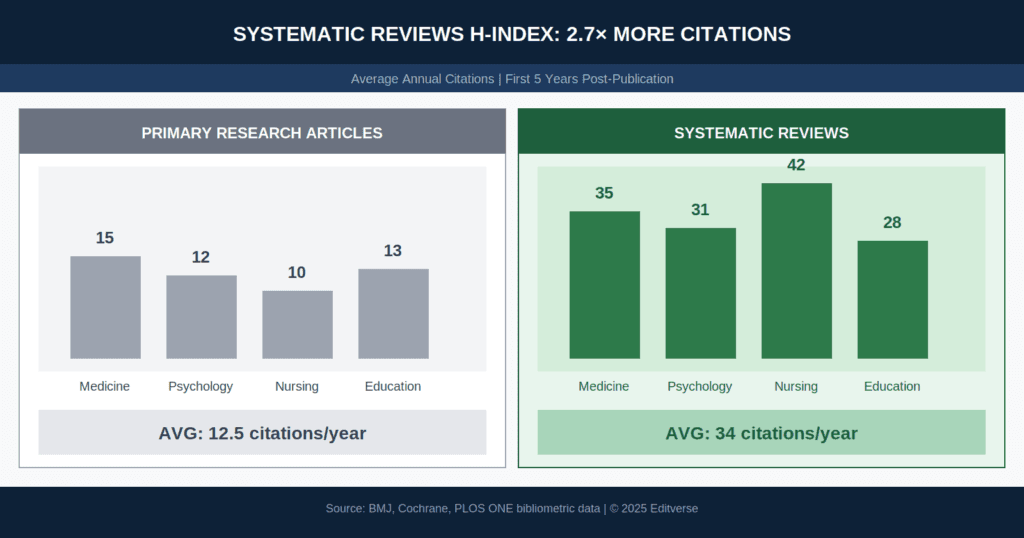
Systematic reviews and h-index improvement are directly connected through citation dynamics. If you’re an academic researcher looking to boost your citation count and h-index, you might assume the answer lies in publishing more primary research studies. However, decades of bibliometric evidence tells a different story: systematic reviews and meta-analyses consistently generate 2.7× more citations than original research articles, making them the fastest path to a higher h-index.
This comprehensive guide explains exactly why systematic reviews boost your h-index so effectively, provides step-by-step instructions for conducting high-impact reviews, and shows you how to strategically integrate them into your publication portfolio for maximum career benefit.
How Systematic Reviews Boost Your H-Index: Citation Evidence
Understanding the relationship between systematic reviews and h-index growth requires examining bibliometric data across disciplines. The evidence is compelling—and the 2.7× citation advantage compounds significantly over an academic career.
Understanding the H-Index: Why It Matters for Your Career
Before diving into systematic review strategies, let’s clarify what the h-index measures and why it’s crucial for academic advancement. The h-index, introduced by physicist Jorge Hirsch in his landmark 2005 Proceedings of the National Academy of Sciences paper, quantifies both the productivity and citation impact of a researcher’s publications.
How it works: You have an h-index of h when h of your papers have each received at least h citations. For example, an h-index of 15 means you have 15 publications that have each been cited at least 15 times.
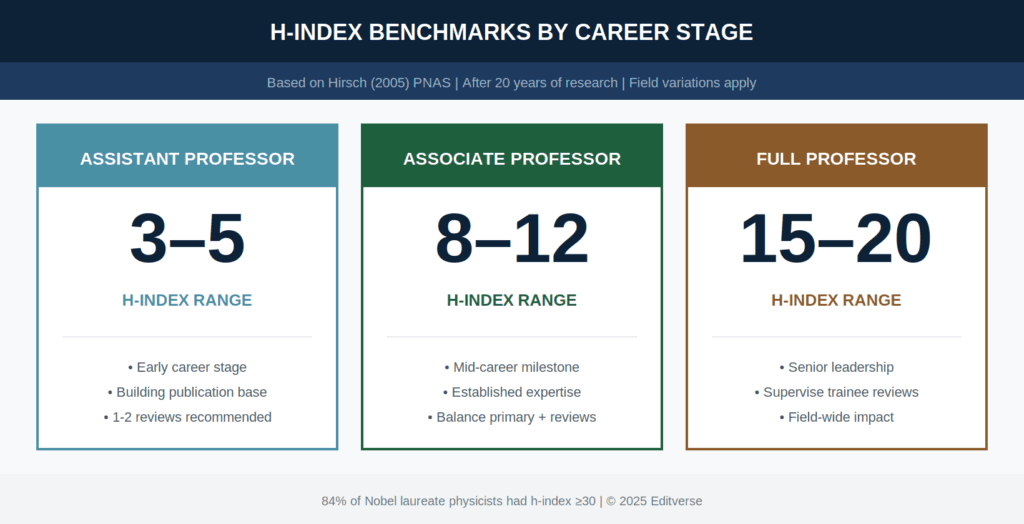
According to Hirsch’s original framework, an h-index of 20 after 20 years of research indicates a “successful scientist,” 40 represents an “outstanding scientist,” and 60 or above is “truly exceptional.” However, these benchmarks vary significantly across disciplines—a humanities scholar with an h-index of 15 may be highly accomplished, while a biomedical researcher might need 30+ for equivalent recognition.
Why Systematic Reviews Generate More Citations: 5 Key Reasons
Understanding why systematic reviews attract more citations helps you design reviews that maximize this advantage for h-index improvement. Here are the five primary mechanisms:
1. The “Foundational Reference” Effect
Every new research paper must establish what is already known about a topic. This creates a structural citation demand for comprehensive summaries of existing evidence. When researchers write their introduction sections, they face a choice: cite 15-20 individual studies, or cite one authoritative systematic review that synthesizes all that evidence.
Most researchers choose the systematic review because it demonstrates thorough scholarship while saving space and reader effort. This makes your systematic review the default citation for an entire body of literature.
How to Maximize the Foundational Reference Effect
Step 1: Write a comprehensive, citable abstract
Include your key quantitative findings (effect sizes, confidence intervals) directly in the abstract. Many researchers cite based on abstracts alone.
Step 2: Create quotable summary statements
Craft clear, specific conclusions that can be directly quoted. “The pooled effect size was 0.45 (95% CI: 0.32-0.58)” is more citable than vague language.
Step 3: Include a “summary of findings” table
GRADE-based summary tables are increasingly required by journals and make your results immediately accessible for citation.
2. Clinical Guideline Integration
Clinical practice guidelines from organizations like the World Health Organization, National Institute for Health and Care Excellence (NICE), and specialty societies rely heavily on systematic reviews as their evidence foundation. When a guideline cites your review, every subsequent paper that references that guideline indirectly extends your work’s reach.
The Cochrane Collaboration reviews, for instance, are explicitly designed to inform clinical guidelines and have accumulated millions of citations collectively. If you’re aiming for Cochrane-quality protocols, our Cochrane Protocol Writing service can help you meet their rigorous standards.
3. Grant Application Requirements
Funding agencies increasingly require evidence synthesis to justify proposed research. Your systematic review becomes the go-to citation for researchers writing grants in your area. This creates a self-reinforcing cycle: funded researchers cite your review, conduct their studies, and their publications reference your work again.
4. Educational and Training Citations
Systematic reviews are ideal teaching resources because they provide comprehensive overviews suitable for students and trainees. Educators cite them in syllabi, textbooks, and training materials, creating sustained citation flow over many years—often longer than typical research paper citation half-lives.
5. Evidence Hierarchy Position
In evidence-based practice frameworks, systematic reviews and meta-analyses occupy the highest position. Research published in Clinical Oral Implants Research confirmed that higher-level evidence studies consistently receive more citations than lower-level studies addressing similar questions (Wu et al., 2020).
Step-by-Step Guide: Conducting Systematic Reviews for H-Index Growth

Now let’s walk through exactly how to conduct a systematic review designed for maximum citation impact and h-index improvement. This process typically takes 6-18 months depending on scope and team size.
Phase 1: Topic Selection and Feasibility Assessment (2-4 weeks)
Your topic choice largely determines your review’s citation potential. A brilliantly executed review on a saturated or niche topic will underperform a competent review on a high-demand topic.
Topic Selection Process
Step 1: Identify 3-5 candidate topics in your expertise area
Start with questions you’ve encountered in clinical practice, teaching, or research. Topics where you genuinely want to know the answer will sustain your motivation through the process.
Step 2: Check for existing reviews
Search Cochrane Library, PROSPERO, and PubMed for recent systematic reviews on your topics. If a high-quality review exists from the past 3 years, consider a different angle or population.
Step 3: Assess primary study availability
Conduct preliminary searches to estimate how many eligible studies exist. Fewer than 5 studies may not justify a full systematic review; more than 200 may require narrowing your scope. Our Literature Search service can help you assess feasibility.
Step 4: Evaluate clinical or policy relevance
Topics that directly inform treatment decisions, public health policy, or clinical guidelines attract more citations than purely academic questions.
Step 5: Consider timing and trends
Reviews addressing emerging technologies, recent controversies, or rapidly accumulating evidence have higher citation potential.
Phase 2: Protocol Development and Registration (2-3 weeks)
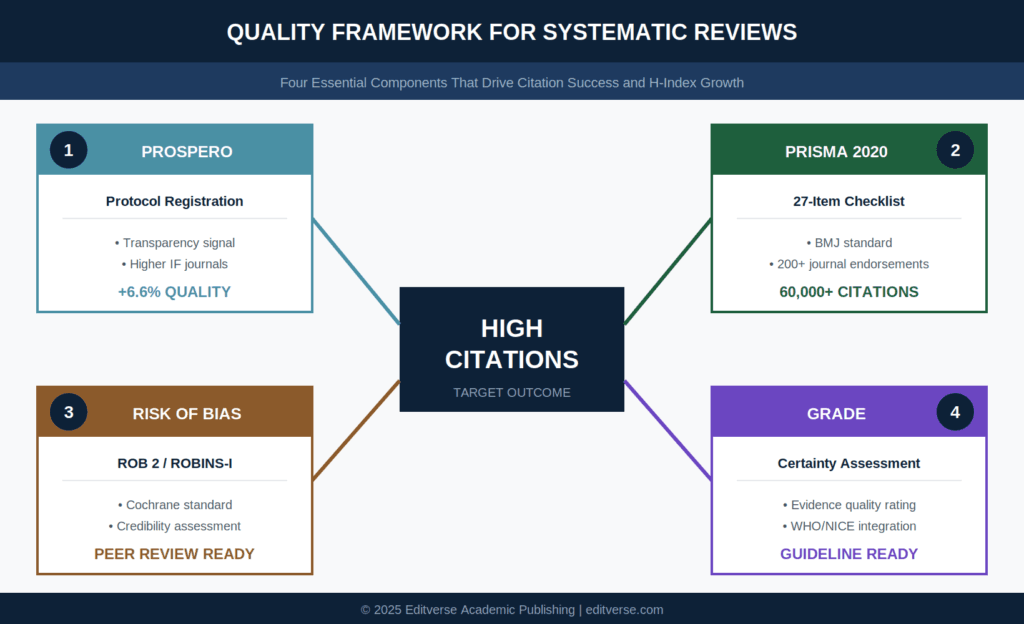
A well-designed protocol is essential for methodological rigor and distinguishes high-quality reviews from narrative summaries. Research published in the Journal of Clinical Epidemiology demonstrated that PROSPERO-registered reviews have 6.6% higher methodological quality scores and are published in journals with higher impact factors (Sideri et al., 2018).
Protocol Development Checklist
Step 1: Define your research question using PICO/PECO framework
Population, Intervention/Exposure, Comparison, Outcome. Example: “In adults with type 2 diabetes (P), does metformin (I) compared to lifestyle modification alone (C) reduce cardiovascular mortality (O)?”
Step 2: Specify eligibility criteria
Define inclusion/exclusion criteria for study designs, populations, interventions, comparators, outcomes, and settings. Be specific enough for reproducibility.
Step 3: Develop search strategy with librarian assistance
Plan to search at minimum: MEDLINE/PubMed, Embase, and Cochrane CENTRAL. Consider field-specific databases (PsycINFO, CINAHL, ERIC) and grey literature sources.
Step 4: Plan data extraction procedures
Create a standardized extraction form. Specify which outcomes, study characteristics, and quality indicators you’ll extract.
Step 5: Select risk of bias assessment tool
Use validated tools: ROB 2 for randomized trials, ROBINS-I for non-randomized studies, or QUADAS-2 for diagnostic accuracy studies.
Step 6: Plan synthesis approach
Decide whether meta-analysis is anticipated and specify statistical methods. If meta-analysis is not possible, describe your narrative synthesis approach.
Step 7: Register on PROSPERO
Submit your protocol to PROSPERO before beginning screening. Registration is free and typically approved within 2-3 weeks. See our PROSPERO Registration Guide.
Phase 3: Literature Search and Screening (4-8 weeks)
The search and screening phase is the most time-intensive part of systematic review conduct. Proper execution here determines whether your review is comprehensive and reproducible.
Search and Screening Process
Step 1: Develop and pilot your search strategy
Work with a medical librarian to develop comprehensive search strings. Test your strategy by checking whether known relevant studies are retrieved.
Step 2: Execute searches across all planned databases
Document the exact search strings, dates, and number of results for each database. This documentation is required for PRISMA reporting.
Step 3: Deduplicate results
Use reference management software (EndNote, Covidence, Rayyan) to remove duplicate records. Document how many duplicates were removed.
Step 4: Title and abstract screening (two reviewers)
Both reviewers independently screen all titles/abstracts against eligibility criteria. Calculate inter-rater agreement (kappa statistic). Resolve disagreements through discussion or third reviewer.
Step 5: Full-text review (two reviewers)
Obtain full texts of potentially eligible studies. Both reviewers independently assess eligibility. Document reasons for exclusion.
Step 6: Search reference lists and citing articles
Check reference lists of included studies and relevant reviews. Use citation tracking to identify studies citing key papers.
Step 7: Create PRISMA flow diagram
Document the number of records at each stage using the PRISMA 2020 flow diagram template. See our PRISMA Flow Chart Guide.
Phase 4: Data Extraction and Quality Assessment (3-6 weeks)
This phase requires meticulous attention to detail. Dual-reviewer extraction ensures accuracy and reduces bias. If you need support with this labor-intensive phase, our Systematic Review Data Extraction service provides expert dual-reviewer extraction starting at $500.
Data Extraction Best Practices
Step 1: Pilot your extraction form
Test your form on 3-5 studies. Refine based on problems encountered. Ensure all reviewers understand each data field.
Step 2: Extract data in duplicate
Two reviewers independently extract data from each study. Compare extractions and resolve discrepancies through discussion.
Step 3: Contact authors for missing data
If key outcome data are not reported, email corresponding authors. Document all contact attempts and responses.
Step 4: Assess risk of bias for each study
Apply your chosen risk of bias tool systematically. Two reviewers should assess independently, then reach consensus.
Step 5: Create risk of bias summary figures
Generate traffic light plots and summary bar charts using tools like robvis or RevMan.
Phase 5: Data Synthesis and Analysis (2-4 weeks)
Your synthesis approach depends on whether the included studies are sufficiently similar to combine quantitatively (meta-analysis) or require narrative synthesis.
Meta-Analysis Steps (if applicable)
Step 1: Assess clinical and methodological heterogeneity
Before calculating statistics, consider whether combining studies makes clinical sense. Are populations, interventions, and outcomes comparable?
Step 2: Select appropriate effect measure
Risk ratios or odds ratios for dichotomous outcomes; mean differences or standardized mean differences for continuous outcomes.
Step 3: Choose fixed-effect or random-effects model
Random-effects models are generally preferred when clinical heterogeneity is expected. Document your rationale.
Step 4: Assess statistical heterogeneity
Calculate I² statistic and conduct chi-squared test. I² >50% suggests substantial heterogeneity requiring exploration.
Step 5: Conduct subgroup and sensitivity analyses
Pre-specified subgroup analyses explore sources of heterogeneity. Sensitivity analyses test robustness of findings.
Step 6: Assess publication bias
Create funnel plots (if ≥10 studies) and conduct statistical tests (Egger’s test). Interpret cautiously—asymmetry may reflect true heterogeneity.
Step 7: Apply GRADE for certainty assessment
Rate the certainty of evidence for each outcome as high, moderate, low, or very low. Create Summary of Findings tables.
Phase 6: Manuscript Preparation and Submission (4-8 weeks)
Writing for Maximum Citation Impact
Step 1: Use PRISMA 2020 checklist throughout
Address all 27 items. Many journals require a completed PRISMA checklist with submission. See our PRISMA 2020 Complete Checklist.
Step 2: Craft a citable abstract
Include your main quantitative findings with confidence intervals. Many citations come from researchers who only read abstracts.
Step 3: Write clear, specific conclusions
Avoid vague statements. “Intervention X reduces outcome Y by 23% (95% CI: 15-31%)” is far more citable than “Intervention X may be beneficial.”
Step 4: Highlight clinical implications
Explicitly state how your findings should influence practice or policy. This increases citations from clinicians and guideline developers.
Step 5: Identify research gaps
Articulate specific questions your review could not answer. Future researchers will cite your review when addressing these gaps.
Step 6: Target journals strategically
Consider specialty journals (higher relevance to your audience), open access options (wider availability), and journals with strong social media presence.
Citation Timeline: How Systematic Reviews Build Your H-Index Over Time
Understanding how systematic reviews contribute to h-index growth requires examining citation accumulation patterns over time.
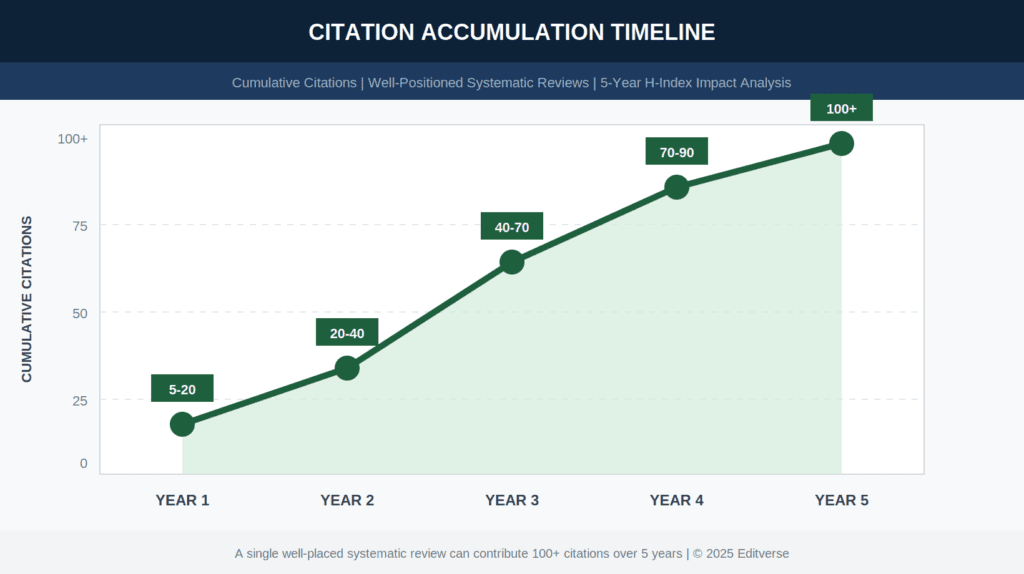
Year 1: Initial Discovery Phase (5-20 citations) — Citations begin slowly as researchers discover your review. Focus on active dissemination: conference presentations, social media, and direct outreach to colleagues.
Year 2: Momentum Building (20-40 cumulative) — Your review starts appearing in literature searches. Early citing papers begin attracting their own citations, indirectly amplifying your work.
Year 3: Peak Growth Begins (40-70 cumulative) — The review becomes an established reference. Citation rate typically reaches its peak during years 3-4. Grant applications citing your review get funded.
Year 4: Sustained High Impact (70-90 cumulative) — If your review addresses a continuing need, citations remain strong. Consider whether an update is warranted as new primary studies accumulate.
Year 5+: Maintenance or Update (100+ cumulative) — Reviews that remain current continue accumulating citations. Outdated reviews see declining citation rates. Plan updates every 3-5 years for sustained impact.
Optimal Publication Strategy: Balancing Systematic Reviews and H-Index Goals
The ideal balance between systematic reviews and primary research for h-index improvement depends on your career stage and field norms.
| Career Stage | Recommended Mix | Strategic Focus |
|---|---|---|
| PhD Student / Postdoc | 1-2 systematic reviews per year alongside primary research | Build expertise reputation; create citable foundation for thesis/dissertation; develop methodological skills |
| Early Career (0-5 years post-PhD) | 1 major systematic review annually | Establish as field expert; target high-impact journals; build collaborative networks through multi-author reviews |
| Mid-Career (Associate level) | 1 senior-authored review per year; supervise trainee-led reviews | Mentor emerging researchers; position for leadership roles; contribute to guidelines and policy |
| Senior Researcher (Full Professor) | Supervise and co-author trainee reviews; author invited reviews and perspectives | Shape field direction; contribute methodological expertise; build legacy through mentorship |
Common Mistakes That Hurt Your Systematic Reviews and H-Index
| Pitfall | Impact on Citations | Prevention Strategy |
|---|---|---|
| Methodological shortcuts | Review gets criticized in commentaries; researchers avoid citing flawed work | Follow PRISMA rigorously; register on PROSPERO; use established risk of bias tools |
| Oversaturated topic | Your review competes with existing syntheses for citations | Search PROSPERO and Cochrane before committing; find unique angles or populations |
| Poor journal targeting | Limited visibility to your target audience | Target specialty journals where clinicians and researchers in your field actually read; consider open access |
| Passive dissemination | Slow citation accumulation; missed early momentum | Present at conferences; share on academic social media; write accessible summaries; contact key opinion leaders |
| Failure to update | Review becomes outdated; citation rate declines; gets superseded | Monitor new primary studies; plan updates every 3-5 years; consider living review format |
| Solo authorship | Limited perspectives; single point of failure; missed networking | Build diverse teams; include methodologist, clinician, and junior researchers; expand citation networks through co-authors |
Tools and Resources for Systematic Review Success
Essential Databases
A comprehensive search requires multiple databases. At minimum, search MEDLINE/PubMed, Embase, and Cochrane CENTRAL. For your specific field, add specialized databases like PsycINFO (psychology), CINAHL (nursing), ERIC (education), or Web of Science (citation tracking). See our guide on PubMed vs. Google Scholar.
Reference Management
Dedicated systematic review software streamlines the process. Popular options include Covidence (user-friendly, subscription required), Rayyan (free, web-based), and EPPI-Reviewer (comprehensive, subscription required). Traditional reference managers like EndNote or Zotero work for smaller reviews.
Statistical Software
RevMan (free from Cochrane) is the standard for meta-analysis. R packages (meta, metafor) offer flexibility for advanced analyses. Stata and Comprehensive Meta-Analysis provide commercial alternatives.
Reporting Guidelines
Use the PRISMA 2020 statement for intervention reviews. For other review types, consult: MOOSE (observational studies), ENTREQ (qualitative synthesis), or PRISMA-DTA (diagnostic test accuracy). See PRISMA, MOOSE, or ENTREQ: Navigating Guidelines.
Professional Systematic Review Services
Need expert support for your systematic review? Editverse offers comprehensive services at every stage:
Conclusion: Your Action Plan for Systematic Reviews and H-Index Success
Systematic reviews and h-index growth go hand-in-hand when you follow evidence-based methodology. The data is clear: reviews generate 2.7× more citations than primary research, serve as foundational references for years, and position you as a recognized authority in your field.
Success requires methodological rigor (PROSPERO registration, PRISMA compliance, validated quality assessment tools), strategic topic selection (evidence gaps with clinical relevance), and active dissemination (conferences, social media, direct outreach).
Your Systematic Review Launch Checklist
☐ Identify 2-3 potential topics in your expertise area
☐ Search PROSPERO and Cochrane for existing reviews
☐ Assess feasibility: sufficient primary studies available?
☐ Develop PICO/PECO research question
☐ Draft protocol following PRISMA-P guidelines
☐ Register protocol on PROSPERO
☐ Assemble team (minimum 2 reviewers)
☐ Engage medical librarian for search strategy
☐ Execute with methodological rigor
☐ Target appropriate journals
☐ Plan active dissemination strategy
Related Editverse Resources
→ What is H-Index? Complete Guide (2025)
→ How to Increase Your H-Index: 10 Proven Strategies
→ Field-Specific H-Index Requirements
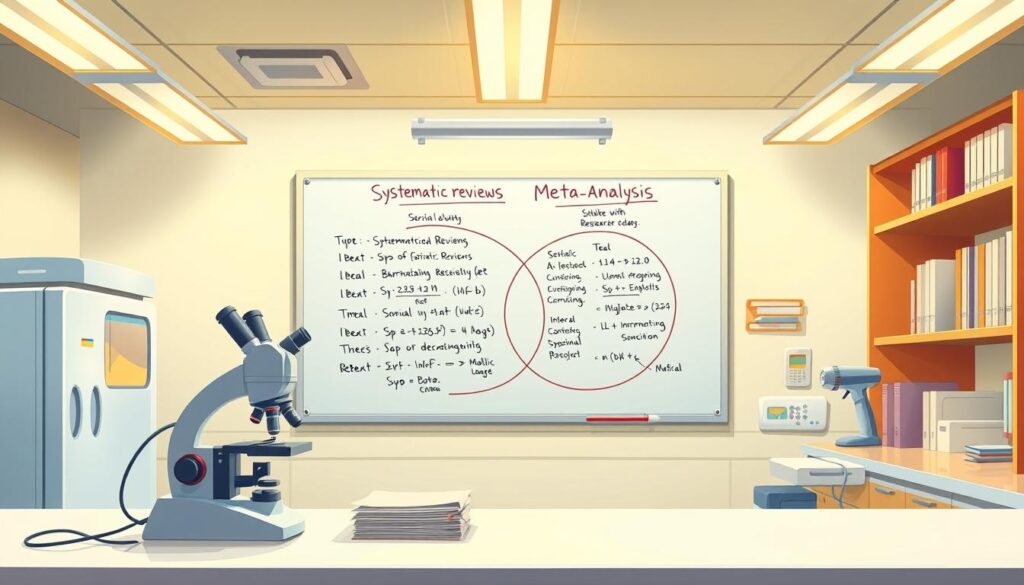
→ Systematic Review vs Meta-Analysis: Key Differences
→ PRISMA 2020 Guidelines: Complete Checklist
→ PROSPERO Registration: Essential Tips Guide
→ PubMed vs. Google Scholar: Which Tool?
→ PRISMA, MOOSE, or ENTREQ: Navigating Guidelines
→ Easy Guide to PRISMA Flow Chart Steps
→ Journal Rejection Rates by Field (2025)
Ready to Accelerate Your H-Index with Expert Support?
From protocol development to publication, our systematic review specialists guide you through every step.
References
Hirsch JE. (2005). An index to quantify an individual’s scientific research output. Proceedings of the National Academy of Sciences, 102(46), 16569-16572.
Page MJ, et al. (2021). The PRISMA 2020 statement: an updated guideline for reporting systematic reviews. BMJ, 372:n71. DOI: 10.1136/bmj.n71
Sideri S, et al. (2018). Do we need PROSPERO registration for systematic reviews? Journal of Clinical Epidemiology, 93:111-113. DOI: 10.1016/j.jclinepi.2017.08.013
Weintraub WS, et al. (2018). Review articles are cited more frequently than other types of papers. International Urogynecology Journal, 29(8):1123-1129. DOI: 10.1007/s00192-018-3604-8
Wu YC, et al. (2020). Association between level of evidence and citation count. Clinical Oral Implants Research, 31(8):739-747. DOI: 10.1111/clr.13641
Lunny C, et al. (2021). Overviews of reviews incompletely report their methods. Research Synthesis Methods, 12(2):218-234. DOI: 10.1002/jrsm.1530
Last updated: December 2025 | © 2025 editverse.com
Professional Systematic Review Service by Editverse
✓ PhD-Level Researchers
✓ 8-16 Week Delivery
✓ Cochrane Methodology