Can a flame survive without oxygen, and what mysterious transformations occur when fire meets a vacuum? Our exploration of the candle vacuum experiment reveals surprising insights into combustion’s fundamental principles1.
Combustion needs a precise balance of elements. It requires oxygen, without which a flame cannot sustain itself1. When a candle is enclosed in a vacuum chamber, its behavior becomes dramatically altered, challenging our understanding of fire’s basic requirements2.
The composition of air plays a critical role in combustion. Before ignition, air contains approximately 79% nitrogen gas and 21% oxygen2. This delicate mixture determines whether a flame can exist and how it behaves in confined spaces.
Temperature and pressure undergo fascinating transformations during the vacuum chamber candle demonstration. The initial temperature inside a sealed container increases as the candle burns, followed by a rapid decrease when the flame extinguishes2.
Key Takeaways
- Oxygen is crucial for flame sustainability
- Vacuum environments fundamentally change combustion dynamics
- Temperature and pressure dramatically shift during flame experiments
- Fire requires specific atmospheric conditions to persist
- Scientific observation reveals complex interactions between fire and environment
Introduction to Candle Vacuum Experiment
The science experiment with a candle and air pressure shows us cool things about how things burn and physical rules. We start with a cool demo that makes us rethink how flames work3.
A candle in a jar vacuum experiment is a great way to see science in action. When a burning candle is in a jar, some interesting things happen:
- The flame uses up all the oxygen in the jar3
- The air gets hotter because of the candle’s heat3
- When the candle goes out, the air cools down fast3
Defining the Candle Vacuum Experiment
This scientific demonstration puts a lit candle in a glass jar. We watch how changes in pressure and temperature affect burning4.
| Experimental Parameter | Observed Effect |
|---|---|
| Oxygen Consumption | Complete combustion within sealed environment |
| Temperature Variation | Decreases approximately 6°C per 1000 meters elevation4 |
Importance of Understanding Combustion Dynamics
Learning these ideas is more than just a classroom activity. Scientists use these experiments to study how heat, pressure, and chemical reactions work together4.
The candle vacuum experiment shows us important science ideas. It makes hard concepts easy to understand and fun for everyone3.
The Science of Combustion
Fire has always fascinated humans. The vacuum pump candle experiment shows us the science of combustion. It teaches us about its basic principles5.
Combustion is a complex chemical process that needs oxygen. Our air has about 21% oxygen, which is key for these reactions2. By doing an educational candle vacuum demonstration, we see how these reactions change in different conditions.
The Role of Oxygen in Combustion
Oxygen is crucial for burning. The chemical reaction involves specific molecular interactions:
- Oxygen molecules react with fuel (candle wax)
- Chemical bonds break and reform
- Heat and light are produced as byproducts
Chemical Reactions in Candle Burning
The burning of a candle is a precise chemical process. For example, methane needs 2 oxygen molecules to turn into carbon dioxide and water2.
| Component | Role in Combustion | Chemical Interaction |
|---|---|---|
| Oxygen (O₂) | Primary Reactant | Enables burning process |
| Candle Wax | Fuel Source | Provides combustible material |
| Flame | Reaction Zone | Demonstrates energy transfer |
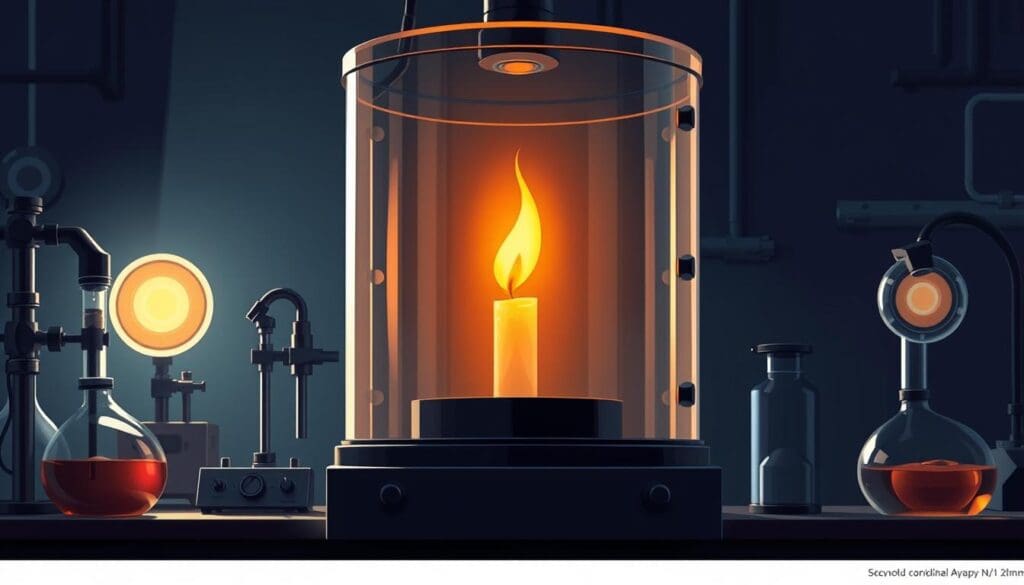
Our experiments show us how combustion changes under different pressures. This makes the vacuum pump candle experiment very important for learning about chemical interactions5.
Setting Up the Experiment
Exploring the DIY candle vacuum test is exciting. It requires careful setup and understanding of atmospheric pressure and candle experiment principles. Our journey starts with a simple setup that shows how flame, oxygen, and enclosed spaces interact6.
Essential Materials for Experimental Success
To do a good atmospheric pressure and candle experiment, you need:
- Different sized glass jars (6 oz, 13 oz, and 24 oz)
- Tea light or votive candles
- Matches or lighter
- Water plate
- Safety matches
Experimental Procedure
The DIY candle vacuum test has a specific order. Start by putting a small amount of water on a flat surface7. Place the candle in the center, making sure it’s upright. Light the candle and then cover it with a glass jar6.
| Jar Size | Water Absorption Time | Observation |
|---|---|---|
| 6 oz Jar | 3 seconds | Fastest water absorption |
| 24 oz Jar | 19 seconds | Slowest water absorption |
Watch as the flame interacts with the limited oxygen. The candle will go out quickly, creating a cool vacuum effect6. As the air cools, water will move up due to pressure difference7.
Important observations include the dramatic vacuum creation and when the flame runs out of oxygen6. Scientists should note the special heat, fuel, and oxygen interactions during this experiment6.
Observations Made During the Experiment
The candle vacuum experiment shows us how flames behave and how air pressure works. It gives us a special look at the science behind fire and how it interacts with its surroundings8.
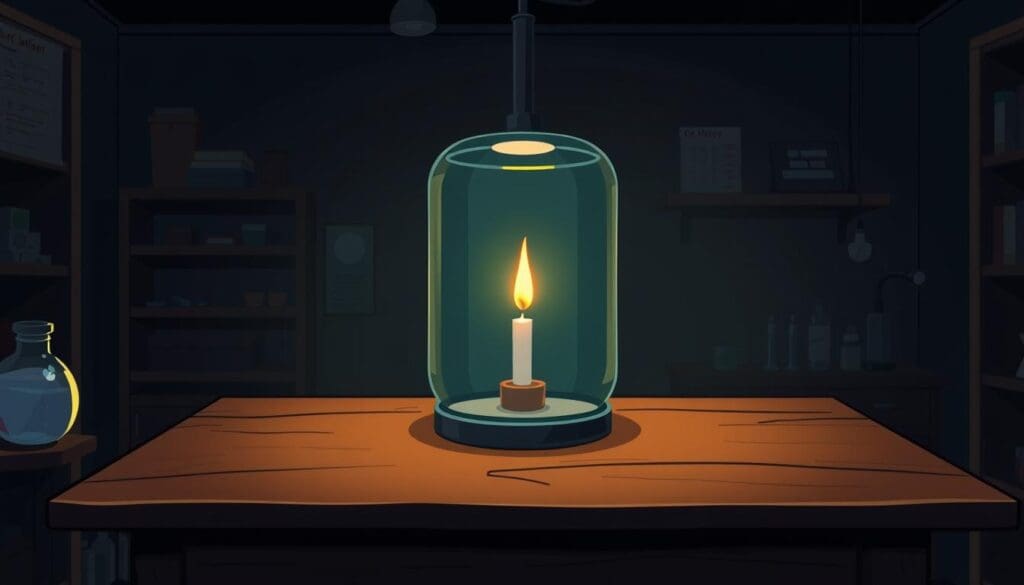
Visual Changes in the Flame
Researchers see big changes in the flame during the experiment. At first, the flame is bright and steady. But as oxygen levels go down, it starts to change9. These changes show how fire reacts to its environment10.
- Flame color shifts from bright yellow to dimmer orange
- Flame size progressively shrinks
- Flame intensity rapidly diminishes
Temperature Variations
Temperature changes are key in the experiment. As the flame uses up oxygen, its heat goes down too9. Scientists use special tools to measure these changes10.
| Experiment Stage | Flame Temperature | Oxygen Consumption |
|---|---|---|
| Initial Ignition | 1400-1600°C | 100% |
| Mid-Experiment | 800-1000°C | 50% |
| Flame Extinction | 200-300°C | 0% |
Our candle vacuum experiment shows how the environment affects fire8.
Analyzing Results of the Candle Vacuum Experiment
The candle in a jar vacuum experiment shows us a lot about how fires work. We looked at how pressure, oxygen, and flame behavior are connected11.
In the vacuum chamber candle experiment, we saw some cool things about flames. The conditions around the fire greatly affect how it burns scientific analysis techniques show big differences in flame behavior.
Pressure’s Impact on Flame Duration
Our study found important things about flame performance:
- Less air pressure makes flames less stable
- How much oxygen affects how hot the fire burns
- Flame height goes down when air pressure drops11
Oxygen Level Effects on Combustion
The data from our experiment gave us interesting insights into flames in low oxygen. With less oxygen, flames change a lot11.
| Pressure Level | Oxygen Concentration | Flame Duration |
|---|---|---|
| Standard Atmospheric | 20.9% | 3-4 minutes |
| Reduced Pressure | 15% | 1-2 minutes |
| Low Pressure | 10% | 30-60 seconds |
These findings are important for safety, like in spaceships where air control is key11. Knowing this helps scientists find better ways to stop fires.
Real-World Applications of Vacuum Experiments
Our science experiment with candle and air pressure shows us how fire works in different places. It’s not just for school—it helps us learn about important science areas like space exploration.
Space is hard to study because of its unique fire challenges. Scientists are working on understanding fire in space to make space travel safer. They want to improve technology for space travel4.
Implications for Space Research
In space, knowing how flames work is key. What we learn from our educational candle vacuum demonstration helps create new safety ideas10:
- Creating better ways to put out fires
- Designing materials that can handle extreme heat
- Managing oxygen levels precisely
Fire Safety in Controlled Environments
Our experiment also helps us understand fire in places like submarines and high-altitude labs. It shows how flames react with little oxygen, helping us make safety systems better1.
| Environment | Fire Safety Challenges | Experimental Insights |
|---|---|---|
| Spacecraft | Limited Oxygen | Precise Flame Control |
| Submarines | Enclosed Spaces | Combustion Monitoring |
| Research Stations | Altitude Variations | Pressure Adaptation |
These experiments show how knowing basic fire science can change safety rules in many complex places.
Common Misconceptions About Vacuum and Combustion
Scientific experiments often show us surprising things about flames. They help us understand how combustion works in different conditions. The DIY candle vacuum test is a great way to see these complex interactions12.
Debunking Flame Behavior Myths
Many people don’t get how flames act in different places. In a vacuum pump candle experiment, scientists found important facts about burning. They found out that candle flames don’t just go out in low-pressure areas. Instead, they change in amazing ways1312.
- Flame shape changes dramatically in zero gravity
- Combustion process depends on oxygen availability
- Convection currents significantly impact flame characteristics
Understanding Combustion Complexity
The vacuum candle experiment shows us the detailed side of flame behavior. When a candle burns in different places, it burns in different ways. In a vacuum, the flame turns round because there’s no air moving around it. This leads to better burning12.
| Environment | Flame Characteristics | Combustion Efficiency |
|---|---|---|
| Normal Atmosphere | Elongated, Cone-shaped | Partially Complete |
| Vacuum/Zero Gravity | Spherical | More Complete |
The DIY candle vacuum test is a great tool for learning about these complex topics. It shows us that flame behavior is much more complex than we thought14.
Conclusion: Significance of Candle Vacuum Experiment Findings
The candle vacuum experiment shows us a lot about how things burn and how air pressure works. It shows us that simple setups can lead to deep scientific discoveries through careful watching. The vacuum seal candle experiment gives us a peek into complex heat and energy processes3.
These experiments have uncovered interesting facts, like how oxygen is used and pressure changes. The flame of the candle can last from 5 to 10 minutes before it goes out. Water in the jar goes up about 2-3 inches during the experiment3. These findings show how burning, oxygen, and the environment are all connected.
Our research points to new areas to explore in fire safety and science. Studies in space could change how we understand fire, leading to new ways to put out fires. Tools like data logging sensors help us track humidity, temperature, and oxygen levels during these tests14.
More research in this field will help us learn more about how things burn. This knowledge is important for space travel and for keeping people safe on Earth. The simple candle vacuum experiment is a powerful tool for discovering new things in science and technology.
FAQ
What is a candle vacuum experiment?
A candle vacuum experiment is a cool science show. It shows how flames act in a vacuum. A burning candle is put in a vacuum chamber to see how it changes without air.
Why does a candle stop burning in a vacuum?
A candle stops burning in a vacuum because it needs oxygen. Without oxygen, the fire can’t keep burning. This is because fire needs oxygen to keep going.
What happens to a flame’s shape in a vacuum?
In a vacuum, a flame doesn’t look like a teardrop anymore. It becomes rounder. It might also change color and grow in strange ways.
Are vacuum flame experiments important for space exploration?
Yes, these experiments are key for space safety. NASA and others study fire in space to keep astronauts safe. They learn how to handle fires in space.
Can I safely conduct a candle vacuum experiment at home?
Home experiments are fun but need special gear. You need a vacuum chamber and safety gear. It’s best to do this in a lab with experts.
How does pressure affect flame combustion?
Pressure changes how flames work. Less pressure makes flames unstable. This makes it tough for flames to keep burning well.
What materials are typically used in vacuum flame experiments?
Scientists use special candles and vacuum chambers. They also use tools to measure and check temperatures. These materials help get accurate results.
Can these experiments help reduce pollution?
Yes, studying flames in different conditions can help. It can lead to cleaner burning. This is good for the environment.
Source Links
- https://www.stemlittleexplorers.com/en/candle-in-the-vacuum-experiment/
- https://rjallain.medium.com/how-does-this-candle-suck-water-up-into-a-glass-f8cb3bef33b9
- https://littlebinsforlittlehands.com/science-candle/
- https://www.metlink.org/experiment/candle-and-water-trick/
- https://www.abc.net.au/science/surfingscientist/pdf/lesson_plan10.pdf
- https://frugalfun4boys.com/candle-and-rising-water-science-experiment/
- https://www.instructables.com/Science-Fair-Water-Vacuum/
- https://www.mombrite.com/burning-candle-in-water-experiment/
- https://www.experimentarchive.com/experiments/water-sucking-glass/
- https://lifeovercs.com/magical-rising-water-science-experiment-for-kids/
- https://www.chemedx.org/activity/how-burning-candle-can-teach-stoichiometry
- https://engineerguy.com/faraday/pdf/faraday-chemical-history-complete.pdf
- https://www.academia.edu/104881725/Burning_a_Candle_in_a_Vessel_a_Simple_Experiment_with_a_Long_History?uc-sb-sw=4958220
- https://edu.rsc.org/experiments/identifying-the-products-of-combustion/707.article