Ever curious about the electrical magic when you touch a plasma ball? These devices turn simple electricity into stunning lights that seem to break the rules of physics1.
Plasma balls are cool scientific tools that show us the complex world of electricity. They have a thick glass sphere with a high-voltage electrode in the middle. Inside, they hold gases like neon and argon2. When you play with plasma ball tricks, you see electric fields and ionization at work3.
Learning to touch a plasma ball means understanding plasma, the most common matter in the universe1. The colorful lights move towards your finger because of your body’s conductivity. This creates a cool discharge path1.
Key Takeaways
- Plasma balls operate using high-frequency electrical currents
- Noble gases create spectacular light displays
- Human body conductivity enables unique interactions
- Plasma is the most prevalent form of matter in the universe
- Electrical discharge creates mesmerizing visual effects
Learn more about these amazing devices in our plasma ball exploration guide.
Understanding Plasma Balls
Plasma balls are amazing scientific devices that amaze both students and science fans. They show off electric energy in a mesmerizing way. These spheres make learning about physics fun through cool tricks4.
The first plasma lamp was invented by Nikola Tesla in 18944. They became popular in the 1970s. This sparked a lot of interest in plasma globe tricks through cool science shows.
What is a Plasma Ball?
A plasma ball is a glass sphere filled with noble gases. It shows off electric field visuals in a cool way. When it’s turned on, the gases ionize and create bright, moving electrical discharges that react to touch5.
How Does a Plasma Ball Work?
Plasma balls use high-frequency alternating current, around 30-35 kHz. They have voltages from 2 to 5 kilovolts54. The central electrode makes electromagnetic radiation that creates plasma filaments.
Components of a Plasma Ball
| Component | Function |
|---|---|
| Glass Sphere | Provides sealed environment for gas mixture |
| Central Electrode | Generates high-frequency electrical current |
| Noble Gases | Creates ionized plasma filaments |
| Electrical Circuit | Controls voltage and frequency |
The magic of plasma balls is in their ability to show electrical energy in a beautiful way. By adding different gases like argon and xenon, makers can make unique patterns and colors5.
Plasma balls are a cool mix of art and science. They turn complex electrical ideas into a fun visual show.
The Science Behind Plasma
Plasma is a fascinating area of science that connects theoretical physics with interactive tricks like plasma globe manipulation1. It’s the most common form of matter in the universe. Plasma has unique properties that set it apart from other states of matter1.
Understanding Plasma’s Unique Nature
Plasma is a hot ionized gas with equal amounts of positive ions and negative electrons1. It forms when gases are heated to high temperatures or exposed to strong electrical fields. This creates a dynamic mix of charged particles.
| Matter State | Particle Behavior | Energy Level |
|---|---|---|
| Solid | Fixed positions | Low |
| Liquid | Fluid movement | Medium |
| Gas | Random motion | High |
| Plasma | Charged particle interaction | Very High |
Plasma’s Electrical Characteristics
Interactive plasma ball tricks show off plasma’s electrical properties plasma is made of noble gases like neon and argon1. These gases create beautiful displays when excited by electricity. This shows plasma’s high conductivity.
The high-voltage electric current creates colorful lights that amaze viewers1. This electrical phenomenon shows how plasma can turn energy into stunning visuals.
- Plasma is the most abundant matter in the universe
- Contains equal positive and negative charges
- Responds dynamically to electrical fields
- Enables fascinating interactive demonstrations
Scientists keep exploring plasma with advanced diagnostic tools and research techniques. They’re unlocking new insights into this extraordinary state of matter.
The Interaction of Touching a Plasma Ball
Plasma balls show amazing electrical phenomena that excite science fans and curious people. Learning about plasma lamp touching tips is key for a safe and fun experience.
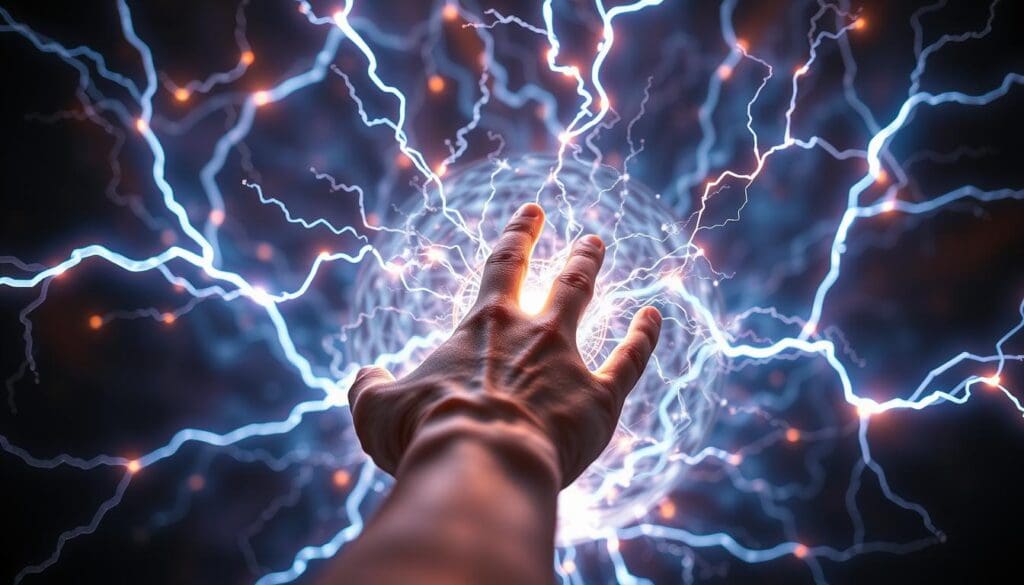
The electric field in a plasma ball creates cool visual effects when touched. Plasma ball tricks show how our body’s conductivity affects energy flow3. Our body’s internal resistance is less than 1000 ohms, making us a good conductor compared to air3.
Electric Fields and Ionization
Approaching a plasma ball leads to interesting phenomena:
- The high-frequency alternating current creates unique energy patterns3
- Voltage between 2 to 5 kV makes spectacular plasma tendrils3
- Our body’s capacitance of about 100 pF affects electrical interactions3
The Path of Least Resistance
Plasma follows the path of least resistance when touched. Our body can act as an antenna, picking up signals from the plasma ball6. This is why plasma threads go towards the point of contact.
Visual Effects of Touching
| Interaction Type | Observable Effect |
|---|---|
| Single Finger Touch | Concentrated plasma stream |
| Multiple Finger Contact | Branching plasma threads |
| Conductive Object Touch | Spark generation |
Be careful when playing with plasma balls, as interactions can lead to unexpected electrical responses3.
Plasma ball tricks need a grasp of electrical principles and human interaction. The sight of ionized gas reacting to touch amazes scientists and fans alike.
Plasma Ball Touching Tricks
Exploring plasma ball touching tricks opens a world of fun science experiments. These cool interactions show the special qualities of plasma7. Whether you love science or just want to try new things, these tricks are a great way to learn about electricity.
Now, let’s look at some amazing plasma ball tricks that will wow and teach you:
- Single Finger Touch: Make a direct electrical link by touching the plasma ball’s surface
- Multiple Finger Technique: See how different fingers make different electrical paths
- Conductivity Experiments: Test various objects near the plasma ball
Exploring Touch Interactions
Plasma ball tricks can create stunning visuals. The electric current acts differently when touching skin compared to other materials8. If you put fluorescent bulbs close to a plasma ball, they can light up because of the electric current8.
| Trick | Expected Outcome | Scientific Principle |
|---|---|---|
| Single Finger Touch | Electrical arc follows finger | Path of Least Resistance |
| Multiple Finger Contact | Complex arc patterns | Electrical Field Interaction |
| Object Interaction | Varies by material conductivity | Electron Flow |
Safety and Precautions
While plasma ball tricks are cool, it’s important to be careful. These high-voltage devices can mess with electronic devices and be risky8. Always watch over experiments and don’t touch for too long.
Remember, plasma balls work at frequencies we can’t feel7. They are both fascinating and dangerous scientific tools.
Safety Considerations
Learning how to touch a plasma ball means knowing the safety risks and the right ways to handle it. These devices are mesmerizing, but it’s important to use them safely.
Plasma balls are mostly safe for casual use. But, it’s important to handle them carefully to avoid risks9. They can also affect electronic devices and medical equipment9.
Key Safety Guidelines
- Avoid prolonged direct contact with the plasma ball
- Keep the device away from individuals with pacemakers9
- Prevent extended exposure to potential ozone emissions9
- Use protective clothing when performing plasma ball tricks9
Potential Risks of Touching Plasma
Understanding plasma interactions shows us some safety tips. The skin effect prevents electrical shock when touching a plasma ball, as electrons move over the skin’s surface10. Electrical currents typically range between 2-5 kilovolts, which might sound scary but usually doesn’t cause serious harm3.
| Safety Aspect | Recommendation |
|---|---|
| Electrical Interference | Keep away from sensitive electronics3 |
| Ozone Exposure | Limit continuous operation to prevent gas buildup3 |
| Medical Devices | Maintain distance from pacemakers9 |
Safety comes first when exploring the fascinating world of plasma globe touching techniques.
Plasma balls are great for showing science in action. But, users should be careful. By following safety tips, fans can enjoy these devices safely1093.
Fun Facts About Plasma Balls
Plasma balls have amazed science fans and curious people for years. They mix science with cool visuals. These mesmerizing devices have a long history in science and pop culture.
Historical Origins
Nikola Tesla started the story of plasma balls with his experiments on high-frequency currents11. He made the first plasma lamp in 1894. This was the start of interactive plasma ball tricks11.
In the 1970s, James Falk made plasma balls widely available11.
Technological Evolution
Plasma spheres have changed a lot since they were first made. Here are some key moments in their development:
- 1894: Nikola Tesla’s initial plasma lamp invention
- 1970s: Commercial production begins
- 1980s: Peak popularity as novelty items12
Popular Culture References
Plasma balls have moved beyond science labs. They are famous in movies, TV, and art. Interactive plasma ball tricks amaze people, showing off their cool visuals.
They also teach science, helping students learn about electricity and plasma. Their ability to show science in action makes them great for teaching physics11.
The Role of Plasma Balls in Education
Plasma balls are now key tools in education, making tough science easy to see1. They let students dive into electricity, ionization, and plasma physics through fun, hands-on activities plasma globe manipulation tricks. This sparks their curiosity and helps them understand science better.
Our teaching method uses plasma balls to show off basic science ideas. When you touch them, colorful lights show how electricity and plasma work1. It’s like seeing science come to life, making hard ideas easy to remember.
Key Educational Concepts
Plasma balls teach important science ideas:
- Electrical conductivity
- Ionization processes
- Energy transfer mechanisms
- Properties of plasma3
Demonstrating Scientific Principles
| Concept | Plasma Ball Demonstration |
|---|---|
| Electrical Conductivity | Seeing light paths when touching glass |
| Plasma States | Seeing ionized gas in action |
| Energy Transfer | Watching electrons move3 |
The modern plasma ball was made by Bill Parker1 and works at 35 kHz3. These devices offer plasma lamp touching tips that make learning science fun and interactive.
Plasma balls make learning science hands-on, connecting theory with real-world observation3. They are essential for sparking curiosity in students of all ages.
Maintenance and Care for Plasma Balls
Keeping your plasma ball in good shape is key. These devices need special care to keep their plasma disk contact moves going strong. This care helps avoid damage13.
Here are some important tips for taking care of your plasma ball. These tips help protect your investment and keep the fun going:
- Avoid turning it on and off too much to stop overheating13
- Don’t let it sit in direct sunlight or get wet
- Use a soft, dry microfiber cloth to clean the glass gently
Safe Cleaning Practices
Cleaning your plasma ball needs care. Never use liquid cleaners or rough materials. Instead, a clean, dry microfiber cloth works best for dust and smudges. Plasma balls have amazed people for over 40 years. Keeping them clean helps keep their magic alive13.
Troubleshooting Common Issues
| Issue | Potential Cause | Solution |
|---|---|---|
| Dimming Plasma Arcs | Aging Electronics | Check power supply, replace if necessary |
| Uneven Plasma Distribution | Internal Gas Pressure Changes | Consult manufacturer warranty13 |
| Electromagnetic Interference | High-Frequency Emissions | Keep away from sensitive electronic devices14 |
Remember, your plasma ball’s warranty usually covers defects for one year when used right13.
By following these care tips, you can make your plasma ball last longer. This way, you can keep enjoying its amazing plasma disk contact moves for many years3.
Where to Buy Plasma Balls
Finding the right plasma ball is important. You might want to try plasma ball touching tricks or learn how to touch a plasma ball. The right model can spark your scientific curiosity6.
Plasma balls vary in size and design. You can find small desktop models or big installations that draw attention6. They suit both hobbyists, teachers, and those who want to decorate.
Popular Brands and Features
Look for these key features when buying a plasma ball:
- Voltage range and electric field strength
- Gas composition6
- Size and design
- Educational potential
Comparative Price Range
| Category | Price Range | Features |
|---|---|---|
| Budget Model | $20-$50 | Basic plasma effects, smaller size |
| Mid-Range | $50-$100 | Enhanced visual effects, multiple gas types |
| Professional | $100-$300 | Advanced scientific demonstrations, larger size |
ArbOrSci is a top brand for plasma balls. They offer models for unique learning experiences6. Prices depend on the model’s complexity and scientific features.
Think about what you need: learning, decoration, or fun. The right plasma ball will change how you see electricity6.
Conclusion: The Fascination of Plasma Balls
Plasma balls are a mix of science and art. They amaze people with their ability to show off electrical science in a cool way15. With high-voltage electricity, they turn complex science into something fun and easy to understand15.
These balls are more than just pretty lights. They help teach about electricity and how gases behave. They are safe, but you should handle them with care15.
Exploring plasma balls is a journey worth taking. They make learning about electricity fun and interactive. Whether you love science, teach it, or just want to learn, plasma balls are a great way to see science in action.
Invitation to Scientific Discovery
We encourage you to explore plasma balls safely. They show how science can be both fascinating and easy to learn. Plasma balls are a symbol of our curiosity and the power of visual learning.
FAQ
What exactly is a plasma ball?
A plasma ball is a cool scientific device that shows the fourth state of matter, plasma. It’s in a sealed glass globe. Inside, there’s a high-voltage electrode and noble gases that make glowing plasma tendrils when electricity flows.
Is it safe to touch a plasma ball?
Plasma balls are usually safe to touch briefly. The electricity is low-voltage and feels mild. But, don’t touch it for too long or near electronics. Always follow the maker’s rules and watch kids when they play with it.
How do plasma ball tendrils actually work?
The plasma tendrils move where the electricity is easiest to flow. When you get close with a conductive object, the plasma goes to you. This creates amazing light filaments that show how electric fields and ionization work.
Can I use different objects to interact with a plasma ball?
Yes, you can use many objects to see different plasma effects. Metals like coins or keys make the plasma stronger. But, non-conductive things like wood or plastic won’t interact much.
Do plasma balls consume a lot of electricity?
Plasma balls use about 3-5 watts of power. They’re designed to run all the time without using too much electricity.
Are plasma balls good for educational purposes?
Yes, they’re great for teaching about electricity, ionization, and plasma physics. They make learning fun and interactive, which is why they’re used in schools and science museums.
How do I clean and maintain my plasma ball?
To clean your plasma ball, use a soft, dry cloth. Don’t use liquids or touch the glass. Keep it away from moisture, extreme temperatures, and sunlight to keep it working well.
What should I consider when buying a plasma ball?
When buying a plasma ball, think about size, power use, quality, and special features. Choose a well-known brand, read reviews, and decide if you want it for learning, decoration, or fun.
Can plasma balls interfere with other electronic devices?
Plasma balls do make electromagnetic fields, but most devices are shielded. Still, it’s best to keep them away from sensitive electronics like computers or medical devices.
Are plasma balls suitable for children?
Plasma balls can be great for kids when watched by an adult. They’re interesting and can make kids curious about science. Just make sure kids know the basics of safety and don’t play with it alone.
Source Links
- https://wonderopolis.org/wonder/how-does-a-plasma-ball-work
- https://assist.asta.edu.au/question/4343/plasma-ball
- https://en.wikipedia.org/wiki/Plasma_globe
- https://science-gifts.co.uk/how-do-plasma-balls-work/?srsltid=AfmBOopef294-uj9dpRk05fUFEuDVtwf1NGx76ZjbuLDT2rmTumEvH_r
- https://phantomdynamics.com/blog/plasma-globes-how-do-they-work/?srsltid=AfmBOorLAP_c7aU-fIo-RFmPbfe406YvojZwQHam5lPLcKV90sf5Onpd
- https://www.arborsci.com/blogs/cool/top-10-demonstrations-with-the-plasma-globe
- https://www.instructables.com/Amazing-plasma-globe-tricks-that-you-never-knew-be/
- https://www.sciencing.com/plasma-ball-tricks-7613499/
- https://sciencestruck.com/what-is-plasma-ball-how-does-it-work
- https://www.teachersource.com/product/plasma-globe-experiment
- https://science-gifts.co.uk/how-do-plasma-balls-work/?srsltid=AfmBOop834KKC-TuaCtTYHw6aZpGqN66KewAjSm1rSZ2Q2nrjhHk93Vu
- https://phantomdynamics.com/blog/plasma-globes-how-do-they-work/?srsltid=AfmBOooz3aG0mqj0LcTqRl1XItZlVRMaeJQ9HcWK5qTWOuPHt0E7Z7p4
- https://www.stdi.ca/amazon/plasma-globes/Plasma Globe Owners Guide – Web.pdf
- https://science-gifts.co.uk/how-do-plasma-balls-work/?srsltid=AfmBOooHHBK6XzCGWxxS0WZABzTftcjz33E1_nBb4P9mXNP4ZEwWCvEu
- http://enciclopedia.paginasdabiblia.com/pages/what-happens-when-you-break-the-glass-of-a-plasma-ball?srsltid=AfmBOorFGuWZvN3AnUPbJOVctXLJsqIBV3kfp3VzExcWrhjuIxQlIlLd