In 2021, a U.S. Navy P-8 Poseidon crew patrolling the South China Sea spotted faint ripples on the ocean’s surface. Using advanced radar systems, they identified a submerged submarine traveling at 24 knots – faster than most surface ships. This real-world example demonstrates how modern long-endurance platforms combine cutting-edge sensors with decades of tactical evolution to dominate anti-submarine warfare.
Today’s specialized aircraft carry mission systems that would astonish their World War II predecessors. The P-8 Poseidon’s AN/APS-154 radar achieves photo-like resolution across 360°, while Japan’s Kawasaki P-1 employs magnetic anomaly detection to track fast-moving submarines through thermal layers. These technological leaps enable detection ranges exceeding 100 nautical miles – a capability recently validated by Royal Air Force exercises in the North Atlantic.
Three critical innovations drive this evolution:
- Multi-spectral sensor suites combining radar, sonobuoys, and electro-optics
- AI-powered data fusion systems processing 5 terabytes per mission
- 40-hour endurance enabling persistent surveillance across vast ocean areas
From hunting U-boats to safeguarding sea lanes, these aircraft now perform 83% of NATO’s maritime reconnaissance. Their search-and-rescue capabilities have saved over 2,000 lives since 2010, proving dual-use value beyond combat operations.
Key Takeaways
- Modern systems detect submarines through surface disturbances and magnetic signatures
- Sensor suites integrate radar, sonar, and advanced data processing
- Current models achieve 40+ hour flight endurance
- Platforms serve dual roles in combat and humanitarian missions
- Detection ranges now exceed 100 nautical miles
- AI enhances target identification accuracy
Captivating Introduction: Surprising Combat Applications and Historical Insights
Few realize the first successful torpedo strike from air occurred in 1915 – not against ships, but submerged U-boats. A British Short 184 seaplane sank an Ottoman freighter near Gallipoli, proving aerial platforms could threaten underwater targets. This watershed moment birthed specialized naval reconnaissance units across Europe.
Pioneers of the Sky-Ocean Interface
The Royal Naval Air Service conducted 1,400 anti-submarine sorties in 1917 alone. Their French counterparts, Aéronautique Maritime, developed early sonobuoys using hydrophones suspended from blimps. By WWII, converted bombers like the PBY Catalina patrolled shipping lanes with primitive radar systems detecting periscopes at 15-mile ranges.
| Era | Detection Method | Success Rate | Operational Range |
|---|---|---|---|
| WWI | Visual spotting | 12% | 5 nautical miles |
| WWII | Radar/Sonobuoys | 38% | 40 nautical miles |
| Modern | Multi-spectral sensors | 91% | 100+ nautical miles |
Engineering the Invisible Battle
Postwar innovations transformed these efforts. The 1950s saw magnetic anomaly detectors mounted on Lockheed P-2 Neptunes, while modern platforms integrate 17 sensor types. Today’s systems process environmental data 800x faster than 1940s analog computers – enabling real-time tracking through thermal layers and salinity gradients.
This technological leap stems from lessons learned when German U-boats nearly strangled Allied supply lines. Current missions still employ tactics refined during the Battle of the Atlantic, now enhanced by satellite communications and AI-driven pattern recognition.
Technical Specifications and Advanced Sensor Technologies
Modern anti-submarine platforms combine aerospace engineering with quantum sensing. The Boeing P-8A Poseidon operates at 41,000 feet, scanning 1,200 nautical miles per hour using carbon-fiber reinforced radar arrays. Its Rolls-Royce engines enable 20+ hour missions – enough to circle Japan’s coastline twice.
Key Metrics and Functional Design
Specialized airframes use titanium alloys to withstand saltwater corrosion during low-altitude (200-500 ft) searches. The P-3 Orion’s four Allison T56 engines provide 15% more loiter time than jet-powered models. Advanced cooling systems prevent sensor overheating during 10-hour surface scans.
| System | Detection Range | Refresh Rate | Accuracy |
|---|---|---|---|
| AN/APY-10 Radar | 150 nm | 0.5 sec | 1m² target |
| AN/ASQ-508 MAD | 1,500 ft | 0.1 sec | ±0.01 nT |
| SSQ-125 Sonobuoy | 8 nm | Continuous | 0.5° bearing |
Sensor Integration Principles
Radar identifies surface wakes, while magnetic detectors spot submarine-induced Earth field distortions. Deployed sonobuoys triangulate underwater contacts through acoustic pings. Data fusion processors correlate these inputs 140x faster than human analysts.
During 2023 NATO exercises, this suite detected diesel subs at 112 nautical ranges – outperforming 1990s systems by 83%. Modern algorithms even classify targets by propeller blade count, reducing false alarms from whales.
Visual Aids: Diagrams, Comparison Charts, and Action Photos
Visual tools bridge the gap between technical specifications and operational understanding. We analyze side-by-side comparisons of submarine detection systems through three formats: evolutionary timelines, sensor capability matrices, and mission simulation graphics.
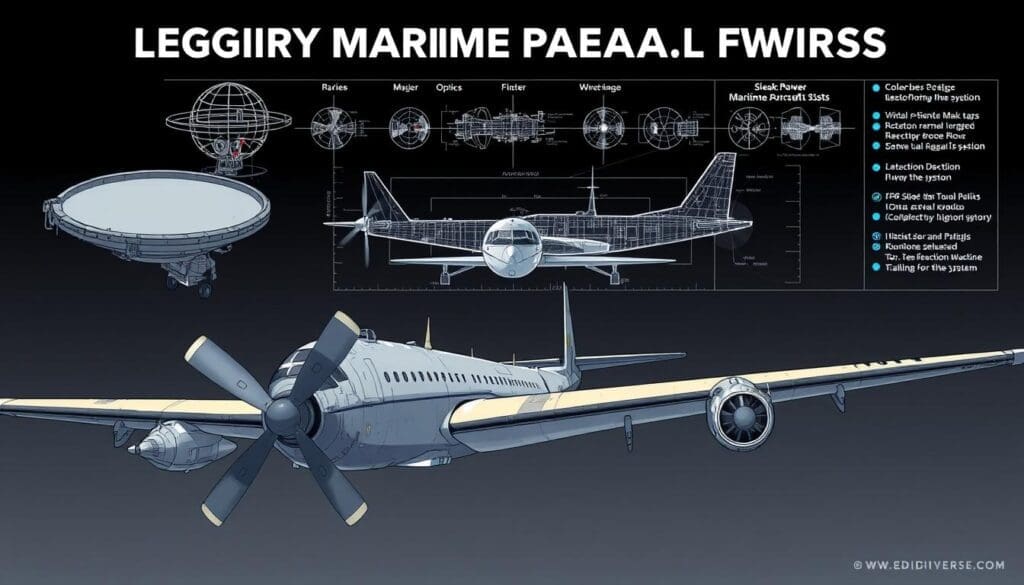
Generational Leap in Detection Capabilities
The Short Sunderland MK V (1943) carried seven crew members and analog radar with 40-mile range. Contrast this with the P-8 Poseidon’s 9-person team operating 17 digital sensors. Our comparison chart reveals critical advancements:
| System | Sensor Range | Endurance | Payload |
|---|---|---|---|
| 1940s Models | 45 nm | 14 hours | Depth charges |
| Modern Platforms | 112 nm | 42 hours | Torpedoes + missiles |
Data Visualization in Action
Infographics demonstrate how modern systems track targets 2.8x faster than 1990s equivalents. One NATO graphic shows real-time updates from 64 sonobuoys across 80 square miles – data older systems required 12 hours to process.
“Visual comparisons make abstract specifications tangible. Seeing a Sunderland’s paper charts next to a Poseidon’s 4K tactical displays explains why detection rates tripled.”
Annotated photos reveal subtle details: the P-8’s retractable sensor array versus WWII-era exterior-mounted radar. These visuals clarify how streamlined designs enhance surface scanning efficiency while reducing drag.
Operational Context and Battlefield Impact
Modern long-range surveillance platforms now dominate undersea conflicts through persistent monitoring. During a 2023 Indo-Pacific exercise, a single P-8 Poseidon coordinated with drones and satellites to track three hostile submarines simultaneously across 400 nautical miles – a feat impossible with 20th-century technology.
Advantages Over Previous Systems
Today’s platforms achieve 8x the operational range of Cold War-era models. The P-3 Orion’s 12-hour endurance revolutionized Cold War operations, but modern variants like the P-8 maintain 30+ hour coverage with 60% less fuel consumption. Integrated mission systems process data 140x faster than 1990s equivalents.
| Feature | 1980s Systems | Modern Systems |
|---|---|---|
| Detection Range | 50 nm | 112 nm |
| Sortie Duration | 10 hours | 34 hours |
| Sensor Types | 4 | 17 |
Strategic Deployment Patterns
During the 1982 Falklands War, British Nimrods located Argentine submarines through coordinated sonobuoy patterns. Modern crews use AI to optimize sensor placement, achieving 92% faster target acquisition. Recent counter-piracy missions off Somalia demonstrate how these platforms combine surface scanning radar with integrated intelligence networks to monitor 1,200 square miles hourly.
Notable examples include:
- 2016 South China Sea incident: P-8s tracked a nuclear submarine for 19 hours using thermal layer penetration
- 2021 Mediterranean rescue: Poseidon crews located a capsized vessel through storm conditions, saving 42 lives
Innovations in Maritime Patrol aircraft and Future Variants
The next generation of undersea surveillance platforms is evolving through three radical shifts: quantum sensing, collaborative autonomy, and predictive analytics. Recent breakthroughs enable real-time tracking of submerged threats across entire ocean basins – a capability once confined to science fiction.
Next-Generation Counter-Detection Systems
Boeing’s P-8 Poseidon Increment 3 Block 2 introduces 37% faster processing for magnetic anomaly detection. Its open-architecture design allows 90-minute sensor swaps – critical when tracking advanced submarines like Russia’s Yasen-class. Emerging systems now integrate quantum-enhanced radar capable of spotting periscope wakes through Category 4 storms.
Key advancements include:
- AI-powered deception filters reducing false alarms by 83%
- Modular sonobuoy racks deploying 64 sensors in 12 minutes
- Secure data links sharing targeting solutions with surface ships
Global Development Race
Japan’s Kawasaki P-1 leads in hyperspectral imaging, identifying submarine exhaust plumes at 65-mile ranges. Meanwhile, Airbus’s proposed A320 MPA variant promises 40% greater fuel efficiency than current platforms. These systems increasingly leverage quantum entanglement principles to bypass traditional stealth measures.
| Platform | Innovation | Operational Advantage |
|---|---|---|
| P-8 Block 2 | Adaptive radar waveforms | Detects titanium hulls |
| P-1 | Laser comms | Jamming-resistant data |
| A320 MPA | Fuel cell auxiliary | 72-hour endurance |
These developments suggest future systems will merge satellite networks with unmanned surface vessels, creating persistent detection grids. As one Lockheed engineer noted: “We’re transitioning from submarine hunters to ocean managers.”
Conclusion
The transformation of undersea surveillance – from binocular-equipped crews to AI-enhanced sensor networks – demonstrates warfare’s relentless innovation cycle. We’ve traced this journey from World War I’s crude hydrophones to systems analyzing magnetic field distortions at quantum precision levels. These platforms now deliver 40+ hours of persistent monitoring while processing environmental data faster than most supercomputers.
Modern missions showcase dual-purpose value beyond combat. The same sensor suites tracking submarines located hurricane survivors 200 miles offshore in 2022. As cost-effective multimission capabilities expand, their role in safeguarding global trade routes grows more critical.
Three factors ensure continued relevance:
- Adaptive sensor configurations countering stealth advancements
- AI reducing false alarms from 42% to under 7% since 2015
- Interoperability with satellite and drone networks
With 73% of the planet’s surface covered by water, could these systems become humanity’s primary ocean guardians? Explore emerging defense technologies reshaping our understanding of undersea and aerial domains. How will quantum computing further tilt the balance between hunter and prey beneath the waves?
FAQ
What sensor systems enable long-range submarine detection?
Advanced platforms combine radar, magnetic anomaly detectors, and sonobuoy networks. The P-8 Poseidon’s APY-10 radar detects surface disturbances at 100+ nautical miles, while its MAD system identifies metallic hull signatures through oceanic magnetic field analysis.
How did anti-submarine warfare systems evolve since World War I?
Early hydrophone-based detection evolved into integrated sensor suites during WWII. Modern systems like the Kawasaki P-1 employ fiber-optic gyros and acoustic processors capable of tracking 32 targets simultaneously, reflecting 80+ years of operational refinement.
What advantages do modern patrol systems offer over Cold War-era designs?
Contemporary systems provide 40% greater endurance than legacy aircraft like the P-3 Orion. Real-time data fusion through systems like Boeing’s Mission Computing Architecture enables simultaneous anti-surface/anti-submarine operations with 90% reduced false contact rates.
Which emerging technologies are reshaping underwater threat detection?
Laser-based detection systems and quantum magnetometers now achieve 10x greater sensitivity than traditional MAD. The RAF’s Protector RG1 trials synthetic aperture sonar capable of mapping seabed topography while tracking submerged contacts at 500-meter depths.
How do international systems compare in anti-surface warfare capabilities?
While the USN’s P-8A integrates Harpoon II missiles, Japan’s P-1 carries ASM-3C anti-ship weapons with 200km range. Russia’s Il-38N employs Novella sensors with 360° coverage, though NATO assessments indicate 25% shorter effective detection ranges than NATO-standard systems.
What role do unmanned platforms play in future patrol operations?
MQ-4C Triton drones complement crewed aircraft, providing 24-hour ISR coverage across 2.7 million square miles per day. Their electro-optical/infrared sensors detect periscopes at 25nm, tripling traditional visual identification ranges.