“The universe is a looking glass, and we are both the viewer and the viewed.” – John Wheeler’s words show how gravitational lensing changes our view of space and time.
Gravitational lensing is a key tool in astronomy. It lets scientists look deeper into the universe’s secrets. This amazing process of bending light through huge cosmic objects lets us see distant galaxies and structures that were hidden from old telescopes1.
When huge objects like galaxy clusters meet light, they create amazing sights. Gravitational lensing bends spacetime, acting like a cosmic magnifying glass. It shows us secrets of the universe that were once hidden1. By changing light’s path, scientists can explore parts of the universe we couldn’t reach before.
Key Takeaways
- Gravitational lensing allows observation of distant cosmic structures
- Massive objects can bend and magnify light from background sources
- The technique reveals hidden details of the early universe
- Einstein’s theory of relativity predicts this fascinating phenomenon
- Gravitational lensing is crucial for understanding dark matter
What Is Gravitational Lensing?
Gravitational lensing is a cool phenomenon where big cosmic objects bend light with their gravity. It lets scientists see far-off stars and learn about space-time2.
This idea changes how we study the universe. It lets us see things we can’t with regular telescopes. Einstein rings are especially cool. They happen when light passes perfectly through massive objects3.
Fundamental Principles of Lensing Effects
To get gravitational lensing, we need to understand how gravity bends space-time. The main ways include:
- Light bending around massive astronomical objects
- Creation of multiple images or distorted light arcs
- Revealing hidden cosmic structures
Types of Gravitational Lensing
There are three main types of gravitational lensing:
- Strong lensing: Big light distortions near huge objects
- Weak lensing: Small light bends that need special tools2
- Microlensing: Brief brightness changes of background stars2
Gravitational lensing is getting even more exciting. Future telescopes like the Large Synoptic Survey Telescope will find millions of lensing events2.
Gravitational lensing changes how we see the universe, letting us see beyond what we could before.
The Science Behind Gravitational Lensing
Gravitational lensing is where Einstein’s theory of relativity meets cosmic phenomena. It shows how big objects can bend and distort light in space2.
Albert Einstein’s insights led to the idea of gravitational distortion. He said massive objects warp space, bending light like a lens2.
Einstein’s Groundbreaking Predictions
Einstein thought gravitational waves could change how we see the universe. The first proof came in 1919, during a solar eclipse. Astronomers saw light bending around the sun2:
- Light rays bend near massive objects
- Spacetime curves act like a magnifying glass
- Gravitational lensing lets us see distant, hidden galaxies2
Light and Gravity Interactions
The dance of light and gravity shows amazing cosmic sights. Astronomers use it to find exoplanets and map dark matter2.
“Gravity bends light as surely as light illuminates gravity” – Astronomical Insight
Our understanding is growing, thanks to ongoing research. Future telescopes like the Large Synoptic Survey Telescope will change what we know about gravity2.
Types of Gravitational Lensing
Gravitational lensing is a cool phenomenon that lets scientists see the universe in new ways. It helps us learn about the universe’s hidden parts. We can study it through three main types: strong lensing, weak lensing, and microlensing revealing cosmic mysteries.
Strong Gravitational Lensing
Strong lensing happens when big galaxy clusters bend light from far away. Scientists have found 67 strong gravitational lenses in big sky surveys. These lenses can make light bend in cool ways, like making multiple images or Einstein rings4.
They give us clues about dark matter too4.
Weak Gravitational Lensing
Weak lensing is a gentler effect. It lets astronomers study big cosmic structures by looking at how they bend light. Galaxy clusters are key to understanding this effect5.
They help us see details about mass that are hard to spot5.
Microlensing
Microlensing is about small objects and exoplanets. It’s a way to find these tiny things. The time it takes for light to bend can be from minutes to months5.
| Lensing Type | Characteristics | Key Observations |
|---|---|---|
| Strong Lensing | Dramatic light bending | Multiple images, Einstein rings |
| Weak Lensing | Subtle mass distortions | Statistical cosmic structure analysis |
| Microlensing | Small-scale interactions | Exoplanet and compact object detection |
Gravitational lensing transforms our understanding of cosmic structures by revealing hidden cosmic dynamics.
Historical Development of Lensing Studies
Gravitational lensing has been a key part of astronomy for decades. It has changed how we see the universe. This tool, like a cosmic magnifying glass, shows us things we couldn’t see before thanks to big scientific leaps.
Early Conceptual Foundations
Albert Einstein’s work started it all. His theory of general relativity said massive things can warp light6. But, it took 60 years after his 1919 solar eclipse test for us to see it in action6.
Pivotal Observational Milestones
- 1919: First successful demonstration of light deflection during solar eclipse6
- 1979: Discovery of the first gravitational lens, SBS 0957+561 A/B6
- Mid-1980s: Detection of giant gravitational arcs in galaxy clusters6
Finding strong lensing is rare because it needs perfect alignment6. Better telescopes have helped us spot these rare sights.
Research Breakthroughs
Today’s surveys have given us new views of gravitational lensing. The SLACS survey found 98 galaxies that bend light from far away6. This shows how lensing can act as a cosmic magnifying glass for us to see distant things.
Our knowledge keeps growing. Scientists are learning more about dark matter and the universe’s structure from lensing7.
How Gravitational Lensing Works
Gravitational lensing is a cool phenomenon where big objects in space bend light. This bending is due to gravity. It lets astronomers see deeper into the universe’s secrets8.
Gravitational lensing happens when massive objects like galaxies and galaxy clusters interact with light. These objects have strong gravitational fields. These fields warp space, creating unique effects9.
The Role of Massive Objects
Big objects in space are key in gravitational lensing. Their strong gravity bends light paths. It also makes distant objects look bigger and can create multiple images.
- Bend light paths around them
- Magnify distant cosmic objects
- Create multiple image projections
The Path of Light Explained
Light in space meets gravitational fields and changes direction. When light goes by a big object, it curves. This creates gravitational lensing effects.
This effect lets scientists see parts of the universe they can’t see normally8.
| Lensing Type | Characteristics | Observation Potential |
|---|---|---|
| Strong Lensing | Significant light bending | High magnification (up to 100x)8 |
| Weak Lensing | Subtle light distortion | Minimal magnification |
| Microlensing | Temporary brightness changes | Detecting distant objects |
By studying gravitational lensing, scientists get new insights into the universe. They learn about distant cosmic structures and hidden phenomena9.
Applications of Gravitational Lensing
Gravitational lensing is a key tool in astronomy. It lets us see parts of the universe we couldn’t before. As a cosmic magnifying glass, it reveals hidden corners of space10.
Exploring Dark Matter
Galaxy clusters are great for studying dark matter. Scientists use gravitational lensing to find and measure this invisible mass11. This method helps them:
- Detect invisible matter
- Measure mass distributions
- Study cosmic structural dynamics
Understanding Cosmic Structures
Gravitational lensing is a powerful tool for space research. It can magnify distant galaxies, showing us details from the early universe10. The Hubble Space Telescope has helped uncover:
- Multiple images of distant galaxies
- Distorted galaxy shapes
- Banana-shaped gravitational arcs
By bending light, gravitational lensing acts like a natural telescope. It helps us understand cosmic structures and dark matter better12.
Gravitational Lensing in Action
Gravitational lensing is a cool phenomenon that lets scientists see deep into our universe. It uses big objects in space as natural telescopes. These objects bend light, showing us secrets of the cosmos through gravity.
The universe shows us amazing sights like Einstein rings and strong lensing. These sights amaze scientists. Some cool examples include:
- The Einstein Cross in QSO 2237+0305, showing multiple images of one quasar1
- The Bullet Cluster, showing lensing effects3
- Galaxy cluster 0024+1654, showing five images of a distant galaxy3
Breakthrough Observations
New research uses weak lensing to learn more. The James Webb Space Telescope has made amazing images. These images show distant galaxies13. They let us see faint objects, looking back in time13.
Remarkable Case Studies
Some studies show how powerful gravitational lensing is. For example, the galaxy cluster MACS J1149.6+2223 is amazing. Hubble saw multiple images of a supernova over time3. This helps us understand the universe and how light and gravity work.
By using gravitational lensing, scientists keep discovering new things. They uncover hidden cosmic landscapes that we couldn’t see before.
The Future of Gravitational Lensing Research
Gravitational lensing research is changing fast. New technologies and missions are coming. They will change how we see the universe.
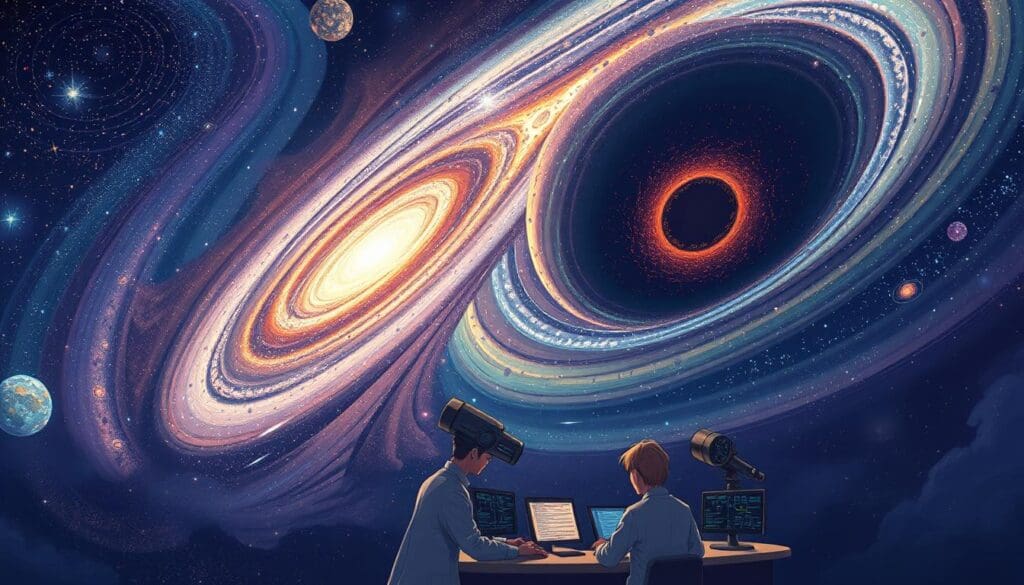
New projects will make our astronomy better. The Vera C. Rubin Observatory’s Legacy Survey of Space and Time is a big step forward14. It will help us learn more about the universe by:
- Covering 18,000 square degrees of the sky
- Running for 10 consecutive years
- Increasing known galaxy-scale lenses by two orders of magnitude14
Technological Breakthroughs in Observation
New tech is making it easier to spot and study gravitational lensing. The Nancy Grace Roman Space Telescope is a big step up. It can make very accurate time-delay estimates14:
- Up to 43.6% of time-delay estimates have fractional errors less than 5%
- Potential for detecting thousands of new gravitational lensing events
Upcoming Research Frontiers
Gravitational waves and gravitational lensing are coming together. This is opening up new areas of study. Scientists are looking forward to making big discoveries, like finding multi-messenger detection of gravitationally lensed cosmic explosions14.
They’re also excited about testing physics and exploring new ideas. This includes:
- Detecting lensing signals in gamma-ray bursts
- Exploring complex modeling of cosmic events
- Improving angular resolution with multi-messenger approaches
Conclusion: The Importance of Gravitational Lensing
Gravitational lensing is a game-changer in astronomy. It acts like a cosmic magnifying glass, letting scientists see the universe’s deepest secrets. This method helps us study distant galaxies and understand complex cosmic structures15.
By bending light from far-off objects, it gives us insights into areas that were once invisible to us16.
Gravitational lensing is more than just a tool for looking. It has revealed amazing sights, like multiple galaxy images and complex light distortions17. It helps us find faint galaxies and map dark matter, making it key in modern astrophysics15.
As research grows, gravitational lensing will help us understand our universe even more. New technologies and missions are letting us explore cosmic structures in more detail. They show us how galaxies form, what dark energy is, and the nature of spacetime16.
The cosmic magnifying glass is changing how we see the vast, mysterious universe around us.
FAQ
What is gravitational lensing?
Gravitational lensing is when massive objects like galaxies bend light from far away. It acts like a cosmic magnifying glass. This lets us see distant cosmic structures that are too faint or far to see normally.
How does gravitational lensing work?
Massive objects warp spacetime with their gravity. This makes light from far away bend and curve. It can create multiple images, magnify objects, or make Einstein rings when everything is perfectly aligned.
What are the different types of gravitational lensing?
There are three main types. Strong lensing makes dramatic changes like multiple images in galaxy clusters. Weak lensing causes small distortions for statistical analysis. Microlensing is on a smaller scale and helps find exoplanets and compact objects.
Why is gravitational lensing important in astronomy?
It’s key for studying dark matter, mapping the universe, and seeing distant galaxies. It’s a powerful tool that lets astronomers see beyond what regular telescopes can.
Can gravitational lensing help detect dark matter?
Yes, it’s a top method for finding dark matter. By seeing how light bends around galaxy clusters, scientists can find and map dark matter. Dark matter doesn’t emit, absorb, or reflect light.
What was the first observational confirmation of gravitational lensing?
The first proof was during the 1919 solar eclipse. It showed Einstein’s predictions about light bending were right. The first gravitational lens was found in 1979, a big step in astronomy.
How precise are gravitational lensing measurements?
Today’s methods are very precise. Astronomers can spot small distortions in light and measure cosmic structures with great accuracy. New telescopes and tech keep improving these measurements.
What future technologies are expected to advance gravitational lensing research?
New projects like the Nancy Grace Roman Space Telescope and the Vera C. Rubin Observatory will help a lot. They will let us detect and study gravitational lensing better. This will give us new insights into the universe and dark matter.
Source Links
- https://www.skyatnightmagazine.com/space-science/a-guide-to-gravitational-lensing
- https://www.cfa.harvard.edu/research/topic/gravitational-lensing
- https://science.nasa.gov/mission/hubble/science/science-behind-the-discoveries/hubble-gravitational-lenses/
- https://www.forbes.com/sites/startswithabang/2020/08/17/two-kinds-of-gravitational-lenses-both-reveal-dark-matter/
- https://www.mdpi.com/2218-1997/9/5/200
- https://pmc.ncbi.nlm.nih.gov/articles/PMC3263800/
- https://www.darkenergysurvey.org/darchive/cross-correlation-of-gravitational-lensing-from-des-science-verification-data-with-spt-and-planck-lensing/
- https://news.berkeley.edu/2015/03/05/distant-supernova-split-four-ways-by-gravitational-lens/
- https://noirlab.edu/public/news/noirlab2104/
- https://esahubble.org/science/gravitational_lensing/
- https://www.universetoday.com/118751/what-is-gravitational-lensing/
- https://pmc.ncbi.nlm.nih.gov/articles/PMC5567250/
- https://newatlas.com/space/james-webb-space-telescope-gravitational-lensing/
- https://royalsociety.org/science-events-and-lectures/2024/03/gravitational-lensing/
- https://esahubble.org/wordbank/gravitational-lensing/
- https://sci.esa.int/web/euclid/-/what-is-gravitational-lensing-
- https://en.wikipedia.org/wiki/Gravitational_lens