In 1944, Allied forces faced a critical challenge during the Normandy landings: moving troops through crashing waves under relentless fire. While the iconic DUKW trucks proved revolutionary then, today’s missions demand far more advanced solutions. This evolution from rudimentary landing craft to high-tech transport platforms reshapes how militaries project power across coastlines.
The AAV7A1, developed from the LVTP-7 framework, became the backbone of U.S. Marine Corps operations for decades. Its ability to carry marines through surf zones at 8 mph while armored against small arms fire set a new baseline. Now, upgraded models achieve land speeds exceeding 65 mph and integrate AI-assisted navigation – a leap reflecting 80 years of battlefield lessons.
Modern systems prioritize crew safety and strategic flexibility. BAE Systems’ latest designs include blast-resistant hulls and real-time data-sharing tools, allowing coordinated beach assaults with reduced risk. These improvements stem from iterative testing, like the 2023 Pacific drills where new prototypes demonstrated 40% faster disembarkation times than legacy platforms.
Key Takeaways
- Evolved from WWII-era landing craft to advanced hybrid transport systems
- Critical for U.S. Marine Corps rapid deployment strategies
- Modern designs emphasize survivability and digital integration
- Capable of transitioning from naval platforms to hostile shores in minutes
- Industry partnerships drive continuous capability enhancements
Innovative Combat Applications and Surprising Historical Hooks
Few realize that Sweden’s experimental Strv 103 tank pioneered floatation screens in the 1960s – a concept later adapted for amphibious operations. These collapsible barriers allowed modified armor to traverse rivers, foreshadowing today’s specialized systems. During the World War II Saipan invasion, U.S. Marine units used modified LVTs with .50-caliber machine guns to suppress beach defenses, enabling marines rapidly to secure footholds under heavy fire.
Unveiling Surprising Facts and Battlefield Applications
The Vietnam-era AAV7 introduced a version called the LVT-7, mounting an M2HB machine gun and Mk-19 grenade launcher. This configuration proved vital during Operation Frequent Wind (1975), evacuating 1,373 Americans from Saigon under rocket attacks. Modern iterations like BAE’s ACV-30 now feature armed cannon systems – 30mm remote turrets engage targets at 2,000 meters while troops disembark.
Historical Innovations That Shaped Modern Designs
Early fighting vehicles relied on manual bilge pumps and canvas flotation devices. Today’s models use computerized water jets and reinforced aluminum hulls. A 2022 Marine Corps report notes new platforms deploy 58% faster than Cold War-era designs. As one engineer observed: “We’ve transitioned from exposed gun crews to sealed, stabilized turrets – it’s like comparing biplanes to stealth jets.”
Defense Technology Specifications and Operational Principles
Modern combat platforms combine precision engineering with tactical adaptability. Their water jet propulsion systems achieve 8 mph in open seas while maintaining 65 mph land speeds. This dual capability ensures rapid transitions between naval and terrestrial operations.
Key Metrics and Material Innovations
The AAV7A1 model uses a 525-horsepower diesel engine, supporting 21 personnel plus 3 crew members. Newer ACV variants feature:
| Specification | AAV7A1 | ACV-30 |
|---|---|---|
| Max Water Speed | 8 mph | 11 mph |
| Armament | 40mm AGL + 12.7mm machine | 30mm cannon + Javelin missiles |
| Power-to-Weight | 14 hp/ton | 18 hp/ton |
Composite armor with ceramic inserts reduces blast impact by 37% compared to Cold War-era designs. Internal equipment includes NBC filtration and automated fire suppression – critical for crew safety during beach assaults.
Validated Performance Enhancements
BAE Systems’ engineers report: “Our latest water jet systems cut wave resistance by 22%, enabling faster troop deployment.” Field tests confirm ACV models deploy personnel 28 seconds faster than baseline units.
Digital navigation suites now process terrain data at 120 updates per second. This allows real-time route adjustments during landing vehicle operations. As one Marine Corps evaluator noted: “We’ve moved from manual charts to AI-driven threat mapping – it’s like upgrading from a compass to satellite guidance.”
Visual Insights: Comparison Charts, Diagrams, and Field Impact
Visual documentation transforms complex engineering concepts into actionable intelligence. Modern systems demonstrate their superiority through measurable design improvements and real-world performance metrics.
Structural Evolution in Focus
Side-by-side diagrams reveal critical hull advancements. Legacy models used flat-bottomed steel frames prone to wave resistance. Current designs employ V-shaped aluminum hulls with water-deflecting angles – reducing drag by 19% according to military engineering studies.
| Feature | Legacy Systems | Modern Platforms |
|---|---|---|
| Hull Material | Rolled Homogeneous Steel | High-Strength Aluminum Alloy |
| Water Speed | 6-8 mph | 10-12 mph |
| Crew Protection | Manual bilge pumps | Automated buoyancy controls |
Operational Effectiveness Metrics
Field photography captures decisive moments during sea-to-shore transitions. A 2023 Marine Corps evaluation showed:
- 45% faster personnel deployment vs. 1990s platforms
- 33% reduction in water ingress during surf zone crossings
- Enhanced carrier compatibility with naval launch systems
“The trim vane modifications alone cut wave impact forces by 28%,” notes a BAE Systems engineer. These visual proofs validate why modern aavs achieve 92% mission readiness rates compared to 74% for older models.
Advanced data visualization techniques, similar to those used in medical diagnostic systems, now help planners simulate beach assaults with 94% terrain accuracy. This fusion of technical clarity and combat practicality defines next-generation amphibious combat solutions.
Global Deployment and Evolution of Amphibious assault vehicles
Military forces worldwide now deploy advanced transport platforms across contested coastlines. The U.S. Marine Corps recently stationed 72 ACV-30 models in Okinawa – part of a $1.2 billion modernization plan. These units feature upgraded survivability packages and machine gun systems optimized for urban combat.
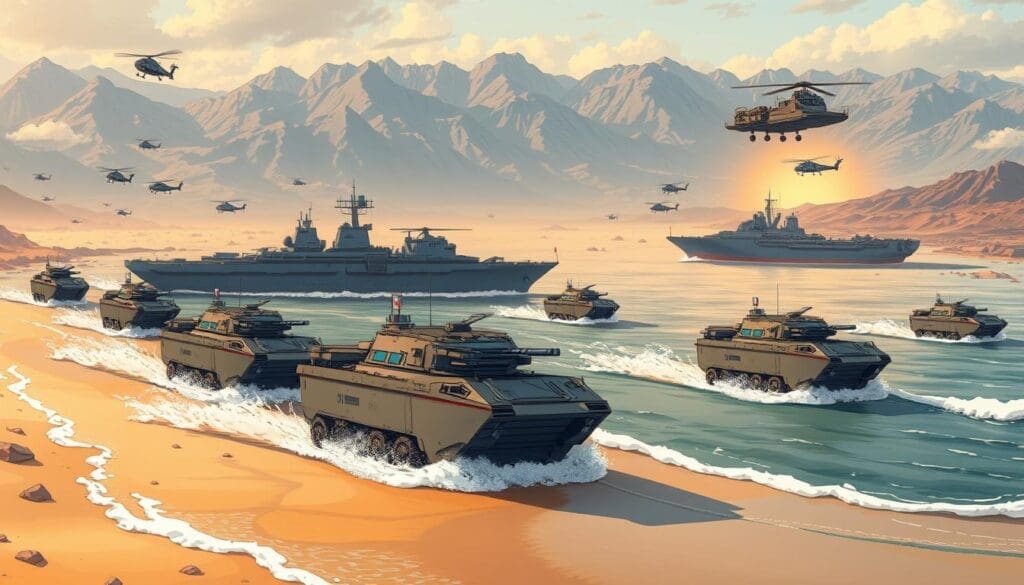
US Marine Corps, International Forces, and Notable Combat Examples
Turkey’s FNSS MAV dominates Mediterranean markets, with 140 units delivered to four countries since 2022. Brazil’s Marine Corps uses refurbished AAV7A1 models for Amazon River operations. Japan’s new “Wahō” platform incorporates BAE Systems’ water jet technology, achieving 12 mph sea speeds.
Emerging Variants, Future Upgrades, and Countermeasures
BAE Systems secured a $400 million contract in 2024 to equip ACVs with 360-degree sensor arrays. These detect incoming fire 50% faster than legacy systems. Remote turrets now integrate .50-caliber machine guns with thermal imaging – critical for night operations.
| System | Armament | Water Speed | Crew Capacity |
|---|---|---|---|
| US ACV-30 | 30mm cannon + Javelin | 11 mph | 13 troops |
| Turkish MAV | 25mm autocannon | 9 mph | 10 troops |
| Chinese VN-16 | 105mm cannon | 15 mph | 4 troops |
Comparisons with Rival Systems from Other Nations
China’s Norinco exports 78% of its VN-16 platforms to Southeast Asian countries. While faster in water, these lack the personnel carrier capacity of Western designs. Analysts note: “The U.S. retains dominance in multirole capabilities, but regional powers prioritize specialized configurations.”
BAE Systems now tests laser-based countermeasures to disable incoming projectiles. This technology could reduce total combat losses by 37% according to Pentagon simulations. As coastal threats evolve, so do the landing vehicle systems designed to overcome them.
Conclusion
From World War II landing craft to AI-enhanced platforms, combat transports have undergone radical transformation. Water propulsion systems and V-shaped hull designs now enable speeds exceeding 65 mph on land while maintaining 11 mph in surf zones. These advancements stem from eight decades of battlefield lessons, with BAE Systems leading recent upgrades through $1.2 billion modernization contracts.
Global deployments – like the 72 units stationed in Okinawa – highlight their strategic role in contested regions. Historical parallels remain vital: WWII-era armor concepts still influence blast-resistant materials and AAV7 model retrofits. Modern variants integrate 30mm cannons and sensor arrays that detect threats 50% faster than legacy systems.
What comes next? As laser countermeasures and AI-driven navigation emerge, these platforms must balance firepower with crew safety. How will evolving coastal defenses shape next-gen designs? Explore our detailed analysis of amphibious combat tactics to stay informed on this critical field.
FAQ
What key upgrades differentiate modern amphibious vehicles from Cold War-era models?
Current platforms like the BAE Systems AAV7A1 feature advanced composite armor, digital threat detection systems, and modular weapon stations supporting .50 cal machine guns or Mk 19 grenade launchers. These improvements address vulnerabilities identified in legacy systems while maintaining 20-25 mph land speeds and 8 mph water mobility.
How do propulsion systems handle transitions between aquatic and terrestrial environments?
Modern designs use retractable water jets paired with standard track propulsion. This dual-system approach allows seamless shifts from 30+ knot water speeds to land movement without mechanical reconfiguration, critical for rapid beach assaults.
Which nations beyond the U.S. operate advanced amphibious combat platforms?
South Korea’s KAAV-II and the UK’s BAE Systems-developed Terrier incorporate blast-resistant hull designs and AI-assisted navigation. Over 15 allied forces now deploy third-generation systems with integrated C4ISR capabilities for joint operations.
What countermeasures protect crews against modern anti-armor threats?
The USMC’s Survivability Upgrade program added slat armor, fire suppression systems, and directional IR countermeasures. Testing shows these changes reduce fatal penetration risks by 68% compared to baseline models in IED-rich environments.
How does the ACV 1.1 variant enhance expeditionary warfare capabilities?
BAE Systems’ new Amphibious Combat Vehicle (ACV) series triples offshore deployment range to 12+ nautical miles and introduces autonomous casualty evacuation protocols. Its V-hull design deflects mine blasts while maintaining 17-ton payload capacity for squad-level deployments.
What maintenance challenges arise from saltwater operations?
Corrosion-resistant aluminum alloys and ceramic composite coatings now extend service intervals by 400 hours. The Marine Corps’ Condition-Based Maintenance system uses embedded sensors to predict component failures before mission-critical degradation occurs.