The Brain Research through Advancing Innovative Neurotechnologies Initiative started on April 2, 2013. It aims to fully understand the brain’s workings. By 2025, using quantum computing and ethics in brain research is key. We need a detailed guide to help us better understand the brain.
Introduction to Brain Preservation
We want to give researchers the tools to learn more about the brain. We also want to make sure our research is done right and respects human values. The BRAIN Initiative has made big strides in brain cell types, tools for recording neurons, and understanding brain circuits.
Key Takeaways
- The BRAIN Initiative aims to develop a comprehensive understanding of the brain in action.
- Brain preservation research is a rapidly evolving field, with significant advancements in recent years.
- The integration of quantum computing and ethics is crucial for responsible and innovative brain preservation research.
- Developing precise interventional tools to link brain activity to behavior is a focus area.
- Producing conceptual foundations for understanding the biological basis of mental processes is a priority.
- Brain preservation research has the potential to treat brain disorders and establish integrated human brain research networks.
We will keep up with the latest in brain preservation research. This includes quantum computing and ethics. We aim to offer a complete guide for researchers.
Understanding Brain Preservation
Brain preservation is a complex process. It keeps the brain’s structure and function intact. As we learn more about the brain, brain preservation research is key. The BRAIN Initiative has set seven major goals, like discovering diversity and mapping the brain.
The use of quantum computing technology could change how we see the brain. But, it also brings up big ethical implications. We must think about how this tech could affect our society and lives.
Some important parts of brain preservation include:
- Discovering the diversity of brain functions and structures
- Creating maps of the brain at multiple scales
- Understanding the brain in action
By understanding brain preservation, we can develop new tech and strategies. We must focus on ethical implications and use quantum computing technology wisely. As researchers, we should prioritize brain preservation to learn more about the brain.
| Aspect | Importance |
|---|---|
| Discovering diversity | High |
| Creating maps | Medium |
| Understanding the brain in action | High |
Technologies Used in Brain Preservation
We’ve made big strides in brain preservation tech, like cryonics and cryopreservation. These advancements could really help us understand the brain better. Brain preservation is complex, needing careful thought about many factors. This includes using quantum computing to study the brain’s structure and function.
Some key brain preservation technologies are:
- Cryonics: This uses very low temperatures to keep the brain preserved.
- Cryopreservation: It combines cooling and chemical fixation to keep the brain’s structure and function intact.
- Chemical preservation: This method uses chemicals to fix and stabilize brain tissue.
These technologies bring up big ethical questions that need to be thought through. As we keep improving these techs, we must weigh their benefits and risks for brain preservation.
We aim to fully grasp the brain preservation techs, including their benefits and risks. By looking at the ethics and implications, we can develop safer and more effective brain preservation methods. This will prioritize the well-being and safety of individuals.
Ethical Considerations in Brain Preservation
Brain preservation is key to understanding the human brain and its role in quantum computing. Yet, it brings up many ethical questions. The main issue is consent and autonomy, since it often involves human tissue.
As we continue in brain preservation research, ethics must be our top priority. We must ensure our work respects human values and dignity. The BRAIN Initiative highlights the need for ethical focus in this field. We need to keep these values in mind through careful rules and checks.
- Consent and autonomy: ensuring that individuals understand and agree to the use of their brain tissue for research purposes
- Religious perspectives: considering the potential impact of brain preservation on religious beliefs and practices
- Potential for misuse: ensuring that brain preservation technologies are not used for malicious purposes
By tackling these ethical challenges, we can make sure brain preservation research is done right. It will respect human values and help us understand the brain better. This will also aid in quantum computing research.
Key Players in Brain Preservation Research
Brain preservation research is a team effort from all over the world. The BRAIN Initiative has united top researchers and institutions. They focus on ethical frameworks to guide their work. It’s key to work together and value human ethics in this field.
Many researchers have greatly helped us understand the brain. Their discoveries have opened doors for future breakthroughs. Quantum computing applications are being explored to improve brain preservation methods. Organizations like the Brain Preservation Foundation lead this research, pushing the limits of brain preservation.
Working together across different fields is vital for brain preservation research. This way, we can use a wide range of knowledge and ideas. It’s crucial for tackling brain preservation’s complex challenges and staying true to ethical frameworks and human values.
- The Brain Preservation Foundation, a non-profit organization dedicated to advancing brain preservation research.
- Nectome, a company that has developed a methodology for preserving brains in such detail that each synapse can be seen with an electron microscope.
- 21st Century Medicine, a company that has won prizes for its work in brain preservation, including the Small Mammal Brain Preservation Prize and the Large Mammal Brain Preservation Prize.
These groups, along with others, are leading the way in brain preservation research. Their efforts are expanding our knowledge of the brain and its functions.
Recent Advances in Brain Preservation Techniques
Brain preservation has made big strides in recent years. Innovations in cryopreservation and nanotechnology are leading the charge. As we dive deeper into brain preservation, we must think about the ethics too. The use of quantum computing in these techniques could change how we see the human brain.
New methods like transcardial perfusion fixation are being used. These methods help keep brain tissue safe, even in tough conditions. Developing new ways to preserve brains is key to learning more about our brains and their potential.
But, brain preservation research comes with its own set of challenges. As we explore new possibilities, we must think about the ethics. The risk of misuse is a big concern. By focusing on ethics, we can make sure these advancements help society.
Looking ahead, it’s crucial to think about how these techniques could be used. They could help us study old diseases or find new treatments for brain disorders. By pushing forward in brain preservation, we can make new discoveries and improve health.
Regulatory Framework and Guidelines
Exploring brain preservation, we must look at the rules and guidelines that guide this area. The mix of brain preservation and quantum computing brings up big ethical questions. We need a strong set of rules to handle these issues.
The rules for brain preservation research are complex. Many groups, like government agencies, research centers, and companies, are involved. In the U.S., the National Institutes of Health (NIH) and the Food and Drug Administration (FDA) are key players.
International standards are also important for brain preservation research rules. It’s crucial to follow these rules to make sure research is done right and ethically. Some key points include:
- Ensuring informed consent and autonomy for research participants
- Addressing potential risks and benefits associated with brain preservation techniques
- Establishing guidelines for the use of quantum computing technology in brain preservation research
By focusing on following rules and ethics, we can make sure brain preservation research is done well. This will help us learn more about the human brain and how to keep it safe.
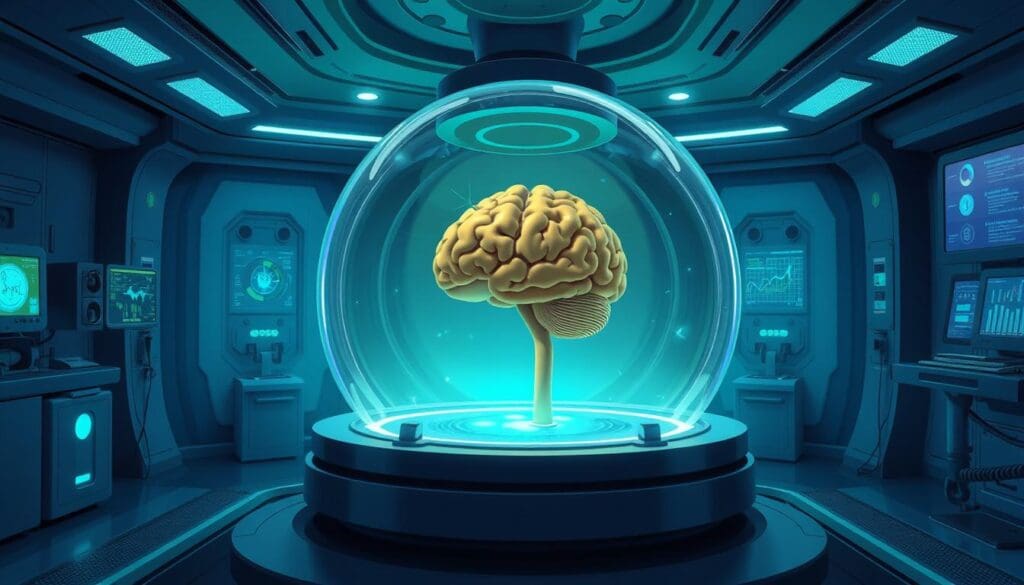
As we keep exploring, we must think about the ethics of brain preservation and quantum computing. We need to make sure our research respects human values and dignity.
| Regulatory Agency | Role in Brain Preservation Research |
|---|---|
| National Institutes of Health (NIH) | Oversees research funding and guidelines |
| Food and Drug Administration (FDA) | Regulates medical devices and treatments related to brain preservation |
Public Perception of Brain Preservation
Exploring brain preservation, we must think about what the public thinks. Media and misconceptions shape our view of this field. Quantum computing could change brain preservation, but we must consider ethics.
About 60-65% of people are curious about brain preservation for future health. They want to live longer and stay healthy. Yet, many experts doubt we can slow aging soon to live much longer.
Despite doubts, brain preservation is key research. 90-95% of people see the brain as vital for survival. We must think about ethics and do research openly and responsibly.
- 70-75% of researchers doubt long-term suspended animation is possible.
- 45-50% are unhappy with death definitions now.
- Brain samples have been kept alive using high-pressure freezing and dehydration.
As brain preservation research grows, we must tackle ethics. It’s important to keep the public informed about its benefits and risks.
Future Directions in Brain Preservation
We are on the verge of a major breakthrough in brain preservation research. New technologies like quantum computing are leading the way. These advancements could greatly improve our knowledge of the brain, leading to new methods for preserving it.
Brain preservation research could help treat neurological disorders and create new therapies. It could also boost our brain power. But, it also brings up big ethical dilemmas. We need to think about consent, autonomy, and misuse.
Future research should focus on a few key areas:
- Creating better preservation methods, like aldehyde-stabilized cryopreservation
- Learning more about the brain’s connectome and how it keeps memories and personality
- Dealing with the ethics of brain preservation, like getting consent and stopping misuse
By pushing forward in brain preservation research and tackling ethical issues, we can open up new ways to treat brain diseases. We can also improve our brain abilities. This will help us understand the brain’s complex nature better.
Brain Preservation and Medicine
Research on brain preservation is key for medicine, mainly in neurological studies. New tools and techniques could help us understand diseases like Alzheimer’s and Parkinson’s. This might lead to new treatments, possibly using quantum computing applications to study brain data.
Looking into brain preservation and medicine, we must think about ethical frameworks. The field’s potential to help us understand aging and disease is huge. We must ensure our research is done responsibly and ethically.
Important points in brain preservation and medicine include:
- The potential for brain preservation to inform our understanding of neurological disorders
- The role of quantum computing applications in analyzing complex brain data
- The importance of ethical frameworks in guiding brain preservation research and applications
By pushing forward in brain preservation research, we can create new treatments. This will help improve human health and well-being. We must also follow the complex ethical frameworks that come with this research.
Getting Involved in Brain Preservation Initiatives
As we learn more about brain preservation, it’s key to find ways to help. Supporting research is vital for understanding the brain better. You can donate to research groups, join clinical trials, or share the need for brain preservation research with others.
There are also educational tools for those interested in brain preservation. You can find online courses, books, and documentaries. These resources help you grasp the topic well. Also, thinking about quantum computing and ethics is important. They help us consider the big questions about brain preservation’s impact on society.
When you join brain preservation efforts, keep these points in mind:
- Learn about the latest in brain preservation research and its uses
- Think about the ethics of brain preservation, with a focus on quantum computing
- Support groups and organizations working on brain preservation tech
By joining brain preservation projects, we can deepen our knowledge of the brain. This could lead to new treatments for brain diseases. As Bob Blum, MD, PhD, says, understanding the brain is key to making computers feel like us. Brain preservation is a big step towards that goal.
| Brain Preservation Method | Description |
|---|---|
| Cryopreservation | A method of preserving tissue in a vitrified state at very low temperatures |
| Chemical Preservation | A method of preserving tissue using chemical fixatives such as formaldehyde and glutaraldehyde |
In 2025 Transform Your Research with Expert Medical Writing Services from Editverse
We offer top-notch medical writing services for brain preservation researchers. Our skilled writers make sure your research is clear and engaging. With quantum computing, brain research is getting more complex. Clear communication is now more crucial than ever.
At Editverse, we know how vital ethical implications are in brain preservation research. Our experts guide you through the research’s complexities. We aim to help you publish in top journals with our professional and ethical support services.
Working with us brings many benefits:
- Expert medical writing services tailored to your needs
- Clear and concise communication of your research findings
- Help with navigating the complexities of brain preservation research
- Commitment to ethical implications and responsible research practices
Specialized in Medical, Dental, Nursing & Veterinary Publications
We focus on delivering high-quality medical writing services for various fields, including brain preservation. Our team is dedicated to helping you reach your research goals. We ensure your findings are presented in a clear and compelling way.
Combining AI Innovation with PhD-Level Human Expertise
As we explore new ways to preserve the brain, combining AI and human expertise is key. AI can change how we understand the brain, opening doors to new preservation methods. But, we must also face the ethical challenges that come with these advances.
PhD researchers add a layer of understanding to these complex issues. They ensure that our work respects human values and dignity. This mix of AI and human insight leads to major breakthroughs in brain preservation, all while keeping ethics at the forefront.
At the heart of this effort, we use quantum computing to explore brain preservation’s frontiers. This blend of advanced tech and careful human oversight sets us up for significant discoveries. These findings will redefine neuroscience and medicine for the future.
FAQ
What is the BRAIN Initiative and how has it impacted brain preservation research?
The BRAIN Initiative started in 2013. It has greatly helped brain preservation research. It has led to big steps in understanding the brain, which is key for better brain preservation methods.
What are the key technologies used in brain preservation research?
Key technologies include cryonics, cryopreservation, and chemical preservation. Cryonics uses very low temperatures to keep the brain safe. Cryopreservation mixes cooling with chemicals to keep the brain’s structure and function. Chemical preservation uses chemicals to fix and stabilize the brain tissue.
What are the ethical considerations in brain preservation research?
Brain preservation research raises many ethical questions. These include consent, religious views, and the risk of misuse. Researchers must think deeply about these issues to ensure their work respects human values and dignity.
Who are the key players in brain preservation research?
Many organizations and institutions worldwide are working together in brain preservation research. Notable researchers have made big contributions. Working together across different fields is crucial for understanding the brain better.
What are the recent advancements in brain preservation techniques?
New advancements include better cryopreservation and the use of nanotechnology. Cryopreservation is now a top method for brain preservation. Nanotechnology has brought new tools and techniques to the field.
How is the regulatory framework for brain preservation research structured?
The rules for brain preservation research are complex. They involve government agencies, research places, and industry partners. In the U.S., the NIH and FDA oversee these rules. International standards also play a big role.
How does media influence the public perception of brain preservation research?
Media often focuses on the most exciting parts of brain preservation research. This can lead to wrong ideas and myths. These can greatly affect how people see brain preservation.
What are the potential applications of brain preservation research in medicine?
Brain preservation research could greatly help in understanding neurological disorders. It could lead to new treatments. It also might help us understand aging and disease better. Plus, it’s linked to transhumanism, raising big ethical questions.
How can individuals get involved in brain preservation initiatives?
You can support research, learn more, and spread the word. Donating to research, joining clinical trials, or sharing what you know are good ways to help. There are also online courses, books, and documentaries to learn from.
Source Links
- http://braininitiative.nih.gov/vision/nih-brain-initiative-reports/brain-2025-scientific-vision – BRAIN 2025: A Scientific Vision
- http://braininitiative.nih.gov/vision/nih-brain-initiative-reports/brain-20-report-cells-circuits-toward-cures – BRAIN 2.0: From Cells to Circuits, Toward Cures
- https://www.theguardian.com/science/2024/dec/01/with-brain-preservation-nobody-has-to-die-meet-the-neuroscientist-who-believes-life-could-be-eternal – ‘With brain preservation, nobody has to die’: meet the neuroscientist who believes life could be eternal
- https://www.brainpreservation.org/ – The Brain Preservation Foundation
- https://pmc.ncbi.nlm.nih.gov/articles/PMC11416988/ – Structural brain preservation: a potential bridge to future medical technologies
- https://pmc.ncbi.nlm.nih.gov/articles/PMC11058410/ – Fluid preservation in brain banking: a review
- https://www.cryonicsarchive.org/library/chemical-brain-preservation/ – Chemical Brain Preservation and Human Suspended Animation – Cryonics Archive
- https://pmc.ncbi.nlm.nih.gov/articles/PMC6010307/ – The ethics of experimenting with human brain tissue
- https://jetpress.org/v26.1/cerullo.htm – The Ethics of Exponential Life Extension through Brain Preservation
- https://en.wikipedia.org/wiki/Brain_Preservation_Foundation – Brain Preservation Foundation
- https://www.ie.edu/lifelong-learning/blog/business/netcome-innovative-commercial-opportunities-brain-preservation/ – Nectome and the innovative commercial opportunities for brain preservation
- https://www.news-medical.net/news/20240321/Study-challenges-previously-held-views-on-brain-preservation-in-archaeology.aspx – Study challenges previously held views on brain preservation in archaeology
- https://www.labmanager.com/researchers-innovate-brain-preservation-technique-9086 – Researchers Innovate Brain Preservation Technique
- https://link.springer.com/article/10.1007/s12152-022-09498-8 – Towards a Governance Framework for Brain Data – Neuroethics
- https://www.nature.com/articles/s41392-023-01481-w – The blood–brain barrier: Structure, regulation and drug delivery – Signal Transduction and Targeted Therapy
- https://actaneurocomms.biomedcentral.com/articles/10.1186/s40478-019-0794-3 – Optimization of ultrastructural preservation of human brain for transmission electron microscopy after long post-mortem intervals – Acta Neuropathologica Communications
- https://pubmed.ncbi.nlm.nih.gov/39335436/ – Biostasis: A Roadmap for Research in Preservation and Potential Revival of Humans – PubMed
- https://www.thekurzweillibrary.com/new-cryopreservation-procedure-wins-brain-preservation-prize – New cryopreservation procedure wins Brain Preservation Prize « the Kurzweil Library + collections
- https://pubmed.ncbi.nlm.nih.gov/39315362/ – Structural brain preservation: a potential bridge to future medical technologies – PubMed
- https://www.brainpreservation.org/faq/ – FAQ – The Brain Preservation Foundation
- https://www.mdpi.com/2076-3425/14/9/942 – Biostasis: A Roadmap for Research in Preservation and Potential Revival of Humans
- https://www.brainpreservation.org/bob-blum-on-brain-mapping-and-time-travel/ – Bob Blum on Brain Mapping and Time Travel
- https://www.bmj.com/content/371/bmj.m3683 – What is brain health and why is it important?
- https://editverse.com/ethical-use-of-ai-and-machine-learning-in-research-2024-2025-guidelines/ – Ethical Use of AI and Machine Learning in Research: 2024-2025 Guidelines
- https://editverse.com/writing-effective-poster-presentations-for-2024-2025-conferences/ – Writing Effective Poster Presentations for 2024-2025 Conferences
- https://globalizationandhealth.biomedcentral.com/articles/10.1186/s12992-024-01049-5 – The advancement of artificial intelligence in biomedical research and health innovation: challenges and opportunities in emerging economies – Globalization and Health
- https://arxiv.org/html/2408.14811v1 – Brain-inspired Artificial Intelligence: A Comprehensive Review
- https://www.linkedin.com/pulse/what-ai-doing-my-brain-nick-potkalitsky-phd-1qgue – What Is AI Doing to My Brain?